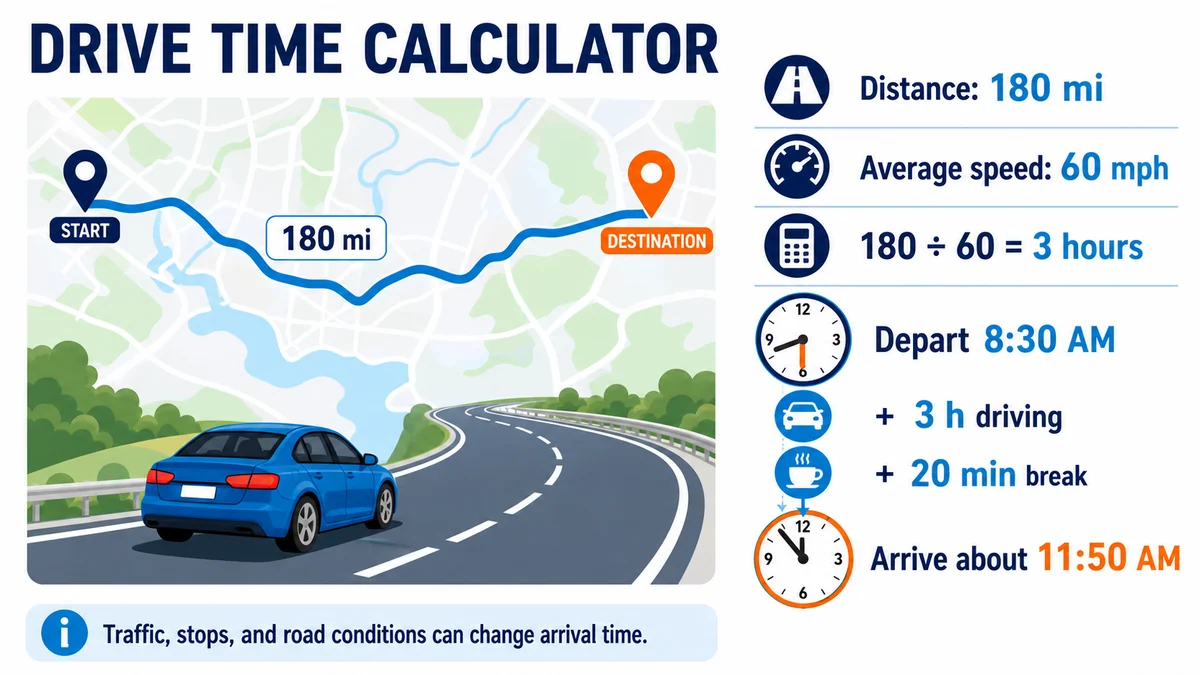
Drive Time Calculator
Calculate trip time, arrival time, fuel used, and fuel cost.
Trip Inputs
Results
Use this Drive Time Calculator to estimate trip time, arrival time, fuel used, total fuel cost, and cost per person. Enter your distance, average speed, break time, and optional departure time, then add fuel efficiency, fuel price, and passenger count if you want a fuel-cost estimate.
Important Note: This Drive Time Calculator estimates total trip time from distance, average speed, and planned break time. If a departure time is entered, it also estimates arrival time. If fuel efficiency, fuel price, and passengers are entered, it can estimate fuel used, total fuel cost, and cost per person.
The result is a planning estimate only. Real drive time can change because of traffic, road work, accidents, weather, speed-limit changes, route changes, border checks, toll booths, ferries, rest stops, fuel stops, parking time, and pickup or drop-off delays.
Fuel-cost results also depend on real-world fuel economy, driving style, vehicle condition, load, tire pressure, terrain, air conditioning use, fuel type, and local fuel prices. Use live navigation, official route data, current fuel prices, and vehicle-specific fuel-economy information when accuracy matters.
Reviewed by: AjaxCalculators Editorial Team
Last updated: April 28, 2026
Method source: Standard distance-speed-time formula, arrival-time addition, fuel-use formulas, and fuel-cost calculation
Editorial standards: AjaxCalculators Editorial Policy
What This Drive Time Calculator Calculates
This calculator estimates how long a drive may take and, when fuel details are entered, how much fuel the trip may use and cost.
The calculator can estimate:
- Total trip time
- Arrival time
- Fuel used
- Total fuel cost
- Cost per person
The live tool supports distance in kilometers or miles, average speed in km/h or mph, fuel efficiency in L/100 km or mpg (US), and fuel price per liter or per US gallon.
What Drive Time Means
Drive time is the estimated travel duration for a trip based on distance and average speed. If you include break time, the calculator adds those stops to the driving time to estimate total trip time.
For example, a 240 km trip at an average speed of 80 km/h has 3 hours of driving time. If you add a 20-minute break, the total trip time becomes 3 hours 20 minutes.
How the Drive Time Calculator Works
1) Driving Time Formula
The basic drive-time formula is:
Driving time = distance ÷ average speed
In this formula:
- distance is the total trip distance
- average speed is the expected average speed over the full trip
- driving time is the estimated moving time before breaks
If distance is entered in kilometers, use km/h for speed. If distance is entered in miles, use mph for speed.
2) Total Trip Time Formula
Total trip time includes both driving time and break time.
Total trip time = driving time + break time
Break time may include rest stops, food stops, refueling stops, pickup stops, or planned waiting time.
3) Arrival Time Formula
If a departure time is entered, the calculator estimates arrival time by adding the total trip time to the departure time.
Arrival time = departure time + total trip time
If no departure time is entered, the calculator can still estimate total trip duration, but arrival time may not be available.
4) Fuel Used with L/100 km
If fuel efficiency is entered as liters per 100 kilometers, fuel used is calculated as:
Fuel used (liters) = distance (km) × L/100 km ÷ 100
For example, if a trip is 300 km and the vehicle uses 7 L/100 km:
Fuel used = 300 × 7 ÷ 100 = 21 liters
5) Fuel Used with MPG
If fuel efficiency is entered as miles per US gallon, fuel used is calculated as:
Fuel used (US gallons) = distance (miles) ÷ mpg
For example, if a trip is 300 miles and the vehicle gets 30 mpg:
Fuel used = 300 ÷ 30 = 10 US gallons
6) Fuel Cost Formula
After fuel used is calculated, the calculator multiplies fuel volume by fuel price.
Total fuel cost = fuel used × fuel price
Use price per liter when fuel used is in liters. Use price per US gallon when fuel used is in US gallons.
7) Cost Per Person Formula
If passengers are sharing fuel cost, the calculator divides total fuel cost by the number of people.
Cost per person = total fuel cost ÷ passengers
Unit Conversions Used by the Calculator
The calculator can work with metric and US customary trip inputs by using standard conversion factors.
| Conversion | Value | Use Note |
|---|---|---|
| 1 mile | 1.609344 kilometers | Used when converting miles to kilometers. |
| 1 kilometer | 0.621371 miles | Used when converting kilometers to miles. |
| 1 US gallon | 3.785411784 liters | Used when converting US gallons to liters. |
| 1 liter | 0.264172 US gallons | Used when converting liters to US gallons. |
| 1 hour | 60 minutes | Used when converting drive time and break time. |
Worked Example: Drive Time and Arrival Time
Suppose you plan a trip with these details:
- Distance: 240 km
- Average speed: 80 km/h
- Break time: 30 minutes
- Departure time: 9:00 AM
Step 1: Calculate driving time
Driving time = distance ÷ average speed
Driving time = 240 ÷ 80
Driving time = 3 hours
Step 2: Add break time
Total trip time = 3 hours + 30 minutes
Total trip time = 3 hours 30 minutes
Step 3: Calculate arrival time
Arrival time = 9:00 AM + 3 hours 30 minutes
Arrival time = 12:30 PM
So, this trip would take about 3 hours 30 minutes including the planned break, with an estimated arrival time of 12:30 PM.
Worked Example: Fuel Used and Fuel Cost
Suppose the same 240 km trip includes fuel details:
- Fuel efficiency: 8 L/100 km
- Fuel price: $1.50 per liter
- Passengers: 3 people
Step 1: Calculate fuel used
Fuel used = distance × L/100 km ÷ 100
Fuel used = 240 × 8 ÷ 100
Fuel used = 19.2 liters
Step 2: Calculate total fuel cost
Total fuel cost = 19.2 × 1.50
Total fuel cost = $28.80
Step 3: Calculate cost per person
Cost per person = 28.80 ÷ 3
Cost per person = $9.60
So, this trip would use about 19.2 liters of fuel, cost about $28.80, and cost about $9.60 per person if split between three people.
Worked Example: Miles and MPG
Suppose you plan a 180-mile trip at an average speed of 60 mph. Your vehicle gets 30 mpg, fuel costs $3.50 per US gallon, and 2 people split the cost.
Step 1: Calculate driving time
Driving time = 180 ÷ 60 = 3 hours
Step 2: Calculate fuel used
Fuel used = 180 ÷ 30 = 6 US gallons
Step 3: Calculate total fuel cost
Total fuel cost = 6 × 3.50 = $21.00
Step 4: Calculate cost per person
Cost per person = 21 ÷ 2 = $10.50
So, a 180-mile trip at 60 mph and 30 mpg would take about 3 hours, use about 6 gallons, cost about $21.00, and cost about $10.50 per person if split between two people.
How to Use This Drive Time Calculator
- Enter the trip distance.
- Select the distance unit: km or mi.
- Enter the expected average speed.
- Select the speed unit: km/h or mph.
- Enter planned break time in minutes, if any.
- Optionally enter a departure time to calculate estimated arrival time.
- Optionally enter fuel efficiency and fuel price to estimate fuel used and fuel cost.
- Optionally enter passenger count to estimate cost per person.
- Click Calculate to estimate total trip time, arrival time, fuel used, total fuel cost, and cost per person.
- Use Reset to clear the calculator and start again.
How to Interpret the Result
| Result | What It Means | Important Caution |
|---|---|---|
| Total trip time | The estimated drive duration after adding planned break time. | This is based on the average speed you enter, not live traffic. |
| Arrival time | The estimated time you may arrive if a departure time is entered. | It does not account for time zones, daylight saving time, road delays, or route changes. |
| Fuel used | The estimated fuel volume needed for the trip. | Real fuel use can vary with driving conditions, vehicle load, maintenance, terrain, and driving style. |
| Total fuel cost | The estimated cost of the fuel used for the trip. | Fuel prices vary by location, fuel grade, taxes, station, and market conditions. |
| Cost per person | Total fuel cost divided by the passenger count. | This only splits fuel cost, not tolls, parking, lodging, food, or vehicle wear. |
Drive Time vs Total Trip Time
Drive time, total trip time, and arrival time are related, but they are not the same.
| Time Type | What It Includes | Example |
|---|---|---|
| Drive time | Moving time based on distance and average speed. | 240 km ÷ 80 km/h = 3 hours of driving. |
| Total trip time | Drive time plus planned break time. | 3 hours driving + 30 minutes break = 3 hours 30 minutes. |
| Arrival time | Departure time plus total trip time. | 9:00 AM + 3 hours 30 minutes = 12:30 PM. |
Choosing a Realistic Average Speed
The average speed you enter should represent the whole trip, not only the fastest road segment. A highway speed limit may be 100 km/h or 65 mph, but the trip average may be lower after traffic, slow zones, stops, intersections, toll booths, fuel stops, and parking delays.
| Factor | How It Can Affect Average Speed |
|---|---|
| City driving | Traffic lights, intersections, congestion, and parking can lower the trip average. |
| Highway driving | Usually faster, but construction, congestion, tolls, and rest stops still reduce average speed. |
| Mountain or winding roads | Curves, slopes, and lower speed limits may increase travel time. |
| Weather and visibility | Rain, snow, fog, wind, or poor visibility may require slower driving. |
| Border crossings, tolls, and checkpoints | Waiting time can increase total trip duration. |
| Food, restroom, and fuel stops | These should be included in break time if they are planned. |
| Parking, pickup, or drop-off time | Destination delays can make actual arrival later than the calculator estimate. |
Fuel Efficiency: L/100 km vs MPG
The calculator supports two common fuel-efficiency formats. Make sure the fuel-efficiency unit matches the fuel-price unit.
| Fuel Efficiency Unit | Meaning | Better Direction | Fuel Price Should Match |
|---|---|---|---|
| L/100 km | Liters used per 100 kilometers. | Lower is better. | Use fuel price per liter. |
| mpg (US) | Miles traveled per US gallon. | Higher is better. | Use fuel price per US gallon. |
Do not enter L/100 km as mpg, and do not enter mpg as L/100 km. These two formats move in opposite directions: lower L/100 km is more efficient, while higher mpg is more efficient.
Why Real Drive Time Can Vary
This calculator gives a planning estimate, not a live traffic prediction. Real travel time can change during the trip.
| Reason | How It Can Change the Trip |
|---|---|
| Traffic congestion | Can lower average speed and delay arrival. |
| Accidents or road closures | Can force detours or long waiting times. |
| Construction zones | Can add reduced-speed sections or lane closures. |
| Speed-limit changes | Can make the real average speed lower than expected. |
| Weather conditions | Rain, snow, fog, ice, wind, or heat can affect driving speed and safety. |
| Rest, food, and fuel stops | Need to be included as break time for a more realistic trip estimate. |
| Border checks, tolls, and ferry waits | Can add delay that is not captured by distance ÷ speed. |
| Parking, pickup, or drop-off delays | Can affect the practical arrival time even after reaching the destination area. |
Why Real Fuel Cost Can Vary
The calculator estimates fuel cost from distance, fuel efficiency, and fuel price. Actual fuel cost can vary because real-world fuel economy changes with driving conditions.
| Factor | Effect on Fuel Use or Cost |
|---|---|
| Aggressive acceleration or braking | Can reduce fuel economy and increase fuel cost. |
| High speeds | Can increase aerodynamic drag and reduce fuel economy. |
| Idling | Uses fuel without adding distance. |
| Cold weather and short trips | Can reduce fuel economy before the engine reaches efficient operating temperature. |
| Air conditioning and electrical accessories | Can increase engine load and fuel use. |
| Cargo, roof racks, or trailers | Can add weight or aerodynamic drag. |
| Tire pressure and maintenance | Poor maintenance or tire issues can reduce fuel economy. |
| Fuel type, fuel blend, and fuel price | Energy content and pump price can vary by fuel type, season, location, and market conditions. |
Fuel Cost vs Total Trip Cost
This calculator estimates fuel-related trip cost. It does not include every possible travel expense.
| Cost Type | Included in This Calculator? | Use Note |
|---|---|---|
| Fuel cost | Yes, if fuel efficiency and fuel price are entered. | Calculated from fuel used × fuel price. |
| Cost per person | Yes, if passenger count is entered. | Splits fuel cost only. |
| Tolls | No | Add toll costs separately. |
| Parking | No | Add parking fees separately. |
| Ferry tickets | No | Add ticket costs separately if your route includes ferries. |
| Food, drinks, and lodging | No | Add travel spending separately for full trip budgeting. |
| Vehicle maintenance and wear | No | Fuel cost does not represent full vehicle operating cost. |
| Rental, insurance, or roadside assistance | No | Add these separately when relevant. |
Common Mistakes to Avoid
| Mistake | Why It Causes Problems |
|---|---|
| Using top speed or speed limit as the whole-trip average speed | Average speed is usually lower after traffic, turns, stops, slow zones, and parking delays. |
| Forgetting break time | Long trips often include rest, food, restroom, or fuel stops. |
| Entering one-way distance when you want a round-trip estimate | A round trip usually needs double the one-way distance unless the route differs. |
| Entering L/100 km as mpg | L/100 km and mpg use opposite efficiency logic. |
| Entering mpg as L/100 km | This can create a very inaccurate fuel-used estimate. |
| Using price per liter while the fuel unit is US gallons | The fuel price unit must match the fuel volume unit. |
| Confusing US gallons with UK imperial gallons | The calculator uses US gallons for mpg and per-gallon fuel price. |
| Expecting arrival time to handle live traffic or time-zone changes | The calculator adds duration to departure time; it is not a live navigation or time-zone tool. |
| Treating fuel cost as full trip cost | Tolls, parking, lodging, meals, maintenance, and other expenses are not included. |
Formula Summary
| What You Want to Find | Formula | Use Note |
|---|---|---|
| Driving time | Driving time = distance ÷ average speed | Use matching distance and speed units. |
| Total trip time | Total trip time = driving time + break time | Add planned rest, food, restroom, or fuel stops. |
| Arrival time | Arrival time = departure time + total trip time | Does not handle time zones or daylight saving changes. |
| Fuel used with L/100 km | Liters = kilometers × L/100 km ÷ 100 | Use with fuel price per liter. |
| Fuel used with mpg | US gallons = miles ÷ mpg | Use with fuel price per US gallon. |
| Total fuel cost | Total fuel cost = fuel used × fuel price | Only fuel cost is included. |
| Cost per person | Cost per person = total fuel cost ÷ passengers | Use when passengers split fuel cost. |
| Miles to kilometers | Kilometers = miles × 1.609344 | Used for metric conversion. |
| US gallons to liters | Liters = US gallons × 3.785411784 | Used for fuel volume conversion. |
Practical Uses
This Drive Time Calculator can be useful for quick road-trip, commute, and fuel-cost planning.
| Use Case | How the Calculator Helps |
|---|---|
| Road trip planning | Estimate total trip duration before leaving. |
| Arrival-time checks | Add estimated trip time to a departure time. |
| Break planning | Add planned rest, meal, fuel, or restroom stops. |
| Commute estimates | Compare distance, average speed, and expected travel duration. |
| Delivery or pickup planning | Estimate basic route timing before adding live navigation details. |
| Fuel planning | Estimate fuel needed from distance and fuel efficiency. |
| Fuel-cost sharing | Split estimated fuel cost between passengers. |
| Route comparison | Compare trip duration and estimated fuel cost between possible routes. |
When You May Need More Than This Calculator
This calculator is best for simple planning estimates. You may need another tool or data source when live conditions, detailed trip cost, or official routing matters.
| Need | Better Tool or Method |
|---|---|
| Live traffic and road closures | Use a navigation app or live traffic service. |
| Route selection | Use a map or route-planning tool with current road data. |
| Time-zone or daylight saving changes | Use a calendar-aware travel planner or time-zone tool. |
| Full trip budget | Add tolls, parking, lodging, meals, ferry tickets, maintenance, and other costs separately. |
| Vehicle-specific fuel economy | Use your actual fuel-economy records, vehicle data, or official fuel-economy source. |
| Electric vehicle trip planning | Use an EV route planner with charging stops, charger availability, speed, elevation, and battery data. |
| Commercial delivery scheduling | Use fleet-routing software with traffic, stop duration, delivery windows, and driver constraints. |
Frequently Asked Questions
How do I calculate drive time?
Divide distance by average speed. For example, 240 km ÷ 80 km/h = 3 hours of driving time.
How do I include breaks in trip time?
Add planned break time to the driving time. For example, 3 hours of driving plus a 30-minute break equals 3 hours 30 minutes total trip time.
How does the calculator estimate arrival time?
If you enter a departure time, the calculator adds total trip time to that departure time to estimate arrival time.
Does this calculator use live traffic?
No. It uses distance, average speed, and break time. It does not use live traffic, road closures, accidents, or navigation data.
How do I estimate fuel used with L/100 km?
Use the formula liters = kilometers × L/100 km ÷ 100. For example, 300 km at 7 L/100 km uses about 21 liters.
How do I estimate fuel used with mpg?
Use the formula US gallons = miles ÷ mpg. For example, 300 miles at 30 mpg uses 10 US gallons.
Does fuel cost include tolls and parking?
No. The calculator estimates fuel cost only. Add tolls, parking, ferry tickets, meals, lodging, and vehicle costs separately.
Why can the real trip time be different?
Actual drive time can vary because of traffic, construction, weather, stops, road conditions, detours, tolls, border checks, parking, and route changes.
References
- OpenStax College Physics 2e — Time, Velocity, and Speed
- FuelEconomy.gov — Many Factors Affect Fuel Economy
- FuelEconomy.gov — Gas Mileage Tips: Driving More Efficiently
- U.S. Energy Information Administration — Factors Affecting Gasoline Prices
- NIST — Approximate Conversions from U.S. Customary Measures to Metric
Related Calculators
- Fuel Cost Calculator
- Gas Cost Calculator
- Mileage Calculator
- Add Time Calculator
- Time Calculator
- Car Finance Calculator
- Loan Calculator
- Electricity Cost Calculator
Drive Time Calculator Disclaimer
This Drive Time Calculator provides planning estimates only. It estimates drive time, total trip time, arrival time, fuel used, total fuel cost, and cost per person from the values you enter.
Actual drive time and arrival time may vary because of traffic, road closures, construction, accidents, weather, road conditions, speed changes, detours, route choice, toll booths, ferry waits, border checks, rest stops, fuel stops, pickup or drop-off delays, parking time, time-zone changes, and daylight saving time changes.
Fuel used and fuel cost may vary because of real-world fuel economy, driving style, vehicle load, tire pressure, maintenance, terrain, air conditioning, idling, fuel type, fuel blend, fuel grade, local fuel prices, taxes, and station pricing. This calculator does not include tolls, parking, lodging, meals, ferry tickets, insurance, maintenance, vehicle wear, rental fees, or live navigation data.