Health • Sleep

Sleep Calculator

Calculate an ideal bedtime or wake-up time using sleep cycles and fall-asleep time.

Inputs
This calculator uses an approximate sleep-cycle model. Real sleep timing varies from person to person and from night to night.

Important Note: This Sleep Calculator provides planning estimates based on sleep-cycle length, time to fall asleep, and your selected bedtime or wake-up time. It is not a medical sleep test and cannot diagnose insomnia, sleep apnea, narcolepsy, circadian rhythm disorders, or any other sleep condition. Sleep cycles are approximate and can vary by age, health, stress, medication, alcohol/caffeine use, sleep debt, and sleep quality. Waking near the end of a sleep cycle may feel easier for some people, but total sleep duration, sleep consistency, and sleep quality still matter. For adults, public health guidance generally recommends at least 7 hours of sleep per night. If you regularly have trouble sleeping, wake up gasping, snore loudly, feel extremely sleepy during the day, or have ongoing sleep concerns, consult a qualified healthcare professional or sleep specialist.

Use this Sleep Calculator to estimate the best bedtime or wake-up time based on sleep cycles, time to fall asleep, and your target schedule. Whether you are planning when to go to bed or trying to choose a realistic wake-up time, this tool gives cycle-based estimates so you can plan around full sleep cycles instead of guessing.

Reviewed by: AjaxCalculators Editorial Team
Last updated: May 1, 2026
Method source: Standard sleep-cycle planning model using sleep latency + cycle length + number of sleep cycles, supported by public sleep-health guidance from the CDC, NHLBI, and NINDS
Editorial standards: AjaxCalculators Editorial Policy

What This Sleep Calculator Calculates

This calculator helps estimate sleep timing based on your selected sleep-cycle settings. It can work from a known wake-up time or from a planned bedtime.

The calculator can estimate:

  • Recommended bedtime from a target wake-up time
  • Estimated wake-up time from a planned bedtime
  • Total time in bed
  • Estimated sleep duration
  • Sleep-cycle schedule options
  • Cycle-based timing for 4, 5, or 6 cycles when selected

The result is a planning estimate. It does not measure your actual sleep stages, sleep quality, or medical sleep health.

Why Sleep Cycles Matter

Sleep is not one flat state. During the night, the body cycles through non-REM and REM sleep stages. The National Heart, Lung, and Blood Institute explains that sleep cycles through rapid eye movement (REM) and non-REM sleep, and the cycle starts over roughly every 80 to 100 minutes.

The National Institute of Neurological Disorders and Stroke notes that REM sleep first occurs about 90 minutes after falling asleep. Because of this, many simple sleep calculators use about 90 minutes as a practical average sleep-cycle length.

Waking near the end of a cycle may feel easier for some people than waking during deeper sleep. However, cycle timing is only one part of healthy sleep. Total sleep duration, sleep consistency, sleep quality, and health factors also matter.

How the Sleep Calculator Works

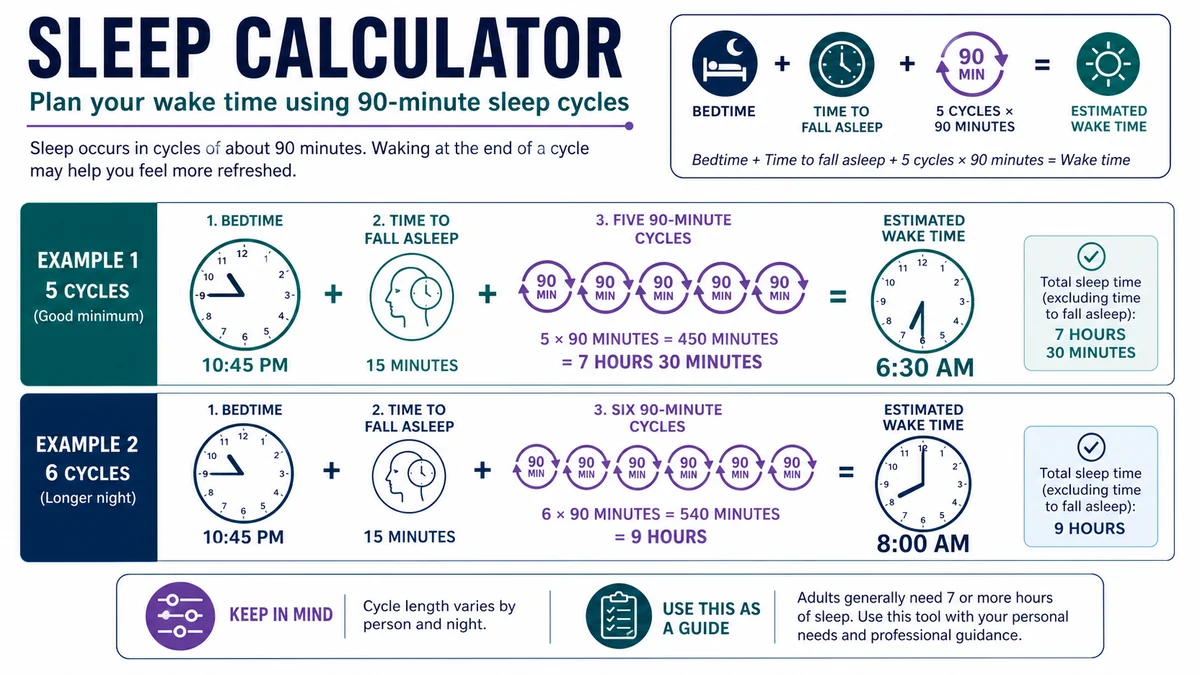
The calculator uses a simple sleep-cycle planning model:

Total time in bed = time to fall asleep + (number of cycles × cycle length)

Estimated sleep duration = number of cycles × cycle length

If you enter a wake-up time, the calculator counts backward to estimate bedtime. If you enter a bedtime, it counts forward to estimate a wake-up time.

Formula Summary

What You Want to Find Formula Example Meaning
Estimated sleep duration Number of cycles × cycle length 5 cycles × 90 minutes = 450 minutes
Total time in bed Sleep latency + estimated sleep duration 15 minutes + 450 minutes = 465 minutes
Bedtime from wake-up time Wake-up time − total time in bed 7:00 AM − 7 hours 45 minutes = 11:15 PM
Wake-up time from bedtime Bedtime + total time in bed 11:00 PM + 7 hours 45 minutes = 6:45 AM

Common Sleep-Cycle Planning Values

The calculator lets you choose your own cycle length, sleep latency, and number of cycles. Many people use these values as a starting point:

Setting Common Planning Value Important Note
Sleep cycle length About 90 minutes Actual cycles may be shorter or longer and can vary across the night
Time to fall asleep About 10 to 20 minutes This is only an estimate; some people fall asleep faster or slower
Number of cycles 4 to 6 cycles More cycles usually means more total sleep time
Adult sleep target At least 7 hours for most adults The CDC recommends 7 or more hours for adults ages 18 to 60

Sleep Duration by Age

Sleep needs vary by age. The CDC sleep guidance lists recommended daily sleep ranges for different age groups.

Age Group General Recommended Sleep Planning Note
School-age children, 6–12 years 9–12 hours Children usually need more sleep than adults
Teens, 13–17 years 8–10 hours Early school schedules can make sleep planning difficult
Adults, 18–60 years 7 or more hours Most adult schedules should not be planned below 7 hours regularly
Adults, 61–64 years 7–9 hours Sleep timing and sleep quality may change with age
Adults, 65 years and older 7–8 hours Frequent waking can affect total sleep quality

This calculator can help plan timing, but it should not be used to justify too little sleep. For most adults, a 4-cycle schedule may be useful for occasional planning, but it is usually shorter than recommended sleep guidance.

Worked Example: Find Bedtime from Wake-Up Time

Suppose you want to wake up at 7:00 AM.

You choose:

  • Sleep cycle length: 90 minutes
  • Time to fall asleep: 15 minutes
  • Number of cycles: 5

Step 1: Calculate estimated sleep duration
Estimated sleep duration = number of cycles × cycle length
Estimated sleep duration = 5 × 90 minutes
Estimated sleep duration = 450 minutes

Step 2: Convert minutes to hours
450 minutes = 7 hours 30 minutes

Step 3: Add time to fall asleep
Total time in bed = 7 hours 30 minutes + 15 minutes
Total time in bed = 7 hours 45 minutes

Step 4: Count backward from wake-up time
7:00 AM − 7 hours 45 minutes = 11:15 PM

Result: If you want to wake up at 7:00 AM and plan for five 90-minute cycles with 15 minutes to fall asleep, a reasonable estimated bedtime is 11:15 PM.

Worked Example: Find Wake-Up Time from Bedtime

Suppose you plan to go to bed at 10:30 PM.

You choose:

  • Sleep cycle length: 90 minutes
  • Time to fall asleep: 20 minutes
  • Number of cycles: 6

Step 1: Calculate estimated sleep duration
6 × 90 minutes = 540 minutes

Step 2: Convert minutes to hours
540 minutes = 9 hours

Step 3: Add time to fall asleep
9 hours + 20 minutes = 9 hours 20 minutes in bed

Step 4: Count forward from bedtime
10:30 PM + 9 hours 20 minutes = 7:50 AM

Result: If you go to bed at 10:30 PM and plan for six 90-minute cycles with 20 minutes to fall asleep, your estimated wake-up time is 7:50 AM.

Sleep Cycle Options Table

The table below shows common cycle-count options using a 90-minute cycle and 15 minutes to fall asleep.

Number of Cycles Estimated Sleep Duration Total Time in Bed with 15-Minute Sleep Latency General Use
4 cycles 6 hours 6 hours 15 minutes Short-night estimate, usually not ideal for regular adult sleep
5 cycles 7 hours 30 minutes 7 hours 45 minutes Common adult planning target
6 cycles 9 hours 9 hours 15 minutes Longer sleep opportunity, useful for people needing more rest

How to Use This Sleep Calculator

  1. Choose whether you want to calculate bedtime or wake-up time.
  2. Enter the time you already know.
  3. Enter your estimated time to fall asleep.
  4. Set your sleep-cycle length in minutes.
  5. Select the number of cycles you want to plan for.
  6. Click Calculate.
  7. Review the bedtime, wake-up time, total time in bed, and estimated sleep duration.
  8. Adjust the cycle count if the schedule is too short, too long, too late, or too early.

How to Interpret the Result

Your result is a schedule-planning estimate. It should help you choose a more realistic bedtime or wake-up time, but it does not guarantee that you will wake up refreshed.

Result What It Means What It Does Not Mean
Recommended bedtime The estimated time to get into bed based on your target wake-up time It does not guarantee immediate sleep
Estimated wake-up time The estimated time after your selected number of cycles It does not measure actual sleep quality
Total time in bed Sleep duration plus estimated time to fall asleep It may not equal actual sleep time if you wake during the night
Estimated sleep duration Cycle length multiplied by number of cycles It does not confirm real REM, deep sleep, or light sleep amounts

Bedtime vs Wake-Up Time Planning

Planning Goal Use This Mode Example Question
You must wake up at a fixed time Calculate bedtime “I need to wake up at 6:30 AM. When should I go to bed?”
You already know when you will go to bed Calculate wake-up time “If I go to bed at 11:00 PM, when should I wake up?”
You want a longer sleep opportunity Increase cycle count “What if I plan for 6 cycles instead of 5?”
You usually take longer to fall asleep Increase sleep latency “What if I need 30 minutes to fall asleep?”

Why Total Sleep Time Still Matters

Cycle timing can be helpful, but total sleep time remains important. The CDC recommends at least 7 hours of sleep for most adults ages 18 to 60. A cycle-based bedtime that gives too little total sleep may still leave you sleep deprived.

For example, waking at the end of a 4-cycle night may feel better than waking in the middle of a deep stage, but 4 cycles of 90 minutes equals only 6 hours of estimated sleep. For most adults, that is below the usual recommended amount when repeated regularly.

Factors That Can Change Your Sleep Timing

Sleep calculators use simplified assumptions. Real sleep timing can change from night to night.

Factor How It Can Affect Sleep
Stress or anxiety May increase time to fall asleep or cause night waking
Caffeine May delay sleep or reduce sleep quality, especially later in the day
Alcohol May make you sleepy at first but can disrupt sleep quality later
Irregular schedule Can make it harder to fall asleep or wake consistently
Age Sleep needs and sleep patterns can change across life stages
Health conditions Pain, breathing problems, mental health, and other conditions can affect sleep
Medications Some medications can affect sleepiness, alertness, or sleep quality

Common Sleep Calculator Mistakes

  • Planning too little total sleep: a cycle-based schedule is not useful if it leaves you regularly short on sleep.
  • Assuming every cycle is exactly 90 minutes: sleep cycles vary by person and across the night.
  • Forgetting sleep latency: time in bed is not the same as time asleep.
  • Using one night as proof: a single good or bad night does not define your sleep pattern.
  • Ignoring daytime symptoms: frequent daytime sleepiness may signal poor sleep quality or a sleep disorder.
  • Relying only on timing: light exposure, caffeine, stress, noise, temperature, and routine can affect sleep quality.
  • Using the calculator as medical advice: this tool estimates timing only and does not diagnose sleep problems.

When This Calculator Is Useful

This calculator is useful for everyday sleep planning when you want a schedule estimate based on your available time.

  • Planning bedtime before work or school
  • Estimating wake-up time after a late night
  • Comparing 4, 5, or 6 sleep-cycle options
  • Building a more consistent bedtime routine
  • Planning sleep around travel, exams, or early appointments
  • Understanding the difference between time in bed and estimated sleep duration
  • Seeing how sleep latency changes your target bedtime

When You May Need More Than a Sleep Calculator

A calculator can help with timing, but it cannot identify the cause of poor sleep. Consider professional guidance if sleep problems are frequent, severe, or affecting daily life.

Speak with a qualified healthcare professional or sleep specialist if you experience:

  • chronic insomnia
  • extreme daytime sleepiness
  • loud snoring or choking/gasping during sleep
  • morning headaches with poor sleep
  • difficulty staying awake while driving or working
  • restless legs or uncomfortable leg sensations at night
  • irregular sleep-wake patterns that disrupt daily life
  • sleep problems related to shift work or jet lag
  • persistent fatigue despite spending enough time in bed

Important Assumptions and Limitations

  • This calculator uses an approximate sleep-cycle model.
  • It does not measure actual REM sleep, deep sleep, light sleep, or sleep quality.
  • Sleep cycles are not exactly 90 minutes for every person or every night.
  • Sleep latency is an estimate and may vary depending on stress, schedule, caffeine, health, and environment.
  • Waking near the end of a cycle may feel easier for some people, but it does not guarantee feeling rested.
  • Total sleep time still matters, especially for adults who regularly get less than recommended sleep.
  • The calculator does not diagnose insomnia, sleep apnea, narcolepsy, circadian rhythm disorders, or other sleep conditions.
  • For medical concerns, use professional healthcare guidance instead of a calculator result.

Practical Uses of a Sleep Calculator

  • Choose a bedtime based on tomorrow’s alarm
  • Estimate wake-up time from tonight’s bedtime
  • Compare short, normal, and longer sleep-cycle schedules
  • Adjust your bedtime for estimated time to fall asleep
  • Plan a more consistent sleep routine
  • Understand how sleep cycles affect schedule planning
  • Support better time management before work, school, travel, or exams

References

  1. Centers for Disease Control and Prevention: About Sleep and Recommended Sleep Duration
  2. CDC: Sleep in Adults, Facts and Statistics
  3. National Heart, Lung, and Blood Institute: Sleep Phases and Stages
  4. National Institute of Neurological Disorders and Stroke: Brain Basics — Understanding Sleep
  5. Sleep Foundation: Sleep Latency

Related Calculators

Frequently Asked Questions

What is a sleep cycle?

A sleep cycle is a repeating pattern of non-REM and REM sleep stages. Public sleep-health sources commonly describe sleep cycles as lasting roughly around 90 minutes, although the exact length can vary by person and across the night.

Is 90 minutes always the correct sleep-cycle length?

No. A 90-minute cycle is a practical average used for planning, not a fixed rule. Some cycles may be shorter or longer, and sleep architecture can change during the night.

How many sleep cycles should I plan for?

Many people compare 4, 5, and 6 cycles. With 90-minute cycles, 4 cycles equals about 6 hours, 5 cycles equals about 7 hours 30 minutes, and 6 cycles equals about 9 hours. For most adults, 5 or 6 cycles usually fits recommended sleep-duration guidance better than 4 cycles.

Does waking at the end of a sleep cycle always make you feel refreshed?

No. Waking near the end of a cycle may feel easier for some people, but feeling rested also depends on total sleep time, sleep quality, consistency, health, stress, and other factors.

What is sleep latency?

Sleep latency is the time it takes to fall asleep after going to bed or trying to sleep. This calculator uses your estimated sleep latency to separate total time in bed from estimated sleep duration.

How much sleep do adults need?

The CDC recommends that adults ages 18 to 60 get 7 or more hours of sleep per night. Older adults commonly need around 7 to 9 hours or 7 to 8 hours depending on age group.

Can this calculator diagnose insomnia or sleep apnea?

No. This calculator only estimates sleep timing. It cannot diagnose insomnia, sleep apnea, narcolepsy, circadian rhythm disorders, or any other sleep condition. If you have ongoing sleep problems or extreme daytime sleepiness, consult a qualified healthcare professional.

Should I use bedtime mode or wake-up mode?

Use bedtime mode if you already know when you need to wake up. Use wake-up mode if you already know when you plan to go to bed and want to estimate possible wake-up times.

Sleep planning note: This Sleep Calculator provides planning estimates based on sleep-cycle length, time to fall asleep, and your selected bedtime or wake-up time. It is not a medical sleep test and cannot diagnose insomnia, sleep apnea, narcolepsy, circadian rhythm disorders, or any other sleep condition. Sleep cycles are approximate and can vary by age, health, stress, medication, alcohol/caffeine use, sleep debt, and sleep quality. Waking near the end of a sleep cycle may feel easier for some people, but total sleep duration, sleep consistency, and sleep quality still matter. For adults, public health guidance generally recommends at least 7 hours of sleep per night. If you regularly have trouble sleeping, wake up gasping, snore loudly, feel extremely sleepy during the day, or have ongoing sleep concerns, consult a qualified healthcare professional or sleep specialist.

More of our calculators...

Calorie Deficit Calculator

Use our Calorie Deficit Calculator to estimate BMR, maintenance calories, TDEE, calorie deficit, target calories, and weekly weight-change estimate.

Face Shape Calculator

Use our Face Shape Calculator to estimate your likely face shape from forehead, cheekbone, jawline, and face length measurements plus chin shape.

Age Difference Calculator

Use our Age Difference Calculator to find the exact age gap between two dates of birth in years, months, days, total months, total days, and approximate years.

Bikini Calculator

Use our Bikini Calculator to estimate your body shape from bust, waist, high hip, and hip measurements, then get bikini style suggestions that fit your shape.

Body Shape Calculator

Body Shape Calculator helps you identify your body type from key measurements and understand which shape category fits you best.

Helium Balloons Calculator

Use our Helium Balloons Calculator to estimate lift per balloon, total helium volume, and how many helium balloons you need to lift a given weight.

RPM Calculator

Use our RPM Calculator to find engine RPM from speed or vehicle speed from RPM using overall gear ratio and tire diameter, plus wheel RPM and tire circumference.

Reading Time Calculator

Use our Reading Time Calculator to estimate how long it takes to read a book, daily pages read, and time needed to finish from pages and reading speed.

Time Calculator

Time Calculator helps you add, subtract, and measure time differences in hours and minutes with ease.