Calorie Deficit Calculator
Estimate BMR, maintenance calories (TDEE), and a daily calorie target for cutting, maintenance, or bulking.
Important Note : This weekly estimate uses a simplified calorie-to-weight rule. Real weight change is not linear and slows over time. Calorie targets should be individualized, especially for teens, pregnancy, breastfeeding, eating disorder history, diabetes, kidney disease, active medical treatment, athletes, or anyone considering very low calorie intake. CDC emphasizes that healthy weight loss includes nutrition, physical activity, sleep, and stress management, and that gradual loss of about 1–2 lb per week is more likely to be maintained.
Use this Calorie Deficit Calculator to estimate your BMR, maintenance calories, TDEE, and daily calorie target for cutting, maintaining, or bulking. Enter your sex, age, height, weight, activity level, and goal to get a practical calorie estimate you can adjust over time based on real progress.
Reviewed by: AjaxCalculators Editorial Team
Last updated: April 29, 2026
Method source: Estimated BMR using the Mifflin-St Jeor equation, estimated TDEE using activity multipliers, and target calories from maintenance calories plus or minus the selected daily adjustment
Editorial standards: AjaxCalculators Editorial Policy
What This Calorie Deficit Calculator Estimates
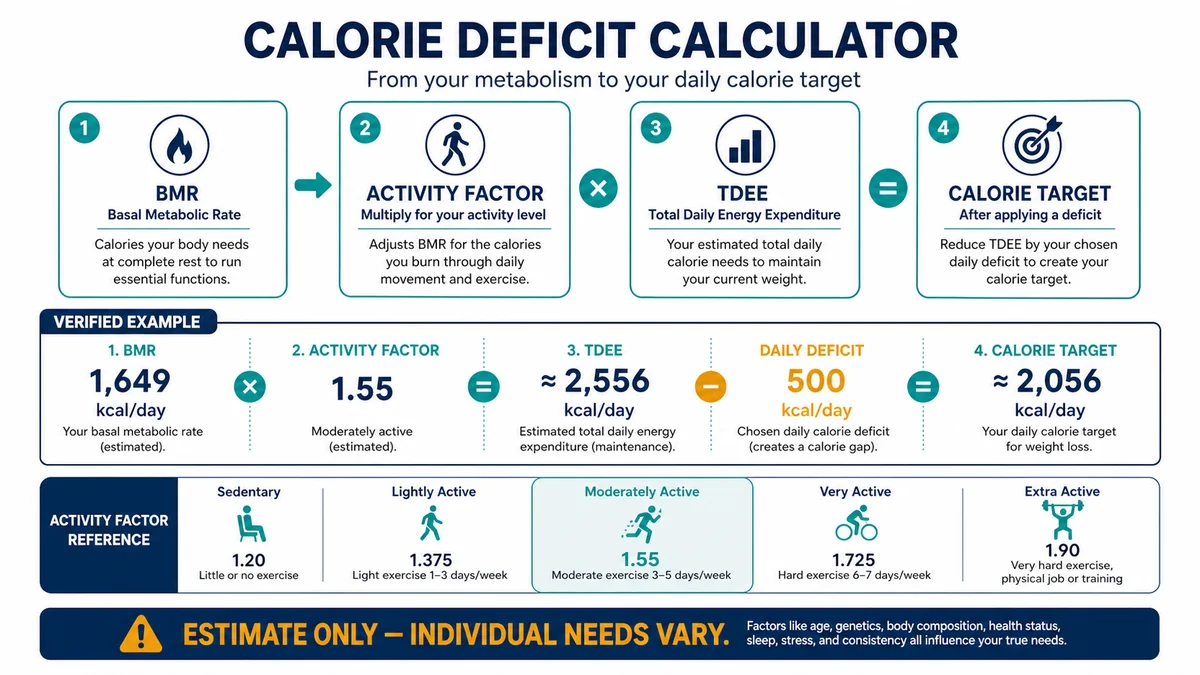
This calculator estimates how many calories you may need each day for weight loss, maintenance, or weight gain. It starts with an estimated basal metabolic rate, adjusts that number by your activity level, then applies your selected calorie deficit or surplus.
The calculator can estimate:
- BMR, or basal metabolic rate
- Maintenance calories, also called estimated TDEE
- Target calories for cutting, maintaining, or bulking
- Net calorie change vs maintenance
- Estimated weekly change using a simple rule of thumb
- Calories per day from height, weight, age, sex, and activity level
This calculator gives an estimate, not an exact prescription. Real-world calorie needs vary by body composition, non-exercise movement, training, hormones, sleep, stress, medical conditions, medications, digestion, and tracking accuracy.
What Is a Calorie Deficit?
A calorie deficit means eating fewer calories than your body uses over time. When energy intake is below energy expenditure, the body must make up the difference from stored energy, which can lead to weight loss.
For example, if your estimated maintenance calories are 2,400 kcal/day and you eat 1,900 kcal/day, your estimated deficit is:
2,400 − 1,900 = 500 kcal/day
A calorie deficit can come from eating fewer calories, increasing activity, or a combination of both. For long-term success, the deficit should usually be realistic enough to maintain while still supporting nutrition, training, sleep, and daily life.
What Is TDEE?
TDEE stands for Total Daily Energy Expenditure. It is an estimate of how many calories your body burns in a full day, including basic body functions, movement, exercise, and digestion.
In this calculator, maintenance calories are estimated as:
TDEE = BMR × activity factor
If your average daily intake equals your TDEE, your body weight is expected to stay roughly stable over time. If your intake is below TDEE, you are in a calorie deficit. If your intake is above TDEE, you are in a calorie surplus.
What Is BMR?
BMR, or basal metabolic rate, is the estimated energy your body uses at rest to support basic life functions such as breathing, circulation, body temperature regulation, and cellular activity.
BMR is not the same as total daily calorie burn. BMR is the starting point. Activity level is then used to estimate maintenance calories.
BMR Formula Used
If this calculator uses the Mifflin-St Jeor method, the formulas are:
Men:
BMR = 10W + 6.25H − 5A + 5
Women:
BMR = 10W + 6.25H − 5A − 161
Where:
- W = body weight in kilograms
- H = height in centimeters
- A = age in years
For best user trust, show the formula directly on the calculator page so users understand how BMR is estimated.
How the Calorie Deficit Calculator Works
1) Enter Your Profile
The calculator uses sex, age, height, and weight to estimate BMR. These values matter because body size and age strongly affect estimated energy needs.
The live calculator accepts height in cm or ft/in, and weight in kg or lb.
2) Estimate BMR
The calculator estimates your BMR using the selected formula. A larger body size generally gives a higher BMR, while age usually lowers the estimate in standard equations.
3) Apply an Activity Multiplier
After BMR is estimated, the calculator multiplies it by an activity factor.
| Activity Level | Multiplier | General Meaning |
|---|---|---|
| Sedentary | 1.2 | Little or no exercise |
| Lightly active | 1.375 | Light exercise 1–3 days per week |
| Moderately active | 1.55 | Exercise 3–5 days per week |
| Very active | 1.725 | Exercise 6–7 days per week |
| Extra active | 1.9 | Physical job, hard training, or very high activity |
The result is an estimated maintenance calorie level.
4) Choose a Goal
The calculator supports three goal types:
- Cut — subtracts a daily calorie adjustment from maintenance
- Maintain — keeps target calories near estimated maintenance
- Bulk — adds a daily calorie adjustment above maintenance
5) Calculate Target Calories
For a cutting goal:
Target calories = TDEE − daily deficit
For maintenance:
Target calories = TDEE
For bulking:
Target calories = TDEE + daily surplus
6) Estimate Weekly Change
The calculator shows an estimated weekly change using a simplified calorie-to-weight rule. A common approximation is:
Weekly lb change ≈ daily calorie change × 7 ÷ 3500
For kilograms:
Weekly kg change ≈ weekly lb change × 0.453592
This is only a rough short-term estimate. Real weight change is not perfectly linear because metabolism, water balance, glycogen, digestion, training, and body-weight changes affect the result.
Calorie Deficit Formula Summary
| What You Want to Estimate | Formula |
|---|---|
| BMR, men | BMR = 10W + 6.25H − 5A + 5 |
| BMR, women | BMR = 10W + 6.25H − 5A − 161 |
| Maintenance calories | TDEE = BMR × activity factor |
| Cutting target | Target = TDEE − deficit |
| Maintenance target | Target = TDEE |
| Bulking target | Target = TDEE + surplus |
| Estimated weekly lb change | daily adjustment × 7 ÷ 3500 |
| Estimated weekly kg change | weekly lb change × 0.453592 |
Worked Example: Calculate a Calorie Deficit
Suppose a male user enters:
- Age: 30 years
- Height: 175 cm
- Weight: 70 kg
- Activity level: Moderately active, 1.55
- Goal: Cut
- Daily deficit: 500 kcal/day
Step 1: Estimate BMR
BMR = 10W + 6.25H − 5A + 5
Step 2: Substitute values
BMR = 10(70) + 6.25(175) − 5(30) + 5
Step 3: Calculate BMR
BMR = 700 + 1093.75 − 150 + 5
BMR = 1648.75 kcal/day
Step 4: Estimate maintenance calories
TDEE = BMR × activity factor
TDEE = 1648.75 × 1.55
TDEE ≈ 2556 kcal/day
Step 5: Apply the calorie deficit
Target calories = 2556 − 500
Target calories ≈ 2056 kcal/day
Step 6: Estimate weekly change
Weekly deficit = 500 × 7 = 3500 kcal/week
Estimated weekly change ≈ 3500 ÷ 3500 = 1 lb/week
So, this example gives an estimated BMR of 1649 kcal/day, maintenance calories of about 2556 kcal/day, and a cutting target of about 2056 kcal/day.
Worked Example: Maintenance Calories
Suppose your estimated BMR is 1500 kcal/day, and your activity factor is 1.375.
Step 1: Use the TDEE formula
TDEE = BMR × activity factor
Step 2: Substitute values
TDEE = 1500 × 1.375
Step 3: Calculate
TDEE = 2062.5 kcal/day
So, estimated maintenance calories are about 2063 kcal/day.
Worked Example: Bulking Calories
Suppose your maintenance calories are 2600 kcal/day, and you choose a bulking surplus of 250 kcal/day.
Step 1: Use the bulking formula
Target calories = TDEE + surplus
Step 2: Substitute values
Target calories = 2600 + 250
Step 3: Calculate
Target calories = 2850 kcal/day
So, your estimated bulking target is 2850 kcal/day.
Worked Example: Aggressive Deficit
Suppose your maintenance calories are 2300 kcal/day, and you choose a deficit of 750 kcal/day.
Step 1: Calculate target calories
Target = 2300 − 750
Target = 1550 kcal/day
Step 2: Estimate weekly calorie deficit
750 × 7 = 5250 kcal/week
Step 3: Estimate weekly change using the simple rule
5250 ÷ 3500 = 1.5 lb/week
This is a rough estimate. Real weight loss may be slower or faster because water balance, training, food intake accuracy, metabolic adaptation, and starting body size all matter.
How to Use This Calorie Deficit Calculator
- Select your sex.
- Enter your age in years.
- Enter your height and choose the correct height unit.
- Enter your weight and choose the correct weight unit.
- Select the activity level that best matches your average weekly routine.
- Select your goal: cut, maintain, or bulk.
- Enter your daily adjustment, such as 250, 500, or 750 kcal/day.
- Review BMR, maintenance calories, target calories, net change, and estimated weekly change.
- Use the result as a starting estimate, then adjust based on actual body-weight trends over 2–4 weeks.
- Click Reload or reset the calculator to start over.
How to Interpret the Results
BMR is the estimated calories your body uses at rest. It is not your full daily calorie burn.
Maintenance calories / TDEE is the estimated calorie intake that would maintain your current weight over time.
Target calories is your estimated daily calorie goal after applying your selected cut, maintenance, or bulk setting.
Net change vs maintenance shows whether your target is below, equal to, or above maintenance.
Estimated weekly change is a simplified estimate based on calorie arithmetic. It is useful for comparison, but it should not be treated as a guaranteed weekly result.
Choosing a Calorie Deficit
A moderate calorie deficit is usually easier to follow than an extreme deficit. Many people start with a daily deficit of about 250–500 kcal/day, then adjust based on results and hunger, training, energy, and adherence.
| Daily Deficit | Estimated Weekly Deficit | Simple Weekly Change Estimate | General Use |
|---|---|---|---|
| 250 kcal/day | 1750 kcal/week | About 0.5 lb/week | Mild, easier to sustain |
| 500 kcal/day | 3500 kcal/week | About 1 lb/week | Common moderate target |
| 750 kcal/day | 5250 kcal/week | About 1.5 lb/week | More aggressive |
| 1000 kcal/day | 7000 kcal/week | About 2 lb/week | Aggressive; not suitable for everyone |
For many adults, calorie deficits around 500–750 kcal/day are common in weight-loss guidance, but targets should be individualized for body size, health status, food quality, activity, and sustainability.
Why the 3,500-Calorie Rule Is Only an Estimate
The calculator’s weekly-change estimate may use the old rule that about 3,500 calories corresponds to about 1 pound of body weight. This can be useful as a rough short-term comparison, but it is not a precise prediction.
Weight loss is not perfectly linear because:
- body weight changes reduce calorie needs
- metabolism can adapt during calorie restriction
- water and glycogen can change quickly
- food tracking may be inaccurate
- exercise burn estimates can be inaccurate
- daily movement often changes during dieting
- digestion and sodium intake affect scale weight
Use the weekly estimate as a planning guide, then adjust your target based on real trend data.
How to Adjust Calories Based on Progress
Because calorie calculators estimate, the best approach is to monitor results and adjust gradually.
- Choose a starting calorie target.
- Track body weight under similar conditions several times per week.
- Use a weekly average rather than one daily weigh-in.
- Follow the target consistently for 2–4 weeks.
- If weight is changing too fast, increase calories slightly.
- If weight is not changing and your goal is fat loss, reduce calories slightly or increase activity.
- Make small changes, such as 100–250 kcal/day, instead of large sudden cuts.
Calorie Deficit vs Fat Loss
A calorie deficit is required for fat loss, but scale weight does not always reflect fat change exactly. Short-term scale changes can include water, glycogen, food volume, and digestive contents.
For better tracking, use several signals:
- weekly average body weight
- waist measurements
- progress photos
- training performance
- energy and hunger levels
- how clothes fit
Fat loss should be judged over time, not from one day’s scale reading.
Calorie Deficit vs Maintenance vs Bulking
| Goal | Calorie Target | Expected Direction |
|---|---|---|
| Cut | Below TDEE | Weight loss over time |
| Maintain | Near TDEE | Weight roughly stable |
| Bulk | Above TDEE | Weight gain over time |
For fat loss, a moderate deficit is usually more sustainable than a very large deficit. For bulking, a modest surplus can help reduce unnecessary fat gain compared with a very large surplus.
How Activity Level Affects Calories
Activity level can change the estimate dramatically. A person with the same age, height, and weight can have very different maintenance calories depending on daily steps, training, work demands, and exercise habits.
Choose the activity multiplier that best describes your average week, not your most active day.
| Activity Choice | Choose This If |
|---|---|
| Sedentary | You sit most of the day and do little formal exercise |
| Lightly active | You exercise lightly a few days per week or get regular light movement |
| Moderately active | You train several days per week and have moderate daily movement |
| Very active | You train hard most days or have a demanding routine |
| Extra active | You combine hard training with a physical job or very high daily activity |
Why Calorie Estimates Can Be Wrong
Even with a good formula, calorie estimates can be off. Common reasons include:
- underestimating food intake
- overestimating exercise calories
- low or high non-exercise activity
- different muscle mass at the same body weight
- water retention
- stress and poor sleep
- menstrual cycle changes
- medical conditions
- medications that affect appetite or weight
- adaptive changes during weight loss
This is why the calculator should be treated as a starting point rather than a final answer.
Safe Calorie Target Considerations
A calorie target should still allow enough food to support protein, essential fats, fiber, vitamins, minerals, hydration, and daily function. Extremely low calorie targets can increase the risk of fatigue, poor training, nutrient gaps, binge-restrict cycles, gallstones, menstrual disruption, and lean-mass loss.
Get professional guidance before using aggressive calorie restriction if you:
- are under 18
- are pregnant or breastfeeding
- have diabetes or use glucose-lowering medication
- have kidney disease, liver disease, heart disease, or thyroid disease
- have a history of eating disorder or disordered eating
- are underweight or close to underweight
- are an endurance athlete or high-volume trainee
- are recovering from illness, injury, or surgery
- are using weight-loss medications
Calorie Deficit and Protein
When dieting, protein can help support muscle retention, fullness, and recovery from training. The calculator estimates calories only; it does not build a full macro plan.
For a more complete plan, consider:
- adequate protein
- fiber-rich carbohydrates
- healthy fats
- enough fruits and vegetables
- hydration
- strength training if appropriate
- sleep and stress management
A calorie number is easier to follow when the food plan is filling, nutritious, and realistic.
Calorie Deficit and Exercise
Exercise can help create a calorie deficit, improve fitness, and support long-term weight management, but exercise calories are often overestimated. It is usually better to treat exercise as a health and performance habit rather than a license to add back every estimated calorie burned.
Helpful activity habits may include:
- daily walking
- resistance training
- cardio you can recover from
- more standing and light movement
- consistent weekly routines
Maintenance Calories Are a Moving Target
Maintenance calories are not fixed forever. They can change when body weight, training, daily steps, job demands, muscle mass, sleep, and diet history change.
If you lose weight, your body usually requires fewer calories than before because there is less tissue to maintain and move. This is one reason weight loss can slow even if the original calorie target worked at first.
What to Do If Weight Loss Stalls
A short stall does not always mean the calorie target is wrong. Water retention, digestion, sodium intake, soreness, stress, and sleep can hide fat loss temporarily.
If your weekly average weight has not changed for 2–4 weeks, consider:
- checking tracking accuracy
- reviewing weekend intake
- increasing steps or daily movement
- reducing calories by 100–250 kcal/day
- improving sleep and stress management
- checking whether your activity multiplier is too high
Cutting, Maintaining, and Bulking Examples
| Estimated TDEE | Goal | Daily Adjustment | Target Calories |
|---|---|---|---|
| 2200 kcal/day | Cut | −500 | 1700 kcal/day |
| 2200 kcal/day | Maintain | 0 | 2200 kcal/day |
| 2200 kcal/day | Bulk | +250 | 2450 kcal/day |
| 2800 kcal/day | Cut | −750 | 2050 kcal/day |
| 2800 kcal/day | Bulk | +300 | 3100 kcal/day |
Common Mistakes to Avoid
- Do not treat the calculator result as an exact medical prescription.
- Do not choose an activity level based only on one hard workout per week.
- Do not assume the 3,500-calorie rule gives perfect weight-loss predictions.
- Do not cut calories so low that nutrition, energy, or training suffers.
- Do not ignore liquid calories, cooking oils, sauces, snacks, and weekend intake.
- Do not compare your calorie target directly with someone else’s.
- Do not change calories every day based on one scale reading.
- Do not forget that maintenance calories fall as body weight decreases.
- Do not use a calorie deficit calculator as eating-disorder treatment or medical nutrition therapy.
Important Assumptions and Limitations
- This calculator estimates calories from formulas and activity multipliers.
- It does not measure your real metabolic rate.
- It does not account for body-fat percentage or lean mass directly.
- It does not diagnose overweight, obesity, underweight, or health risk.
- It does not create a complete diet plan or macro plan.
- It does not account for pregnancy, breastfeeding, youth growth needs, medical conditions, or medications.
- Activity multipliers are broad estimates and may not match your true expenditure.
- The weekly weight-change estimate is simplified and may not match real results.
- For medical, athletic, pregnancy, diabetes, kidney, heart, eating-disorder, or clinical weight-management needs, use professional guidance.
Practical Uses
This Calorie Deficit Calculator can be useful for:
- estimating calories for fat loss
- finding maintenance calories
- checking TDEE from BMR and activity level
- planning a moderate calorie deficit
- planning a small calorie surplus for bulking
- comparing different deficit sizes
- understanding why activity level matters
- setting a starting calorie target
- adjusting calories based on real progress
When You May Need a Different Calculator
This calculator estimates calorie targets. You may need another calculator if you want to calculate:
- BMR only
- maintenance calories only
- macronutrients from calories
- protein intake
- BMI
- body-fat percentage
- calories burned from exercise
- healthy weight range
- pregnancy calorie needs
- medical nutrition targets
References
- AjaxCalculators live Calorie Deficit Calculator
- Mifflin MD, St Jeor ST, Hill LA, et al. A New Predictive Equation for Resting Energy Expenditure in Healthy Individuals
- Endotext: Estimating Resting Metabolic Rate
- NIDDK: NIH Body Weight Planner and 3,500-Calorie Rule Limitation
- Academy of Nutrition and Dietetics Evidence Analysis Library: Adult Weight Management Caloric Reduction
- CDC: Steps for Losing Weight
- NIDDK: Choosing a Safe and Successful Weight-loss Program
- Dietary Guidelines for Americans 2020–2025
Related Calculators
- Maintenance Calorie Calculator
- Calorie Calculator
- BMR Calculator
- Harris-Benedict BMR Calculator
- Weight Loss Calculator
- Weight Gain Calculator
- BMI Calculator
- Calories Burned Calculator
Disclaimer: This calculator provides estimated calorie targets only. It is not medical advice, a diagnosis, or a personalized nutrition prescription. Calorie needs vary by body composition, activity, health status, medications, sleep, stress, and tracking accuracy. If you are pregnant, breastfeeding, under 18, have diabetes, kidney disease, heart disease, an eating disorder history, or any medical condition, consult a qualified healthcare professional or registered dietitian before using calorie restriction or weight-loss targets.