Dilution Ratio Calculator

Enter exactly any two fields, then click Calculate. Ratio is Water : Concentrate = r : 1.

Results

Final volume
Concentrate
Water
Ratio

Step-by-step derivation

Quick summary

References

  • Total parts = 1 concentrate + r water, so V = S + W and W = r × S.
  • Useful formulas: S = V / (r + 1) and W = r × V / (r + 1).
  • 1 L = 1000 mL.

Use this Dilution Ratio Calculator to calculate how much concentrate and water you need for a selected dilution ratio. Enter any two values, such as final volume and ratio, concentrate and ratio, or water and concentrate, then calculate the missing values.

Important Note: This Dilution Ratio Calculator performs volume-ratio math only. It calculates final volume, concentrate volume, water volume, and dilution ratio when the ratio is written as Water : Concentrate = r : 1.

The calculator does not verify whether a mixture is safe, effective, legal, food-safe, disinfectant-compliant, pesticide-compliant, lab-accurate, or compatible with a specific product. For cleaners, disinfectants, pesticides, pool chemicals, lab chemicals, food-service sanitizers, and hazardous concentrates, always follow the product label, Safety Data Sheet, workplace rules, and local regulations.

Never mix chemicals unless the product directions specifically say the mixture is safe. Use proper ventilation, gloves, eye protection, measuring tools, storage containers, and labeling whenever the product label or Safety Data Sheet requires them.

Reviewed by: AjaxCalculators Editorial Team
Last updated: April 28, 2026
Method source: Standard dilution-ratio volume formulas using water, concentrate, final volume, and water-to-concentrate ratio
Editorial standards: AjaxCalculators Editorial Policy

What This Dilution Ratio Calculator Calculates

This calculator solves basic dilution-ratio problems where a concentrate is mixed with water. The visible ratio format is:

Water : Concentrate = r : 1

The calculator can estimate:

  • Final volume
  • Dilution ratio
  • Concentrate volume
  • Water volume
  • Step-by-step derivation

The live tool supports several volume units, including liters, milliliters, cubic centimeters, cubic meters, cubic inches, cubic feet, US gallons, and UK gallons.

What a Dilution Ratio Means

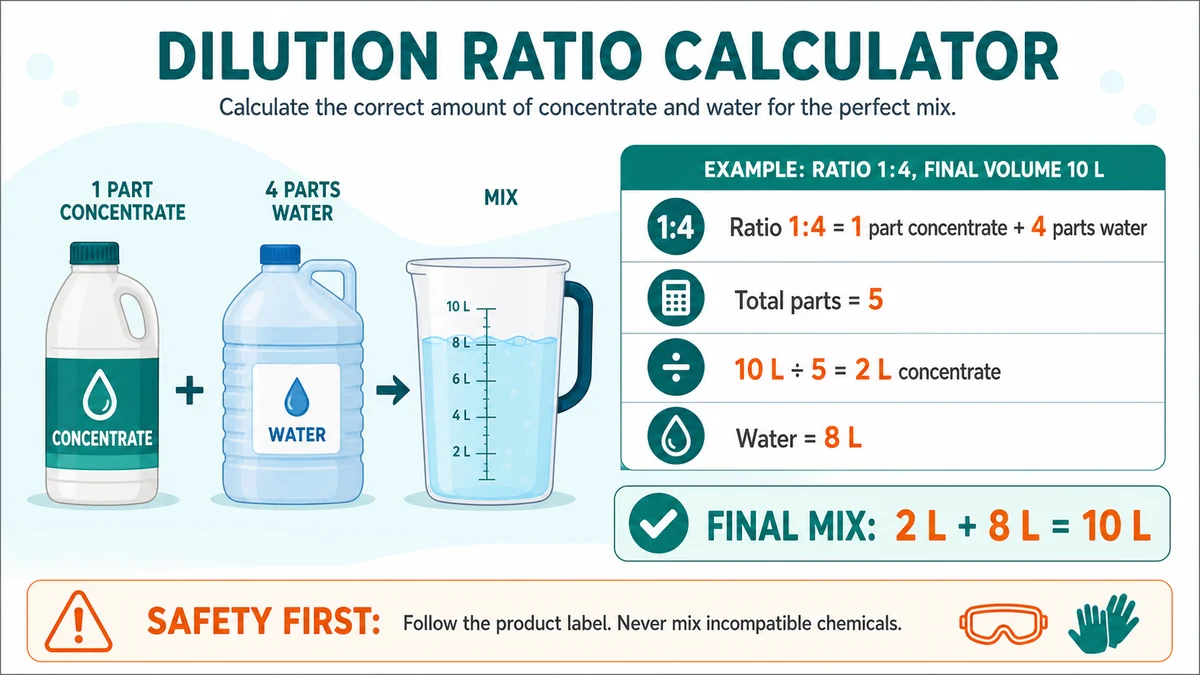
A dilution ratio tells you how many parts of water are mixed with one part of concentrate.

For example, a 4:1 dilution ratio means:

  • 4 parts water
  • 1 part concentrate
  • 5 total parts

So, if the final mixture is 5 liters at a 4:1 ratio, it contains 4 liters of water and 1 liter of concentrate.

How the Dilution Ratio Calculator Works

1) Total Volume Formula

The final volume is the sum of concentrate and water.

Final volume = concentrate volume + water volume

Using symbols:

V = S + W

In this formula:

  • V is the final mixed volume
  • S is the concentrate volume
  • W is the water volume

2) Water from Ratio and Concentrate

If the dilution ratio is Water : Concentrate = r : 1, then water volume is:

Water volume = ratio × concentrate volume

Using symbols:

W = r × S

3) Concentrate from Final Volume and Ratio

A ratio of r : 1 has r + 1 total parts. One part is concentrate and r parts are water.

Concentrate volume = final volume ÷ (ratio + 1)

Using symbols:

S = V ÷ (r + 1)

4) Water from Final Volume and Ratio

Once the concentrate volume is known, the water volume can be calculated directly:

Water volume = ratio × final volume ÷ (ratio + 1)

Using symbols:

W = r × V ÷ (r + 1)

5) Ratio from Water and Concentrate

If you already know the water volume and concentrate volume, the dilution ratio is:

Ratio = water volume ÷ concentrate volume

Using symbols:

r = W ÷ S

Dilution Ratio Formula Summary

The calculator uses the ratio format Water : Concentrate = r : 1. In this format, there are r parts water and 1 part concentrate.

What You Want to Find Formula Use Note
Final volume V = S + W Add concentrate volume and water volume.
Water from ratio and concentrate W = r × S Use when concentrate volume and ratio are known.
Concentrate from final volume and ratio S = V ÷ (r + 1) Use when final volume and ratio are known.
Water from final volume and ratio W = r × V ÷ (r + 1) Use when final volume and ratio are known.
Dilution ratio from water and concentrate r = W ÷ S Use when water and concentrate volumes are known.
Final volume from concentrate and ratio V = S × (r + 1) Use when concentrate volume and ratio are known.
Final volume from water and ratio V = W × (r + 1) ÷ r Use when water volume and ratio are known. Ratio must be greater than zero.
Concentrate from final volume and water S = V − W Use when final volume and water volume are known.
Water from final volume and concentrate W = V − S Use when final volume and concentrate volume are known.

Volume Units Used by the Calculator

The calculator can convert between common metric, imperial, and US customary volume units. Using a consistent base unit allows the calculator to solve dilution problems even when the entered values use different units.

Unit Equivalent Use Note
1 liter 1,000 milliliters Common for larger household, cleaning, garden, and lab mixtures.
1 milliliter 1 cubic centimeter Useful for small measured volumes.
1 cubic meter 1,000 liters Useful for very large volume comparisons.
1 US gallon 3.785411784 liters Use for US gallon-based product directions.
1 UK gallon 4.54609 liters Use only when the direction specifically uses UK imperial gallons.
1 cubic foot 28.316846592 liters Useful for larger volume conversions.
1 cubic inch 0.016387064 liters Useful for small imperial volume conversions.

Worked Example: Find Water and Concentrate from Final Volume

Suppose you need 10 liters of final mixture at a 4:1 dilution ratio.

Step Calculation Result
Identify ratio Water : Concentrate = 4 : 1 r = 4
Find total parts Total parts = 4 + 1 5 parts
Find concentrate volume S = 10 ÷ 5 2 L concentrate
Find water volume W = 4 × 2 8 L water
Check final volume V = 2 + 8 10 L final mixture

So, to make 10 liters at a 4:1 water-to-concentrate ratio, mix 8 liters of water with 2 liters of concentrate.

Worked Example: Find Final Volume from Concentrate and Ratio

Suppose you have 500 mL of concentrate and want a 9:1 dilution ratio.

Step Calculation Result
Identify ratio Water : Concentrate = 9 : 1 r = 9
Find water volume W = 9 × 500 mL 4,500 mL water
Find final volume V = 500 mL + 4,500 mL 5,000 mL
Convert final volume 5,000 mL ÷ 1,000 5 L

So, 500 mL of concentrate at a 9:1 ratio makes 5 liters of final mixture.

Worked Example: Find Dilution Ratio from Water and Concentrate

Suppose you mixed 3 liters of water with 0.5 liters of concentrate.

Step Calculation Result
Use the ratio formula r = W ÷ S Ratio factor formula
Substitute values r = 3 ÷ 0.5 Water divided by concentrate
Calculate ratio factor r = 6 6 parts water per 1 part concentrate
Write dilution ratio Water : Concentrate = 6 : 1 6:1 dilution ratio

So, the dilution ratio is 6:1, meaning 6 parts water to 1 part concentrate.

How to Use This Dilution Ratio Calculator

  1. Enter any two known values: final volume, dilution ratio, concentrate volume, or water volume.
  2. Select the correct unit for each entered volume.
  3. Use the ratio format Water : Concentrate = r : 1.
  4. Click Calculate.
  5. Review the calculated final volume, concentrate volume, water volume, and step-by-step derivation.

How to Interpret the Result

Result What It Means Important Caution
Final volume The total mixture volume after water and concentrate are combined. This assumes simple volume addition and does not account for contraction, reaction, or density effects.
Dilution ratio The number of water parts for each 1 part of concentrate. A 10:1 result means 10 parts water to 1 part concentrate, not 10 parts concentrate.
Concentrate volume The amount of original concentrate needed. Use the exact product label concentration and directions when safety or effectiveness matters.
Water volume The amount of water added to reach the selected dilution ratio. Check whether the label specifies water temperature, water quality, or mixing order.
Step-by-step derivation The formula path used by the calculator. Use it to confirm that the ratio was interpreted as water-to-concentrate.

Dilution Ratio vs Percentage Concentration

A dilution ratio and a percentage concentration describe related ideas, but they are not written the same way. For a water-to-concentrate ratio of r : 1, the concentrate fraction is 1 ÷ (r + 1).

Dilution Ratio Total Parts Concentrate Fraction Approximate Concentrate Percentage
1:1 2 1 ÷ 2 50%
4:1 5 1 ÷ 5 20%
9:1 10 1 ÷ 10 10%
19:1 20 1 ÷ 20 5%
49:1 50 1 ÷ 50 2%
99:1 100 1 ÷ 100 1%

This table assumes the ratio is written as Water : Concentrate. Always check the product label because some instructions may write ratios in a different order.

Common Dilution Ratio Uses

A dilution ratio calculator can be useful when a product label or mixing instruction gives a simple water-to-concentrate ratio.

Use Case How the Calculator Helps Important Caution
Cleaning concentrates Calculates water and concentrate amounts for a target ratio. Follow the label for surface compatibility, contact time, and PPE.
Car detailing chemicals Helps scale spray-bottle or bucket mixtures. Check whether the label uses water-to-product or product-to-water wording.
Garden and lawn products Calculates simple product-to-water mixing volumes. For pesticides or herbicides, label directions and regulations take priority.
Pool and spa chemicals Helps with simple volume-ratio math when appropriate. Pool chemistry often needs concentration, pH, and safety checks beyond ratio math.
Food-service sanitizing solutions Helps calculate label-based mixing ratios. Use official sanitizer instructions, contact time, and test strips when required.
Laboratory preparation Useful only for simple volume-ratio preparation. Use lab protocols for molarity, ppm, active ingredient, pH, or precision work.
Industrial maintenance products Helps scale larger mixtures from a ratio. Follow SDS, PPE, ventilation, storage, and disposal requirements.

Important Safety Notes

Safety Rule Why It Matters
Read and follow the product label before diluting a concentrate. The label may specify the correct dilution, surface use, mixing order, contact time, and storage limits.
Review the Safety Data Sheet when using hazardous or workplace chemicals. The SDS provides hazard, handling, PPE, storage, spill, and first-aid information.
Do not mix bleach, disinfectants, acids, ammonia, or other cleaners unless the label says it is safe. Unsafe mixing can release dangerous vapors or cause hazardous reactions.
Use proper ventilation. Ventilation helps reduce exposure to fumes, vapors, or aerosols when required.
Wear gloves, eye protection, or other PPE when required. Concentrates may irritate or injure skin, eyes, or lungs.
Use clean, compatible measuring tools and containers. Incorrect tools, residues, or incompatible containers can create contamination or safety issues.
Label stored diluted mixtures clearly. Unlabeled mixtures can be misused, mixed incorrectly, or stored too long.
Do not assume a diluted chemical remains effective indefinitely. Some products lose effectiveness after dilution or have limited use periods.
Use exact label or protocol concentrations for regulated products. Disinfectants, pesticides, food-service sanitizers, and lab reagents may require strict compliance.

Assumptions and Limitations

Assumption or Limitation What It Means
Simple volume addition The calculator assumes final volume = concentrate volume + water volume.
Water-to-concentrate ratio The calculator assumes the ratio is written as Water : Concentrate = r : 1.
Volume math only It does not account for density, mass percent, active ingredient, purity, or concentration units.
No chemical reaction modeling It does not account for reactions, heat release, gas formation, precipitation, or incompatibility.
No volume contraction or expansion Some mixtures may not have perfectly additive volumes.
No temperature correction Temperature can affect volume and chemical behavior in some applications.
No safety validation The calculator does not confirm whether a mixture is safe, effective, legal, or label-compliant.
No disinfectant or pesticide compliance check Regulated products must follow label directions and applicable regulations.
No medical or pharmaceutical use Do not use this calculator for medical dosing, injections, IV fluids, compounding, or patient care.
No lab-precision guarantee Formal laboratory work may require calibrated glassware, concentration calculations, and written protocols.

Common Mistakes to Avoid

Mistake Why It Causes Problems
Confusing water-to-concentrate ratio with concentrate-to-water ratio A 4:1 water-to-concentrate ratio is not the same as 4 parts concentrate to 1 part water.
Treating 4:1 as 4 total parts 4:1 means 4 parts water plus 1 part concentrate, or 5 total parts.
Ignoring unit conversion Mixing liters, gallons, and milliliters without conversion can create wrong volumes.
Using US gallons and UK gallons interchangeably US and UK gallons have different liter equivalents.
Assuming the calculator confirms product safety The tool only calculates volumes; it does not check hazards, compatibility, or label compliance.
Ignoring product contact time Disinfectants and sanitizers may require a surface to remain wet for a specified time.
Using old or unlabeled diluted mixtures Effectiveness and safety may change after dilution or storage.
Mixing chemicals to make them stronger Unsafe mixing can create toxic fumes or dangerous reactions.
Using ratio math instead of a lab protocol Laboratory dilutions may require concentration units such as molarity, ppm, or mass percent.
Using this calculator for medical dosing Medical and pharmaceutical calculations require professional protocols and verification.

Practical Uses

This Dilution Ratio Calculator is useful when you already know the intended water-to-concentrate ratio and need to scale the mixture up or down.

Practical Use Example
Find concentrate for a spray bottle Calculate concentrate and water for 500 mL, 750 mL, or 1 L bottles.
Scale a dilution recipe Increase or reduce a known ratio while keeping the same mixture strength.
Convert ratio into final volume Find how much final mixture a known concentrate amount can make.
Find water needed Calculate how much water to add to a known concentrate volume.
Find ratio from known volumes Check the ratio after mixing known water and concentrate amounts.
Compare common ratios Compare 4:1, 9:1, 19:1, 49:1, and similar dilution ratios.
Plan label-based mixtures Use when a product label gives a simple ratio and the product is safe to dilute as directed.

When You May Need a Different Calculator or Method

This calculator is best for simple volume-ratio mixing. You may need a different calculator, official label, or professional method when concentration or safety requirements matter.

Need Better Tool or Method
Molarity dilution Use a C₁V₁ = C₂V₂ dilution calculator or lab protocol.
PPM or active ingredient concentration Use a ppm calculator, product label, or validated chemical method.
Mass percent or weight/volume percent Use concentration formulas with mass, volume, and density when required.
Disinfectant effectiveness Use the exact EPA-registered product label directions and required contact time.
Pesticide or herbicide use Follow the pesticide label, legal application rate, and local regulations.
Pool or spa chemistry Use pool-chemistry testing, pH, alkalinity, chlorine, stabilizer, and manufacturer guidance.
Medical or pharmaceutical dilution Use licensed professional guidance and verified clinical/pharmacy protocols.
Hazardous chemical mixing Use the SDS, workplace procedure, engineering controls, PPE, and qualified safety review.

Frequently Asked Questions

What does a 4:1 dilution ratio mean?

In this calculator, 4:1 means 4 parts water to 1 part concentrate. That makes 5 total parts.

How do I calculate concentrate from final volume and ratio?

Use S = V ÷ (r + 1). For example, for 10 liters at 4:1, concentrate = 10 ÷ 5 = 2 liters.

How do I calculate water from final volume and ratio?

Use W = r × V ÷ (r + 1). For example, for 10 liters at 4:1, water = 4 × 10 ÷ 5 = 8 liters.

How do I calculate final volume from concentrate and ratio?

Use V = S × (r + 1). For example, 500 mL of concentrate at 9:1 makes 500 × 10 = 5,000 mL of final mixture.

Is 4:1 the same as 20% concentrate?

Yes, if the ratio is water to concentrate. A 4:1 ratio has 5 total parts, so the concentrate fraction is 1 ÷ 5 = 20%.

Does the calculator use water-to-concentrate or concentrate-to-water?

It uses water-to-concentrate: Water : Concentrate = r : 1. Always check the product label because some instructions may write ratios differently.

Can I use this for bleach, disinfectants, or pesticides?

You can use it only for basic volume math when the product label gives a simple ratio. The label, Safety Data Sheet, contact time, PPE, and legal directions take priority.

Can I use this for molarity or ppm dilution?

No. This calculator performs volume-ratio math only. For molarity, ppm, active ingredient, or lab concentration calculations, use the correct concentration-based method.

Can I use this for medical or pharmaceutical dilution?

No. Do not use this calculator for medical dosing, injections, IV fluids, pharmaceutical compounding, or patient-care calculations.

References

  1. CDC — Cleaning and Disinfecting with Bleach
  2. EPA — Selected EPA-Registered Disinfectants
  3. OSHA — Hazard Communication Standard: Safety Data Sheets
  4. NIST — Approximate Conversions from U.S. Customary Measures to Metric
  5. OpenStax Chemistry 2e — Molarity and Dilution Calculations
  6. Chemistry LibreTexts — Solution Dilution

Related Calculators

Dilution Ratio Calculator Disclaimer

This Dilution Ratio Calculator provides volume-ratio math only. It calculates final volume, water volume, concentrate volume, and ratio when the ratio is written as Water : Concentrate = r : 1.

It does not verify chemical safety, product compatibility, disinfectant effectiveness, pesticide compliance, food safety, lab accuracy, medical suitability, surface compatibility, storage life, contact time, pH, molarity, normality, ppm, active ingredient concentration, purity, temperature effects, density differences, or chemical reactions.

Always follow the product label, Safety Data Sheet, workplace procedure, and local regulations. Never mix chemicals unless the product directions specifically say the mixture is safe. Do not use this calculator for medical dosing, injections, IV fluids, pharmaceutical compounding, hazardous chemical procedures, or regulated chemical applications without qualified professional guidance.

More of our calculators...

Calorie Deficit Calculator

Use our Calorie Deficit Calculator to estimate BMR, maintenance calories, TDEE, calorie deficit, target calories, and weekly weight-change estimate.

SLEEP CALCULATOR

Use our Sleep Calculator to find the best bedtime or wake-up time based on sleep cycles, fall-asleep time, and total hours in bed for a smoother morning.

Face Shape Calculator

Use our Face Shape Calculator to estimate your likely face shape from forehead, cheekbone, jawline, and face length measurements plus chin shape.

Age Difference Calculator

Use our Age Difference Calculator to find the exact age gap between two dates of birth in years, months, days, total months, total days, and approximate years.

Bikini Calculator

Use our Bikini Calculator to estimate your body shape from bust, waist, high hip, and hip measurements, then get bikini style suggestions that fit your shape.

Body Shape Calculator

Body Shape Calculator helps you identify your body type from key measurements and understand which shape category fits you best.

Helium Balloons Calculator

Use our Helium Balloons Calculator to estimate lift per balloon, total helium volume, and how many helium balloons you need to lift a given weight.

RPM Calculator

Use our RPM Calculator to find engine RPM from speed or vehicle speed from RPM using overall gear ratio and tire diameter, plus wheel RPM and tire circumference.

Reading Time Calculator

Use our Reading Time Calculator to estimate how long it takes to read a book, daily pages read, and time needed to finish from pages and reading speed.