Cord of Wood Calculator

Enter stack dimensions and price per cord, then click calculate.

Inputs

Use 16 in depth for a typical face cord.
per cord

Results

Volume
Volume (m³)
Full cords
Face cords
Cord percentage
Face-cord percentage
Reference face-cord volume
42.67 ft³
Estimated cost

Quick summary

Step-by-step derivation

Use this Cord of Wood Calculator to estimate how much firewood is in a measured stack. Enter the stack length, height, depth, and optional price per cord, then calculate the firewood volume, full cords, face cords, cord percentage, face-cord percentage, and estimated cost.

Important Note: This Cord of Wood Calculator estimates stacked firewood volume from measured stack dimensions. It calculates cubic feet, cubic meters, full cords, reference face cords, cord percentage, face-cord percentage, and optional estimated cost from price per cord.

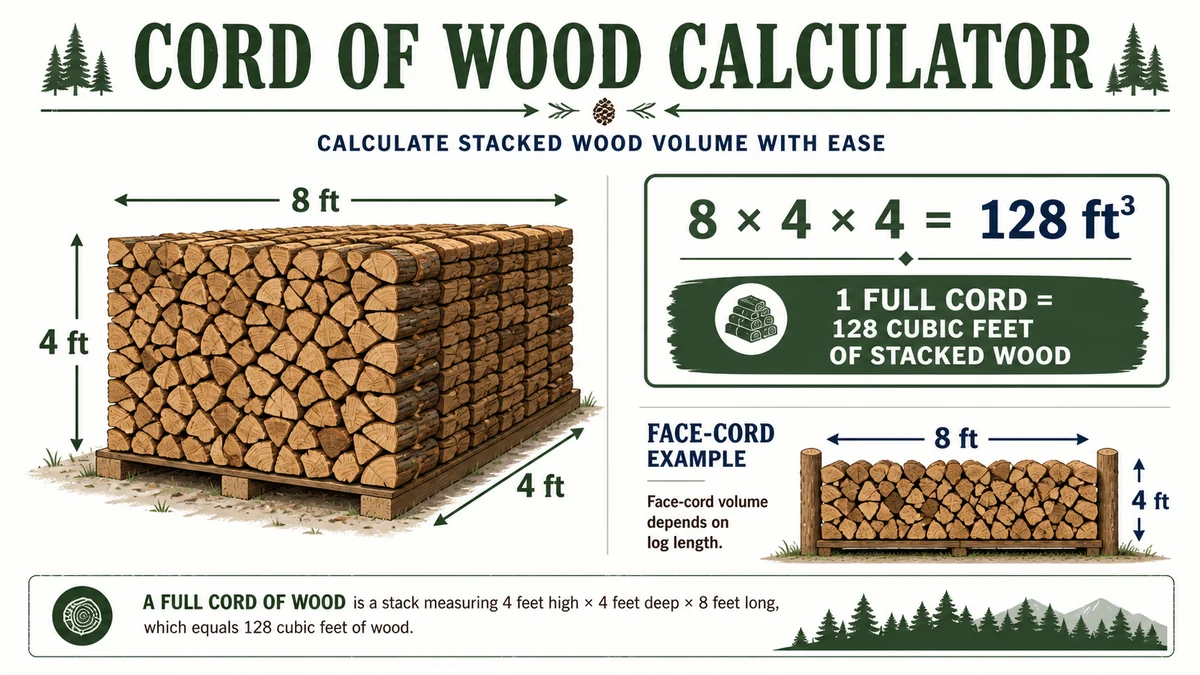
A full cord is commonly measured as 128 cubic feet of ranked, well-stowed firewood. A typical full cord can be stacked as 4 ft high × 8 ft long × 4 ft deep, but any compact stack with equivalent volume may equal one full cord.

This calculator estimates stacked volume only. It does not verify legal sale compliance, wood species, moisture content, seasoning, heat output, BTU value, delivery fee, stacking fee, local taxes, seller claims, loose-pile volume, or truckload quantity. For purchases, measure the stacked wood carefully and check local weights-and-measures rules before relying on terms such as face cord, rack, rick, pile, or truckload.

Reviewed by: AjaxCalculators Editorial Team
Last updated: April 28, 2026
Method source: Standard stacked-firewood volume formulas using cubic feet, full cord volume, and reference face-cord volume
Editorial standards: AjaxCalculators Editorial Policy

What This Cord of Wood Calculator Calculates

This calculator estimates firewood quantity from the measured dimensions of a stacked wood pile. It is useful for checking deliveries, comparing firewood offers, estimating storage space, and calculating the value of a partial stack.

Result What It Means Use Note
Stack volume The measured firewood stack volume in cubic feet. Calculated from length × height × depth.
Volume in m³ The same stack volume converted to cubic meters. Useful for metric comparison.
Full cords The stack volume divided by 128 cubic feet. Shows how much of a standard full cord the stack represents.
Face cords The stack volume divided by the calculator’s reference face-cord volume. Uses 42.67 ft³ as the reference face cord based on 8 ft × 4 ft × 16 in.
Cord percentage The calculated full cords shown as a percentage. For example, 0.5 cords equals 50% of a full cord.
Face-cord percentage The calculated reference face cords shown as a percentage. Useful only when comparing against the same reference face-cord depth.
Estimated cost Full cords multiplied by the price per cord. Volume-based estimate only; quality, delivery, seasoning, and fees are not included.

What a Cord of Wood Means

A cord of wood is a standard stacked volume of firewood. In common U.S. firewood measurement, a full cord equals:

1 full cord = 128 cubic feet

A typical full cord is often stacked as:

4 ft high × 8 ft long × 4 ft deep = 128 ft³

The stack does not have to use exactly those dimensions. Any compact, well-stacked pile that measures 128 cubic feet can equal one full cord.

How the Cord of Wood Calculator Works

1) Stack Volume Formula

The calculator first finds the total stacked volume:

Stack volume = length × height × depth

In this formula:

  • length is the horizontal length of the wood stack
  • height is the vertical height of the stack
  • depth is the front-to-back depth of the stack, usually the log length

If the dimensions are entered in inches or meters, the calculator converts them into the needed base unit before calculating the final result.

2) Full Cords Formula

After calculating cubic feet, the calculator divides by the standard full-cord volume:

Full cords = stack volume in ft³ ÷ 128

For example, a stack with 64 cubic feet is:

64 ÷ 128 = 0.5 full cords

3) Face Cords Formula

The calculator uses a reference face cord based on a common stack size of 8 ft long, 4 ft high, and 16 inches deep.

Reference face cord volume = 8 ft × 4 ft × 16 in

Since 16 inches equals 1.3333 feet:

Reference face cord volume = 8 × 4 × 1.3333 ≈ 42.67 ft³

Then:

Face cords = stack volume in ft³ ÷ 42.67

4) Cord Percentage Formula

Cord percentage shows how much of a full cord the measured stack represents.

Cord percentage = full cords × 100

For example, 0.75 cords equals 75% of a full cord.

5) Estimated Cost Formula

If price per cord is entered, the calculator estimates the stack value:

Estimated cost = full cords × price per cord

This estimate is based only on volume. It does not adjust for wood species, moisture content, delivery fee, stacking fee, local taxes, or firewood quality.

Full Cord vs Face Cord

A full cord and a face cord are not the same measurement. A full cord has a standard stacked volume of 128 cubic feet. A face cord usually describes one row of firewood that is 4 feet high and 8 feet long, but its depth depends on log length.

Measurement Common Dimensions Approximate Volume Important Note
Full cord 4 ft × 8 ft × 4 ft 128 ft³ Standard full-cord volume when wood is ranked and well stowed.
Face cord with 12-inch logs 4 ft × 8 ft × 12 in 32 ft³ About one-quarter of a full cord.
Face cord with 16-inch logs 4 ft × 8 ft × 16 in 42.67 ft³ About one-third of a full cord.
Face cord with 24-inch logs 4 ft × 8 ft × 24 in 64 ft³ About one-half of a full cord.

Because face-cord volume depends on log length, always confirm the actual stack depth before comparing prices.

Worked Example: Full Cord Calculation

Suppose a firewood stack measures 8 ft long, 4 ft high, and 4 ft deep.

Step Calculation Result
Find stack volume Volume = 8 × 4 × 4 128 ft³
Convert to full cords Full cords = 128 ÷ 128 1 full cord
Find cord percentage Cord percentage = 1 × 100 100%

So, an 8 ft × 4 ft × 4 ft ranked and well-stowed stack equals 1 full cord.

Worked Example: Face Cord Calculation

Suppose a firewood stack measures 8 ft long, 4 ft high, and 16 inches deep.

Step Calculation Result
Convert depth to feet 16 in ÷ 12 1.3333 ft
Find stack volume Volume = 8 × 4 × 1.3333 42.67 ft³
Convert to full cords Full cords = 42.67 ÷ 128 0.333 cords
Convert to reference face cords Face cords = 42.67 ÷ 42.67 1 reference face cord

So, an 8 ft × 4 ft × 16 in stack is about 1 reference face cord, or about one-third of a full cord.

How to Use This Cord of Wood Calculator

  1. Measure the length of the firewood stack.
  2. Measure the height of the firewood stack.
  3. Measure the depth of the stack, usually the log length.
  4. Select the correct unit for each measurement: feet, inches, or meters.
  5. Enter the optional price per cord if you want a cost estimate.
  6. Click Calculate.
  7. Review the stack volume, full cords, face cords, percentages, and estimated cost.

How to Interpret the Result

Result What It Means Important Caution
Volume The measured stacked volume of the firewood pile. This includes air gaps between stacked logs; it is not solid wood volume.
Volume in m³ The measured stack volume converted to cubic meters. Useful for metric comparison, not a separate legal-firewood standard by itself.
Full cords The stack volume divided by 128 ft³. Best for comparing against standard cord-based firewood sales.
Face cords The stack volume divided by 42.67 ft³. Uses a 16-inch-log reference face cord. Actual seller use of “face cord” may vary.
Cord percentage The calculated full-cord amount shown as a percentage. Helpful for partial stacks, such as 25%, 50%, or 75% of a cord.
Estimated cost Full cords multiplied by the entered price per cord. Does not include species, moisture, delivery, stacking, taxes, or local market differences.

Why Stack Depth Matters

Stack depth is one of the most important measurements because it usually equals the log length. A stack that is 8 feet long and 4 feet high can contain very different amounts of wood depending on whether the logs are 12 inches, 16 inches, 24 inches, or 48 inches long.

Stack Dimensions Stack Volume Approximate Full Cords
8 ft × 4 ft × 12 in 32 ft³ 0.25 cords
8 ft × 4 ft × 16 in 42.67 ft³ 0.333 cords
8 ft × 4 ft × 24 in 64 ft³ 0.5 cords
8 ft × 4 ft × 48 in 128 ft³ 1 cord

This is why you should measure depth before comparing a face cord, rack, rick, pile, truckload, or other local firewood term.

Buying Firewood: What to Check

When buying firewood, measure the stack after it is neatly piled. Firewood should be stacked in a compact row with pieces aligned, touching, and reasonably parallel so the dimensions can be measured fairly.

Check Why It Matters
Advertised quantity Confirm whether the seller is offering a full cord, fraction of a cord, face cord, rack, rick, or truckload.
Stack length, height, and depth These dimensions determine the actual stacked volume.
Log length Shorter or longer logs change the depth and therefore the volume.
Wood species Oak, maple, birch, pine, and mixed hardwood can differ in heat value, density, and price.
Moisture and seasoning Seasoned or kiln-dried wood may burn better than green wood.
Delivery and stacking fees These may not be included in the listed price per cord.
Local measurement rules Firewood sale rules can vary by jurisdiction, so check local weights-and-measures guidance.
Invoice or written quantity A written record helps if there is a delivery or measurement dispute.

Full Cord, Half Cord, Quarter Cord, and Face Cord

Here is a quick comparison of common firewood quantities by stacked volume.

Firewood Amount Stacked Volume Fraction of Full Cord Use Note
Full cord 128 ft³ 1 cord Standard full-cord volume.
Half cord 64 ft³ 0.5 cord Half of a full cord by stacked volume.
Quarter cord 32 ft³ 0.25 cord One-quarter of a full cord by stacked volume.
Face cord with 16-inch logs About 42.67 ft³ About 0.333 cord Depends on log depth; not always a fixed legal sale term.

These values are based on stacked volume, not the solid wood volume after removing air gaps between logs.

Important Limitations

Limitation What It Means
Stacked volume only The calculator estimates the volume of the stacked pile, including air gaps between logs.
Not solid wood volume It does not calculate the exact amount of wood fiber after removing void space.
Requires measurable stack dimensions Loose dumped piles, truck beds, bags, and irregular piles are harder to measure accurately.
Face-cord terms vary Face cord, rack, rick, and similar terms may vary by seller, region, or local rules.
No moisture estimate The calculator does not measure whether the wood is green, seasoned, kiln-dried, or wet.
No heat-output estimate It does not calculate BTUs, burn time, stove efficiency, or heating value.
No firewood-quality adjustment Species, split size, rot, bark, dirt, and mixed wood quality are not included.
No legal verification For purchase disputes or regulated sales, check local weights-and-measures rules.
No full delivery-cost estimate Delivery, stacking, taxes, tips, and other fees are not included unless reflected in the price per cord.

Common Mistakes to Avoid

Mistake Why It Causes Problems
Assuming every face cord equals one-third of a full cord That is only true when the stack is 8 ft × 4 ft × 16 in, or about 42.67 ft³.
Comparing prices without checking depth Two stacks with the same front face can contain different amounts of wood if log length differs.
Treating a truckload as a fixed quantity Truckload volume depends on truck size, stacking, side height, and whether the wood is loose or ranked.
Measuring a loose pile as if it were a ranked stack Loose piles usually contain more air space and are harder to compare fairly.
Forgetting to convert inches to feet Cubic feet calculations require all dimensions to use feet.
Ignoring wood moisture Green wood, wet wood, seasoned wood, and kiln-dried wood can differ in burn quality and usable heat.
Assuming volume equals heat value Different wood species and moisture levels can produce different heating performance.
Ignoring local firewood-sale rules Legal sale terms and invoice requirements can vary by location.

Formula Summary

What You Want to Find Formula Use Note
Stack volume Volume = length × height × depth Use matching units before multiplying.
Full cords Full cords = volume in ft³ ÷ 128 128 ft³ is the standard full-cord volume.
Reference face-cord volume 8 ft × 4 ft × 16 in = about 42.67 ft³ Uses a common 16-inch-log reference face cord.
Face cords Face cords = volume in ft³ ÷ 42.67 Reference comparison only; actual face-cord definitions may vary.
Cord percentage Cord percentage = full cords × 100 Shows what percentage of a full cord the stack represents.
Face-cord percentage Face-cord percentage = face cords × 100 Shows percentage of the calculator’s reference face cord.
Estimated cost Estimated cost = full cords × price per cord Volume-based estimate only.
Cubic feet to cubic meters m³ = ft³ × 0.028316846592 Metric volume conversion.

Practical Uses

This Cord of Wood Calculator can be useful whenever you need to estimate, verify, or compare stacked firewood volume.

Use Case How the Calculator Helps
Checking a firewood delivery Estimate whether a stacked delivery matches the advertised amount.
Comparing seller offers Convert different stack sizes into full-cord equivalents.
Measuring a partial stack Find whether a stack is a quarter cord, half cord, or another fraction.
Checking a face cord Use actual log depth to estimate how much of a full cord it represents.
Estimating firewood value Multiply calculated cords by price per cord.
Planning storage space Estimate how much space a firewood stack will occupy.
Metric comparison Convert stack volume into cubic meters.
Avoiding vague quantity terms Convert rack, rick, pile, or truckload claims into measured dimensions when possible.

When You May Need More Than This Calculator

This calculator is best for measuring stacked firewood volume. You may need additional checks when quality, heat value, legal sale compliance, or delivery disputes matter.

Need Better Method or Additional Check
Legal sale compliance Check local weights-and-measures rules or your state/provincial consumer protection guidance.
Purchase dispute Measure the stacked wood, keep photos, keep the invoice, and contact the relevant local agency if needed.
Heat output estimate Use wood species, moisture content, stove efficiency, and BTU data.
Moisture check Use a firewood moisture meter and test a freshly split face.
Loose pile or truckload estimate Stack the wood first or use a method designed for loose-volume adjustment.
Delivery-cost comparison Include delivery fee, stacking fee, taxes, minimum order, and distance charges.
Storage planning Consider airflow, cover, ground clearance, rain exposure, and safe stacking.

Frequently Asked Questions

How many cubic feet are in a cord of wood?

A full cord of wood is commonly measured as 128 cubic feet when the wood is ranked and well stowed.

What are the common dimensions of a full cord?

A common full-cord stack is 4 ft high × 8 ft long × 4 ft deep, which equals 128 cubic feet.

How do I calculate cords of wood?

Multiply stack length × height × depth to find cubic feet, then divide by 128 to estimate full cords.

What is a face cord?

A face cord usually describes one row of firewood that is 4 ft high and 8 ft long, but the depth depends on log length. A 16-inch-deep face cord is about 42.67 cubic feet.

Is a face cord always one-third of a full cord?

No. A face cord is about one-third of a full cord only when the depth is 16 inches. A 12-inch face cord is about one-quarter of a cord, while a 24-inch face cord is about one-half of a cord.

Does stacked volume equal solid wood volume?

No. Stacked firewood volume includes air gaps between logs. The calculator estimates stacked volume, not exact solid wood volume.

Can I use this calculator for a truckload of firewood?

Only if you know the stack dimensions after the wood is ranked and well stowed. Loose truckloads can be difficult to compare fairly because the wood is not compactly stacked.

Does this calculator estimate BTU or heat output?

No. Heat output depends on wood species, moisture content, seasoning, stove efficiency, and burn conditions. This calculator estimates volume only.

References

  1. Washington State Department of Agriculture — Firewood
  2. Arizona Department of Agriculture — Firewood Sale Requirements
  3. Connecticut Department of Consumer Protection — Firewood and Stove Wood Regulations
  4. California Department of Food and Agriculture — Firewood Buying Guidance
  5. NIST Guide to the SI — Appendix B.9: Conversion Factors

Related Calculators

Cord of Wood Calculator Disclaimer

This Cord of Wood Calculator estimates stacked firewood volume from measured stack dimensions. It calculates cubic feet, cubic meters, full cords, reference face cords, cord percentages, and optional estimated cost from price per cord.

It does not verify legal sale compliance, wood species, moisture content, seasoning, kiln-drying, heat output, BTU value, stove performance, burn time, delivery quantity, seller claims, local taxes, delivery fees, stacking fees, or firewood quality. It also does not accurately measure loose dumped piles, bags, truckloads, or irregular piles unless the wood is stacked and measured.

For buying or selling firewood, measure stacked wood carefully, confirm length, height, and depth, keep written records, and check local weights-and-measures rules before relying on terms such as face cord, rack, rick, pile, truckload, or similar local labels.

More of our calculators...

Calorie Deficit Calculator

Use our Calorie Deficit Calculator to estimate BMR, maintenance calories, TDEE, calorie deficit, target calories, and weekly weight-change estimate.

SLEEP CALCULATOR

Use our Sleep Calculator to find the best bedtime or wake-up time based on sleep cycles, fall-asleep time, and total hours in bed for a smoother morning.

Face Shape Calculator

Use our Face Shape Calculator to estimate your likely face shape from forehead, cheekbone, jawline, and face length measurements plus chin shape.

Age Difference Calculator

Use our Age Difference Calculator to find the exact age gap between two dates of birth in years, months, days, total months, total days, and approximate years.

Bikini Calculator

Use our Bikini Calculator to estimate your body shape from bust, waist, high hip, and hip measurements, then get bikini style suggestions that fit your shape.

Body Shape Calculator

Body Shape Calculator helps you identify your body type from key measurements and understand which shape category fits you best.

Helium Balloons Calculator

Use our Helium Balloons Calculator to estimate lift per balloon, total helium volume, and how many helium balloons you need to lift a given weight.

RPM Calculator

Use our RPM Calculator to find engine RPM from speed or vehicle speed from RPM using overall gear ratio and tire diameter, plus wheel RPM and tire circumference.

Reading Time Calculator

Use our Reading Time Calculator to estimate how long it takes to read a book, daily pages read, and time needed to finish from pages and reading speed.