Speed Calculator

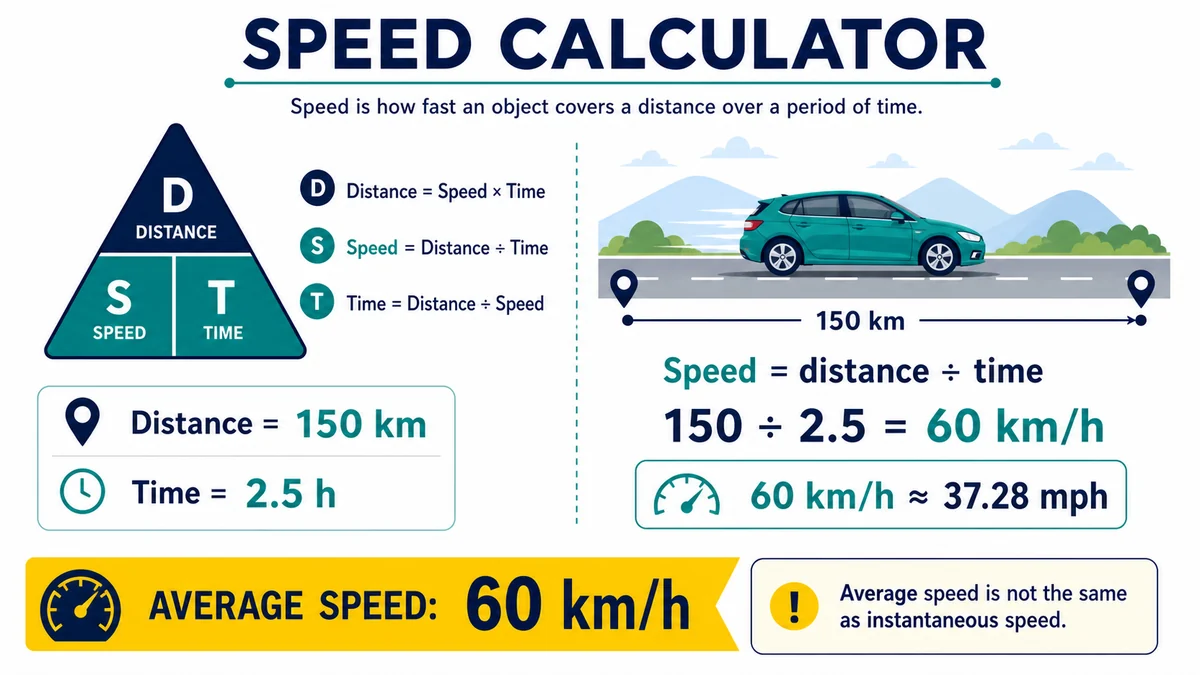
Average speed = distance / time. Enter distance and time; results update instantly.

Distance

Time

Speed (Result)

Unit:
Speed
0 km/h

Enter distance and time to see your speed.

Step-by-step derivation

Formula: v = d / t
(Provide inputs to see the steps.)

Actions

Reference table & sources

Common speed conversions
Base Unit = km/h = mph = ft/s = kn
1 m/s3.62.236943.280841.94384
1 km/h10.6213710.9113440.539957
1 mph1.6093411.466670.868976
1 kn1.8521.150781.687811

Source note: SI and customary conversion factors are supported by NIST and BIPM references. Knot conversion is based on the nautical mile per hour definition.

  • SI units & conversions: NIST & BIPM
  • Knots definition: International Hydrographic Organization
  • Use this Speed Calculator to find average speed from distance and time. Enter the distance traveled, enter the elapsed time in hours, minutes, and seconds, then choose the speed unit you want to display. The calculator can show the result in meters per second, kilometers per hour, miles per hour, feet per second, or knots.

    Important Note: This Speed Calculator estimates average speed from total distance and total elapsed time using the formula speed = distance ÷ time. It can display the result in meters per second, kilometers per hour, miles per hour, feet per second, or knots.

    The result is an average speed for the full distance and time entered. It does not measure instantaneous speed, acceleration, traffic-adjusted travel time, GPS speed, wind or current effects, route changes, slope, terrain, or velocity direction.

    Use this calculator for general travel, running, cycling, walking, homework, unit conversion, and race-speed estimates. For official transportation, athletics, aviation, marine, engineering, or safety-related use, verify measurements with appropriate instruments, timing systems, official route data, or professional guidance.

    Reviewed by: AjaxCalculators Editorial Team
    Last updated: April 28, 2026
    Method source: Standard average-speed formula using distance divided by elapsed time, with common speed-unit conversions
    Editorial standards: AjaxCalculators Editorial Policy

    What This Speed Calculator Calculates

    This calculator estimates average speed from total distance and total elapsed time.

    The calculator can calculate:

    • Average speed
    • Speed in meters per second
    • Speed in kilometers per hour
    • Speed in miles per hour
    • Speed in feet per second
    • Speed in knots
    • Step-by-step derivation

    The live tool supports distance units of m, km, mi, ft, and yd. Time is entered as hours, minutes, and seconds, and the result can be shown in m/s, km/h, mph, ft/s, or kn.

    What Speed Means

    Speed tells you how much distance is covered per unit of time. For example, a car traveling 60 miles in 1 hour has an average speed of 60 miles per hour.

    This calculator finds average speed. Average speed uses the total distance and total elapsed time for the whole trip or movement. It does not show how fast something was moving at every moment during the trip.

    How the Speed Calculator Works

    1) Average Speed Formula

    The standard average-speed formula is:

    Speed = distance ÷ time

    Using symbols:

    v = d ÷ t

    In this formula:

    • v is average speed
    • d is distance traveled
    • t is elapsed time

    2) Time Conversion

    The calculator combines hours, minutes, and seconds into one total time value before calculating speed.

    Total seconds = hours × 3,600 + minutes × 60 + seconds

    For example, 1 hour, 30 minutes, and 0 seconds equals:

    1 × 3,600 + 30 × 60 + 0 = 5,400 seconds

    3) Distance Conversion

    The calculator converts the entered distance into a consistent base distance before calculating and converting the final speed.

    Distance Unit Equivalent in Meters Use Note
    1 meter 1 m Base SI length unit.
    1 kilometer 1,000 m Common for road distance, running, cycling, and travel.
    1 mile 1,609.344 m Common for road distance in the United States and some other contexts.
    1 foot 0.3048 m Useful for short-distance motion and engineering-style examples.
    1 yard 0.9144 m Useful for sports, short distances, and imperial-unit examples.

    4) Speed Unit Conversion

    After average speed is calculated, the result can be converted into the selected speed unit.

    Speed Unit Meaning Common Use
    m/s Meters per second Physics, engineering, science, and technical motion calculations.
    km/h Kilometers per hour Road speed, travel speed, running, cycling, and general use in many countries.
    mph Miles per hour Road speed and travel speed in the United States and some other places.
    ft/s Feet per second Engineering, physics examples, projectile motion, and short-distance motion checks.
    kn Knots, or nautical miles per hour Marine, aviation, navigation, wind speed, and current speed.

    Common Speed Conversions

    The calculator uses standard speed conversions. These are useful when comparing results across different measurement systems.

    Starting Unit km/h mph ft/s kn
    1 m/s 3.6 2.23694 3.28084 1.94384
    1 km/h 1 0.621371 0.911344 0.539957
    1 mph 1.609344 1 1.46667 0.868976
    1 knot 1.852 1.15078 1.68781 1

    Knots are nautical miles per hour, so they are most useful for marine, aviation, navigation, wind, and current-speed contexts.

    Worked Example: Find Speed in km/h

    Suppose you travel 120 km in 2 hours.

    Step 1: Use the speed formula
    Speed = distance ÷ time

    Step 2: Substitute the values
    Speed = 120 km ÷ 2 hours

    Step 3: Calculate
    Speed = 60 km/h

    So, traveling 120 km in 2 hours gives an average speed of 60 km/h.

    Worked Example: Find Speed in mph

    Suppose you travel 150 miles in 3 hours.

    Step 1: Use the formula
    Speed = distance ÷ time

    Step 2: Substitute the values
    Speed = 150 miles ÷ 3 hours

    Step 3: Calculate
    Speed = 50 mph

    So, traveling 150 miles in 3 hours gives an average speed of 50 mph.

    Worked Example: Hours, Minutes, and Seconds

    Suppose a runner covers 5 km in 25 minutes.

    Step 1: Convert time to hours
    25 minutes ÷ 60 = 0.4167 hours

    Step 2: Calculate speed in km/h
    Speed = 5 ÷ 0.4167

    Step 3: Calculate
    Speed ≈ 12 km/h

    Step 4: Convert to m/s if needed
    12 km/h ÷ 3.6 = 3.33 m/s

    So, running 5 km in 25 minutes gives an average speed of about 12 km/h, or about 3.33 m/s.

    How to Use This Speed Calculator

    1. Enter the distance traveled.
    2. Select the distance unit: m, km, mi, ft, or yd.
    3. Enter the elapsed time using hours, minutes, and seconds.
    4. Select the speed result unit: m/s, km/h, mph, ft/s, or kn.
    5. Review the average speed result. The calculator updates automatically when valid inputs are entered.
    6. Check the step-by-step derivation to confirm the distance, time, and speed calculation path.
    7. Use Refresh to clear the calculator and start again.

    How to Interpret the Result

    Result What It Means Important Caution
    Average speed The total distance divided by the total elapsed time. It is not necessarily the highest speed or the speed at any one moment.
    m/s Meters traveled per second. Useful for physics, science, engineering, and short-duration motion.
    km/h Kilometers traveled per hour. Useful for road, running, cycling, and travel-speed comparisons.
    mph Miles traveled per hour. Useful for US-style road speed and travel-speed comparisons.
    ft/s Feet traveled per second. Useful for engineering-style examples and short-distance calculations.
    kn Nautical miles traveled per hour. Useful for marine, aviation, wind, and current speed.
    Step-by-step derivation The calculation path used by the tool. Use it to verify distance conversion, time conversion, and output unit conversion.

    If the result is 60 km/h, it means the average movement rate was 60 kilometers per hour across the total distance and elapsed time entered. The actual speed may have been higher or lower at different moments.

    Average Speed vs Instantaneous Speed

    Average speed and instantaneous speed are related, but they answer different questions.

    Speed Type Meaning Example Calculator Scope
    Average speed Total distance divided by total elapsed time. 120 km in 2 hours = 60 km/h average. This calculator calculates average speed.
    Instantaneous speed Speed at a specific moment. A speedometer reading of 80 km/h at one second. This calculator does not measure instantaneous speed.

    Average speed is useful for whole trips, races, workouts, and distance-time problems. Instantaneous speed requires measurement at a specific moment, such as from a speedometer, radar, timing sensor, or GPS device.

    Speed vs Velocity

    Speed and velocity are related, but they are not identical in physics. Speed does not include direction. Velocity includes direction.

    Measure Quantity Type What It Uses Example
    Speed Scalar Distance and time 60 km/h
    Velocity Vector Displacement, time, and direction 60 km/h north

    This calculator finds average speed only. It does not calculate vector velocity because it does not use direction or displacement.

    When to Use a Speed Calculator

    This calculator is useful whenever you know distance and elapsed time and want to find average speed.

    Use Case Example Why It Helps
    Running speed 5 km in 25 minutes Finds average pace-related speed in km/h or m/s.
    Cycling speed 30 km in 1 hour 15 minutes Converts ride distance and time into average speed.
    Walking speed 2 miles in 40 minutes Helps compare walking speeds in mph or km/h.
    Travel estimate 150 miles in 3 hours Finds average trip speed.
    Physics homework Distance divided by elapsed time Shows the basic speed formula and derivation.
    Marine or aviation speed Convert km/h or mph into knots Useful when a result needs to be shown in kn.
    Race or workout checks Distance and finish time Provides average speed over the full activity.

    Travel Speed vs Real Trip Time

    This calculator uses distance and elapsed time. It does not predict real-world travel conditions.

    Factor Why It Matters Calculator Scope
    Traffic Traffic can reduce actual average speed. Not included.
    Stops and delays Breaks, signals, queues, and rest stops affect elapsed time. Included only if your entered time includes them.
    Route changes Actual distance may differ from planned distance. Use the actual route distance when possible.
    Terrain or slope Hills and rough terrain affect running, cycling, and walking speed. Not modeled separately.
    Wind or current Wind and water current can affect aircraft, boats, and outdoor activities. Not modeled.
    GPS accuracy GPS distance and time can contain measurement error. Verify with reliable instruments when accuracy matters.

    Important Assumptions and Limitations

    Assumption or Limitation What It Means
    Average speed only The calculator divides total distance by total elapsed time.
    Distance must be accurate Incorrect route distance, GPS distance, or unit selection will change the result.
    Elapsed time must be accurate Hours, minutes, and seconds must represent the full time you want included.
    Zero time is invalid Speed cannot be calculated by dividing by zero.
    No acceleration calculation The calculator does not model changing speed over time.
    No instantaneous speed The result is not a speedometer-style reading at one moment.
    No velocity direction The calculator does not calculate vector velocity because direction is not entered.
    No traffic or route model Traffic, stops, route changes, terrain, wind, and current are not modeled separately.
    Rounded display Displayed results may be rounded for readability.
    Not an official timing system For official racing, transport, aviation, marine, or engineering use, verify with appropriate instruments or data sources.

    Common Mistakes to Avoid

    Mistake Why It Causes Problems
    Entering minutes as decimal hours 30 minutes is 0.5 hours, not 0.30 hours.
    Forgetting seconds for short activities Seconds can matter for races, sprints, and short-distance timing.
    Comparing km/h and mph without conversion They use different distance units, so the numbers are not directly comparable.
    Treating average speed as maximum speed The average may be lower than the highest speed reached during the trip.
    Using speed when velocity is required Velocity requires direction or displacement, not only distance.
    Entering zero time Division by zero is undefined, so speed cannot be calculated.
    Confusing knots with mph One knot is one nautical mile per hour, not one statute mile per hour.
    Using planned time instead of actual elapsed time If you want actual average speed, use actual elapsed time including the stops you want counted.
    Using planned route distance when actual route differs A detour, trail variation, GPS error, or route change can change the average-speed result.

    Formula Summary

    What You Want to Find Formula or Conversion Example
    Average speed Speed = distance ÷ time 120 km ÷ 2 h = 60 km/h
    Symbol form v = d ÷ t v = average speed, d = distance, t = time
    Total seconds seconds = hours × 3,600 + minutes × 60 + seconds 1 h 30 min = 5,400 s
    m/s to km/h km/h = m/s × 3.6 10 m/s = 36 km/h
    km/h to m/s m/s = km/h ÷ 3.6 72 km/h = 20 m/s
    mph to km/h km/h = mph × 1.609344 60 mph = 96.5606 km/h
    km/h to mph mph = km/h × 0.621371 100 km/h ≈ 62.1371 mph
    knots to km/h km/h = knots × 1.852 10 kn = 18.52 km/h
    km/h to knots knots = km/h × 0.539957 18.52 km/h = 10 kn

    Practical Uses

    This Speed Calculator can be useful for quick average-speed estimates and speed-unit conversions.

    Practical Use Example
    Running speed Find average km/h or mph from race distance and finish time.
    Cycling speed Convert ride distance and elapsed time into average speed.
    Walking speed Estimate average walking speed from distance and time.
    Travel checks Find average trip speed from route distance and elapsed time.
    Physics problems Use the standard distance ÷ time relationship.
    Marine and aviation conversions Convert between km/h, mph, and knots.
    Unit conversion Compare speed values in m/s, km/h, mph, ft/s, and kn.

    When You May Need a Different Calculator

    This calculator is best for average speed from distance and time. You may need a different calculator when speed is only one part of the problem.

    Need Better Tool or Method
    Find distance from speed and time Use a distance calculator or rearrange the formula as distance = speed × time.
    Find time from distance and speed Use a travel time calculator or rearrange the formula as time = distance ÷ speed.
    Calculate acceleration Use an acceleration calculator with change in velocity and time.
    Calculate velocity with direction Use a velocity calculator or vector method.
    Estimate drive time with traffic Use a navigation or route-planning tool with traffic data.
    Calculate running pace Use a running pace or split calculator.
    Measure live speed Use GPS, timing gates, radar, onboard instruments, or official timing systems.

    Frequently Asked Questions

    How do I calculate average speed?

    Divide total distance by total elapsed time. For example, 120 km in 2 hours gives 120 ÷ 2 = 60 km/h.

    What formula does this speed calculator use?

    The calculator uses speed = distance ÷ time, also written as v = d ÷ t.

    Is this calculator finding average speed or instantaneous speed?

    It finds average speed over the full distance and elapsed time entered. It does not measure instantaneous speed at one moment.

    What is the difference between speed and velocity?

    Speed is a scalar value and does not include direction. Velocity is a vector value and includes direction.

    How do I convert m/s to km/h?

    Multiply meters per second by 3.6. For example, 10 m/s = 36 km/h.

    How do I convert mph to km/h?

    Multiply miles per hour by 1.609344. For example, 60 mph is about 96.56 km/h.

    What is a knot?

    A knot is one nautical mile per hour. It is commonly used in marine, aviation, navigation, wind, and current-speed contexts.

    Can I use this for travel time with traffic?

    You can use it for basic average-speed math, but it does not predict traffic, road conditions, stops, route changes, or delays.

    References

    1. OpenStax Physics — Speed and Velocity
    2. OpenStax College Physics 2e — Time, Velocity, and Speed
    3. NIST Guide to the SI — Appendix B.9: Speed Conversion Factors
    4. NOAA Ocean Service — Nautical Miles and Knots
    5. BIPM — The International System of Units SI Brochure

    Related Calculators

    Speed Calculator Disclaimer

    This Speed Calculator provides average-speed estimates from total distance and total elapsed time. It converts the result between m/s, km/h, mph, ft/s, and knots using standard conversion factors.

    It does not measure instantaneous speed, acceleration, live GPS speed, traffic-adjusted travel time, route changes, wind, current, slope, terrain, stop time unless included in the entered elapsed time, or velocity direction. It also does not verify official race timing, vehicle speed, aviation speed, marine navigation data, or safety-critical measurements.

    For official transportation, athletics, aviation, marine, engineering, legal, or safety-related use, verify the distance, elapsed time, unit conversion, and measurement method with appropriate instruments, official timing data, navigation systems, service documentation, or qualified professionals.

    More of our calculators...

    SLEEP CALCULATOR

    Use our Sleep Calculator to find the best bedtime or wake-up time based on sleep cycles, fall-asleep time, and total hours in bed for a smoother morning.

    Calorie Deficit Calculator

    Use our Calorie Deficit Calculator to estimate BMR, maintenance calories, TDEE, calorie deficit, target calories, and weekly weight-change estimate.

    Face Shape Calculator

    Use our Face Shape Calculator to estimate your likely face shape from forehead, cheekbone, jawline, and face length measurements plus chin shape.

    Age Difference Calculator

    Use our Age Difference Calculator to find the exact age gap between two dates of birth in years, months, days, total months, total days, and approximate years.

    Bikini Calculator

    Use our Bikini Calculator to estimate your body shape from bust, waist, high hip, and hip measurements, then get bikini style suggestions that fit your shape.

    Body Shape Calculator

    Body Shape Calculator helps you identify your body type from key measurements and understand which shape category fits you best.

    Helium Balloons Calculator

    Use our Helium Balloons Calculator to estimate lift per balloon, total helium volume, and how many helium balloons you need to lift a given weight.

    RPM Calculator

    Use our RPM Calculator to find engine RPM from speed or vehicle speed from RPM using overall gear ratio and tire diameter, plus wheel RPM and tire circumference.

    Reading Time Calculator

    Use our Reading Time Calculator to estimate how long it takes to read a book, daily pages read, and time needed to finish from pages and reading speed.