Percent Yield Calculator
- Convert both yields into grams internally.
- Apply the formula % yield = (actual / theoretical) × 100.
- Substitute values: —
- Result: —
- Percent yield = (actual yield ÷ theoretical yield) × 100.
- Unit switching is local to each field and recalculates from the saved source value.
A reaction may predict one amount of product on paper and produce a smaller amount at the laboratory bench. The Percent Yield Calculator measures that difference by comparing the product actually collected with the maximum amount predicted by stoichiometry.
Enter the actual and theoretical yields in milligrams, grams or kilograms. The tool converts the measurements to compatible units, calculates the yield percentage and shows the actual-to-theoretical ratio, mass difference, interpretation and calculation steps.
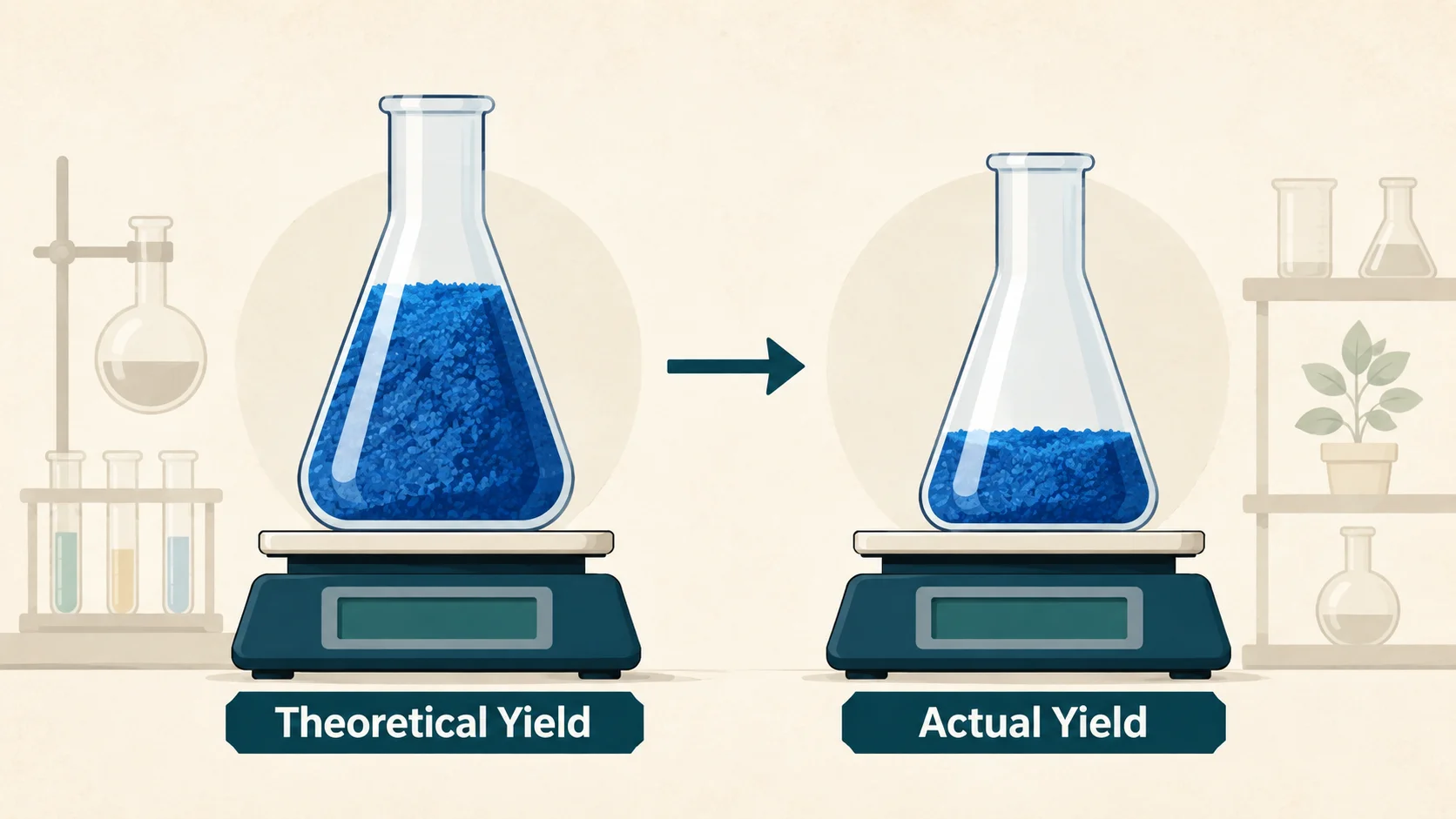
Percent Yield Formula
Percent yield = (actual yield ÷ theoretical yield) × 100
Both measurements must describe the same chemical product and be expressed in compatible units before division. Because the units cancel, percent yield itself has no mass unit and is reported as a percentage.
| Quantity | Meaning | How it is obtained |
|---|---|---|
| Actual yield | Product amount collected from the experiment | Measured after reaction, separation and any required purification or drying |
| Theoretical yield | Maximum product amount predicted under the stoichiometric assumptions | Calculated from the balanced equation and limiting reagent |
| Percent yield | Actual product expressed as a percentage of theoretical product | Actual yield divided by theoretical yield, multiplied by 100 |
How to Use the Percent Yield Calculator
- Enter the product amount actually obtained from the experiment.
- Select mg, g or kg for the actual-yield unit.
- Enter the theoretical yield calculated from stoichiometry.
- Select the theoretical-yield unit independently.
- Click Calculate.
- Review the percentage, ratio, difference and interpretation.
- Check the step-by-step derivation or select Reset to begin again.
The theoretical yield must be greater than zero. Negative yield values are not meaningful for this calculation.
Worked Percent Yield Example
Suppose a reaction is predicted to produce 15.0 g of a compound, but only 12.5 g is collected.
Percent yield = (12.5 ÷ 15.0) × 100
Percent yield = 0.8333 × 100
Percent yield ≈ 83.33%
The experiment produced approximately 83.33% of the theoretical amount. The difference from theoretical yield is:
12.5 g − 15.0 g = −2.5 g
The negative difference means that 2.5 g less product was collected than the predicted maximum.
Example with Different Mass Units
Suppose the actual yield is 850 mg and the theoretical yield is 1.2 g. Convert the actual yield first:
850 mg = 0.85 g
Percent yield = (0.85 ÷ 1.2) × 100 ≈ 70.83%
The live calculator performs this mg-to-g conversion internally. Unit conversion changes only how the quantities are expressed; it does not change the underlying yield ratio.
How to Interpret Percent Yield
| Calculated result | General meaning | What to review |
|---|---|---|
| Below 100% | Less product was collected than the theoretical amount | Incomplete reaction, side reactions, transfer loss, filtration or purification loss |
| Approximately 100% | Actual and theoretical yields are close | Rounding, balance precision, product identity, purity and drying |
| Above 100% | The measured product mass exceeds the predicted maximum | Moisture, retained solvent, impurities, contamination, unreacted material or weighing error |
A value below 100% does not identify one specific experimental problem. It only quantifies the difference between the collected and predicted product amounts. The procedure and observations are needed to explain the cause.
Why Experimental Yield Is Often Lower
- The reaction may not reach complete conversion.
- Competing reactions may form other products.
- Some desired product may remain dissolved in a solvent.
- Material may be lost during pouring, filtering, washing or transfer.
- Purification and drying steps may reduce the recovered amount.
- Reactant purity and measurement uncertainty may affect the result.
Why Percent Yield Can Exceed 100%
A result above 100% usually does not mean the reaction created more product than the stoichiometric maximum. It commonly indicates that the measured sample contains something besides the intended dry product.
Check whether the product retained water or solvent, contained impurities or unreacted material, was weighed with residue, or was measured using an incorrect theoretical yield. Product identity and purity cannot be determined from percent yield alone.
Common Calculation Mistakes
- Dividing theoretical yield by actual yield instead of actual by theoretical
- Comparing milligrams directly with grams without conversion
- Using yields that refer to different products
- Forgetting to multiply the ratio by 100
- Calculating theoretical yield from the wrong limiting reagent
- Treating a value above 100% as proof of exceptional reaction performance
Assumptions and Limitations
- Actual and theoretical yields must refer to the same product.
- The calculator accepts mass measurements in mg, g and kg.
- It does not calculate theoretical yield from reactant quantities.
- It does not identify the limiting reagent or verify a balanced equation.
- It cannot measure purity, moisture, retained solvent or experimental uncertainty.
- Displayed answers may be rounded for readability.
Follow the laboratory procedure, instructor guidance and applicable safety data sheets when performing chemical work. This calculation is educational and does not replace laboratory safety or professional chemical analysis.
Frequently Asked Questions
What is a good percent yield?
There is no universal good value for every reaction. Expected yield depends on the reaction, scale, equilibrium, purification method and experimental purpose. Compare the result with an appropriate published or laboratory reference.
Can percent yield be greater than 100%?
The calculation can exceed 100%, but the result usually signals wet product, retained solvent, impurities, contamination, weighing error or an incorrect theoretical yield.
Do actual and theoretical yield need the same unit?
They must be converted to compatible units before division. This Percent Yield Calculator accepts different mg, g and kg selections and converts them internally.
Is theoretical yield the same as actual yield?
No. Theoretical yield is calculated from stoichiometry, while actual yield is measured from the product obtained experimentally.
Does percent yield measure product purity?
No. A sample can have a high measured mass while still containing solvent, moisture or impurities. Purity requires suitable analytical testing.
Can the calculator find theoretical yield?
No. Calculate it first from the limiting reagent and balanced equation with the Theoretical Yield Calculator, then return here with the actual product mass.
Related Chemistry Calculators
- Theoretical Yield Calculator – calculate the maximum product amount from a known limiting reagent.
- Molarity Calculator – calculate molar concentration, solution moles or solute mass.
- Dilution Ratio Calculator – determine concentrate, water and final mixture amounts from a dilution ratio.
References
- OpenStax Chemistry 2e – Reaction Yields
- Chemistry LibreTexts – Theoretical Yield and Percent Yield
- IUPAC Gold Book – Chemical Yield
Percent Yield Compares Actual With Theoretical Product
Percent yield divides the experimentally obtained amount by the theoretical yield and multiplies by 100. Use the same product form and units in both values, and determine theoretical yield from the limiting reactant. Results above 100% often indicate moisture, impurities, incomplete drying, weighing error, or an incorrect formula rather than unusually successful chemistry.