Dog Age Calculator
Settings
Enter ages
Results
Action
A dog age calculator gives an approximate human-age equivalent based on a dog’s age and size. It is more useful than multiplying by seven because dogs mature rapidly in their first years and larger dogs often age differently from smaller dogs later in life.
How the Dog Age Calculator Handles Dog Years
A one-year-old dog has already passed several developmental milestones, so the first year cannot sensibly equal only seven human years. Growth then slows, and aging patterns diverge by body size, genetics and health.
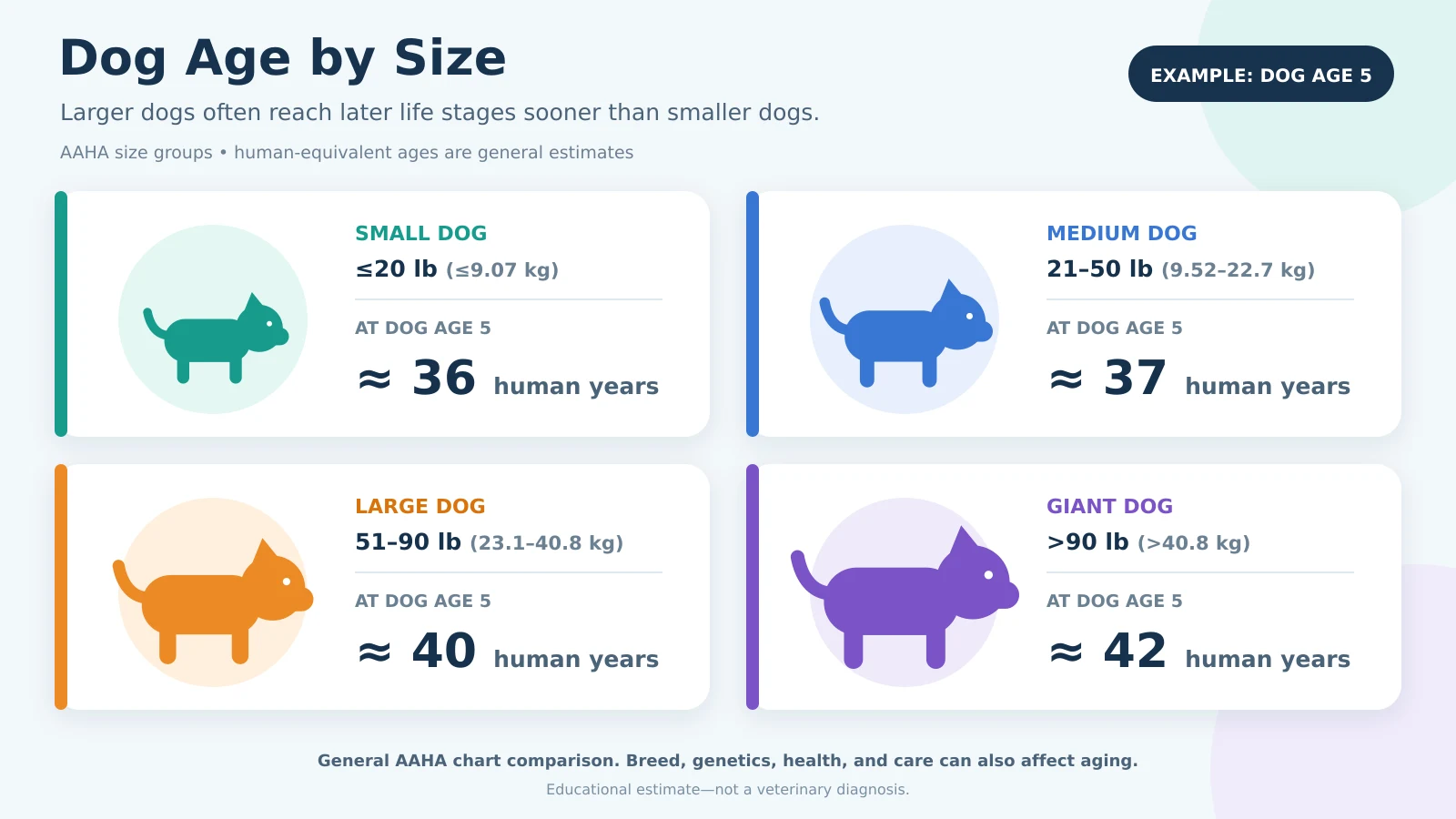
Dog Age Calculator Size Categories
Use expected healthy adult weight for a puppy and current healthy size for an adult. A breed label alone can be misleading for mixed-breed dogs. If a dog sits near a category boundary, compare both estimates and treat them as a range.
Reading the age estimate
The human-years result is an analogy, not a biological measurement. Its best use is explaining life stage—puppy, young adult, mature adult or senior—and prompting age-appropriate conversations about activity, nutrition and veterinary screening.
Example: two dogs of the same calendar age
A small dog and a giant dog may receive similar early-life estimates but different later-life equivalents. That does not predict either animal’s lifespan. It shows why size becomes a more important part of the model as age increases.
What the calculator cannot know
- Breed-specific longevity and inherited disease.
- Past illness, dental health, body condition or mobility.
- Quality of nutrition, preventive care and environment.
- The exact point at which an individual dog becomes senior.
Use life stage, not the number alone
Veterinary needs depend on the individual animal. A calculator cannot diagnose pain, cognitive change or disease. New thirst, weight change, breathing difficulty, collapse, persistent vomiting or major behavior changes warrant veterinary attention regardless of the displayed age.
Puppy development needs more than a human-years number
During the first year, puppies pass through rapid physical, social and behavioral stages. Vaccination timing, socialization, growth-plate development and reproductive maturity do not map neatly to a human-age analogy. Enter months accurately for a young dog, but use the result only as a broad explanation of maturity. Breed, projected adult size and individual development are more useful for decisions about exercise, diet and preventive care.
Recognizing the transition to senior care
Large and giant dogs often reach later life stages earlier than small dogs, which is why the selected size group affects older-age estimates. “Senior” does not mean that disease is inevitable. It is a prompt to watch mobility, dental comfort, body condition, hearing, vision and behavior more closely and to discuss screening frequency with a veterinarian. A lively older dog and a chronically ill younger dog still need individualized plans.
Mixed breeds and dogs near a weight boundary
For a mixed-breed dog, use a healthy adult weight rather than choosing the size of the best-known breed in the mix. If the adult weight is unknown, a veterinary growth assessment can provide a better estimate. When a dog falls close to two categories, calculate both and treat the span as uncertainty rather than forcing false precision. Body weight is only a practical proxy; genetics and body condition also influence aging.
Use the result for better observations
- Keep annual notes on weight, appetite, activity and mobility.
- Record new stiffness, confusion, house-soiling or sleep changes.
- Review food portions when growth or activity changes.
- Ask which preventive tests suit the dog’s breed, size and history.
- Seek prompt care for collapse, breathing difficulty, repeated vomiting or sudden weakness.
The human-equivalent age is best used as a conversation starter. It cannot determine a dog’s exact biological age, predict lifespan or replace a physical examination. For adoption records with an uncertain birth date, a veterinarian may estimate age from teeth, eyes, coat and overall development, but even that estimate has a range.
The American Veterinary Medical Association senior-pet guide explains why age-related care should be individualized.
dog age calculator FAQs
Is one dog year equal to seven human years?
No. It is a memorable shortcut, but it ignores fast early development and later differences among sizes.
Which weight should I use for a puppy?
Use the expected adult-size category when known. Ask a veterinarian if breed mix or growth makes that uncertain.
Can this calculator predict lifespan?
No. It estimates an age equivalent, not life expectancy or future health.
For related pet planning, compare the Cat Age Calculator or review the dog medication safety guide only with veterinary direction.