Ideal Gas Law Calculator
Results
Use this Ideal Gas Law Calculator to solve pressure, volume, amount of gas, or temperature using the standard equation PV = nRT. It is useful for chemistry homework, physics problems, gas-law conversions, and quick checks when you know any three of the four ideal-gas variables.
Reviewed by: AjaxCalculators Editorial Team
Last updated: May 2, 2026
Method source: Standard ideal gas law using PV = nRT with compatible gas-constant and unit-system selection
Editorial standards: AjaxCalculators Editorial Policy
What This Ideal Gas Law Calculator Calculates
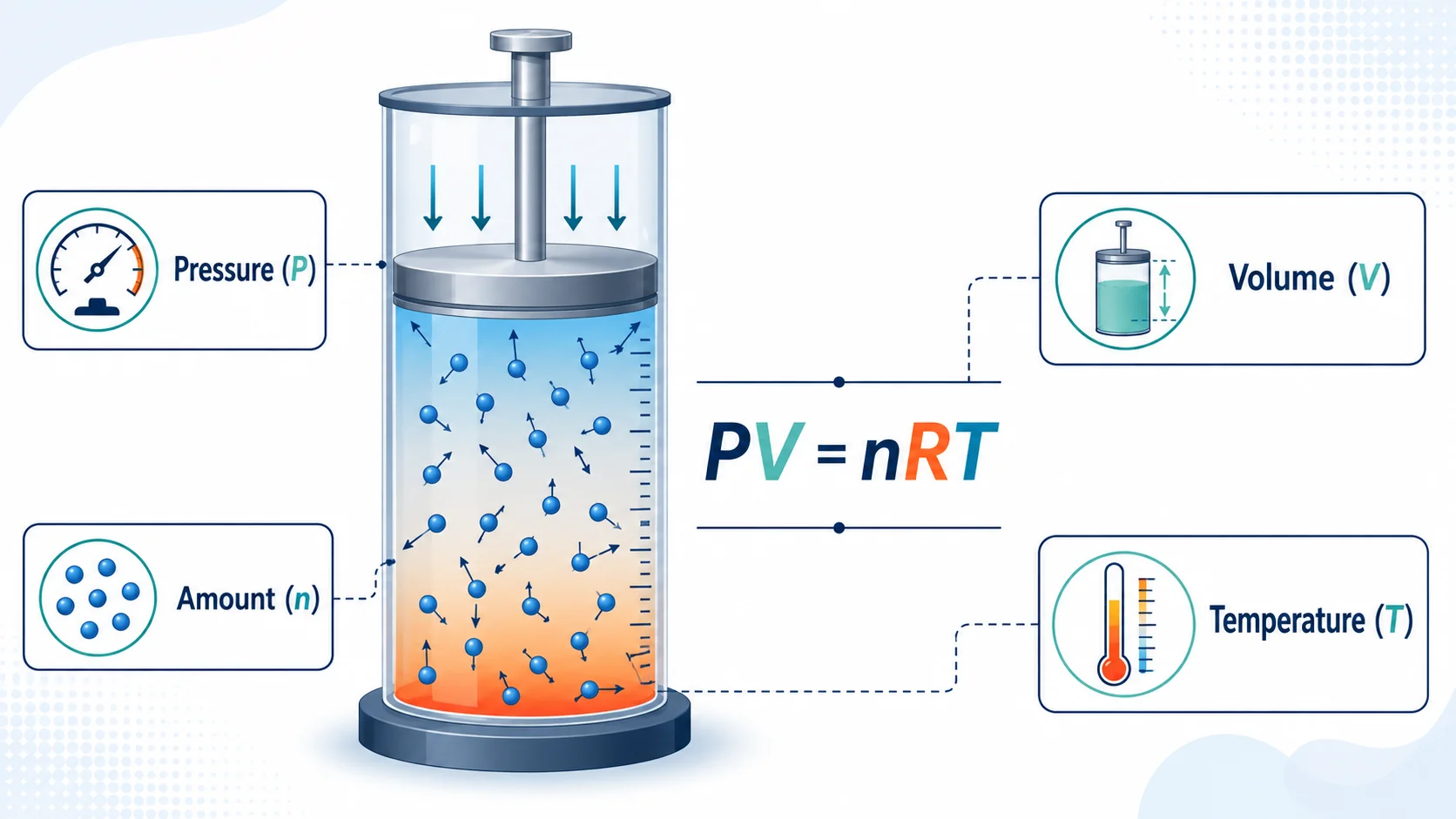
This calculator solves for one unknown in the ideal gas law when the other three values are known. The four main variables are:
- Pressure (P): the force per unit area exerted by the gas
- Volume (V): the space occupied by the gas
- Amount of gas (n): the number of moles of gas
- Temperature (T): the absolute temperature of the gas
You can leave one field blank and enter the other three values to solve for the missing variable. For example, you can solve for pressure from volume, moles, and temperature, or solve for moles from pressure, volume, and temperature.
What the Ideal Gas Law Means
The ideal gas law relates the pressure, volume, amount, and temperature of an ideal gas. It combines several simpler gas laws into one equation:
PV = nRT
The equation is based on an idealized model of gas behavior. In that model, gas particles are assumed to have negligible individual volume and negligible attraction or repulsion between particles.
This ideal model is often accurate enough for classroom chemistry and physics problems, especially when gases are at relatively low pressure and high temperature. However, real gases can deviate from the ideal model when pressure is high, temperature is low, or the gas is close to condensing.
How the Ideal Gas Law Calculator Works
The calculator starts with the ideal gas law:
PV = nRT
In this formula:
- P = pressure
- V = volume
- n = amount of gas in moles
- R = ideal gas constant
- T = absolute temperature in kelvin
The calculator rearranges the equation depending on which value is missing. Because the ideal gas constant has units, the pressure, volume, and temperature units must be compatible with the selected gas-constant system.
Formula Summary
| Unknown Variable | Rearranged Formula | Known Values Needed |
|---|---|---|
| Pressure | P = nRT / V | Moles, gas constant, temperature, and volume |
| Volume | V = nRT / P | Moles, gas constant, temperature, and pressure |
| Moles | n = PV / RT | Pressure, volume, gas constant, and temperature |
| Temperature | T = PV / nR | Pressure, volume, moles, and gas constant |
Common Gas Constant Values
The gas constant R must match the unit system used for pressure and volume. The calculator may handle conversions internally, but it is still important to understand why different R values appear in gas-law problems.
| Gas Constant Value | Common Units | Best Used With |
|---|---|---|
| 8.314462618 | J·mol-1·K-1 | SI-style calculations using pascals and cubic meters |
| 8.314462618 | kPa·L·mol-1·K-1 | kPa and liters, since 1 kPa·L = 1 J |
| 0.082057366 | L·atm·mol-1·K-1 | Liters and atmospheres |
| 62.3637 | L·torr·mol-1·K-1 | Liters and torr |
If a gas-law result seems far too large or too small, the gas constant and unit selections are often the first things to check.
Temperature Must Be Absolute
Gas-law calculations require absolute temperature. In SI-style chemistry and physics calculations, this means temperature must be in kelvin internally.
| Temperature Input | Conversion to Kelvin | Important Note |
|---|---|---|
| Celsius | K = °C + 273.15 | 0 °C = 273.15 K |
| Fahrenheit | K = (°F − 32) × 5/9 + 273.15 | Used when Fahrenheit input is supported |
| Kelvin | K = K | Already absolute temperature |
The calculator can accept Celsius or Fahrenheit only if those values convert to a temperature above absolute zero. A temperature at or below 0 K is not physically valid for an ideal gas-law calculation.
Pressure and Volume Unit Notes
Pressure and volume must be paired with the correct gas constant. The calculator may convert units automatically, but the physical equation still requires consistency.
| Pressure Unit | Volume Unit | Common Matching R Form |
|---|---|---|
| Pa | m³ | 8.314462618 J·mol-1·K-1 |
| kPa | L | 8.314462618 kPa·L·mol-1·K-1 |
| atm | L | 0.082057366 L·atm·mol-1·K-1 |
| torr | L | 62.3637 L·torr·mol-1·K-1 |
Using mismatched units is one of the most common reasons for incorrect ideal-gas-law results.
Worked Example: Solve for Moles
Suppose a gas has:
- Pressure: 2.00 atm
- Volume: 5.00 L
- Temperature: 300 K
We want to solve for n, the amount of gas in moles.
Step 1: Start with the ideal gas law
PV = nRT
Step 2: Rearrange for moles
n = PV / RT
Step 3: Choose the matching gas constant
Because pressure is in atm and volume is in L, use:
R = 0.082057366 L·atm·mol-1·K-1
Step 4: Substitute values
n = (2.00 × 5.00) / (0.082057366 × 300)
Step 5: Calculate
n = 10.00 / 24.6172098
n ≈ 0.406 mol
Result: A 5.00 L gas sample at 2.00 atm and 300 K contains about 0.406 moles of gas under the ideal-gas model.
Worked Example: Solve for Pressure
Suppose a container has:
- Moles: 1.25 mol
- Volume: 10.0 L
- Temperature: 298 K
We want to solve for pressure in atm.
Step 1: Rearrange the formula
P = nRT / V
Step 2: Use the L·atm gas constant
R = 0.082057366 L·atm·mol-1·K-1
Step 3: Substitute values
P = (1.25 × 0.082057366 × 298) / 10.0
Step 4: Calculate
P ≈ 3.06 atm
Result: The ideal-gas pressure is about 3.06 atm.
Worked Example: Solve for Volume
Suppose a gas has:
- Moles: 0.750 mol
- Pressure: 101.325 kPa
- Temperature: 273.15 K
We want to solve for volume in liters.
Step 1: Rearrange the formula
V = nRT / P
Step 2: Use the kPa·L gas constant
R = 8.314462618 kPa·L·mol-1·K-1
Step 3: Substitute values
V = (0.750 × 8.314462618 × 273.15) / 101.325
Step 4: Calculate
V ≈ 16.81 L
Result: The gas occupies about 16.81 liters under the ideal-gas model.
Worked Example: Solve for Temperature
Suppose a gas has:
- Pressure: 1.50 atm
- Volume: 8.00 L
- Moles: 0.500 mol
We want to solve for temperature.
Step 1: Rearrange the formula
T = PV / nR
Step 2: Use the L·atm gas constant
R = 0.082057366 L·atm·mol-1·K-1
Step 3: Substitute values
T = (1.50 × 8.00) / (0.500 × 0.082057366)
Step 4: Calculate
T ≈ 292.48 K
Step 5: Convert to Celsius if needed
°C = K − 273.15
°C = 292.48 − 273.15 ≈ 19.33 °C
Result: The ideal-gas temperature is about 292.48 K, or about 19.33 °C.
How to Use This Ideal Gas Law Calculator
- Decide which variable you want to solve: pressure, volume, moles, or temperature.
- Enter any three of the four variables.
- Leave the unknown field blank if the calculator is designed to solve the blank field automatically.
- Select the correct unit for pressure.
- Select the correct unit for volume.
- Select the correct unit for temperature.
- Choose the gas constant system that matches the pressure and volume units if the calculator provides that option.
- Click Calculate if the tool requires it.
- Review the solved result and check whether the result is physically reasonable.
How to Interpret the Result
Your result gives the missing thermodynamic variable for an ideal-gas model.
| Solved Variable | Meaning of the Result | What to Check |
|---|---|---|
| Pressure | The pressure needed for the gas state entered | Check pressure unit and volume unit consistency |
| Volume | The space occupied by the gas | Check whether the result is realistic for the amount of gas |
| Moles | The amount of gas present | Check whether pressure and volume were entered in compatible units |
| Temperature | The absolute temperature required for the gas state | Check that the result is above 0 K |
If the result seems unrealistic, check the unit selections first, especially pressure, volume, and temperature.
Ideal Gas Law Relationships
The ideal gas law shows how pressure, volume, amount, and temperature are connected. When one variable changes, another variable may need to change to keep the equation balanced.
| When This Increases | And These Stay Constant | Expected Ideal-Gas Effect |
|---|---|---|
| Temperature | Volume and moles | Pressure increases |
| Temperature | Pressure and moles | Volume increases |
| Volume | Temperature and moles | Pressure decreases |
| Moles | Temperature and volume | Pressure increases |
| Moles | Temperature and pressure | Volume increases |
Ideal Gas Law vs Combined Gas Law
The ideal gas law and combined gas law are related, but they are used in different situations.
| Law | Formula | Best Used For |
|---|---|---|
| Ideal gas law | PV = nRT | Solving for P, V, n, or T when three values are known |
| Combined gas law | P1V1 / T1 = P2V2 / T2 | Comparing two gas states when amount of gas stays constant |
Use the ideal gas law when moles are part of the calculation. Use the combined gas law when the same gas sample changes pressure, volume, or temperature but the amount of gas remains constant.
Ideal Gas Law vs Real Gas Behavior
The ideal gas law is an approximation. It works best when gas particles are far apart and intermolecular attractions are small enough to ignore.
| Condition | Ideal Gas Law Accuracy | Why It Matters |
|---|---|---|
| Low pressure | Usually better | Gas particles are farther apart, so particle volume and attractions matter less |
| High temperature | Usually better | Particles have more kinetic energy and are less affected by attractions |
| High pressure | Often worse | Gas particles are closer together, so particle volume becomes more important |
| Low temperature | Often worse | Intermolecular attractions become more important |
| Near condensation | Often poor | The gas may no longer behave like an ideal gas |
For non-ideal gases, equations such as the van der Waals equation or other real-gas models may be more appropriate.
When This Calculator Is Useful
This calculator is useful when you need a quick ideal-gas estimate and the assumptions match the problem.
- Chemistry homework and exam practice
- Physics gas-law problems
- Solving for pressure, volume, moles, or temperature
- Checking unit conversions in gas-law problems
- Estimating moles of gas in a container
- Comparing gas behavior under different pressure, volume, or temperature conditions
- Learning how pressure, volume, amount, and temperature are related
When You May Need More Than This Calculator
A simple ideal gas law calculator may not be enough when real-gas behavior, safety, or high precision matters.
Use a more detailed method when working with:
- very high gas pressure
- very low gas temperature
- compressed gas cylinders
- cryogenic gases
- gas near condensation or liquefaction
- industrial gas systems
- reactor or process engineering calculations
- laboratory-grade thermodynamic analysis
- real-gas equations of state
- safety-critical pressure vessels or containers
Common Mistakes to Avoid
- Using Celsius directly in PV = nRT: temperature must be absolute temperature in kelvin internally.
- Using the wrong gas constant: R must match the pressure and volume units.
- Mixing atm with pascals: pressure units must be converted before using a specific R value.
- Mixing liters with cubic meters: volume units must match the selected equation setup.
- Entering all four variables: many calculators expect one unknown field to be blank.
- Leaving more than one variable unknown: PV = nRT can solve one missing value when the other three are known.
- Ignoring real-gas behavior: high pressure and low temperature can make the ideal model inaccurate.
- Using gauge pressure instead of absolute pressure: gas-law calculations generally require absolute pressure.
- Accepting impossible temperatures: solved temperature must be above 0 K.
Absolute Pressure vs Gauge Pressure
Gas-law calculations generally use absolute pressure. Absolute pressure is measured relative to a complete vacuum. Gauge pressure is measured relative to atmospheric pressure.
| Pressure Type | Meaning | Gas-Law Note |
|---|---|---|
| Absolute pressure | Pressure relative to vacuum | Usually required for PV = nRT |
| Gauge pressure | Pressure relative to local atmosphere | Must often be converted to absolute pressure |
| Atmospheric pressure | Pressure of the surrounding air | Added to gauge pressure to estimate absolute pressure |
For example, if a gauge reads 2 atm above atmospheric pressure, the absolute pressure is not 2 atm; it is approximately 3 atm if local atmospheric pressure is about 1 atm.
Important Assumptions and Limitations
- This calculator uses the ideal gas law, PV = nRT.
- It assumes ideal gas behavior.
- It solves one unknown when the other three variables are known.
- Temperature is handled as absolute temperature in kelvin internally.
- Pressure should be absolute pressure for gas-law calculations.
- The selected gas constant must match the pressure and volume unit system.
- The calculator does not model real-gas deviations, condensation, chemical reactions, leaks, or changing gas composition.
- The calculator does not replace laboratory measurement, real-gas equations of state, pressure-vessel design, or industrial thermodynamic analysis.
Practical Uses of an Ideal Gas Law Calculator
- Solve for gas pressure from volume, moles, and temperature
- Solve for gas volume from pressure, moles, and temperature
- Find moles of gas in a container
- Find ideal-gas temperature from pressure, volume, and moles
- Check chemistry homework setups
- Convert between gas-law unit systems
- Understand how gas variables relate to each other
- Estimate simple gas states before using more advanced methods
References
- OpenStax Chemistry 2e: Relating Pressure, Volume, Amount, and Temperature — The Ideal Gas Law
- OpenStax Chemistry 2e: Non-Ideal Gas Behavior
- Chemistry LibreTexts: The Ideal Gas Law
- NIST CODATA: Molar Gas Constant
Related Calculators
- Pressure Calculator
- Density / Mass / Volume Calculator
- Temperature Converter
- Volume Calculator
- mcg to IU Converter
Frequently Asked Questions
What is the ideal gas law formula?
The ideal gas law formula is PV = nRT, where P is pressure, V is volume, n is moles, R is the gas constant, and T is absolute temperature.
What can this Ideal Gas Law Calculator solve?
It can solve for pressure, volume, moles, or temperature when the other three values are known.
What does R mean in PV = nRT?
R is the ideal gas constant. Its numerical value depends on the pressure and volume units used in the calculation.
Why must temperature be in kelvin?
Gas-law calculations require absolute temperature. Kelvin starts at absolute zero, so it works correctly in proportional gas-law relationships.
Can I use Celsius in the calculator?
The calculator may accept Celsius as an input unit, but it must convert Celsius to kelvin internally before applying PV = nRT.
Can I use Fahrenheit in the calculator?
If Fahrenheit input is supported, the value must be converted to kelvin internally before the ideal gas law is applied.
Should I use absolute pressure or gauge pressure?
Ideal gas law calculations generally require absolute pressure. Gauge pressure may need to be converted by adding atmospheric pressure.
What happens if I use the wrong gas constant?
Using the wrong gas constant can produce a result that is off by a large factor. Always match R to the pressure and volume units.
When does the ideal gas law work best?
The ideal gas law works best when gases are at relatively low pressure and high temperature, where particle volume and intermolecular attractions are less important.
When does the ideal gas law become less accurate?
It becomes less accurate at high pressure, low temperature, near condensation, or when real-gas particle volume and attractions become important.
Can this calculator be used for compressed gas cylinders?
It can provide a rough educational estimate, but compressed gas cylinders often require real-gas behavior, safety standards, and professional engineering methods.
Does this calculator handle real-gas equations?
No. This calculator uses the ideal gas law only. Real-gas equations such as the van der Waals equation or other equations of state are not included unless specifically stated by the tool.
Disclaimer: This Ideal Gas Law Calculator provides educational estimates using the ideal gas equation PV = nRT. It assumes the gas behaves ideally, meaning gas particles are treated as having negligible volume and negligible intermolecular attraction. The result depends on the pressure, volume, amount of gas, temperature, unit selections, and gas constant system entered. Temperature must be handled as absolute temperature in kelvin internally, so Celsius or Fahrenheit inputs must convert to a value above 0 K. The ideal gas law works best at relatively low pressures and high temperatures. Real gases can deviate from ideal behavior at high pressure, low temperature, near condensation, or when molecular attractions and particle volume become important. Use this calculator for chemistry homework, physics practice, and general gas-law checks, and use real-gas equations, laboratory data, or professional thermodynamic analysis for compressed gases, cryogenic conditions, industrial systems, safety-critical containers, or precision gas behavior.