
Cat Age Calculator
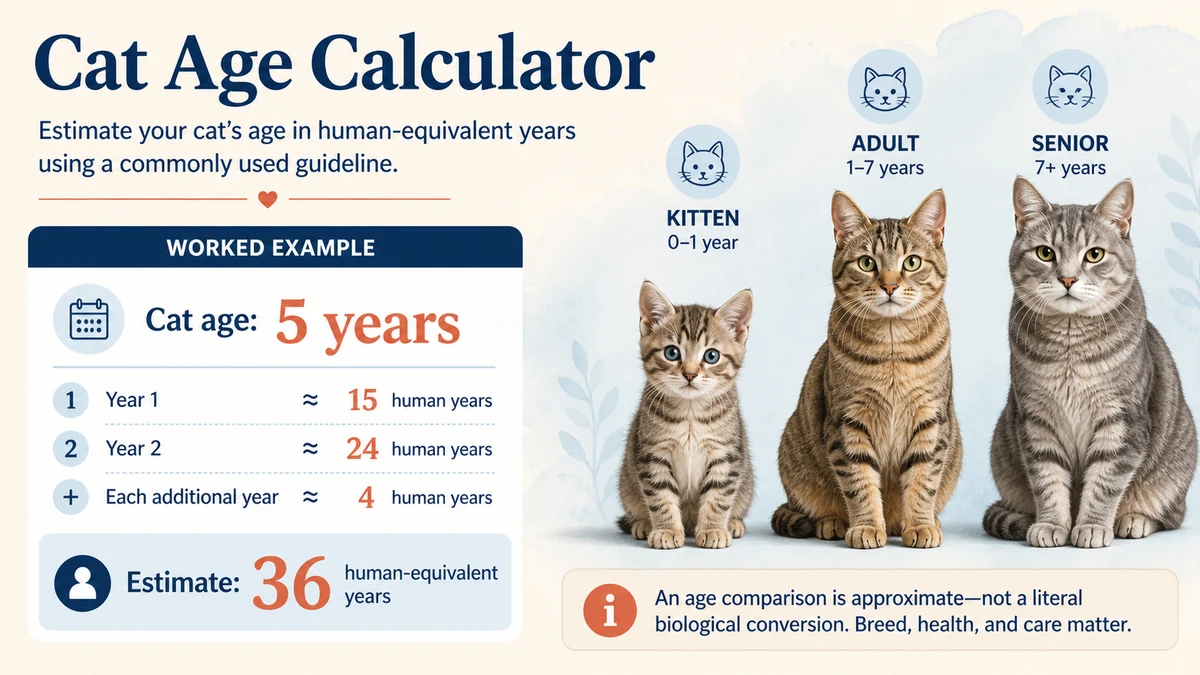
Convert your cat’s age into an approximate human-equivalent age using the common 15 / 24 / +4 cat age chart.
Results
Formula Used
—
Care Note
—
This result is an estimate only. Cat aging varies by genetics, indoor/outdoor lifestyle, nutrition, body condition, dental health, chronic disease, and veterinary care.
Cat Age Chart Used
| Cat Age | Estimated Human-Equivalent Age |
|---|---|
| 1 year | 15 years |
| 2 years | 24 years |
| After 2 years | Add about 4 human years per additional cat year |
Cats race through early development: a one-year-old cat is already far beyond the equivalent stage of a one-year-old child. The Cat Age Calculator converts your cat’s years, months and days into an approximate human-equivalent age using a staged method that gives greater weight to the first two feline years.
The result also provides a general feline life stage. It can help put your cat’s age into familiar terms, but it cannot measure biological aging, diagnose illness or predict how long an individual cat will live.
How the Cat Age Calculator Works
The conversion follows the commonly used 15 / 24 / +4 guideline:
- The first cat year corresponds to approximately 15 human years.
- The second cat year brings the total to approximately 24 human years.
- Every complete cat year after age two adds approximately four human years.
For cats older than two years, the main formula is:
Human-equivalent age = 24 + 4 × (cat age − 2)
The calculator converts additional months into fractions of a year by dividing by 12. Days are converted using 365.25 days per year. Fractional ages are then evaluated within the appropriate stage of the conversion.
This staged approach reflects how quickly cats mature early in life. It is more useful for a general comparison than multiplying every cat year by one fixed number.
How to Calculate Your Cat’s Human-Equivalent Age
- Enter your cat’s complete age in years.
- Add any extra completed months.
- Enter additional days when you know the exact birth or adoption date.
- Select Calculate.
- Review the entered feline age, human-equivalent estimate and life stage.
- Read the formula and care note generated with the result.
- Select Reset before entering a different age.
If the exact birthday is unknown, enter the best age estimate available from adoption records or a veterinary assessment. The result can only be as precise as the age entered.
Cat Years to Human Years Chart
| Cat age | Approximate human-equivalent age |
|---|---|
| 1 year | 15 years |
| 2 years | 24 years |
| 3 years | 28 years |
| 4 years | 32 years |
| 5 years | 36 years |
| 6 years | 40 years |
| 7 years | 44 years |
| 8 years | 48 years |
| 10 years | 56 years |
| 12 years | 64 years |
| 15 years | 76 years |
| 18 years | 88 years |
| 20 years | 96 years |
These figures are comparisons produced by the conversion method, not clinical measurements. Two cats of the same calendar age can have different health, mobility, body condition and care needs.
Worked Cat-Age Example
Suppose a cat is 6 years and 3 months old.
First, convert three months into a fraction of a year:
3 ÷ 12 = 0.25 year
The cat’s total age is therefore 6.25 years. Because the cat is older than two:
Human-equivalent age = 24 + 4 × (6.25 − 2)
Human-equivalent age = 24 + 4 × 4.25
Human-equivalent age = 41 years
A cat aged 6 years and 3 months is approximately 41 human years by this guideline and falls near the end of the young-adult feline stage.
Understanding Feline Life Stages
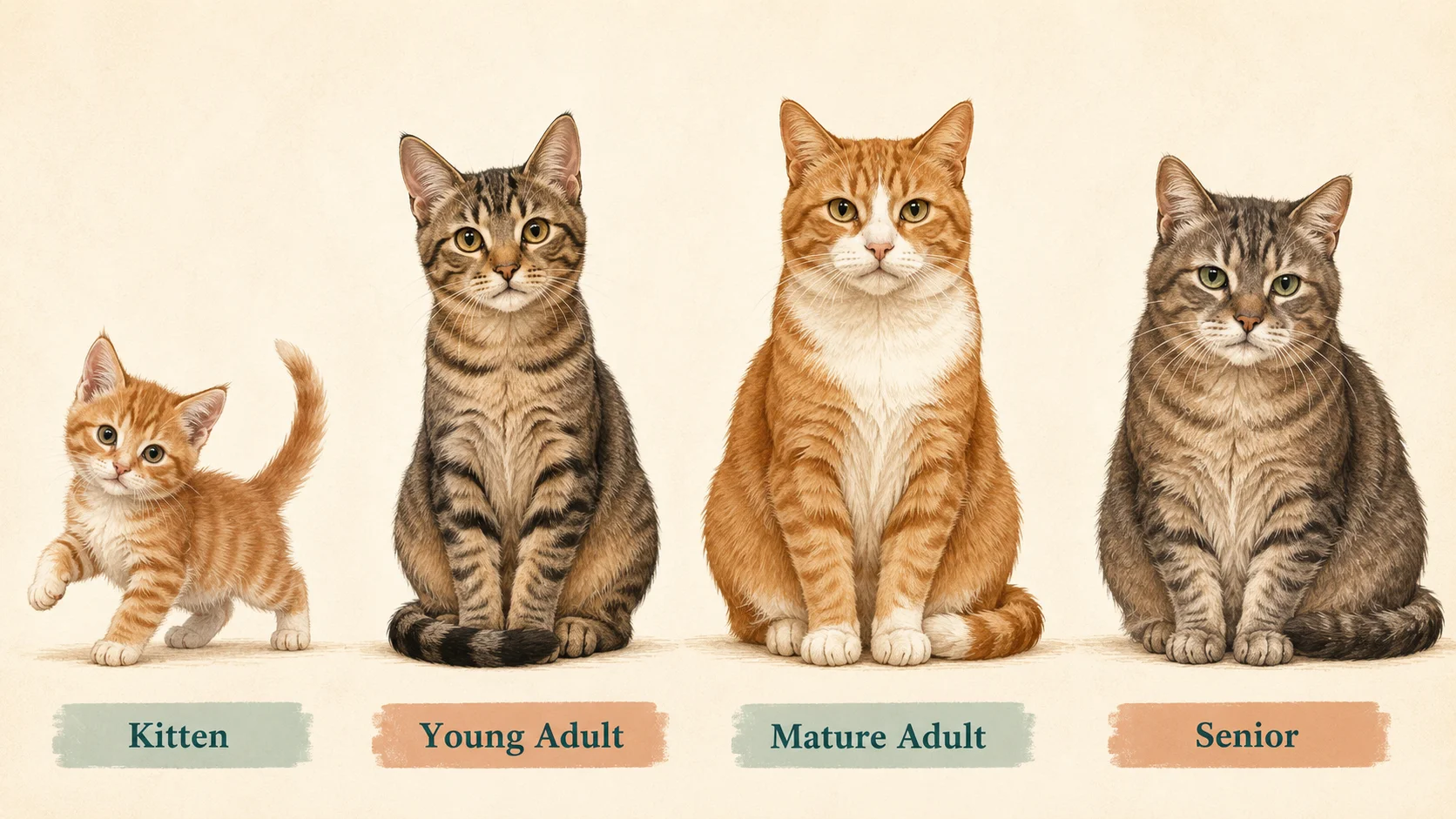
The AAHA/AAFP feline guidelines organize cats into four age-related stages, plus a separate end-of-life stage that can occur at any age.
| Life stage | General age range | Broad care focus |
|---|---|---|
| Kitten | Birth to 1 year | Growth, socialization, nutrition, vaccination and parasite prevention |
| Young adult | 1–6 years | Healthy weight, activity, dental care and preventive health |
| Mature adult | 7–10 years | Monitoring weight, muscle condition, mobility and age-associated changes |
| Senior | Older than 10 years | Closer observation for changes in appetite, comfort, behaviour and daily routines |
These boundaries provide a framework for age-appropriate discussions rather than a judgment about an individual cat’s condition. A healthy senior cat may remain active, while a younger cat may have medical needs requiring individualized care.
Why One Cat Year Does Not Equal Seven Human Years
The seven-year rule assumes steady aging from birth onward. Cats do not develop at a steady human-equivalent rate: their first year includes rapid physical and behavioural maturation, and their second year adds another substantial developmental period.
After age two, adding approximately four human years for each cat year produces a more gradual comparison. Even so, no mathematical conversion can reproduce the biological aging of every cat.
What Can Affect How a Cat Ages?
- Genetics and inherited health risks
- Indoor, outdoor or mixed lifestyle
- Nutrition, activity and body condition
- Dental health
- Chronic disease or previous injury
- Preventive care and veterinary monitoring
- Home environment, stress and enrichment
The human-equivalent number does not account for these factors. Base healthcare decisions on the cat’s actual age, history, lifestyle, examination findings and veterinary recommendations.
When to Contact a Veterinarian
Arrange veterinary advice when you notice persistent or unexplained changes in appetite, drinking, body weight, grooming, mobility, breathing, behaviour, sleep or litter-box habits. Do not assume that a new symptom is simply normal aging.
If a cat repeatedly strains in the litter box but produces little or no urine—particularly a male cat—seek urgent veterinary attention.
Assumptions and Limitations
- The conversion uses a general 15 / 24 / +4 guideline.
- Human-equivalent age is an analogy, not biological age.
- The calculator does not account for breed, lifestyle, health history or body condition.
- A known or estimated calendar age must be entered; the tool cannot determine an unknown cat’s age from appearance.
- The life-stage result is broad and may not describe an individual cat’s health needs.
- The result cannot diagnose illness, assess pain or predict lifespan.
Frequently Asked Questions
How old is a one-year-old cat in human years?
A one-year-old cat is approximately 15 human years according to the conversion used here.
How old is a two-year-old cat in human years?
A two-year-old cat corresponds to approximately 24 human years. Each later cat year adds about four human years.
What is a ten-year-old cat in human years?
The formula gives approximately 56 human years: 24 + 4 × (10 − 2) = 56.
Do indoor and outdoor cats convert differently?
The mathematical conversion is the same. However, lifestyle can affect disease exposure, injury risk, health and longevity, so the result does not predict how an individual cat will age.
Can this calculator determine the age of a rescued cat?
No. It converts an age you already know or estimate. A veterinarian may approximate an unknown age using teeth, eyes, coat, muscle condition and other findings, but the result may still be a range.
Does human-equivalent age tell me whether my cat is healthy?
No. Health cannot be determined from an age conversion. Veterinary assessment should consider symptoms, examination findings, medical history and appropriate testing.
Related Pet Calculators
- Dog Age Calculator – compare dog years with human years using several conversion methods.
- Hamster Age Calculator – estimate hamster age in human-equivalent years.
- Bird Age Calculator – compare bird age with human age by species or expected lifespan.
References
- International Cat Care – How to Tell Your Cat’s Age in Human Years
- Feline Veterinary Medical Association – AAHA/AAFP Feline Life Stage Guidelines
- AAHA – Feline Life Stage Guidelines Executive Summary
Cat Age Is Better Understood by Life Stage
Cat-to-human age comparisons are approximate because kittens mature rapidly and later years do not follow one constant multiplier. Breed, indoor or outdoor lifestyle, nutrition, weight, dental health, and disease influence aging. Use the estimate to understand life stage and preventive-care needs, then follow a veterinarian’s advice for examinations, vaccination, nutrition, and senior screening.