Enter values and click Calculate.
n = m / Mrc = m / VM = n / V = m / (Mr × V)
Use this Molarity Calculator to calculate moles, mass concentration, and molarity from solute mass, molar mass, and solution volume. Enter the mass of solute, its molar mass, and the final solution volume to find the number of moles and the molar concentration in mol/L.
Important Note: This Molarity Calculator provides educational chemistry calculations from solute mass, molar mass, and final solution volume. It calculates moles, mass concentration, and molarity using standard concentration formulas.
Molarity is based on the final volume of the solution, not simply the amount of solvent added. For accurate lab preparation, the volume should represent the final solution volume after the solute is dissolved and the solution is made up to the target volume.
This calculator does not identify unknown chemicals, calculate molar mass from a formula, account for temperature, density, nonideal solution behavior, activity coefficients, purity, hydrates, or lab measurement uncertainty. Follow your lab protocol, chemical safety guidance, and instructor or professional instructions when preparing real solutions.
Reviewed by: AjaxCalculators Editorial Team
Last updated: April 29, 2026
Method source: Standard chemistry concentration formulas using n = m / Mr, c = m / V, and M = n / V
Editorial standards: AjaxCalculators Editorial Policy
What This Molarity Calculator Calculates
This calculator finds the molarity of a solution from solute mass, molar mass, and solution volume. It also calculates the number of moles and the mass concentration of the solute.
The calculator can calculate:
- Moles of solute
- Mass concentration
- Molarity
- Molar concentration in mol/L
- Step-by-step derivation
The live tool uses three main inputs: mass, molar mass, and volume. It then reports moles, mass concentration, and molarity.
What Molarity Means
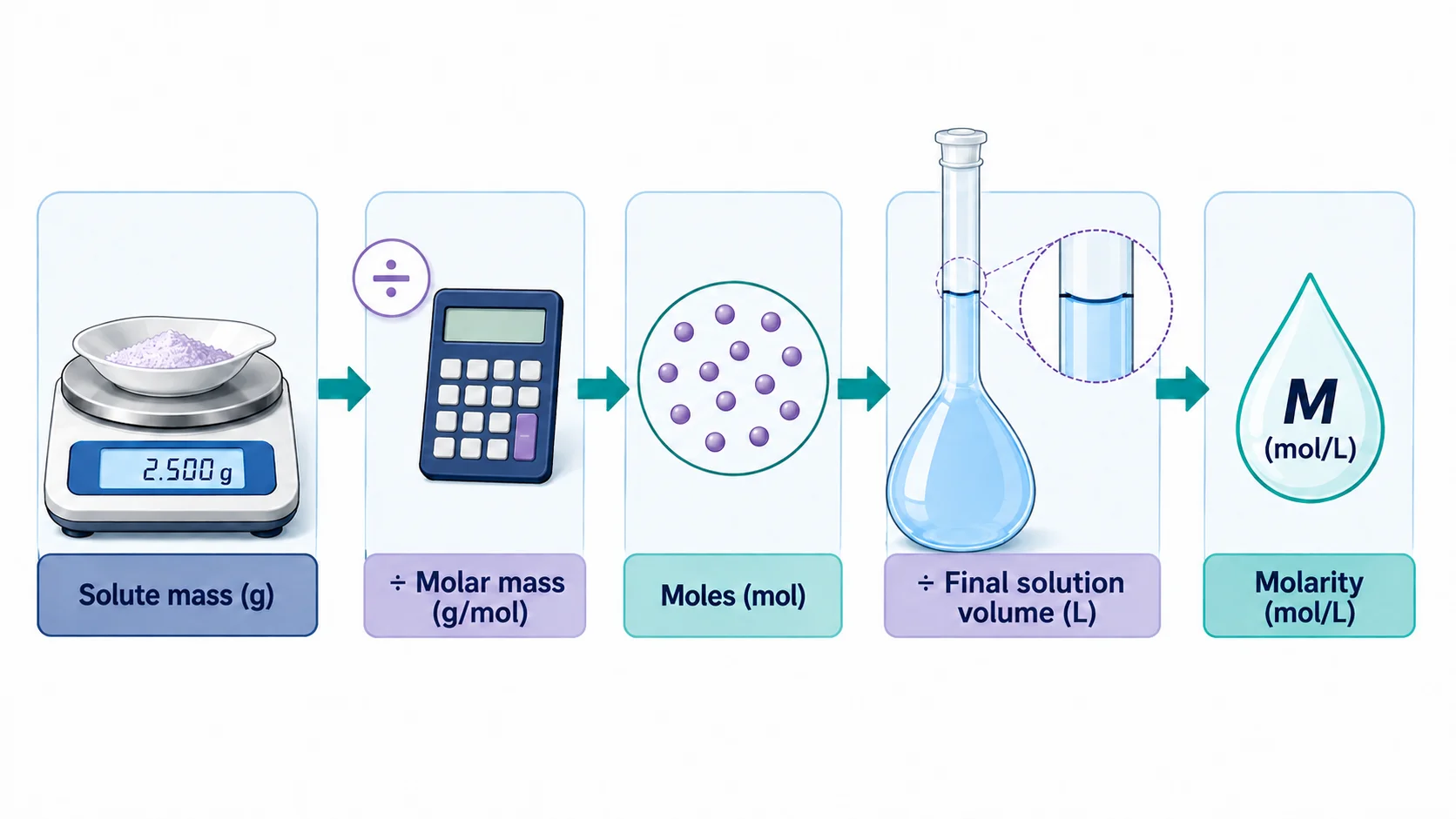
Molarity, written as M, is the number of moles of solute per liter of solution.
Molarity = moles of solute ÷ liters of solution
Using symbols:
M = n / V
In this formula:
- M is molarity in mol/L
- n is moles of solute
- V is solution volume in liters
For example, a solution containing 1 mole of solute in 1 liter of final solution has a molarity of 1 M.
Important: Use Final Solution Volume
Molarity uses liters of solution, not just liters of solvent. This means the volume should represent the final prepared solution volume whenever accuracy matters.
For example, if a lab procedure says to dissolve a solute and dilute to a final volume of 1.000 L, the volume used in the molarity formula is 1.000 L. It is not necessarily the amount of water added before the solute dissolved.
How the Molarity Calculator Works
1) Convert Mass to Moles
The calculator first converts solute mass into moles using molar mass.
Moles = mass ÷ molar mass
Using symbols:
n = m / Mr
In this formula:
- n is moles of solute
- m is solute mass in grams
- Mr is molar mass in g/mol
2) Calculate Mass Concentration
The calculator also finds mass concentration by dividing mass by volume.
Mass concentration = mass ÷ volume
Using symbols:
c = m / V
If mass is entered in grams and volume is entered in liters, the mass concentration is in g/L.
3) Calculate Molarity
After moles are known, molarity is calculated by dividing moles by solution volume.
Molarity = moles ÷ volume
Using symbols:
M = n / V
Because n = m / Mr, the combined formula is:
M = m / (Mr × V)
Molarity Formula Summary
| What You Want to Find | Formula | Meaning |
|---|---|---|
| Moles from mass | n = m / Mr | Solute mass divided by molar mass |
| Mass concentration | c = m / V | Solute mass divided by solution volume |
| Molarity from moles | M = n / V | Moles of solute divided by liters of solution |
| Molarity from mass, molar mass, and volume | M = m / (Mr × V) | Direct formula when mass, molar mass, and volume are known |
| Mass from target molarity | m = M × Mr × V | Useful when preparing a target molar solution |
| Volume from mass and molarity | V = m / (M × Mr) | Useful when solving for required solution volume |
Worked Example: Calculate Molarity from Mass
Suppose you dissolve 58.44 g of sodium chloride in enough water to make 1 L of solution. The molar mass of sodium chloride is 58.44 g/mol.
Step 1: Calculate moles
n = m / Mr
n = 58.44 / 58.44
n = 1 mol
Step 2: Calculate molarity
M = n / V
M = 1 / 1
M = 1 M
So, 58.44 g of NaCl in 1 L of final solution gives a molarity of 1 M.
Worked Example: Calculate Moles and Molarity
Suppose a solution is prepared using:
- Mass: 10 g
- Molar mass: 50 g/mol
- Volume: 2 L
Step 1: Calculate moles
n = mass ÷ molar mass
n = 10 ÷ 50
n = 0.2 mol
Step 2: Calculate molarity
M = moles ÷ volume
M = 0.2 ÷ 2
M = 0.1 M
Step 3: Calculate mass concentration
c = mass ÷ volume
c = 10 ÷ 2
c = 5 g/L
So, the solution contains 0.2 mol of solute, has a mass concentration of 5 g/L, and has a molarity of 0.1 M.
Worked Example: Calculate Molarity of Glucose Solution
Suppose you dissolve 18.0 g of glucose in enough water to make 0.500 L of solution. The molar mass of glucose is about 180.16 g/mol.
Step 1: Convert mass to moles
n = 18.0 ÷ 180.16
n ≈ 0.0999 mol
Step 2: Divide by solution volume
M = 0.0999 ÷ 0.500
M ≈ 0.200 M
So, 18.0 g of glucose in 0.500 L of solution is approximately 0.200 M.
Worked Example: Calculate Mass Concentration
Suppose a solution contains 25 g of solute in 0.500 L of solution.
Step 1: Use the mass concentration formula
c = m / V
Step 2: Substitute the values
c = 25 / 0.500
Step 3: Calculate
c = 50 g/L
So, the mass concentration is 50 g/L.
Worked Example: Find Mass Needed for a Target Molarity
The live calculator focuses on finding molarity from mass, molar mass, and volume, but the same formula can be rearranged. Suppose you want to prepare 0.250 L of a 0.100 M solution using a solute with molar mass 58.44 g/mol.
Step 1: Use the rearranged formula
m = M × Mr × V
Step 2: Substitute the values
m = 0.100 × 58.44 × 0.250
Step 3: Calculate
m = 1.461 g
So, you would need about 1.46 g of solute to prepare 0.250 L of a 0.100 M solution, assuming the final solution volume is made up to 0.250 L.
How to Use This Molarity Calculator
- Enter the mass of solute in grams.
- Enter the molar mass of the solute in g/mol.
- Enter the volume of the final solution in liters.
- Click Calculate.
- Review the calculated moles, mass concentration, and molarity.
- Use the step-by-step section to check the formula path.
- Click Reset to clear the calculator and start again.
How to Interpret the Results
| Result | What It Means | Important Caution |
|---|---|---|
| Moles | The amount of solute in mol, calculated from mass and molar mass. | Only accurate if the entered molar mass matches the exact substance used. |
| Mass concentration | The amount of solute mass per liter of solution. | If mass is in grams and volume is in liters, the result is in g/L. |
| Molarity | The number of moles of solute per liter of final solution. | Use final solution volume, not just the amount of solvent added. |
| Step-by-step derivation | The formula path used to calculate moles, mass concentration, and molarity. | Check mass, molar mass, volume, and units before using the result in lab work. |
Moles, Molar Mass, and Molarity Explained
| Quantity | Symbol | Common Unit | Meaning |
|---|---|---|---|
| Mass | m | g | Amount of solute by mass |
| Molar mass | Mr | g/mol | Mass of one mole of the substance |
| Moles | n | mol | Amount of substance |
| Volume | V | L | Final solution volume |
| Molarity | M | mol/L | Moles of solute per liter of final solution |
Mass Concentration vs Molarity
Mass concentration and molarity both describe solution concentration, but they use different bases.
| Concentration Type | Formula | Common Unit | Depends on Molar Mass? |
|---|---|---|---|
| Mass concentration | c = m / V | g/L | No |
| Molarity | M = n / V | mol/L or M | Yes |
Two solutions can have the same mass concentration but different molarity if the solutes have different molar masses. Molarity depends on how many moles of solute are present, not only how many grams are present.
Why Molar Mass Matters
Molar mass converts grams into moles. Because molarity is based on moles, the same mass can produce different molarities depending on the substance.
For example, 10 g of a substance with molar mass 50 g/mol gives:
10 ÷ 50 = 0.2 mol
But 10 g of a substance with molar mass 200 g/mol gives:
10 ÷ 200 = 0.05 mol
If both are dissolved to the same final volume, the first solution has a higher molarity because it contains more moles of solute.
Common Molarity Unit Conversions
| Unit | Meaning | Relationship to M |
|---|---|---|
| M | Molar | 1 M = 1 mol/L |
| mM | Millimolar | 1 mM = 0.001 M |
| μM | Micromolar | 1 μM = 0.000001 M |
| nM | Nanomolar | 1 nM = 0.000000001 M |
| mol/L | Moles per liter | Same as M |
Common Volume Unit Conversions
| Volume Unit | Equivalent in Liters |
|---|---|
| 1 mL | 0.001 L |
| 100 mL | 0.100 L |
| 250 mL | 0.250 L |
| 500 mL | 0.500 L |
| 1000 mL | 1 L |
If your solution volume is measured in milliliters, convert it to liters before using the molarity formula manually.
Common Molarity Examples
| Mass | Molar Mass | Volume | Moles | Molarity |
|---|---|---|---|---|
| 58.44 g | 58.44 g/mol | 1 L | 1 mol | 1 M |
| 29.22 g | 58.44 g/mol | 1 L | 0.5 mol | 0.5 M |
| 5.844 g | 58.44 g/mol | 1 L | 0.1 mol | 0.1 M |
| 5.844 g | 58.44 g/mol | 0.5 L | 0.1 mol | 0.2 M |
| 10 g | 50 g/mol | 2 L | 0.2 mol | 0.1 M |
How to Find Molar Mass
Molar mass is usually found from the chemical formula. Add the atomic masses of all atoms in the formula.
For example, sodium chloride is NaCl:
- Na is about 22.99 g/mol
- Cl is about 35.45 g/mol
So:
Molar mass of NaCl ≈ 22.99 + 35.45 = 58.44 g/mol
For hydrates, ions, acids, and complex formulas, make sure the molar mass matches the exact substance used in the solution.
Preparing Solutions and Molarity
When preparing a molar solution in a lab, the usual workflow is:
- Calculate the required mass of solute.
- Weigh the solute accurately.
- Dissolve the solute in some solvent.
- Transfer to a volumetric flask or final container.
- Dilute to the final target solution volume.
- Mix thoroughly.
The final solution volume is the volume used in the molarity calculation. Adding solute to exactly 1 L of water may not produce exactly 1 L of final solution.
When to Use This Molarity Calculator
This calculator is useful when you know the solute mass, molar mass, and solution volume.
Common uses include:
- chemistry homework
- general chemistry solution problems
- lab report concentration checks
- preparing solution concentration examples
- converting grams of solute into moles
- calculating mol/L from mass and volume
- checking mass concentration in g/L
- learning the relationship between mass, moles, volume, and molarity
Common Mistakes to Avoid
- Do not use milliliters directly in the molarity formula unless you convert them to liters or use a consistent mmol/mL method.
- Do not confuse mass concentration in g/L with molarity in mol/L.
- Do not use the wrong molar mass for the solute.
- Do not use solvent volume when the problem gives final solution volume.
- Do not forget that molarity depends on volume, so dilution changes molarity.
- Do not use molarity for gas ppm, mass percent, or molality unless the units have been properly converted.
- Do not round molar mass too aggressively if the calculation requires precision.
- Do not assume density is irrelevant when converting from mass percent or volume percent to molarity.
Important Assumptions and Limitations
- This calculator assumes mass is entered in grams.
- It assumes molar mass is entered in g/mol.
- It assumes volume is entered in liters.
- The volume should represent final solution volume for accurate molarity.
- It calculates moles, mass concentration, and molarity from the values entered by the user.
- It does not calculate molar mass from a chemical formula.
- It does not verify whether the selected molar mass matches the exact compound, hydrate, ion, acid, salt, or reagent form.
- It does not account for purity percentage, assay value, water of hydration, density, temperature expansion, nonideal mixing, activity coefficients, or volume change on dissolving.
- It does not calculate dilution, pH, molality, normality, ppm, mass percent, or solution stoichiometry.
- It does not replace a lab protocol, safety data sheet, instructor guidance, analytical method, or chemical safety procedure.
- Displayed values may be rounded for readability.
Practical Uses
This Molarity Calculator can be useful for:
- calculating solution molarity from solute mass
- checking moles from grams
- finding mass concentration in g/L
- preparing chemistry solution examples
- checking lab-report calculations
- converting mass and molar mass into mol/L
- understanding concentration units
- building the first step before dilution, pH, or stoichiometry calculations
When You May Need a Different Calculator
This calculator is best for finding molarity from mass, molar mass, and final solution volume. You may need another calculator if your problem uses a different concentration method.
| Need | Better Tool or Method |
|---|---|
| Calculate dilution | Use M1V1 = M2V2 |
| Convert ppm or ppb to molarity | Use a PPM to Molarity Calculator with molar mass assumptions |
| Calculate pH | Use acid/base concentration and pH formulas |
| Find molar mass from a formula | Use a molar mass or formula mass calculator |
| Calculate molality | Use moles of solute per kilogram of solvent |
| Convert mass percent to molarity | Use solution density and mass percent data |
| Perform solution stoichiometry | Use a balanced chemical equation and stoichiometric ratios |
References
- OpenStax Chemistry 2e — Molarity
- OpenStax Chemistry 2e — Chapter 3 Summary
- Chemistry LibreTexts — Concentration of Solutions
- Sigma-Aldrich — Mass Molarity Calculator
- Tocris — Molarity Calculator
Related Calculators
- PPM to Molarity Calculator
- pH Calculator
- Dilution Ratio Calculator
- Theoretical Yield Calculator
- Percent Yield Calculator
- mg to mL Calculator
- mL to Grams Converter
- Avogadro’s Number Calculator
Chemistry Disclaimer
This Molarity Calculator provides educational molarity calculations from solute mass, molar mass, and final solution volume. It assumes grams, g/mol, liters, and standard concentration formulas. Results depend on accurate measurements, correct molar mass, correct final solution volume, and appropriate rounding.
This calculator does not calculate molar mass from formulas, verify chemical identity, account for purity, hydrates, density, temperature effects, nonideal solution behavior, volume change on dissolving, activity coefficients, or laboratory measurement uncertainty. It does not replace a lab protocol, safety data sheet, chemical handling procedure, instructor instruction, or professional analytical method.