
Theoretical Yield Calculator
Use limiting reagent data to calculate product moles and theoretical yield.
Limiting reagent
Desired product
Step-by-step
Enter values, then click Calculate.
A balanced chemical equation sets a mathematical upper limit on how much product a reaction can form. This maximum amount is the theoretical yield, calculated from the limiting reagent before incomplete conversion, side reactions, purification losses, or handling losses are considered.
The Theoretical Yield Calculator converts the limiting reagent from mass to moles, applies the stoichiometric coefficient ratio, and converts the resulting product moles into a predicted mass. You may also enter the limiting reagent amount directly in moles.
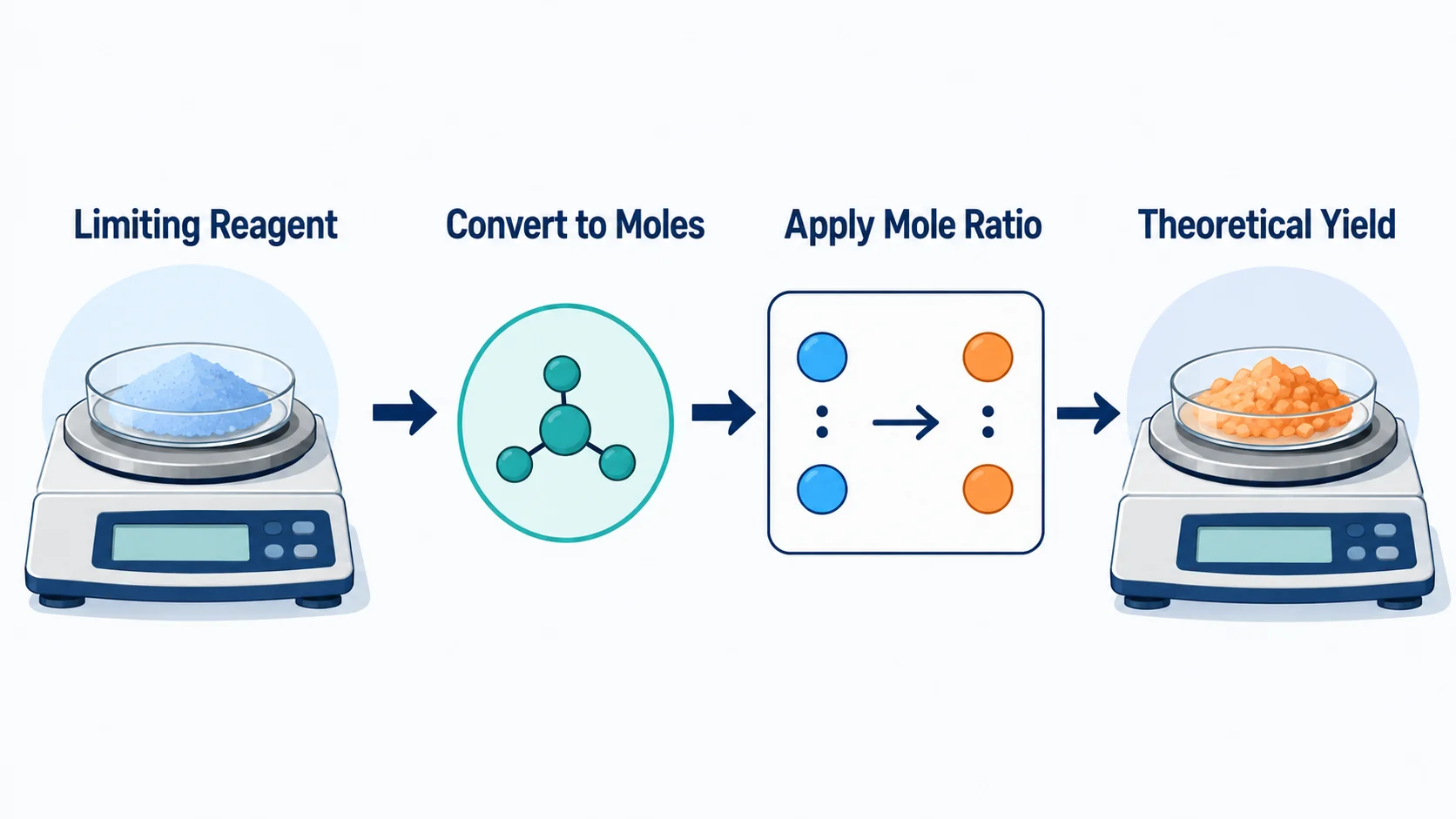
What the Theoretical Yield Calculator Finds
The calculator returns two connected results:
- Product moles: the maximum number of moles of the desired product predicted by the balanced equation.
- Theoretical yield: the maximum predicted product mass under ideal reaction conditions.
The calculation starts with the reagent that will run out first. If the limiting reagent has not already been identified, compare the available reactants using the balanced equation before entering the values.
Theoretical Yield Formula
When the limiting reagent is entered by mass, the first step converts it to moles:
Limiting reagent moles = Reagent mass ÷ Reagent molar mass
The coefficients from the balanced equation provide the mole ratio:
Product moles = Limiting reagent moles × (Product coefficient ÷ Reagent coefficient)
Finally, product moles are converted to product mass:
Theoretical yield = Product moles × Product molar mass
Combining the three steps gives:
Theoretical yield = (Reagent mass ÷ Reagent molar mass) × (Product coefficient ÷ Reagent coefficient) × Product molar mass
Inputs You Need
Limiting reagent amount: Enter either its measured mass or its known amount in moles. Do not enter both unless the calculator specifically uses one as an override.
Reagent molar mass: The mass of one mole of the limiting reagent in grams per mole. It must match the exact chemical formula and hydration state used in the reaction.
Reagent coefficient: The whole-number coefficient placed before the limiting reagent in the balanced chemical equation.
Product coefficient: The coefficient placed before the desired product in the same balanced equation.
Product molar mass: The molar mass of the exact product whose theoretical yield is required.
How to Use the Calculator
- Write and balance the chemical equation.
- Identify which reactant is limiting.
- Enter its mass and molar mass, or enter its moles directly.
- Enter the limiting reagent’s stoichiometric coefficient.
- Enter the desired product’s coefficient and molar mass.
- Select the appropriate mass or mole units.
- Click Calculate and review the displayed steps.
Worked Example: Aluminum Oxide
Aluminum reacts with excess oxygen according to the balanced equation:
4Al + 3O2 → 2Al2O3
Suppose 10.0 g of aluminum is the limiting reagent. The molar mass of aluminum is 26.9815 g/mol, and the molar mass of aluminum oxide is 101.961 g/mol.
Al moles = 10.0 ÷ 26.9815 = 0.3706 mol
The equation produces 2 mol of aluminum oxide for every 4 mol of aluminum:
Al2O3 moles = 0.3706 × (2 ÷ 4) = 0.1853 mol
Convert the product moles to mass:
Theoretical yield = 0.1853 × 101.961 = 18.90 g
Under ideal conditions, 10.0 g of limiting aluminum can therefore produce a maximum of approximately 18.9 g of aluminum oxide.
Limiting Reagent and Excess Reagent
The limiting reagent determines theoretical yield because it is consumed first. An excess reagent remains after the limiting reagent has been used, so basing the calculation on the excess reagent would overestimate the possible product.
When amounts are provided for multiple reactants, convert each to moles and compare how much product each could form using the balanced coefficients. The reactant that predicts the smaller product amount is limiting.
Purity and Real Sample Mass
The mass field normally assumes the reagent is pure. If a sample is only 85% pure, calculate the usable reagent mass before entering it:
Pure reagent mass = Sample mass × (Purity percentage ÷ 100)
For example, 20 g of an 85% pure sample contains 17 g of the target reagent. This adjustment is separate from percent yield, which compares the product actually recovered with the theoretical amount.
Theoretical Yield vs Actual and Percent Yield
Theoretical yield is the maximum amount predicted by stoichiometry. Actual yield is the amount of product obtained experimentally. Percent yield expresses the actual yield as a percentage of the theoretical value:
Percent yield = (Actual yield ÷ Theoretical yield) × 100
Actual yield is commonly lower because reactions may be incomplete, competing reactions may occur, or product may be lost during transfer, filtration, washing, drying, or purification.
Common Mistakes
- Using an unbalanced equation: the coefficient ratio will be incorrect.
- Choosing the excess reagent: theoretical yield must be based on the limiting reagent.
- Using subscripts as coefficients: coefficients describe mole ratios; formula subscripts describe composition.
- Entering the wrong molar mass: check chemical formulas, hydrates, and unit consistency.
- Ignoring purity: an impure sample contains less usable reagent than its total measured mass.
- Confusing theoretical and actual yield: theoretical yield is a calculated maximum, not the amount collected.
Assumptions and Limitations
The calculation assumes the chemical equation is balanced, the limiting reagent is correctly identified, and the entered molar masses and coefficients describe the intended substances. It also assumes complete conversion of the limiting reagent into the selected product.
The result does not automatically account for reagent purity, incomplete reaction, equilibrium, competing pathways, product decomposition, measurement uncertainty, or laboratory recovery losses. Use experimental data and an appropriate chemical method for laboratory reporting or process design.
Theoretical Yield Calculator FAQs
What is theoretical yield?
Theoretical yield is the maximum amount of product predicted from the limiting reagent and the stoichiometric ratios in a balanced chemical equation.
Why must the equation be balanced?
The coefficients in a balanced equation supply the mole ratio between the reagent and product. An unbalanced equation produces an invalid ratio.
Can I calculate theoretical yield directly from grams?
Yes, but the reagent mass must first be divided by its molar mass. The resulting moles are converted to product moles and then back to product mass.
What if I have amounts for two reactants?
Determine how much product each reactant could form. The reactant producing the smaller amount is limiting and should be used for the theoretical-yield calculation.
Can theoretical yield be lower than actual yield?
A reported actual yield above the theoretical value usually indicates remaining solvent, impurities, incomplete drying, measurement error, or an incorrect calculation.
Is theoretical yield the same as percent yield?
No. Theoretical yield is the calculated maximum product amount. Percent yield compares the experimentally obtained amount with that maximum.
Related Chemistry Calculators
- Percent Yield Calculator — compare actual yield with theoretical yield.
- Molarity Calculator — calculate concentration, moles, or solution volume.
- Avogadro’s Number Calculator — convert among moles, mass, and particles.
References
The Limiting Reactant Sets Theoretical Yield
Theoretical yield comes from the balanced chemical equation and the reactant that produces the least product after stoichiometric conversion. Convert inputs to moles, identify the limiting reactant, then convert product moles to the requested mass. Purity, hydration state, side reactions, incomplete conversion, and handling losses affect actual yield; never choose the largest reactant amount without comparing stoichiometric equivalents.