pH Calculator
Use this pH Calculator to calculate pH, pOH, hydrogen ion concentration, and hydroxide ion concentration for aqueous acid and base solutions. Choose a calculation mode, enter the known concentration or ion value, and calculate the related pH values with a step-by-step explanation.
Important Note: This pH Calculator provides educational aqueous acid-base estimates. It can calculate pH, pOH, hydrogen ion concentration, and hydroxide ion concentration from strong acid/base concentration, weak acid/base inputs when supported, direct [H+], direct [OH−], or pOH.
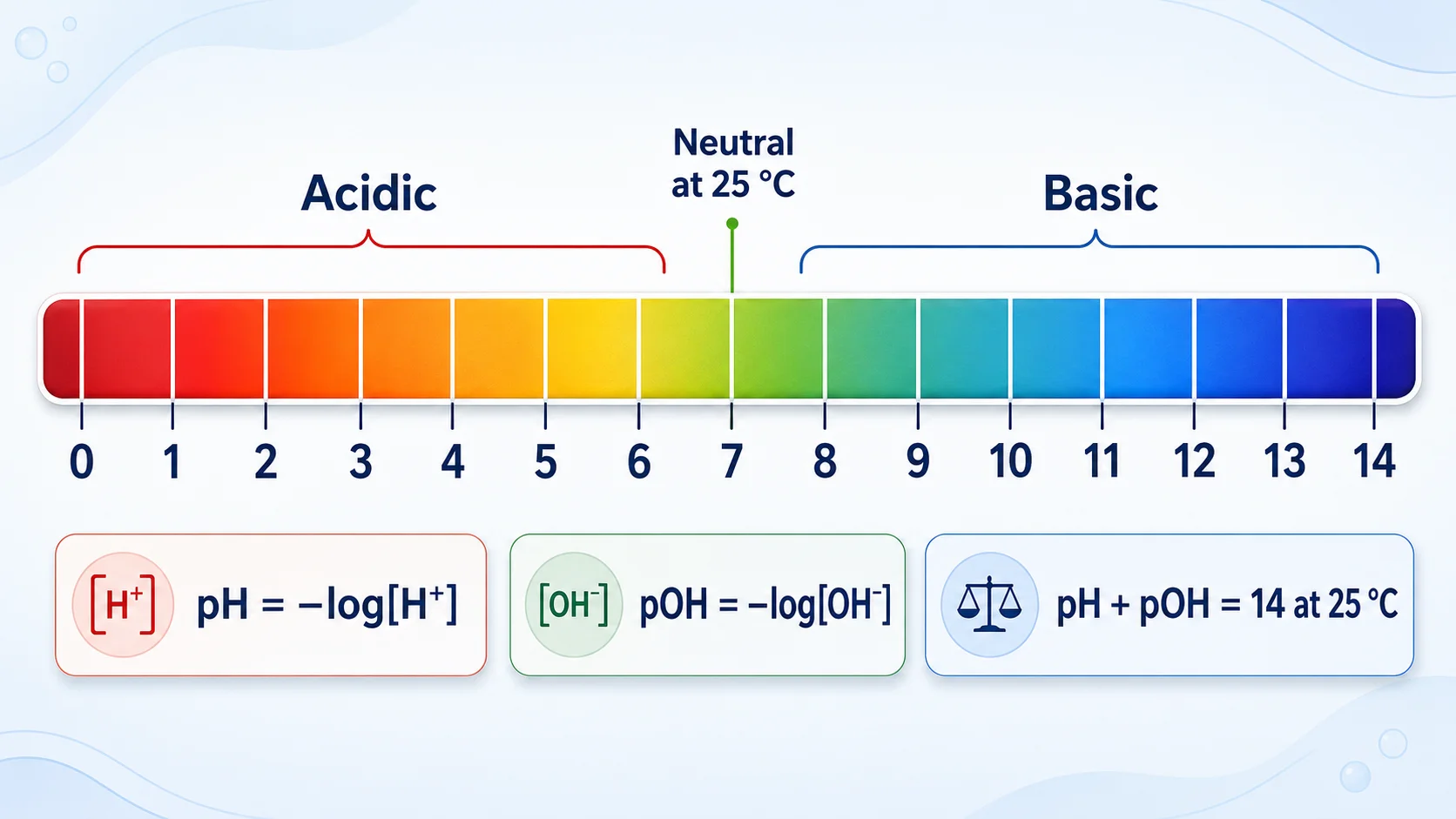
The calculator uses common classroom chemistry relationships such as pH = −log[H+], pOH = −log[OH−], and pH + pOH = 14 at 25°C. Real measured pH can differ because pH is activity-based and affected by temperature, ionic strength, buffers, mixed acid/base systems, weak acid/base equilibrium, calibration, and electrode condition.
Use this calculator for chemistry learning and calculation checks only. For laboratory, safety, regulatory, medical, agricultural, aquarium, pool, or industrial decisions, verify results using calibrated equipment, the required standard method, and qualified professional guidance.
Reviewed by: AjaxCalculators Editorial Team
Last updated: April 29, 2026
Method source: Standard aqueous acid-base formulas using pH = −log[H⁺], pOH = −log[OH⁻], pH + pOH = 14 at 25°C, and strong acid/base dissociation assumptions
Editorial standards: AjaxCalculators Editorial Policy
What This pH Calculator Calculates
This calculator estimates pH-related values for aqueous acid and base solutions. It can work from strong acid concentration, strong base concentration, weak acid/base inputs when supported, or direct values such as [H⁺], [OH⁻], or pOH.
The calculator can calculate:
- pH
- pOH
- Hydrogen ion concentration [H⁺]
- Hydroxide ion concentration [OH⁻]
- Strong acid pH from concentration
- Strong base pH from concentration
- Ion concentration from pH or pOH
- Step-by-step acid-base calculation
The live tool shows result cards for pH, pOH, [H⁺], and [OH⁻]. It also includes an assumption note that uses pH + pOH = 14 at 25°C.
What pH Means
pH is a measure of how acidic or basic an aqueous solution is. In common chemistry calculations, pH is calculated from hydrogen ion concentration.
pH = −log10[H⁺]
In this formula:
- pH measures acidity or basicity
- [H⁺] is the hydrogen ion concentration in mol/L
- log10 means base-10 logarithm
A lower pH means a higher hydrogen ion concentration. A higher pH means a lower hydrogen ion concentration.
What pOH Means
pOH is similar to pH, but it is based on hydroxide ion concentration.
pOH = −log10[OH⁻]
In this formula:
- pOH measures hydroxide ion concentration on a logarithmic scale
- [OH⁻] is the hydroxide ion concentration in mol/L
At 25°C in common classroom aqueous calculations:
pH + pOH = 14
This relationship is based on the ion product of water at 25°C. At other temperatures, the neutral point and pH + pOH relationship can shift.
How the pH Calculator Works
1) Strong Acid from Concentration
For a strong acid, the calculator assumes complete dissociation. This means the acid releases its hydrogen ions fully in water.
[H⁺] = acid concentration × H⁺ equivalents
Then:
pH = −log10[H⁺]
For example, hydrochloric acid, HCl, has 1 H⁺ equivalent per formula unit. If HCl concentration is 0.10 M:
[H⁺] = 0.10 × 1 = 0.10 M
pH = −log(0.10) = 1.00
2) Strong Base from Concentration
For a strong base, the calculator assumes complete dissociation into hydroxide ions.
[OH⁻] = base concentration × OH⁻ equivalents
Then:
pOH = −log10[OH⁻]
And at 25°C:
pH = 14 − pOH
For example, sodium hydroxide, NaOH, has 1 OH⁻ equivalent per formula unit. If NaOH concentration is 0.01 M:
[OH⁻] = 0.01 M
pOH = −log(0.01) = 2.00
pH = 14 − 2 = 12.00
3) Directly from [H⁺]
If hydrogen ion concentration is known, pH can be calculated directly.
pH = −log10[H⁺]
For example, if:
[H⁺] = 1 × 10⁻⁵ M
Then:
pH = 5
4) Directly from [OH⁻]
If hydroxide ion concentration is known, the calculator first finds pOH.
pOH = −log10[OH⁻]
Then, at 25°C:
pH = 14 − pOH
5) Directly from pOH
If pOH is known, pH is found from the 25°C relationship:
pH = 14 − pOH
Then ion concentrations can be calculated as:
[OH⁻] = 10−pOH
[H⁺] = 10−pH
pH Formula Summary
| What You Want to Find | Formula | Use When |
|---|---|---|
| pH from hydrogen ion concentration | pH = −log10[H+] | You know [H+] in mol/L. |
| pOH from hydroxide ion concentration | pOH = −log10[OH−] | You know [OH−] in mol/L. |
| Hydrogen ion concentration from pH | [H+] = 10−pH | You know pH and want [H+]. |
| Hydroxide ion concentration from pOH | [OH−] = 10−pOH | You know pOH and want [OH−]. |
| pH and pOH relationship at 25°C | pH + pOH = 14 | You are using the common 25°C classroom assumption. |
| pH from pOH at 25°C | pH = 14 − pOH | You know pOH and assume 25°C. |
| pOH from pH at 25°C | pOH = 14 − pH | You know pH and assume 25°C. |
Worked Example: Strong Acid pH
Suppose you have a 0.10 M HCl solution. HCl is treated as a strong acid with 1 H⁺ equivalent per formula unit.
Step 1: Calculate hydrogen ion concentration
[H⁺] = acid concentration × H⁺ equivalents
[H⁺] = 0.10 × 1
[H⁺] = 0.10 M
Step 2: Calculate pH
pH = −log10[H⁺]
pH = −log10(0.10)
pH = 1.00
Step 3: Calculate pOH at 25°C
pOH = 14 − pH
pOH = 14 − 1.00
pOH = 13.00
So, a 0.10 M strong acid with one H⁺ equivalent has a pH of 1.00.
Worked Example: Strong Base pH
Suppose you have a 0.010 M NaOH solution. NaOH is treated as a strong base with 1 OH⁻ equivalent per formula unit.
Step 1: Calculate hydroxide ion concentration
[OH⁻] = base concentration × OH⁻ equivalents
[OH⁻] = 0.010 × 1
[OH⁻] = 0.010 M
Step 2: Calculate pOH
pOH = −log10[OH⁻]
pOH = −log10(0.010)
pOH = 2.00
Step 3: Calculate pH at 25°C
pH = 14 − pOH
pH = 14 − 2.00
pH = 12.00
So, a 0.010 M NaOH solution has a pOH of 2.00 and a pH of 12.00.
Worked Example: pH from [H⁺]
Suppose the hydrogen ion concentration is:
[H⁺] = 3.2 × 10⁻⁴ M
Step 1: Use the pH formula
pH = −log10[H⁺]
Step 2: Substitute the concentration
pH = −log10(3.2 × 10⁻⁴)
Step 3: Calculate
pH ≈ 3.49
So, [H⁺] = 3.2 × 10⁻⁴ M corresponds to a pH of about 3.49.
Worked Example: [H⁺] from pH
Suppose a solution has:
pH = 5.25
Step 1: Use the inverse pH formula
[H⁺] = 10−pH
Step 2: Substitute pH
[H⁺] = 10−5.25
Step 3: Calculate
[H⁺] ≈ 5.62 × 10⁻⁶ M
So, a pH of 5.25 corresponds to a hydrogen ion concentration of about 5.62 × 10⁻⁶ M.
Strong Acids and Strong Bases
Strong acids and strong bases are often treated as fully dissociated in introductory pH calculations. That means the calculator can multiply concentration by the number of H+ or OH− equivalents to estimate ion concentration.
| Substance | Common Type | Equivalent Example | Important Note |
|---|---|---|---|
| HCl | Strong acid | 1 H+ equivalent | Often treated as fully dissociated in dilute aqueous solutions. |
| HNO3 | Strong acid | 1 H+ equivalent | Common strong acid example. |
| H2SO4 | Acid often simplified in basic calculators | 2 H+ equivalents, depending on assumption | The second dissociation is not always treated the same way in more detailed chemistry. |
| NaOH | Strong base | 1 OH− equivalent | Common strong base example. |
| Ca(OH)2 | Strong base example | 2 OH− equivalents | Solubility and concentration assumptions can matter. |
| Al(OH)3 | Base example | 3 OH− equivalents, if fully dissociated | Real solubility and equilibrium behavior may require a more detailed model. |
For classroom-style strong acid/base calculations, complete dissociation is a useful simplifying assumption. For concentrated, mixed, weak, partially soluble, or buffered systems, more detailed chemistry may be required.
Weak Acid and Weak Base Notes
Weak acids and weak bases do not fully dissociate in water. Their pH depends on equilibrium constants such as Ka for weak acids and Kb for weak bases.
For a weak acid HA:
HA ⇌ H⁺ + A⁻
The acid dissociation constant is:
Ka = [H⁺][A⁻] ÷ [HA]
For a weak base B:
B + H₂O ⇌ BH⁺ + OH⁻
The base dissociation constant is:
Kb = [BH⁺][OH⁻] ÷ [B]
Weak acid and weak base calculations usually require equilibrium setup, approximation, or solving a quadratic equation. The result can differ from a strong acid/base calculation at the same concentration.
pH Scale Interpretation
The pH scale is logarithmic. A difference of 1 pH unit represents a 10-fold difference in hydrogen ion concentration.
| pH Range | General Meaning | Hydrogen Ion Level | 25°C Classroom Note |
|---|---|---|---|
| Below 7 | Acidic | Higher [H+] | Hydronium concentration is greater than hydroxide concentration. |
| About 7 at 25°C | Neutral water approximation | [H+] and [OH−] are approximately equal | Neutral pH changes with temperature. |
| Above 7 | Basic or alkaline | Lower [H+] and higher [OH−] | Hydroxide concentration is greater than hydronium concentration. |
Because pH is logarithmic, pH 3 is not just slightly more acidic than pH 4. It has about 10 times the hydrogen ion concentration.
Common pH and [H+] Values
| pH | [H+] in M | General Description |
|---|---|---|
| 1 | 1 × 10⁻¹ | Strongly acidic |
| 2 | 1 × 10⁻² | Acidic |
| 3 | 1 × 10⁻³ | Acidic |
| 4 | 1 × 10⁻⁴ | Mildly acidic |
| 7 | 1 × 10⁻⁷ | Neutral approximation at 25°C |
| 10 | 1 × 10⁻¹⁰ | Basic |
| 14 | 1 × 10⁻¹⁴ | Strongly basic in common classroom scale |
How to Use This pH Calculator
- Select the calculation mode, such as strong acid, strong base, weak acid/base, [H⁺], [OH⁻], or pOH when available.
- Enter the known concentration or ion value.
- Select the correct concentration unit, such as M, mM, μM, or another supported unit.
- For strong acid mode, enter the number of H⁺ equivalents per formula unit.
- For strong base mode, enter the number of OH⁻ equivalents per formula unit if that option is shown.
- For weak acid/base mode, enter the required equilibrium constant such as Ka or Kb if the selected mode asks for it.
- Click Calculate.
- Review pH, pOH, [H⁺], and [OH⁻].
- Use the step-by-step section to check the formula path.
How to Interpret the Results
| Result | What It Means | Important Caution |
|---|---|---|
| pH | Shows acidity or basicity using the hydrogen ion scale. | Calculated pH is not the same as a calibrated pH meter measurement. |
| pOH | Shows the related hydroxide ion scale. | The pH + pOH = 14 relationship assumes 25°C. |
| [H+] | Estimated hydrogen ion concentration in mol/L. | Real pH is activity-based, so concentration-only estimates can differ from measured pH. |
| [OH−] | Estimated hydroxide ion concentration in mol/L. | Temperature and solution chemistry can affect the water ion-product relationship. |
| Step-by-step result | Shows the calculation path used by the selected mode. | Check concentration unit, equivalent count, Ka/Kb input, and calculation mode. |
For dilute classroom-style calculations at 25°C, pH and pOH are connected by:
pH + pOH = 14
If temperature, ionic strength, or solution composition changes significantly, real measured pH may differ from this simple calculation.
pH vs pOH
pH and pOH describe opposite sides of the same acid-base relationship in water.
| Quantity | Based On | Formula | General Meaning |
|---|---|---|---|
| pH | Hydrogen ion concentration | pH = −log[H+] | Lower pH usually means more acidic. |
| pOH | Hydroxide ion concentration | pOH = −log[OH−] | Lower pOH usually means more basic. |
| Relationship at 25°C | Water ion product | pH + pOH = 14 | Common classroom relationship at 25°C. |
Acidic solutions have lower pH and higher pOH. Basic solutions have higher pH and lower pOH.
Concentration Units
The calculator may support several concentration units. The base chemistry formulas use molarity, or moles per liter.
| Unit | Meaning | Relationship to M |
|---|---|---|
| M | Moles per liter | 1 M |
| mM | Millimolar | 1 mM = 10−3 M |
| μM | Micromolar | 1 μM = 10−6 M |
| nM | Nanomolar | 1 nM = 10−9 M |
Always check the selected unit before calculating. Entering 0.10 mM instead of 0.10 M changes the concentration by a factor of 1000.
Why Real Measured pH Can Differ
This calculator gives a mathematical estimate. Real pH measurements can differ from ideal calculations because pH is affected by more than simple concentration.
| Factor | Why It Matters |
|---|---|
| Temperature | The water ion product changes with temperature, so the neutral point and pH + pOH relationship can shift. |
| Ionic strength | Ion interactions can make activity differ from simple concentration. |
| Activity coefficients | Measured pH is related to hydrogen ion activity, not only molar concentration. |
| Weak acid/base equilibrium | Weak acids and bases do not fully dissociate and require equilibrium calculations. |
| Buffers | Buffer systems resist pH change and require additional equilibrium information. |
| Mixed acids and bases | Multiple acid/base species can interact and change the final pH. |
| Polyprotic acid behavior | Acids with more than one ionizable proton may require stepwise equilibrium treatment. |
| Limited solubility | Not all compounds fully dissolve at the entered concentration. |
| pH meter calibration | Measured pH depends on calibration buffers, instrument setup, and procedure. |
| Electrode condition | Dirty, aging, damaged, or improperly stored electrodes can give inaccurate readings. |
For lab reporting, use the measurement method required by the lab manual, instructor, standard method, or instrument documentation.
Common Mistakes to Avoid
- Do not enter pH where concentration is requested.
- Do not forget that pH uses a negative base-10 logarithm.
- Do not assume weak acids and weak bases fully dissociate.
- Do not use pH + pOH = 14 without noting that it is the common 25°C classroom assumption.
- Do not confuse M, mM, μM, and nM.
- Do not use the wrong number of H⁺ or OH⁻ equivalents.
- Do not treat calculated pH as a calibrated lab measurement.
- Do not ignore solution temperature, ionic strength, or buffering when accuracy matters.
Important Assumptions and Limitations
- This calculator is intended for educational aqueous acid-base estimates.
- Strong acid and strong base modes assume complete dissociation.
- The pH + pOH = 14 relationship assumes 25°C in standard classroom-style calculations.
- Weak acid and weak base calculations require appropriate Ka or Kb assumptions when those modes are used.
- The calculator does not replace a calibrated pH meter or approved analytical method.
- It does not fully account for activity coefficients, ionic strength, buffers, mixed acid/base systems, temperature-dependent Kw, polyprotic equilibria, or nonideal solution behavior unless specifically supported by the selected mode.
- It does not verify chemical identity, purity, solubility, concentration preparation, lab technique, calibration, electrode condition, or sample handling.
- It should not be used as the sole basis for laboratory safety, regulatory reporting, medical decisions, agriculture treatment, aquarium dosing, pool chemical treatment, industrial process control, or environmental compliance.
- Displayed values may be rounded for readability.
Practical Uses
This pH Calculator can be useful for:
- chemistry homework
- acid-base concentration examples
- strong acid pH calculations
- strong base pH calculations
- weak acid/base learning examples
- pOH and hydroxide ion conversions
- hydrogen ion concentration calculations
- lab report calculation checks
- understanding the logarithmic pH scale
When You May Need More Than This Calculator
This calculator is best for educational pH math and simple aqueous acid-base calculations. You may need more detailed analysis if your solution involves more complex chemistry.
| Situation | Why This Calculator May Not Be Enough |
|---|---|
| Buffer solutions | Buffer pH depends on acid/base pair concentrations and equilibrium constants. |
| Titration curves | pH changes by reaction stage, equivalence point, and buffer region. |
| Polyprotic acids | Multiple dissociation steps may need separate equilibrium treatment. |
| Mixed acid/base systems | Several reacting species can interact and change the final pH. |
| Non-aqueous solvents | The standard water-based pH/pOH relationships may not apply. |
| Very concentrated acids or bases | Activity, nonideal behavior, and safety concerns become more important. |
| Very dilute solutions near neutral water autoionization limits | Water autoionization may become important relative to added acid/base. |
| Temperature-dependent pH calculations | Kw and neutral pH vary with temperature. |
| Regulatory water-quality reporting | Use required standard methods, calibrated meters, and documentation procedures. |
| Industrial process control | Use calibrated instrumentation, process-specific controls, and qualified oversight. |
References
- IUPAC Gold Book — pH Definition
- OpenStax Chemistry 2e — pH and pOH
- OpenStax Chemistry 2e — Relative Strengths of Acids and Bases
- Chemistry LibreTexts — Acid-Base Titrations
- Chemistry LibreTexts — ICE Tables
Related Calculators
- Molarity Calculator
- PPM to Molarity Calculator
- Dilution Ratio Calculator
- Alcohol Dilution Calculator
- Theoretical Yield Calculator
- Percent Yield Calculator
- mg to mL Calculator
- mL to Grams Converter
Chemistry Disclaimer
This pH Calculator provides educational aqueous acid-base estimates. It uses common formulas such as pH = −log[H+], pOH = −log[OH−], and pH + pOH = 14 at 25°C. Results depend on the selected mode, entered concentration, concentration unit, ion equivalents, Ka/Kb values when used, and the assumptions behind the calculation.
Real measured pH can differ because pH is activity-based and affected by temperature, ionic strength, activity coefficients, buffers, weak acid/base equilibria, mixed systems, sample preparation, calibration, electrode condition, and measurement method. This calculator does not replace a calibrated pH meter, laboratory protocol, safety data sheet, regulatory method, instructor guidance, or professional chemical analysis.
For laboratory, safety, regulatory, medical, agricultural, aquarium, pool, environmental, or industrial decisions, verify results with the appropriate standard method, calibrated equipment, and qualified guidance.