PPM ⇄ Molarity Calculator

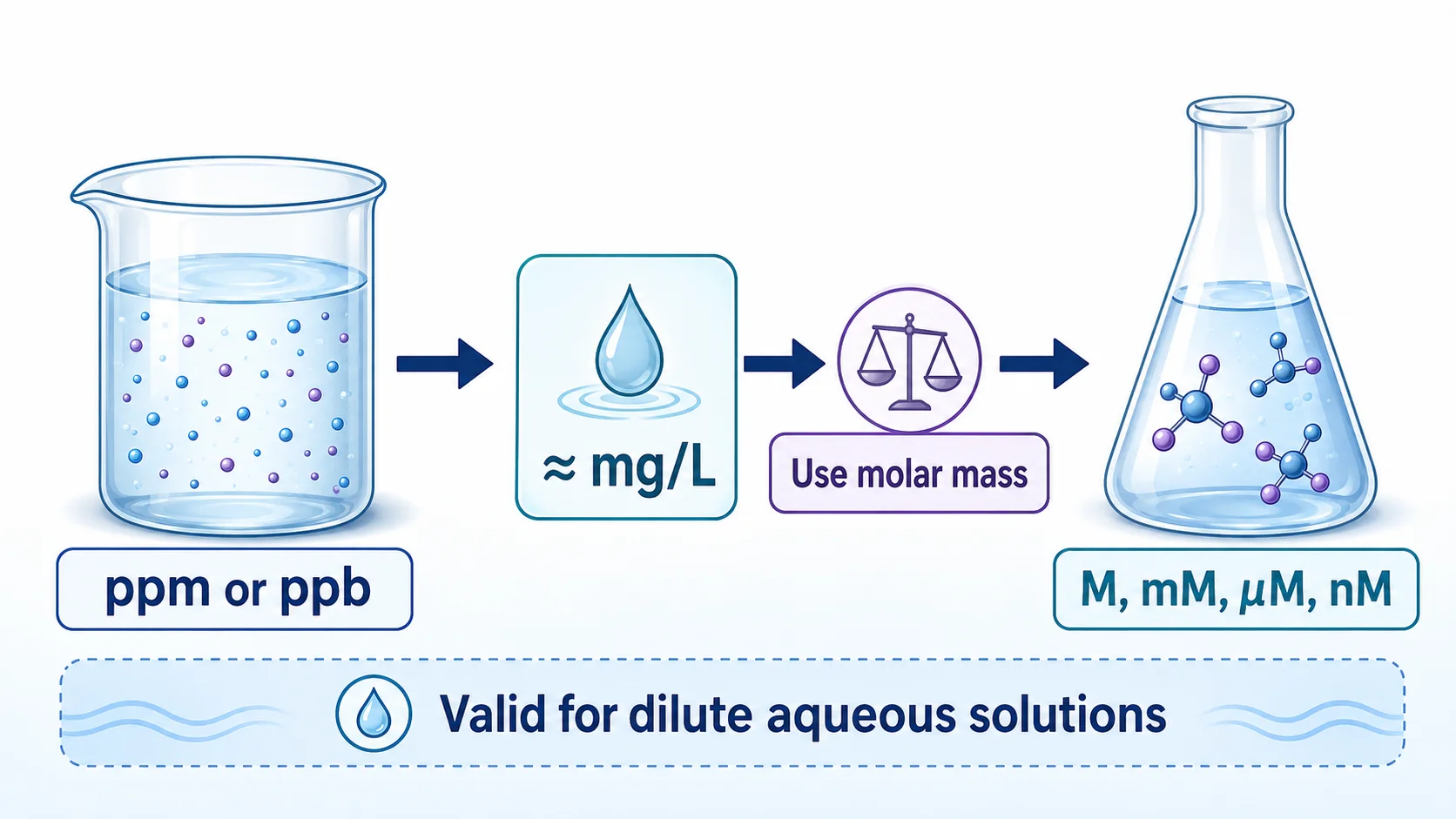
Convert between ppm/ppb and molarity using molar mass for dilute aqueous solutions.
Inputs
Assumes dilute aqueous solution: 1 ppm ≈ 1 mg/L.
Results
ppm
ppb
mg/L
M
mM
μM
nM
Step-by-step derivation
Enter values and click Calculate.
References
  • For dilute aqueous solutions, 1 ppm ≈ 1 mg/L and 1 ppb ≈ 0.001 mg/L.
  • M = c / (1000 × Mw) where c is in mg/L and Mw is in g/mol.
  • Inverse: c = M × Mw × 1000 in mg/L.

Use this PPM to Molarity Calculator to convert between ppm, ppb, mg/L, molarity, millimolar, micromolar, and nanomolar concentration units. Enter the concentration or molarity, provide the molar mass, and calculate the equivalent concentration values for dilute aqueous solutions.

Important Note: This PPM to Molarity Calculator provides educational dilute aqueous concentration conversions between ppm, ppb, mg/L, M, mM, μM, and nM. It uses molar mass to convert between mass concentration and molar concentration.

The calculator assumes a dilute water-based solution where 1 ppm ≈ 1 mg/L and 1 ppb ≈ 0.001 mg/L. This approximation is common for dilute aqueous solutions, but it should not be applied blindly to gases, solids, concentrated mixtures, non-aqueous solvents, volume-based ppm, mole-fraction ppm, or regulatory reporting methods that define ppm differently.

Always match the molar mass to the exact analyte being reported. For example, ppm chloride should use the molar mass of chloride ion, while ppm NaCl should use the molar mass of sodium chloride.

Reviewed by: AjaxCalculators Editorial Team
Last updated: April 29, 2026
Method source: Standard dilute aqueous concentration conversion using 1 ppm ≈ 1 mg/L, 1 ppb ≈ 0.001 mg/L, and molarity = mass concentration ÷ molar mass
Editorial standards: AjaxCalculators Editorial Policy

What This PPM to Molarity Calculator Converts

This calculator converts between mass concentration units and molar concentration units for dilute aqueous solutions. It is useful when a concentration is given in ppm or ppb, but a chemistry calculation needs molarity, or when a molar concentration needs to be reported as ppm or ppb.

The calculator can convert:

  • ppm to molarity
  • ppb to molarity
  • mg/L to molarity
  • molarity to ppm
  • molarity to ppb
  • M to mM, μM, and nM
  • mM, μM, or nM back to ppm and ppb

The live tool supports concentration inputs in parts per million (ppm) and parts per billion (ppb). It supports molarity outputs in M, mM, μM, and nM, and it uses molar mass in g/mol or kg/mol.

What PPM to Molarity Means

PPM to molarity means converting a mass-based concentration into a mole-based concentration.

In dilute aqueous solutions, ppm is commonly treated as approximately equal to mg/L:

1 ppm ≈ 1 mg/L

Molarity, written as M, means moles of solute per liter of solution:

M = mol/L

To convert ppm to molarity, the calculator first treats ppm as mg/L, then converts milligrams to grams, then divides by the molar mass in g/mol.

Important: This Calculator Assumes a Dilute Aqueous Solution

This calculator assumes the solution is dilute and water-based. Under that assumption, the density of the solution is close enough to water that:

  • 1 ppm ≈ 1 mg/L
  • 1 ppb ≈ 0.001 mg/L

This assumption is common in water chemistry and environmental concentration work, but it is not universal. For concentrated solutions, non-aqueous solvents, dense mixtures, gas-phase concentrations, or mass fractions in solids, ppm may not equal mg/L without additional density or composition information.

How the PPM to Molarity Calculator Works

1) Convert ppm or ppb to mg/L

The calculator first converts the entered concentration into mg/L.

For dilute aqueous solutions:

mg/L = ppm

For ppb:

mg/L = ppb ÷ 1000

For example:

200 ppm ≈ 200 mg/L

And:

500 ppb = 0.5 mg/L

2) Convert mg/L to g/L

Molar mass is usually entered in g/mol, so the calculator converts milligrams to grams.

g/L = mg/L ÷ 1000

For example:

200 mg/L ÷ 1000 = 0.200 g/L

3) Convert g/L to molarity

Molarity is calculated by dividing grams per liter by molar mass.

M = (g/L) ÷ molar mass

Combining the mg/L step gives:

M = mg/L ÷ (1000 × molar mass)

Where molar mass is in g/mol.

4) Convert Molarity to mM, μM, and nM

After molarity is calculated in M, the calculator converts it into smaller molar units.

Molar Unit Relationship to M Meaning
M 1 M Moles per liter
mM mM = M × 1000 Millimoles per liter
μM μM = M × 1,000,000 Micromoles per liter
nM nM = M × 1,000,000,000 Nanomoles per liter

5) Convert Molarity Back to ppm or ppb

To convert molarity back to mass concentration, the calculator reverses the formula.

mg/L = M × molar mass × 1000

For dilute aqueous solutions:

ppm ≈ mg/L

And:

ppb ≈ ppm × 1000

PPM to Molarity Formula Summary

What You Want to Convert Formula Assumption
ppm to mg/L mg/L ≈ ppm Dilute aqueous solution
ppb to mg/L mg/L = ppb ÷ 1000 Dilute aqueous solution
mg/L to molarity M = mg/L ÷ (1000 × molar mass) Molar mass in g/mol
ppm to molarity M = ppm ÷ (1000 × molar mass) ppm treated as mg/L
ppb to molarity M = ppb ÷ (1,000,000 × molar mass) ppb treated as 0.001 mg/L
molarity to mg/L mg/L = M × molar mass × 1000 Molar mass in g/mol
molarity to ppm ppm ≈ M × molar mass × 1000 Dilute aqueous solution
molarity to ppb ppb ≈ M × molar mass × 1,000,000 Dilute aqueous solution

Worked Example: Convert ppm to Molarity

Suppose you have a 200 ppm sodium chloride solution. The molar mass of sodium chloride is approximately 58.44 g/mol.

Step 1: Convert ppm to mg/L
For a dilute aqueous solution:
200 ppm ≈ 200 mg/L

Step 2: Use the ppm-to-molarity formula
M = mg/L ÷ (1000 × molar mass)

Step 3: Substitute the values
M = 200 ÷ (1000 × 58.44)

Step 4: Calculate
M = 200 ÷ 58,440
M ≈ 0.003422 M

Step 5: Convert to mM
mM = 0.003422 × 1000
mM ≈ 3.422 mM

So, 200 ppm NaCl is approximately 0.00342 M, or 3.42 mM, assuming a dilute aqueous solution.

Worked Example: Convert ppb to Molarity

Suppose a solution contains 500 ppb of a compound with molar mass 100 g/mol.

Step 1: Convert ppb to mg/L
mg/L = ppb ÷ 1000
mg/L = 500 ÷ 1000
mg/L = 0.5 mg/L

Step 2: Convert mg/L to molarity
M = mg/L ÷ (1000 × molar mass)

Step 3: Substitute the values
M = 0.5 ÷ (1000 × 100)

Step 4: Calculate
M = 0.5 ÷ 100,000
M = 0.000005 M

Step 5: Convert to μM
μM = 0.000005 × 1,000,000
μM = 5 μM

So, 500 ppb of a 100 g/mol compound is approximately 5 μM.

Worked Example: Convert Molarity to ppm

Suppose you have a solution with concentration 0.01 M and molar mass 40 g/mol.

Step 1: Use the molarity-to-mg/L formula
mg/L = M × molar mass × 1000

Step 2: Substitute the values
mg/L = 0.01 × 40 × 1000

Step 3: Calculate
mg/L = 400 mg/L

Step 4: Convert mg/L to ppm
For a dilute aqueous solution:
ppm ≈ mg/L

So, 0.01 M of a 40 g/mol compound is approximately 400 ppm.

Worked Example: Convert mM to ppm

Suppose a solution is 2 mM and the molar mass is 58.44 g/mol.

Step 1: Convert mM to M
M = mM ÷ 1000
M = 2 ÷ 1000
M = 0.002 M

Step 2: Convert M to mg/L
mg/L = M × molar mass × 1000
mg/L = 0.002 × 58.44 × 1000
mg/L = 116.88 mg/L

Step 3: Convert mg/L to ppm
ppm ≈ mg/L

So, 2 mM NaCl is approximately 116.88 ppm for a dilute aqueous solution.

How to Use This PPM to Molarity Calculator

  1. Select the conversion direction: Concentration → Molarity or Molarity → Concentration.
  2. Enter the concentration value if converting from ppm or ppb.
  3. Select the concentration unit: ppm or ppb.
  4. Or enter the molarity value if converting from M, mM, μM, or nM.
  5. Select the molarity unit.
  6. Enter the molar mass of the solute.
  7. Select the molar mass unit: g/mol or kg/mol.
  8. Click Calculate.
  9. Review ppm, ppb, mg/L, M, mM, μM, and nM results.
  10. Use the step-by-step derivation to verify the conversion path.

How to Interpret the Results

Result What It Means Important Caution
ppm Parts per million, treated as approximately mg/L for dilute aqueous solutions. Do not assume ppm equals mg/L for gases, solids, concentrated solutions, or non-water solvents.
ppb Parts per billion. In dilute aqueous solutions, 1 ppb is approximately 0.001 mg/L. 1 ppm equals 1000 ppb.
mg/L Mass concentration as milligrams of solute or analyte per liter of solution. Make sure the reported analyte matches the molar mass used.
M Molarity in moles per liter of solution. Requires the correct molar mass.
mM Millimolar concentration. 1 mM = 0.001 M.
μM Micromolar concentration. 1 μM = 0.000001 M.
nM Nanomolar concentration. 1 nM = 0.000000001 M.

Why Molar Mass Is Required

PPM, ppb, and mg/L are mass-based concentration units. Molarity is based on moles. To convert mass into moles, the calculator needs the molar mass of the solute.

For example, 100 mg/L of a substance with molar mass 50 g/mol is a different molarity than 100 mg/L of a substance with molar mass 200 g/mol.

The higher the molar mass, the fewer moles are present for the same mass concentration.

Common Molarity Unit Conversions

Unit Meaning Relationship to M
M Moles per liter 1 M
mM Millimoles per liter 1 mM = 10−3 M
μM Micromoles per liter 1 μM = 10−6 M
nM Nanomoles per liter 1 nM = 10−9 M

PPM, PPB, and mg/L Compared

PPM, ppb, and mg/L can be related in dilute aqueous solutions, but they are not always interchangeable in every context.

Unit Meaning Dilute Aqueous Approximation
ppm Parts per million 1 ppm ≈ 1 mg/L
ppb Parts per billion 1 ppb ≈ 0.001 mg/L
mg/L Milligrams per liter Mass concentration by solution volume

The approximation is most appropriate for dilute water-based solutions. It should not be applied blindly to gases, solids, non-water solvents, concentrated mixtures, or regulatory methods that define ppm differently.

Common Mistakes to Avoid

  • Do not use this conversion without molar mass.
  • Do not assume ppm equals mg/L for every material or solvent.
  • Do not use the full compound molar mass if the ppm value refers only to a specific ion or element.
  • Do not confuse ppm and ppb; 1 ppm equals 1000 ppb.
  • Do not enter kg/mol when the calculator is set to g/mol.
  • Do not forget to convert mM, μM, or nM into M before using the base formula manually.
  • Do not use this calculator for gas-phase ppm unless the formula and assumptions match the gas concentration definition.
  • Do not use it for concentrated solutions without considering solution density.

When PPM Refers to an Ion Instead of a Compound

In water chemistry and environmental reporting, ppm may refer to a specific ion, element, or analyte rather than the full compound that was added to the solution.

Reported Concentration Molar Mass to Use Example
ppm chloride Use chloride ion molar mass Cl ≈ 35.45 g/mol
ppm sodium Use sodium ion/element molar mass Na+ ≈ 22.99 g/mol
ppm nitrate Use nitrate ion molar mass NO3 ≈ 62.00 g/mol
ppm NaCl Use sodium chloride molar mass NaCl ≈ 58.44 g/mol

Always match the molar mass to exactly what the ppm or ppb value represents. Using the compound molar mass when the result refers only to an ion can produce the wrong molarity.

When This Calculator Is Most Useful

This calculator is best for dilute aqueous chemistry conversions where ppm or ppb can reasonably be treated as mass concentration in water.

Use Case How the Calculator Helps
Water-quality chemistry Converts ppm or ppb results into molarity for chemical calculations.
Environmental concentration conversions Helps compare mass concentration with mole-based concentration.
Lab solution calculations Converts mg/L-style concentration into M, mM, μM, or nM.
Analytical chemistry results Helps compare reported analyte concentration units.
Trace contaminant estimates Converts ppb-level concentrations into μM or nM where appropriate.
Nutrient solution conversions Converts ppm nutrient values into molar concentration when molar mass is known.
Homework and lab reports Shows the conversion steps from ppm/ppb to molarity.

Important Assumptions and Limitations

  • This calculator assumes a dilute aqueous solution.
  • It assumes 1 ppm ≈ 1 mg/L and 1 ppb ≈ 0.001 mg/L.
  • It requires the correct molar mass for the reported solute, ion, compound, or analyte.
  • It converts mass concentration into molarity using molar mass.
  • It does not automatically correct for solution density.
  • It does not calculate molar mass from a chemical formula.
  • It does not verify whether ppm refers to an ion, element, compound, salt, nutrient, or full analyte group.
  • It does not handle gas-phase ppm, volume/volume ppm, mole-fraction ppm, solid mass fraction ppm, or concentrated solution ppm unless those values are first converted into compatible mass concentration units.
  • It does not account for activity coefficients, ionic strength, temperature effects, reagent purity, hydration state, complexation, speciation, or analytical uncertainty.
  • It does not replace lab protocols, regulatory reporting requirements, chemical safety guidance, environmental reporting methods, or analytical method instructions.
  • For concentrated or non-aqueous solutions, use a method that includes density and the correct definition of ppm.

Practical Uses

This PPM to Molarity Calculator can be useful for:

  • converting ppm to mol/L
  • converting ppb to micromolar or nanomolar
  • converting molarity to ppm
  • checking water chemistry results
  • comparing analytical chemistry units
  • preparing lab calculations
  • checking environmental concentration data
  • converting mg/L values into mM, μM, or nM
  • learning how molar mass affects concentration conversion

When You May Need a Different Calculator

This calculator is best for dilute aqueous ppm/ppb and molarity conversions. You may need another calculator or method if your concentration uses a different definition.

Need Better Tool or Method
Gas ppm or gas ppb Use gas concentration formulas based on mole fraction, pressure, temperature, and ideal gas assumptions.
Volume/volume ppm Use a volume-fraction conversion method.
Mass fraction in solids Use mass fraction, mg/kg, or solid concentration methods.
Concentrated acids or bases Use density, assay percentage, molar mass, and solution-specific data.
Non-aqueous solvents Use solvent density and the exact ppm definition.
Solutions where density is not close to water Use a density-corrected concentration conversion.
Normality Use equivalent weight and reaction-specific equivalents.
Molality Use moles of solute per kilogram of solvent.
Mole fraction Use moles of component divided by total moles.
Regulatory reporting Use the reporting unit and method specified by the relevant authority or analytical method.

References

  1. USGS Water-Supply Paper 2254 — Water-Quality Units and Concentration Terminology
  2. OpenStax Chemistry 2e — Molarity
  3. OpenStax Chemistry 2e — Composition of Substances and Solutions
  4. Sigma-Aldrich — Mass Molarity Calculator
  5. Tocris — Molarity Calculator

Related Calculators

Chemistry Conversion Disclaimer

This PPM to Molarity Calculator provides dilute aqueous concentration conversions only. It assumes 1 ppm ≈ 1 mg/L and 1 ppb ≈ 0.001 mg/L, and it uses molar mass to convert between mass concentration and molarity.

Results depend on the correct molar mass, the exact analyte being reported, and the dilute aqueous assumption. If ppm refers to an ion, element, nutrient, salt, compound, or analyte group, use the molar mass that matches the reported value.

This calculator does not handle gas-phase ppm, volume ppm, mole-fraction ppm, solid mass fractions, concentrated solutions, non-aqueous solvents, density corrections, activity effects, speciation, regulatory reporting requirements, or safety-critical analytical work unless the concentration has first been converted into a compatible mass concentration basis. For laboratory, environmental, industrial, regulatory, or safety-critical work, confirm the correct ppm definition, density assumptions, analyte molar mass, and required method before relying on the result.

More of our calculators...

Ideal Gas Law Calculator

Use our Ideal Gas Law Calculator to solve pressure, volume, moles, or temperature with PV = nRT. Supports SI and L·atm gas constants with unit conversion.

Atom Calculator

Use our Atom Calculator to find protons, neutrons, electrons, atomic number, mass number, and ionic charge quickly from standard atomic relationships.

Theoretical Yield Calculator

Theoretical Yield Calculator to find the maximum product yield from stoichiometry, limiting reagent, and molar relationships.

pH Calculator

Free pH calculator that syncs [H+], [OH−], pOH, concentration, and mass/volume. Supports strong/weak acids and bases, unit options, steps, and PDF.

Percent Yield Calculator

Use our Percent Yield Calculator to calculate chemistry percent yield from actual yield and theoretical yield in mg, g, or kg.

Molarity Calculator

Use our Molarity Calculator to find moles, mass concentration, and molarity from solute mass, molar mass, and solution volume.

Half-Life Calculator

Use our Half-Life Calculator to find remaining quantity, half-life, total time, decay constant, and mean lifetime for exponential decay.

Avogadro’s number calculator

Use our Avogadro Number Calculator to find molar mass and number of particles from mass, moles, and Avogadro’s constant.