Age Calculator

Exact calendar or continuous time — your choice

Pick your birth date.
Leave blank if unknown.
Blank uses today (internally only).
Blank uses current time (internally only).
Calendar Y/M/D is exact by calendar; “months/years (avg.)” use 30.4375 & 365.25 days.
Updates instantly when any input changes.
⚡ Quick summary

Total days

Total weeks

Total hours

Use this Age Calculator to find your exact age from your date of birth. You can calculate age today, age on a specific date, age with optional time of birth, next birthday countdown, and total age in days, weeks, hours, minutes, seconds, or milliseconds.

Important Note: This Age Calculator estimates age from the date and time values entered. It can show exact calendar age in years, months, and days, plus elapsed-time outputs such as total days, weeks, hours, minutes, seconds, and milliseconds.

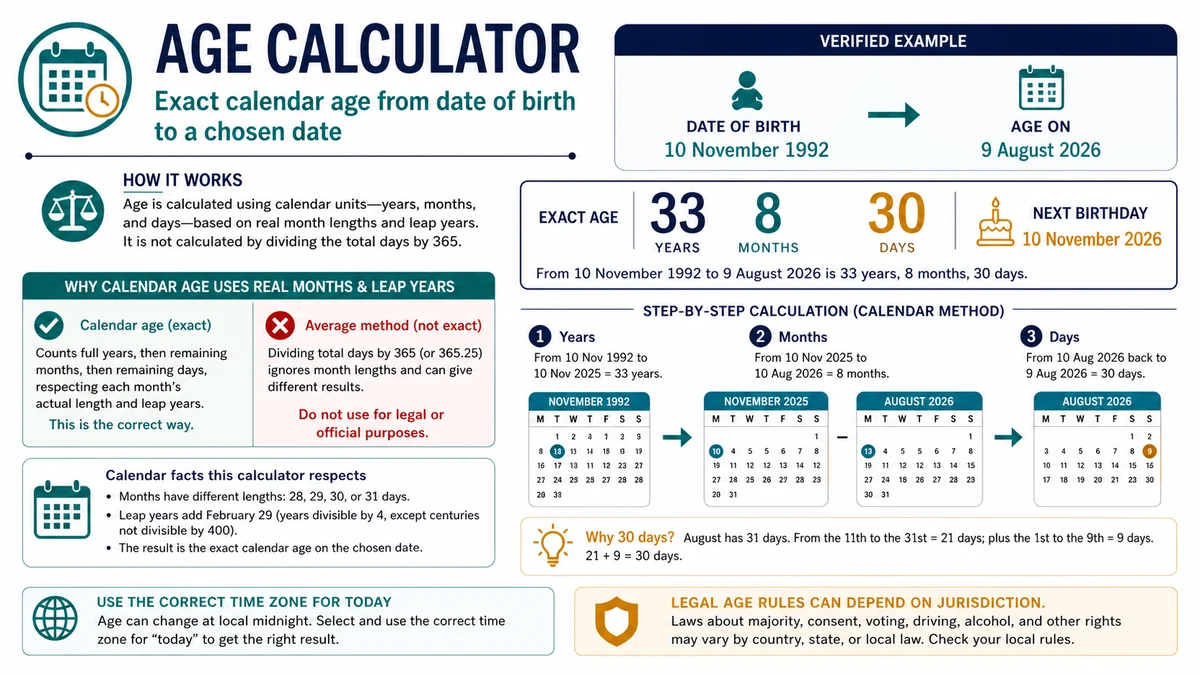
Calendar age and elapsed time are not the same. Calendar age follows real calendar boundaries such as months, birthdays, and leap years. Elapsed-time outputs convert the total time between two moments into continuous units such as days, hours, or seconds.

This calculator is for educational, planning, and general reference use only. Do not use it as the final source for legal age, immigration, employment, school admission, sports eligibility, insurance, medical, identity verification, contract, or official deadline decisions. For official use, confirm the exact rule with the relevant authority, document, institution, or qualified professional.

Reviewed by: AjaxCalculators Editorial Team
Last updated: April 27, 2026
Method source: Calendar-based age calculation using date of birth, optional time of birth, calculation date, calculation time, and elapsed-time conversions
Editorial standards: AjaxCalculators Editorial Policy

What This Age Calculator Calculates

This calculator estimates a person’s age from a date of birth and an optional calculation date. It also supports optional time-of-birth and calculation-time inputs for more detailed elapsed-time outputs.

Result What It Means Use Note
Calendar age Age shown in completed years, months, and days. Best for birthday-style age results.
Age on a specific date Age calculated on a selected past, current, or future date. Useful for milestones, records, and planning.
Age with optional time of birth Elapsed age calculated with a birth time when provided. Useful for hours, minutes, seconds, and milliseconds.
Total days lived Total elapsed days between birth date/time and calculation date/time. Useful for age milestones such as 10,000 days old.
Total weeks lived Total elapsed days divided by 7. Useful for weekly age estimates.
Total hours, minutes, seconds, and milliseconds Continuous elapsed-time outputs from the selected birth and calculation values. Most accurate when both birth time and calculation time are known.
Average months and average years Elapsed-time estimates using fixed average day values. Not the same as exact calendar months or birthday-based years.
Next birthday countdown Time remaining until the next birthday from the calculation date. Special interpretation may be needed for February 29 birthdays.

How the Age Calculator Works

The calculator can produce both calendar-style age and elapsed-time age. Calendar age counts completed calendar years, completed calendar months, and remaining days. Elapsed-time outputs convert the full time difference into one selected unit.

Calculation Type Method Best Use
Calendar age Compares date of birth with the selected calculation date and counts completed years, months, and days. Birthdays, personal age, and general age display.
Elapsed days Calculates the total elapsed duration and converts it into days. Total days lived and age milestones.
Elapsed weeks Total days ÷ 7. Approximate week-based age.
Elapsed hours Total days × 24, with time inputs included when available. Continuous-time age estimates.
Elapsed minutes Total hours × 60. Detailed time-lived estimates.
Elapsed seconds Total minutes × 60. Fun milestones and precise elapsed-time estimates.
Elapsed milliseconds Total seconds × 1,000. Very fine elapsed-time output, not normally needed for official use.
Next birthday Finds the next occurrence of the birth month and day after the calculation date. Birthday countdowns and reminders.

Calendar Age vs Total Time Lived

Calendar age and total elapsed time answer different questions. Calendar age follows real calendar boundaries, while total time lived measures the continuous duration between two points in time.

Age Type Question It Answers Example Use
Calendar age How old am I in years, months, and days? Birthday age, personal age, general forms, and age explanation.
Total days lived How many full or partial days have elapsed since birth? 10,000-day milestones and time-lived facts.
Total weeks lived How many weeks have elapsed since birth? Weekly age comparisons and milestone tracking.
Total hours, minutes, or seconds lived How much continuous time has passed since birth? Fun calculations, precise elapsed-time estimates, and educational examples.
Average months or years How does elapsed time look when divided by fixed average values? Approximate continuous-time conversion only.

Average Months and Average Years

The calculator’s average month and average year outputs are continuous-time conversions. They are useful for approximation, but they are not the same as exact calendar age.

Output Type Calculator Assumption Important Limitation
Average month 1 average month = 30.4375 days Real calendar months can have 28, 29, 30, or 31 days.
Average year 1 average year = 365.25 days Birthday-based age depends on actual calendar dates.
Calendar years/months/days Counts actual calendar boundaries. Better for age-style results.
Official age rules Not determined by average-month or average-year output. Use the exact rule from the relevant authority.

Why Age Calculation Can Be Tricky

Age calculation can be more complicated than subtracting years because real calendars are uneven and official rules can vary by purpose.

Issue Why It Matters
Different month lengths Months can have 28, 29, 30, or 31 days, so calendar months are not equal-length units.
Leap years Leap years add February 29 and create 366-day calendar years.
February 29 birthdays Non-leap-year birthday treatment can depend on legal, cultural, or personal rules.
Time of birth Precise hour, minute, second, and millisecond results depend on the actual birth time.
Calculation date Age changes depending on the date selected for the calculation.
Time zone and daylight saving Exact time-based results may depend on how dates and times are interpreted locally.
Official eligibility rules Schools, sports, immigration, employment, insurance, and legal systems may define cutoffs differently.

Assumptions and Important Notes

Assumption or Limitation What It Means
User-entered values The calculator uses the date and time values entered by the user.
Blank calculation date If no calculation date is entered, the live tool uses today internally.
Blank calculation time If no calculation time is entered, the live tool uses the current time internally.
Calendar Y/M/D result Calculated as a calendar-style age in years, months, and days.
Elapsed-time outputs Days, weeks, hours, minutes, seconds, and milliseconds are continuous elapsed-time values.
Average month and year outputs These use approximate day-based values, not exact calendar months or years.
Browser/device time handling Local date, time, and time-zone handling may affect precise time-based results.
No official verification The calculator does not verify identity, legal age, documents, eligibility, or official records.
No legal interpretation Organizations may use different cutoff dates, local rules, or special definitions of age.

Worked Example: Exact Calendar Age

Suppose someone was born on March 10, 2000, and you want to calculate age on April 27, 2026.

Step Calendar Count Result
Count completed years March 10, 2000 to March 10, 2026 26 years
Count completed months after birthday March 10, 2026 to April 10, 2026 1 month
Count remaining days April 10, 2026 to April 27, 2026 17 days
Combine calendar result 26 years + 1 month + 17 days 26 years, 1 month, 17 days

So, someone born on March 10, 2000 is 26 years, 1 month, and 17 days old on April 27, 2026.

Worked Example: Total Days Lived

Suppose the elapsed time between the date of birth and the calculation date is 9,545 days.

Step Calculation Result
Start with total days Total days = 9,545 9,545 days
Convert days to weeks 9,545 ÷ 7 About 1,363.57 weeks
Interpret the result Elapsed days converted into weeks Useful for week-based age milestones.

So, 9,545 days is about 1,363.57 weeks.

Worked Example: Age in Hours

If someone has lived 9,545 days, age in hours can be estimated by multiplying total days by 24.

Step Calculation Result
Start with total days Total days = 9,545 9,545 days
Convert days to hours 9,545 × 24 229,080 hours
Interpret the result Total elapsed time shown in hours Useful for fun milestones and continuous-time comparisons.

So, 9,545 days equals about 229,080 hours.

Worked Example: Next Birthday

Suppose someone was born on September 12, and the selected calculation date is April 27, 2026.

Step Calendar Check Result
Check this year’s birthday September 12, 2026 is after April 27, 2026. Birthday has not happened yet this year.
Choose next birthday date Use September 12, 2026. Next birthday is in the current selected year.
Count time remaining September 12, 2026 − April 27, 2026 The calculator displays the countdown.

If the birthday had already passed in the selected year, the calculator would use the birthday date in the following year.

How to Use This Age Calculator

  1. Enter the date of birth.
  2. Enter the time of birth if known, or leave it blank.
  3. Enter the date you want to calculate age on, or leave it blank to use today.
  4. Enter the calculation time if needed, or leave it blank to use the current time.
  5. Select the result format: milliseconds, seconds, minutes, hours, days, weeks, average months, average years, or calendar years/months/days.
  6. Review the age result, next birthday countdown, quick summary, and elapsed-time values.
  7. Use Refresh to clear the calculator and start again.

How to Interpret the Result

Result What It Means Important Caution
Years, months, and days Calendar-style age result. Best for birthday-style age, but official rules may still differ.
Total days Total elapsed days between birth and calculation date/time. May differ from calendar age because it is a continuous-time output.
Total weeks Total days divided by 7. Useful as an approximate week-based age.
Total hours Total elapsed days converted into hours. More precise when time of birth and calculation time are entered.
Total minutes, seconds, or milliseconds Fine elapsed-time outputs. Not normally used for official age decisions.
Next birthday in Time remaining until the next birthday. February 29 birthdays may need special interpretation in non-leap years.
Average months and years Elapsed time divided by fixed average day values. Not the same as exact calendar months or birthday-based age.

Age on a Specific Date

The “Calculate age on” field lets you calculate how old someone was, is, or will be on a selected date.

Use Case How It Helps Important Caution
Past milestone Find age on a past event date. Use correct historical date and time if precision matters.
Future milestone Estimate age on an upcoming event or birthday. Future rules or eligibility requirements may change.
School admission planning Estimate age on a school cutoff date. Always check the school or education authority’s official rule.
Sports eligibility Estimate age on a sports league cutoff date. Different leagues may define age groups differently.
Event age checks Estimate whether someone meets an age requirement on an event date. Use official event or venue rules for final decisions.
Legal or administrative purposes May help with a rough date check. Do not use this calculator as the final legal authority.

Age With Time of Birth

Entering the time of birth can make elapsed-time outputs more precise. This is most useful when calculating total hours, minutes, seconds, or milliseconds.

Input Situation Effect on Result Use Note
Birth time entered Elapsed-time outputs can include the time difference from the exact entered birth time. Better for precise hours, minutes, seconds, and milliseconds.
Birth time left blank The calculator can still estimate calendar age from the date of birth. Fine for most birthday-style age results.
Calculation time entered Elapsed-time outputs are calculated to the selected time. Useful for exact time-lived estimates.
Calculation time left blank The live tool uses the current time internally. Result can change as time passes.

February 29 Birthdays

People born on February 29 have a calendar birthday that appears only in leap years. In non-leap years, legal, cultural, institutional, or personal conventions may treat the birthday differently.

Situation Possible Interpretation Important Caution
Leap year February 29 exists, so the birthday occurs on the calendar date. This is the simplest case.
Non-leap year Some rules may use February 28. Check the applicable authority or document.
Non-leap year Some rules may use March 1. Official treatment can vary by country, institution, or purpose.
Legal eligibility The calculator should not decide the rule. Use the official legal or administrative rule.
Personal celebration The person may choose how to celebrate in non-leap years. This is separate from official age rules.

Practical Uses of an Age Calculator

This Age Calculator can be useful for personal, educational, planning, and time-milestone calculations.

Practical Use How the Calculator Helps
Calculate exact age from date of birth Shows age in years, months, and days.
Find age on a specific date Useful for past events, future milestones, and planning dates.
Check next birthday countdown Shows how much time remains until the next birthday.
Calculate total days lived Useful for 1,000-day or 10,000-day milestones.
Calculate age in weeks or hours Useful for fun comparisons and educational examples.
Estimate age in seconds or milliseconds Useful for time-lived facts and precise elapsed-time outputs.
Compare calendar age with elapsed time Helps explain why calendar years/months/days differ from total days or hours.
Planning around cutoff dates Can support rough checks for school, sports, or event dates.

Common Mistakes to Avoid

Mistake Why It Causes Problems
Treating average months as exact calendar months Calendar months have different lengths.
Treating average years as birthday-based years Birthday age follows calendar dates, not only total days divided by 365.25.
Forgetting to enter a calculation date The result will use today internally instead of the past or future date you intended.
Using precise time outputs without birth time Total hours, minutes, seconds, and milliseconds may not represent the exact birth moment.
Ignoring time zone effects Very precise results can depend on how the date and time are interpreted locally.
Assuming every organization uses the same cutoff rule Schools, sports leagues, government agencies, and events may define age eligibility differently.
Ignoring February 29 birthday rules Non-leap-year treatment can vary by legal or institutional rule.
Using the calculator for official verification Official age decisions require documents, policies, or authority-specific rules.

Formula Summary

What You Want to Find Formula or Method Use Note
Calendar age Calendar age = calculation date − date of birth Count completed years, completed months, and remaining days.
Total days Total days = elapsed milliseconds ÷ 86,400,000 Based on continuous elapsed time.
Total weeks Total weeks = total days ÷ 7 Week-based elapsed-time output.
Total hours Total hours = total days × 24 Time input improves precision.
Total minutes Total minutes = total hours × 60 Continuous-time output.
Total seconds Total seconds = total minutes × 60 Continuous-time output.
Total milliseconds Total milliseconds = total seconds × 1,000 Very fine elapsed-time output.
Average months Average months = total days ÷ 30.4375 Approximate, not exact calendar months.
Average years Average years = total days ÷ 365.25 Approximate, not birthday-based calendar years.
Next birthday countdown Next birthday countdown = next birthday date − calculation date Special handling may be needed for February 29 birthdays.

When You Should Not Use This Calculator

This calculator is helpful for general age estimates, but it should not be used as the final authority for official decisions.

Situation What to Use Instead
Legal age or identity verification Use official identity documents and the relevant legal rule.
Immigration or visa eligibility Use the government agency’s official rules and documents.
School admission cutoff Use the school or education authority’s official age cutoff policy.
Sports eligibility Use the league, federation, or event’s official age rule.
Employment or retirement eligibility Use employer policy, contract terms, and applicable law.
Insurance or medical eligibility Use the insurer, healthcare provider, or official policy documents.
Legal deadlines or contracts Use exact legal or contract-specific date rules.
February 29 official interpretation Use the relevant jurisdiction or institution’s official rule.

Frequently Asked Questions

What does this Age Calculator do?

It calculates age from a date of birth and an optional calculation date. It can show calendar age in years, months, and days, plus elapsed-time outputs such as days, weeks, hours, minutes, seconds, and milliseconds.

How do I calculate exact age in years, months, and days?

Enter the date of birth and the calculation date, then select the calendar years/months/days output. The calculator counts completed years, completed months, and remaining days.

What is the difference between calendar age and total days lived?

Calendar age follows real calendar boundaries. Total days lived measures the elapsed number of days between two dates or times.

Why are average months and calendar months different?

Average months use a fixed value of 30.4375 days. Real calendar months can have 28, 29, 30, or 31 days.

Why are average years and birthday age different?

Average years divide elapsed days by 365.25. Birthday age depends on completed birthdays and actual calendar dates.

Can I calculate age on a future or past date?

Yes. Use the “Calculate age on” field to select the date you want to measure age on.

Does the time of birth matter?

Time of birth matters for precise elapsed-time outputs such as hours, minutes, seconds, and milliseconds. It usually matters less for basic calendar age.

How does the calculator handle February 29 birthdays?

February 29 birthdays are straightforward in leap years. In non-leap years, official or personal treatment may vary, so check the relevant rule when the result matters.

Can I use this calculator for official age verification?

No. Use official documents, agency rules, school rules, sports rules, legal rules, or professional guidance for official age decisions.

References

  1. BIPM — SI Base Unit: Second
  2. NIST — Time and Frequency from A to Z: Leap Day, Leap Year, Leap Second
  3. NIST — Leap Seconds FAQs
  4. NIST Guide to the SI, Chapter 8 — Time and Rotational Frequency
  5. BIPM — SI Brochure

Related Calculators

Age Calculator Disclaimer

This Age Calculator is for educational, planning, and general date-calculation use only. It estimates age from the date and time values entered by the user.

Calendar age, average years, average months, and continuous elapsed-time outputs can differ because they use different calculation methods. Calendar age follows real calendar dates, while average-year and average-month outputs use fixed day-based approximations.

This calculator does not verify legal identity, birth records, immigration status, school eligibility, sports eligibility, employment eligibility, insurance eligibility, medical eligibility, contract deadlines, or official legal age. For legal, medical, school, immigration, insurance, employment, contract, or official eligibility decisions, confirm the exact rule with the relevant authority, document, institution, or qualified professional.

More of our calculators...

SLEEP CALCULATOR

Use our Sleep Calculator to find the best bedtime or wake-up time based on sleep cycles, fall-asleep time, and total hours in bed for a smoother morning.

Calorie Deficit Calculator

Use our Calorie Deficit Calculator to estimate BMR, maintenance calories, TDEE, calorie deficit, target calories, and weekly weight-change estimate.

Face Shape Calculator

Use our Face Shape Calculator to estimate your likely face shape from forehead, cheekbone, jawline, and face length measurements plus chin shape.

Age Difference Calculator

Use our Age Difference Calculator to find the exact age gap between two dates of birth in years, months, days, total months, total days, and approximate years.

Bikini Calculator

Use our Bikini Calculator to estimate your body shape from bust, waist, high hip, and hip measurements, then get bikini style suggestions that fit your shape.

Body Shape Calculator

Body Shape Calculator helps you identify your body type from key measurements and understand which shape category fits you best.

Helium Balloons Calculator

Use our Helium Balloons Calculator to estimate lift per balloon, total helium volume, and how many helium balloons you need to lift a given weight.

RPM Calculator

Use our RPM Calculator to find engine RPM from speed or vehicle speed from RPM using overall gear ratio and tire diameter, plus wheel RPM and tire circumference.

Reading Time Calculator

Use our Reading Time Calculator to estimate how long it takes to read a book, daily pages read, and time needed to finish from pages and reading speed.