BC ⇄ AD Year Difference
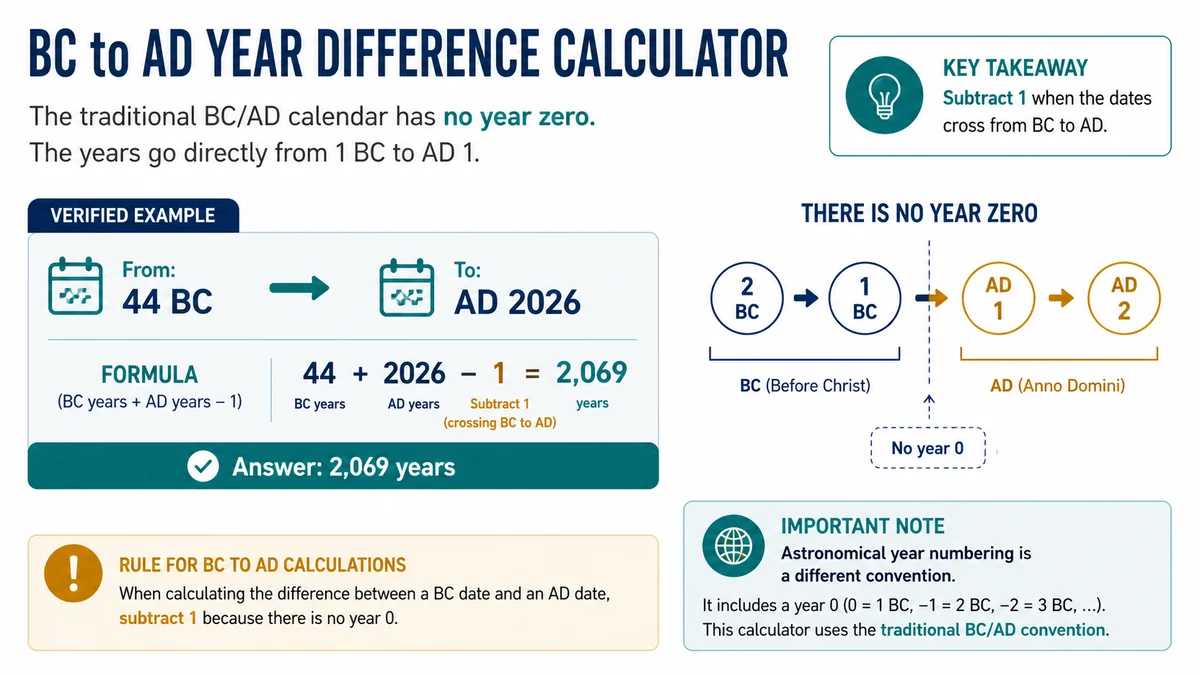
Compute the time between a BC/BCE year and an AD/CE year. Formula: D = BC + AD − 1 (no year 0).
Inputs
D = BC + AD − 1 (there’s no year 0). Enter here (with any other field) to solve the third.Quick summary
Step-by-step derivation
Formula (no year 0): D = BC + AD − 1
Substitute: D = …
Solve: …
Actions
Reference table & sources
- There is no year 0. 1 BC is followed immediately by AD 1.
- Formula:
D = BC + AD − 1, where D counts full years between the given years. - Naming equivalencies: BC ≡ BCE; AD ≡ CE (labels only; values unchanged).
Use this BC to AD Year Difference Calculator to find the number of years between a BC/BCE year and an AD/CE year. The calculator uses the historical calendar rule that there is no year 0, so 1 BC is followed immediately by AD 1.
Important Note: This BC to AD Year Difference Calculator counts the number of years between a BC/BCE year and an AD/CE year using historical year numbering.
The calculator uses the no-year-0 rule: 1 BC is followed immediately by AD 1. Because there is no year 0 in historical BC/AD notation, the main formula is D = BC + AD − 1.
This calculator is for year-number differences only. It does not calculate exact historical dates, months, days, calendar reforms, Julian-to-Gregorian changes, regional calendar adoption dates, archaeological dating uncertainty, regnal years, astronomical year numbering, Julian Day Numbers, or radiocarbon dating ranges. For specialist chronology, always confirm the calendar system and dating convention used by your source.
Reviewed by: AjaxCalculators Editorial Team
Last updated: April 27, 2026
Method source: Historical BC/AD and BCE/CE year-counting convention using the no-year-0 formula D = BC + AD − 1
Editorial standards: AjaxCalculators Editorial Policy
No-Year-0 Formula Notes
| Rule | Meaning | Calculator Effect |
|---|---|---|
| No year 0 | Historical BC/AD notation goes from 1 BC directly to AD 1. | Subtract 1 when crossing from BC/BCE to AD/CE. |
| Main formula | D = BC + AD − 1 | Finds the year-number difference across the era boundary. |
| BC/BCE labels | BC and BCE refer to the same numeric year label before AD/CE. | Label choice does not change the calculation. |
| AD/CE labels | AD and CE refer to the same numeric year label after BC/BCE. | Label choice does not change the calculation. |
| Century unit | 1 century = 100 years for numeric conversion. | This is different from naming historical centuries. |
What This BC to AD Year Difference Calculator Calculates
This calculator estimates year-number differences across the BC/BCE and AD/CE era boundary using the historical no-year-0 convention.
| Calculation | What It Means | Required Inputs |
|---|---|---|
| Time between BC/BCE and AD/CE | Finds how many years separate a BC/BCE year and an AD/CE year. | BC/BCE year and AD/CE year. |
| Missing BC/BCE year | Finds the BC/BCE year when the AD/CE year and time between are known. | AD/CE year and time between. |
| Missing AD/CE year | Finds the AD/CE year when the BC/BCE year and time between are known. | BC/BCE year and time between. |
| Years or centuries | Displays the result as years or numeric centuries. | Selected output unit. |
| Step-by-step derivation | Shows the formula, substitution, and final result. | Useful for checking the no-year-0 adjustment. |
How the BC to AD Year Difference Calculator Works
The calculator uses historical BC/AD or BCE/CE year numbering. In that system, there is no year 0, so the formula must subtract 1 when crossing from BC/BCE into AD/CE.
| What You Want to Find | Formula | Example |
|---|---|---|
| Time between BC and AD | D = BC + AD − 1 | 300 BC to AD 200: 300 + 200 − 1 = 499 years |
| Missing BC year | BC = D − AD + 1 | D = 499 and AD = 200: 499 − 200 + 1 = 300 BC |
| Missing AD year | AD = D − BC + 1 | D = 499 and BC = 300: 499 − 300 + 1 = AD 200 |
| Centuries from years | Centuries = years ÷ 100 | 499 years = 4.99 centuries |
| Years from centuries | Years = centuries × 100 | 4.99 centuries = 499 years |
Why There Is No Year 0
In normal historical BC/AD year numbering, the sequence around the era transition is:
| Historical Sequence | What Comes Next? |
|---|---|
| 3 BC | 2 BC |
| 2 BC | 1 BC |
| 1 BC | AD 1 |
| AD 1 | AD 2 |
There is no year labeled 0 between 1 BC and AD 1. That is why crossing the boundary requires subtracting 1 from the simple addition of the two year numbers.
BC/BCE and AD/CE Labels
BC/BCE and AD/CE are label choices. They do not change the numeric year calculation.
| Label | Meaning | Calculation Effect |
|---|---|---|
| BC | Before Christ | Same numeric value as BCE. |
| BCE | Before Common Era | Same numeric value as BC. |
| AD | Anno Domini | Same numeric value as CE. |
| CE | Common Era | Same numeric value as AD. |
For example, 500 BC and 500 BCE refer to the same year number for this calculator. AD 200 and 200 CE also refer to the same year number for this calculator.
Years vs Centuries
The calculator’s century option is a numeric unit conversion. It is not the same as naming historical centuries such as “5th century BC” or “1st century AD.”
| Concept | Meaning | Example |
|---|---|---|
| Numeric years | The calculated number of years between two year labels. | 500 BC to AD 500 = 999 years. |
| Numeric centuries | Years divided by 100. | 999 years = 9.99 centuries. |
| Named historical century | A label for a range of years, such as 5th century BC. | Can be confusing because century names do not equal exact year numbers. |
Use the century output only as a numeric conversion of the calculated year difference.
Historical Year Numbering vs Astronomical Year Numbering
This calculator uses historical BC/AD or BCE/CE year numbering. It does not use astronomical year numbering.
| System | How It Treats the Era Boundary | Example | Use Case |
|---|---|---|---|
| Historical BC/AD or BCE/CE | No year 0. 1 BC is followed by AD 1. | 1 BC to AD 1 = 1 year. | History timelines, general chronology, school history, archaeology notes, and ordinary historical writing. |
| Astronomical year numbering | Includes year 0 and uses negative years before year 0. | Astronomical year 0 corresponds to 1 BCE/BC. | Astronomy, ephemerides, computational chronology, and date algorithms. |
Do not mix these systems in the same calculation unless you deliberately convert between them.
Assumptions and Important Notes
| Assumption or Limitation | What It Means |
|---|---|
| Historical BC/AD notation | The calculator assumes the ordinary historical convention with no year 0. |
| BC/BCE values must be 1 or greater | There is no 0 BC or 0 BCE in this model. |
| AD/CE values must be 1 or greater | There is no AD 0 or CE 0 in this model. |
| BC and BCE are equivalent labels | Changing the label does not change the number. |
| AD and CE are equivalent labels | Changing the label does not change the number. |
| Year-number difference only | The result does not include exact months, days, seasons, or historical date details. |
| No astronomical year numbering | The calculator does not use year 0 or negative-number years. |
| No calendar reform modeling | The calculator does not model Julian/Gregorian calendar changes or local adoption dates. |
| No historical dating uncertainty | The calculator does not account for uncertain dates, regnal years, manuscript traditions, or archaeological dating ranges. |
Worked Example: 500 BC to AD 500
Suppose you want to calculate the year difference between 500 BC and AD 500.
| Step | Calculation | Result |
|---|---|---|
| Identify the BC year | BC = 500 | 500 BC |
| Identify the AD year | AD = 500 | AD 500 |
| Use the no-year-0 formula | D = BC + AD − 1 | Formula selected |
| Substitute values | D = 500 + 500 − 1 | 999 |
| Interpret result | 500 BC to AD 500 | 999 years |
So, the time between 500 BC and AD 500 is 999 years, not 1,000 years, because there is no year 0.
Worked Example: 1 BC to AD 1
This example shows why the calculator subtracts 1 when crossing the BC/AD boundary.
| Step | Calculation | Result |
|---|---|---|
| Identify the BC year | BC = 1 | 1 BC |
| Identify the AD year | AD = 1 | AD 1 |
| Apply the formula | D = 1 + 1 − 1 | 1 |
| Interpret result | 1 BC to AD 1 | 1 year |
So, 1 BC to AD 1 is a difference of 1 year. Adding 1 + 1 without subtracting 1 would incorrectly count a year 0.
Worked Example: Find the Missing AD Year
Suppose the BC year is 250 BC and the time between is 449 years. You want to find the AD year.
| Step | Calculation | Result |
|---|---|---|
| Use the rearranged formula | AD = D − BC + 1 | Formula selected |
| Substitute values | AD = 449 − 250 + 1 | 200 |
| Interpret result | AD = 200 | AD 200 |
So, a 449-year span after 250 BC reaches AD 200.
Worked Example: Find the Missing BC Year
Suppose the AD year is AD 300 and the time between is 699 years. You want to find the BC year.
| Step | Calculation | Result |
|---|---|---|
| Use the rearranged formula | BC = D − AD + 1 | Formula selected |
| Substitute values | BC = 699 − 300 + 1 | 400 |
| Interpret result | BC = 400 | 400 BC |
So, a 699-year span ending in AD 300 begins at 400 BC.
How to Use This BC to AD Year Difference Calculator
- Enter the BC or BCE year if known.
- Enter the AD or CE year if known.
- Leave the time-between field blank if you want the calculator to find the difference.
- Or enter the time between with either the BC/BCE year or AD/CE year to solve the missing year.
- Select years or centuries depending on how you want the result displayed.
- Choose BC/BCE or AD/CE labels based on your preferred notation. The labels do not change the math.
- Review the quick summary and step-by-step derivation.
- Use Refresh to clear the fields and start again.
How to Interpret the Result
| Result Item | What It Means | Important Caution |
|---|---|---|
| Year BC/BCE | The year number before the AD/CE era. | Must be 1 or greater in historical notation. |
| Year AD/CE | The year number after the BC/BCE era transition. | Must be 1 or greater in historical notation. |
| Time between | The calculated year-number difference using D = BC + AD − 1. | This is not an exact month/day/date interval. |
| Also equals | The same result shown in another unit, such as centuries. | Century output is numeric conversion, not historical century naming. |
| Step-by-step derivation | The formula path used by the calculator. | Use it to confirm the no-year-0 adjustment. |
Why Simple Addition or Subtraction Can Be Wrong Across BC and AD
BC and AD year labels do not form a continuous historical number line with zero in the middle. That makes ordinary arithmetic misleading unless you adjust for the missing year 0.
| Example | Wrong Method | Correct Method | Correct Result |
|---|---|---|---|
| 1 BC to AD 1 | 1 + 1 = 2 | 1 + 1 − 1 | 1 year |
| 100 BC to AD 100 | 100 + 100 = 200 | 100 + 100 − 1 | 199 years |
| 500 BC to AD 500 | 500 + 500 = 1,000 | 500 + 500 − 1 | 999 years |
The missing year 0 is the reason the calculator subtracts 1 when crossing from BC/BCE to AD/CE.
Practical Uses of a BC to AD Year Difference Calculator
This calculator is useful when you need a quick year-number span across the BC/BCE and AD/CE boundary.
| Use Case | How the Calculator Helps |
|---|---|
| History homework | Checks year differences across the BC/AD transition. |
| Teaching chronology | Demonstrates why there is no year 0 in historical notation. |
| Ancient-to-modern timeline spans | Estimates the number of years between ancient BC/BCE years and AD/CE years. |
| Archaeology notes | Helps compare simplified BC/BCE and AD/CE year labels. |
| Museum or educational timelines | Supports quick timeline-span checks for exhibits or study material. |
| Solving missing year values | Finds the missing BC/BCE or AD/CE year when a span is known. |
| Avoiding the year-zero mistake | Prevents overcounting by one year across the era transition. |
Common Mistakes to Avoid
| Mistake | Why It Causes Problems |
|---|---|
| Including a year 0 in historical BC/AD notation | Historical notation moves directly from 1 BC to AD 1. |
| Forgetting to subtract 1 across BC and AD | This overcounts the span by one year. |
| Entering 0 as a BC/BCE or AD/CE year | There is no year 0 in this calculator’s historical model. |
| Confusing BC/BCE with different numbers | BC and BCE are label alternatives for the same numeric year value. |
| Confusing AD/CE with different numbers | AD and CE are label alternatives for the same numeric year value. |
| Using astronomical year numbering by mistake | Astronomical year numbering includes year 0 and uses a different numeric system. |
| Using named centuries as exact year numbers | Historical century names can be confusing and are not the same as numeric year differences. |
| Using this calculator for exact historical dates | The calculator does not handle months, days, calendar reforms, or local calendar adoption. |
| Ignoring source-specific dating conventions | Historical, archaeological, astronomical, and religious sources may use different dating conventions. |
Formula Summary
| What You Want to Find | Formula | Use Note |
|---|---|---|
| Time between BC and AD | D = BC + AD − 1 | Subtract 1 because there is no year 0. |
| BC year from D and AD | BC = D − AD + 1 | Use when time between and AD/CE year are known. |
| AD year from D and BC | AD = D − BC + 1 | Use when time between and BC/BCE year are known. |
| Centuries from years | Centuries = years ÷ 100 | Numeric unit conversion only. |
| Years from centuries | Years = centuries × 100 | Numeric unit conversion only. |
When You May Need a Different Method
This calculator is best for simple year-number differences across BC/BCE and AD/CE. Some historical or technical work needs a more specific method.
| Need | Better Method |
|---|---|
| Exact date interval | Use a date calculator that supports the correct calendar system. |
| Julian vs Gregorian calendar dates | Use a calendar-conversion method and verify local adoption dates. |
| Astronomical calculations | Use astronomical year numbering or Julian Day Numbers as required. |
| Archaeological dating ranges | Use the dating convention and uncertainty range provided by the source. |
| Radiocarbon dates | Use calibrated radiocarbon methods and source-specific reporting conventions. |
| Regnal years or ancient calendars | Use a specialist chronology reference for that culture or period. |
| Manuscript or historical-source dating | Check the source’s calendar system, era, and scholarly dating notes. |
Frequently Asked Questions
How do I calculate the years between BC and AD?
Use D = BC + AD − 1. The subtraction of 1 is needed because there is no year 0 in historical BC/AD notation.
Why do you subtract 1 when calculating from BC to AD?
Historical year numbering goes from 1 BC directly to AD 1. Subtracting 1 prevents accidentally counting a year 0 that did not exist in that system.
How many years are between 1 BC and AD 1?
There is 1 year between 1 BC and AD 1. The calculation is 1 + 1 − 1 = 1.
How many years are between 500 BC and AD 500?
There are 999 years between 500 BC and AD 500. The calculation is 500 + 500 − 1 = 999.
Is BC the same as BCE?
For this calculator, yes. BC and BCE are treated as equivalent labels for the same numeric year before AD/CE.
Is AD the same as CE?
For this calculator, yes. AD and CE are treated as equivalent labels for the same numeric year after BC/BCE.
Is there a year 0 between BC and AD?
No. In historical BC/AD notation, 1 BC is followed immediately by AD 1.
What is astronomical year numbering?
Astronomical year numbering is a different system that includes year 0 and negative years. This calculator does not use that system.
Can I use this calculator for exact historical dates?
No. This calculator handles year-number differences only. It does not calculate exact month/day intervals, calendar reforms, Julian-to-Gregorian changes, or historical dating uncertainty.
What does the century result mean?
The century result is a numeric conversion where 1 century equals 100 years. It is not the same as naming historical centuries such as “5th century BC.”
References
- NASA Eclipse Web Site — Year Dating Conventions
- NASA Eclipse Web Site — Calendars and Their History
- NASA/JPL NAIF CSPICE Documentation — Calendar Date Convention and No Year 0 Note
- Britannica Dictionary — BCE Definition
- Britannica Dictionary — AD Definition
Related Calculators
- Time Calculator
- Add Time Calculator
- Age Calculator
- Age Difference Calculator
- Reading Time Calculator
- Words Per Minute Calculator
- Sleep Calculator
BC to AD Year Difference Calculator Disclaimer
This BC to AD Year Difference Calculator is for educational, historical, and general timeline use only. It calculates year-number differences between BC/BCE and AD/CE years using the historical no-year-0 convention.
It does not calculate exact dates, months, days, calendar reforms, Julian-to-Gregorian changes, local calendar adoption dates, astronomical year numbering, Julian Day Numbers, regnal years, archaeological dating uncertainty, radiocarbon ranges, manuscript dating, or specialist chronology conventions.
For academic, archaeological, astronomical, legal, religious, manuscript, or specialist historical work, verify the calendar system, era notation, source convention, and dating method used by the relevant source or qualified expert.