Korean Age Calculator
Convert your age to the traditional 🇰🇷 Korean system in real time.
🧮 Step-by-step derivation
📚 Reference
| System | Rule | Formula (given) |
|---|---|---|
| International age | 0 at birth; +1 on birthday | Age = current year − birth year (adjust by birthday) |
| Korean age (traditional) | 1 at birth; +1 each Jan 1 | By year: (CY − YOB) + 1 | By age: age + 1 (if passed) else + 2 |
| “Year age” | Same birth year ⇒ same age | CY − YOB |
South Korea adopted international age for official use in 2023, but the traditional “Korean age” is still commonly used informally.
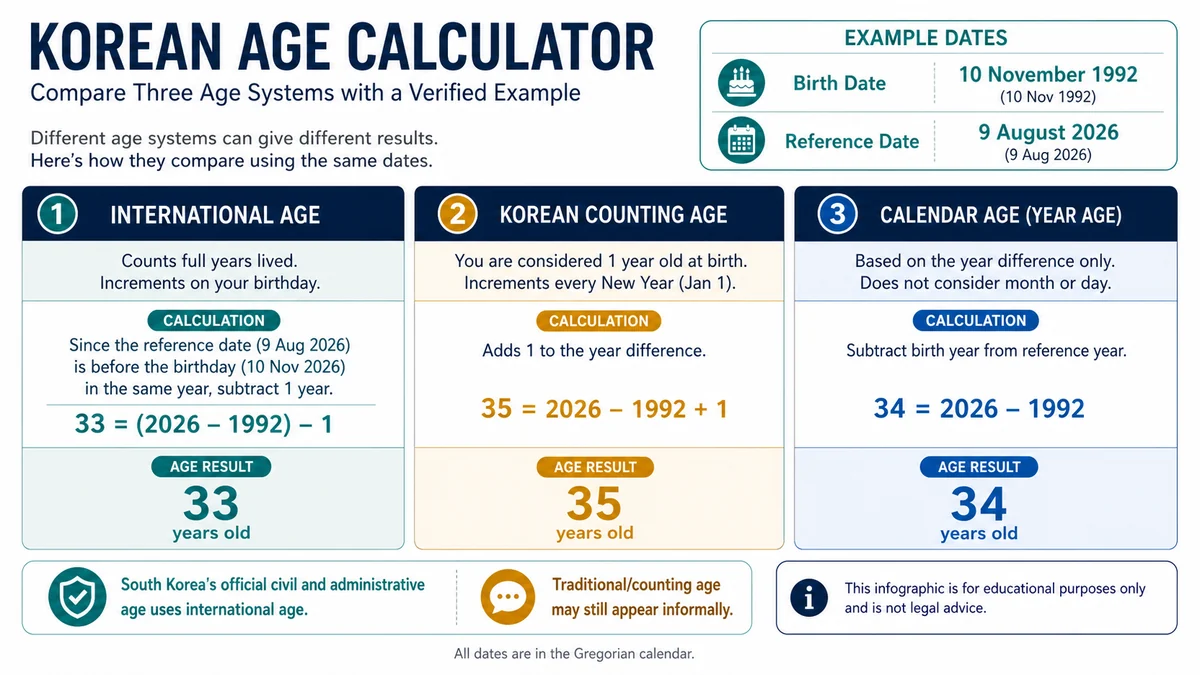
Use this Korean Age Calculator to convert your birth year or international age into the traditional Korean age system. The calculator can estimate Korean age from a birth year, or convert your current international age into the traditional Korean age used informally in Korea.
Important Note: This Korean Age Calculator explains and estimates the traditional Korean age-counting system. Traditional Korean age counts a person as 1 year old at birth and adds one year every January 1.
South Korea standardized the use of international age for most civil and administrative purposes from June 28, 2023. That means traditional Korean age is mainly useful today for cultural, informal, educational, entertainment, and historical context, not for most official age decisions.
Do not use this calculator for legal eligibility, immigration, military service, alcohol, tobacco, employment, school entry, healthcare, contracts, age-restricted services, or official South Korean administrative decisions. For official use, follow the relevant South Korean law, agency guidance, document, or professional advice.
Reviewed by: AjaxCalculators Editorial Team
Last updated: April 28, 2026
Method source: Traditional Korean age formula, international age formula, and Korean calendar-age/year-age explanation
Editorial standards: AjaxCalculators Editorial Policy
Korean Age Formula Notes
| Age System | Rule | Formula |
|---|---|---|
| International age | Starts at 0 at birth and increases on the birthday. | Current year − birth year, adjusted by whether the birthday has passed. |
| Traditional Korean age | Starts at 1 at birth and increases every January 1. | Korean age = current year − birth year + 1 |
| Year age / calendar age | Groups people by birth year and does not check the birthday. | Year age = current year − birth year |
| Korean age from current international age | Depends on whether the birthday has passed this year. | Age + 1 after birthday; age + 2 before birthday. |
What This Korean Age Calculator Calculates
This calculator estimates traditional Korean age and compares it with international age and year age. It is designed for cultural understanding, Korean language learning, entertainment profiles, and general age-system comparison.
| Result | What It Means | Use Note |
|---|---|---|
| Traditional Korean age | The older Korean counting method where a person is 1 at birth and gains another year on January 1. | Useful for cultural and informal age references. |
| International age | The birthday-based age system used in most countries and now standardized for most South Korean civil and administrative purposes. | Use for most official age contexts unless a special rule applies. |
| Year age / calendar age | Current year minus birth year, without checking whether the birthday has passed. | Some special laws or contexts may still use year-based age rules. |
| Step-by-step derivation | The calculation path used by the tool. | Helps explain why Korean age may be 1 or 2 years higher than international age. |
Important 2023 Update About Korean Age
South Korea changed its official age-counting standard in 2023. From June 28, 2023, the international age-counting system became the standard for most civil and administrative purposes.
| Age System | After the 2023 Change | Important Note |
|---|---|---|
| International age | Standard for most civil and administrative purposes. | Starts at 0 at birth and increases on the birthday. |
| Traditional Korean age | Mainly cultural, social, informal, educational, or historical. | Do not use it as the default official legal age. |
| Year age / calendar age | May still appear in some specific laws or administrative rules. | Check the relevant law or agency rule before using it for eligibility. |
For official decisions, the safest rule is to use international age unless a specific South Korean law, agency, or document states a different age-counting method.
What Korean Age Means
Korean age traditionally counts a person as 1 year old at birth. Then everyone becomes one year older on January 1, not on their individual birthday.
Because of this, traditional Korean age is usually one or two years higher than international age.
For example, a baby born on December 31 would be 1 year old in traditional Korean age on the day of birth. On January 1, that baby would become 2 years old in Korean age, even though only one day has passed.
How the Korean Age Calculator Works
1) Traditional Korean Age Formula
The standard traditional Korean age formula is:
Korean age = current year − birth year + 1
In this formula:
- current year is the Gregorian calendar year
- birth year is the year the person was born
- +1 is added because traditional Korean age starts at 1 at birth
2) International Age Formula
International age starts at 0 at birth and increases on the person’s birthday.
If your birthday has already passed this year:
International age = current year − birth year
If your birthday has not passed yet this year:
International age = current year − birth year − 1
3) Converting Current Age to Korean Age
If you already know your current international age, traditional Korean age is usually estimated like this:
If your birthday has passed this year: Korean age = international age + 1
If your birthday has not passed this year: Korean age = international age + 2
This happens because traditional Korean age increases on January 1, while international age increases on the birthday.
4) Year Age Formula
Year age, also called calendar age, is calculated by subtracting birth year from current year.
Year age = current year − birth year
Year age does not check whether the birthday has passed. It groups everyone born in the same calendar year together.
Korean Age vs International Age vs Year Age
Korea has used more than one age-counting method. The differences matter because each system can produce a different number for the same person.
| Age System | How It Counts Age | Formula | Typical Use |
|---|---|---|---|
| Traditional Korean age | Starts at 1 at birth and increases every January 1. | Current year − birth year + 1 | Cultural, informal, entertainment, social, or historical references. |
| International age | Starts at 0 at birth and increases on the birthday. | Current year − birth year, adjusted by birthday. | Most official civil and administrative use in South Korea after the 2023 standardization. |
| Year age / calendar age | Counts only the difference between current year and birth year. | Current year − birth year | Some special legal or administrative contexts where year-based rules apply. |
Worked Example Using Birth Year
Suppose someone was born in 2000 and the current year is 2026.
| Step | Calculation | Result |
|---|---|---|
| Use the traditional Korean age formula | Korean age = current year − birth year + 1 | Formula selected |
| Substitute values | 2026 − 2000 + 1 | 26 + 1 |
| Calculate Korean age | 26 + 1 | 27 |
So, someone born in 2000 would be 27 years old in the traditional Korean age system during 2026.
Worked Example Using Current International Age
Suppose someone is 25 years old by international age.
| Birthday Status | Formula | Traditional Korean Age |
|---|---|---|
| Birthday has passed this year | Korean age = international age + 1 | 25 + 1 = 26 |
| Birthday has not passed this year | Korean age = international age + 2 | 25 + 2 = 27 |
This is why the calculator asks whether the birthday has passed this year when converting from current international age.
How to Use This Korean Age Calculator
- Select whether you want to calculate by Year of birth or Current age.
- If using year of birth, enter the current year and your birth year.
- Select whether your birthday has passed this year.
- If using current age, enter your current international age.
- Review the traditional Korean age result, quick summary, and step-by-step derivation.
- Use Refresh to clear the calculator and start again.
How to Interpret the Result
| Result | What It Means | Important Caution |
|---|---|---|
| Traditional Korean age | The cultural age-counting result where a person is 1 at birth and gains another year every January 1. | Useful for informal or cultural understanding, not most official decisions after the 2023 standardization. |
| International age | The birthday-based age system where a person starts at 0 and gains one year on the birthday. | This is the main standard for most official South Korean civil and administrative use. |
| Year age / calendar age | Current year minus birth year, without checking the birthday. | May still be used in some specific legal or administrative contexts. |
| Birthday passed status | Used to estimate the difference between international age and traditional Korean age. | Needed for current-age conversion because international age changes on the birthday. |
| Step-by-step derivation | The formula path used by the calculator. | Use it to check whether the correct method and birthday status were selected. |
Why Korean Age Can Be Confusing
Korean age can be confusing because traditional Korean age, international age, and year age use different counting rules.
| Reason | Why It Causes Confusion |
|---|---|
| Traditional Korean age starts at 1 | Many countries count a newborn as 0 years old, so starting at 1 can feel unusual. |
| Traditional Korean age increases on January 1 | Everyone becomes one year older together, not on individual birthdays. |
| International age increases on the birthday | It depends on whether the person’s birthday has passed this year. |
| Year age ignores birthday | It groups everyone born in the same calendar year together. |
| South Korea changed official age rules in 2023 | Traditional Korean age may still appear informally, but international age is now the main official standard. |
| Some laws may still use year-based rules | Specific statutes or agencies may use calendar age, so official eligibility should be verified. |
Is Korean Age Still Official in South Korea?
Traditional Korean age is not the general official standard for civil and administrative use in South Korea after the 2023 age-standardization change. International age is now the main standard in most official situations.
| Context | Use International Age? | Important Note |
|---|---|---|
| Civil and administrative use | Usually yes | International age is the standard after the 2023 change. |
| Everyday cultural discussion | Not always | Traditional Korean age may still be discussed informally. |
| Entertainment profiles or Korean culture content | Depends on context | Traditional Korean age may appear for explanation or cultural reference. |
| Military, youth protection, school, or age-restricted rules | Verify first | Some contexts may use specific legal definitions or year-based rules. |
| Immigration, healthcare, employment, contracts, or eligibility | Verify with the official source | Do not rely on a general Korean age calculator for official decisions. |
Common Mistakes to Avoid
| Mistake | Why It Causes Problems |
|---|---|
| Using traditional Korean age for official eligibility | South Korea now uses international age as the main civil and administrative standard. |
| Subtracting birth year only and calling it Korean age | Traditional Korean age adds 1 because the person is counted as 1 at birth. |
| Forgetting January 1 | Traditional Korean age increases on January 1, not on the individual birthday. |
| Confusing traditional Korean age with year age | Year age is current year minus birth year, while traditional Korean age adds 1. |
| Confusing international age with year age | International age checks whether the birthday has passed; year age does not. |
| Using the current-age method without birthday status | The conversion from international age to Korean age changes depending on whether the birthday has passed. |
| Using lunar birthday assumptions without context | The calculator uses Gregorian calendar years and does not handle lunar-calendar birthday rules. |
| Using the calculator for legal, immigration, military, alcohol, tobacco, school-entry, or healthcare decisions | Those decisions may require official rules, documents, or agency guidance. |
Korean Age Formula Summary
| What You Want to Find | Formula | Use Note |
|---|---|---|
| Traditional Korean age | Korean age = current year − birth year + 1 | Starts at 1 at birth and increases every January 1. |
| International age after birthday | International age = current year − birth year | Use when the birthday has already passed this year. |
| International age before birthday | International age = current year − birth year − 1 | Use when the birthday has not passed yet this year. |
| Year age / calendar age | Year age = current year − birth year | Does not check the birthday. |
| Korean age from current age after birthday | Korean age = international age + 1 | Use when the birthday has passed this year. |
| Korean age from current age before birthday | Korean age = international age + 2 | Use when the birthday has not passed yet this year. |
Practical Uses
This Korean Age Calculator is useful for understanding age references in Korean cultural, educational, and entertainment contexts.
| Use Case | How the Calculator Helps |
|---|---|
| Korean culture learning | Explains why traditional Korean age can be higher than international age. |
| Korean language learning | Helps learners understand age-related conversations and cultural references. |
| K-pop or entertainment profiles | Helps compare traditional Korean age, international age, and birth-year age references. |
| Travel and social context | Helps visitors understand informal age discussions in Korea. |
| Education and classroom examples | Provides simple examples for teaching age-counting differences. |
| Birth-year comparison | Shows how people born in the same calendar year can share the same traditional Korean age. |
| Understanding the 2023 age-standardization change | Clarifies why international age is now the main official standard in South Korea. |
When You Should Not Use This Calculator
This calculator is for educational and cultural explanation. It should not be used as the final source for official eligibility or regulated age decisions.
| Situation | What to Use Instead |
|---|---|
| Immigration or visa decisions | Use the relevant government agency’s official age rule. |
| Military service or conscription | Use the applicable South Korean statute or official military guidance. |
| Alcohol, tobacco, or youth-protection rules | Use the exact legal standard in the relevant law. |
| School entry or education eligibility | Use the official education authority or school rule. |
| Employment, retirement, pension, or benefits | Use the contract, statute, employer policy, or agency guidance. |
| Healthcare, insurance, or medical eligibility | Use official records and professional guidance. |
| Contracts or legal documents | Use the legal age definition required by the document or jurisdiction. |
Frequently Asked Questions
What is Korean age?
Traditional Korean age is an age-counting system where a person is counted as 1 year old at birth and gains another year every January 1.
How do I calculate traditional Korean age?
Use Korean age = current year − birth year + 1. For example, in 2026, someone born in 2000 has a traditional Korean age of 27.
Why is Korean age higher than international age?
Traditional Korean age starts at 1 at birth and increases on January 1, while international age starts at 0 and increases on the birthday. That is why Korean age is often 1 or 2 years higher.
What is international age?
International age is the birthday-based age system. A person starts at 0 at birth and becomes one year older on their birthday.
What is year age or calendar age?
Year age is current year minus birth year. It does not check whether the person’s birthday has passed.
Is Korean age still official in South Korea?
Traditional Korean age is not the general official standard after South Korea’s 2023 age-standardization change. International age is now the main standard for most civil and administrative purposes.
Can some South Korean laws still use calendar age?
Yes. Some specific laws or administrative rules may still use calendar age or year-based age rules. Always check the relevant official rule for legal or eligibility decisions.
Can I use this calculator for legal age decisions?
No. Do not use it for immigration, military service, alcohol, tobacco, healthcare, school entry, employment, contracts, or official eligibility decisions.
Does this calculator handle lunar birthdays?
No. This calculator uses Gregorian calendar year logic and does not handle lunar-calendar birthday assumptions.
References
- Seoul Foreign Portal — A National Law on Standardizing International Age Will Take Effect on June 28, 2023
- Library of Congress — Koreans Becoming Younger: Unification of Age-Counting Systems
- Reuters — South Koreans Become a Year or Two Younger as Traditional Age Counting Scrapped
- Al Jazeera — South Korea Age System Explained
- Ministry of Government Legislation — International Age Calculation Information
Related Calculators
- Age Calculator
- Age Difference Calculator
- Time Calculator
- BC to AD Year Difference Calculator
- Reading Time Calculator
- Sleep Calculator
Korean Age Calculator Disclaimer
This Korean Age Calculator is for educational, cultural, and general reference use only. It explains traditional Korean age, international age, and year age using simple formulas.
South Korea standardized international age for most civil and administrative purposes from June 28, 2023. Traditional Korean age may still appear in informal, social, cultural, entertainment, or historical contexts, but it should not be treated as the default official legal age.
Do not use this calculator for legal eligibility, immigration, military service, alcohol, tobacco, employment, school entry, healthcare, contracts, age-restricted services, or official administrative decisions. Some special laws or agencies may still use calendar-age or year-based rules, so verify official age requirements with the relevant law, document, agency, or qualified professional.