Reading Time Calculator

Estimate how long it will take to read a book, and plan your daily reading.

Total reading time

Reader type presets fill a typical speed. Choose “Custom” to enter your own.

pages /
Preset: Average ≈ 0.5 pages/min
pages
Hours & minutes: —

Book reading duration

pages / day

References

  • Total time (min) = pages ÷ (pages/min).
  • Unit links: 1 hour = 60 min; 1 week ≈ 7 days; 1 month ≈ 30 days.
  • Typical adult reading speed ≈ 0.5 pages/min (useful as an “average” preset).

Use this Reading Time Calculator to estimate how long it will take to read a book from its page count and your reading speed. You can also enter your daily reading time to estimate how many pages you can read per day and how long it may take to finish the book.

Important Note: This Reading Time Calculator estimates book reading time from page count and reading speed. It can estimate total reading time, pages per day, and how long it may take to finish a book based on your daily reading time.

The result is a planning estimate only. Real reading time can vary by page size, words per page, font size, margins, illustrations, topic difficulty, reader focus, language fluency, fatigue, rereading, note-taking, highlighting, and whether the book is fiction, nonfiction, academic, technical, or exam-related.

For exact article, script, or web-content timing, a word-count and words-per-minute calculator is usually more precise than a page-based calculator. For school, exams, professional study, or technical reading, add extra time for notes, review, comprehension checks, and rereading.

Reviewed by: AjaxCalculators Editorial Team
Last updated: April 26, 2026
Method source: Standard reading-time formulas using book length in pages, reading speed in pages per minute or pages per hour, and daily reading time
Editorial standards: AjaxCalculators Editorial Policy

Reading Time Formula Notes

Item Formula or Rule Use Note
Total reading time Total time = pages ÷ reading speed Use pages per minute or pages per hour consistently.
Pages per hour Pages per hour = pages per minute × 60 Useful for book-reading estimates.
Pages per minute Pages per minute = pages per hour ÷ 60 Useful when the reading speed is entered by hour.
Daily pages Daily pages = reading speed × daily reading time Daily reading time must be in the matching time unit.
Days to finish Days = total pages ÷ daily pages Assumes the same reading habit continues each day.
Average month 1 month ≈ 30 days Approximate planning value only, not a calendar-month guarantee.

What This Reading Time Calculator Calculates

This calculator estimates reading time and reading-plan values from page count, reading speed, and optional daily reading time.

Result What It Means Important Use Note
Total reading time The estimated active reading time needed to finish the book. Based on page count and selected reading speed.
Time in minutes Total reading time shown as minutes. Useful for shorter books, chapters, or study sessions.
Time in hours Total reading time converted into hours. Useful for planning total reading workload.
Hours and minutes A more readable mixed-time format. Useful for everyday planning.
Daily reading pages Estimated pages you may read per day. Based on reading speed and daily reading time.
Period needed to finish Estimated days, weeks, or months needed to finish the book. Assumes the same daily reading habit continues.

How the Reading Time Calculator Works

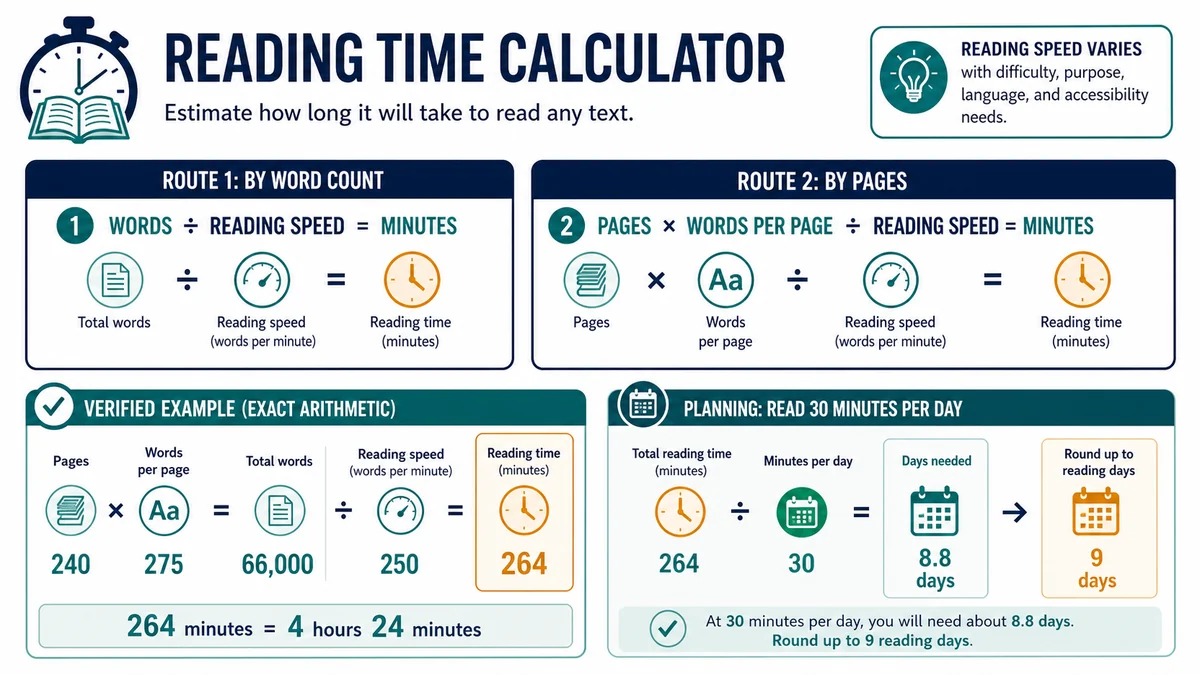
The calculator uses simple reading-time formulas. It divides book pages by reading speed, then converts the result into the selected time format.

Step Formula or Method Example
Total time in minutes Total minutes = total pages ÷ pages per minute 240 pages ÷ 0.5 pages/min = 480 minutes
Total time in hours Total hours = total minutes ÷ 60 480 ÷ 60 = 8 hours
Pages per hour Pages per hour = pages per minute × 60 0.5 × 60 = 30 pages/hour
Pages per minute Pages per minute = pages per hour ÷ 60 45 ÷ 60 = 0.75 pages/min
Daily pages Daily pages = pages per minute × daily reading minutes 0.5 × 30 = 15 pages/day
Days to finish Days = total pages ÷ daily pages 240 ÷ 15 = 16 days

Reader Type Presets

The calculator includes reader presets to make estimates faster. These presets are planning shortcuts, not fixed reading-speed rules.

Reader Preset Best For Important Caution
Slow Dense books, textbooks, technical material, careful reading, second-language reading, or note-taking. Use when comprehension matters more than speed.
Average General book reading, familiar nonfiction, or ordinary reading plans. The live tool shows the average preset as about 0.5 pages per minute.
Quick Easier material, light fiction, familiar topics, or faster readers. May be too fast for academic, technical, or unfamiliar books.
Custom Your measured reading speed. Best option when you know your actual pages-per-minute or pages-per-hour speed.

Pages vs Words

This calculator estimates reading time from page count. That is useful when a book’s page count is easier to find than its exact word count, but page-based estimates are less precise than word-based estimates.

Method Best Use Limitation
Page-based reading time Books, textbooks, printed materials, manuals, and reading challenges. Pages can vary by font size, margin, page dimensions, images, and word density.
Word-based reading time Articles, scripts, web pages, essays, manuscripts, and exact text timing. Requires a reliable word count.
Pages per minute Personal book-reading pace. Depends heavily on book layout and difficulty.
Words per minute More standardized reading-speed comparison. Still varies by language, difficulty, purpose, and reader skill.

If you know the exact word count, use a words-per-minute calculator for a more precise timing estimate.

Assumptions and Important Notes

Assumption or Limitation What It Means
Page-based estimate The calculator estimates reading time from page count, not exact word count.
Constant reading speed The calculator assumes your selected pages-per-minute or pages-per-hour speed stays the same.
No automatic difficulty adjustment The calculator does not know whether the book is light fiction, dense nonfiction, academic, technical, or exam material.
No layout adjustment It does not adjust for font size, margins, page dimensions, images, charts, footnotes, or spacing.
No study-time buffer It does not automatically add time for notes, highlighting, exercises, review, or rereading.
Daily plan assumes consistency The finish-date estimate assumes you keep the same daily reading time and speed.
Month output is approximate The calculator uses an approximate month for planning, not exact calendar months.
Not a comprehension measure A fast reading-time estimate does not prove that the material was understood or retained.

Worked Example: Total Reading Time

Suppose you want to read a 240-page book and your reading speed is 0.5 pages per minute.

Step Calculation Result
Use the total reading time formula Total time = pages ÷ pages per minute Formula selected
Insert the values 240 ÷ 0.5 240 pages at 0.5 pages/min
Calculate minutes 240 ÷ 0.5 = 480 480 minutes
Convert minutes to hours 480 ÷ 60 8 hours

So, a 240-page book at 0.5 pages per minute takes about 8 hours of active reading time.

Worked Example: Daily Reading Plan

Suppose a book has 240 pages, and you plan to read for 30 minutes per day at 0.5 pages per minute.

Step Calculation Result
Calculate daily pages Daily pages = pages per minute × daily reading minutes Formula selected
Insert the values 0.5 × 30 15 pages/day
Calculate days to finish 240 ÷ 15 16 days
Interpret the plan 30 minutes per day at 15 pages/day About 16 reading days

So, if you read 30 minutes per day at this pace, you may finish the 240-page book in about 16 days.

Worked Example: Pages Per Hour

Suppose you read 45 pages per hour and the book has 360 pages.

Step Calculation Result
Use the hours formula Total hours = pages ÷ pages per hour Formula selected
Insert the values 360 ÷ 45 360 pages at 45 pages/hour
Calculate total hours 360 ÷ 45 = 8 8 hours

So, at 45 pages per hour, a 360-page book takes about 8 hours of active reading time.

How to Use This Reading Time Calculator

  1. Select your reader type: Slow, Average, Quick, or Custom.
  2. Enter your reading speed in pages per minute or pages per hour.
  3. Enter the book length in pages.
  4. Review the total reading time in minutes, hours, and hours plus minutes.
  5. Enter your daily reading time if you want a reading schedule estimate.
  6. Review estimated pages per day and the period needed to finish the book.
  7. Use Refresh to clear the inputs and start again.

How to Interpret the Result

Result What It Means Important Caution
Total reading time Estimated active reading time needed to finish the book. Does not include breaks, distractions, notes, or review time.
Hours and minutes The same reading time shown in a more readable format. Rounded values may differ slightly from manual calculations.
Daily reading Estimated pages read per day based on your daily reading time. Assumes your speed and daily schedule stay consistent.
Period spent reading Estimated time needed to finish the book under your daily plan. May change if you skip days, read longer, read slower, or change books.
Pages per minute Your estimated page-based reading speed. Not directly comparable across books with very different layouts.
Pages per hour Your page-based reading speed converted to an hourly pace. Useful for book planning but still depends on book design and difficulty.

Book Reading Time vs Study Time

Reading time is not always the same as study time. A page-based estimate may be enough for casual reading, but academic or professional reading often needs extra time.

Activity Included in Basic Reading Time? Planning Note
Reading the page once Yes This is what the basic estimate is closest to.
Taking notes No Add extra time for summaries, outlines, or margin notes.
Highlighting and marking key ideas No Can slow reading but improve review efficiency.
Rereading difficult sections No Important for dense nonfiction, textbooks, and technical material.
Answering questions or exercises No Common in textbooks and exam preparation.
Checking references, diagrams, or formulas No Academic and technical books may need a large buffer.
Review and memorization No Study plans should include review time beyond first reading.

For school, exams, professional learning, or technical reading, consider adding a study buffer instead of relying only on raw reading time.

Why Reading Speed Can Change

Reading speed can change from book to book and even from chapter to chapter. A fixed page-per-minute estimate should be treated as a planning shortcut.

Factor How It Can Affect Reading Time
Topic difficulty Difficult or unfamiliar topics usually take longer.
Word density per page Dense pages can take much longer than light pages.
Font size and layout Large fonts, wide spacing, illustrations, and margins can reduce words per page.
Fiction vs nonfiction Light fiction may read faster than dense nonfiction or academic text.
Technical terms and formulas Definitions, equations, diagrams, and specialist vocabulary can slow reading.
Reading purpose Skimming is faster than reading for deep comprehension or exam preparation.
Focus and energy Fatigue, distraction, and low concentration can reduce reading speed.
Language fluency Second-language or unfamiliar-language reading may require more time.
Note-taking and review Active study methods increase total session time.

Practical Uses of a Reading Time Calculator

This calculator is useful when you know a book’s page count and want to plan reading time or daily progress.

Practical Use How the Calculator Helps
Estimate how long a book will take Converts page count and reading speed into total reading time.
Plan daily reading goals Shows estimated pages per day based on available daily reading time.
Create a reading schedule Estimates how many days, weeks, or months may be needed to finish.
Prepare for exams Helps estimate reading workload before adding study and review time.
Plan a book club deadline Breaks the book into manageable daily reading targets.
Compare reading speeds Shows how slow, average, quick, and custom speeds change the result.
Plan textbook reading Provides a starting estimate before adding notes, exercises, and review.
Track a reading challenge Helps estimate pages per day needed to stay on schedule.

Common Mistakes to Avoid

Mistake Why It Causes Problems
Assuming every page has the same number of words Page density can vary greatly between books.
Using a fast preset for dense textbooks Technical or academic material usually needs more time.
Forgetting breaks Long reading sessions often include rest, distraction, or fatigue.
Treating reading time as study time Study time may include notes, review, exercises, and rereading.
Comparing two books only by page count Two books with the same page count can have very different word counts and difficulty.
Assuming reading speed stays constant Speed can change with topic, focus, energy, language, and purpose.
Ignoring exact word count when available Word-based timing is usually more precise than page-based timing.
Using month output as a calendar promise The month estimate is approximate and assumes consistent daily reading.

Formula Summary

What You Want to Find Formula Use Note
Total time in minutes Total time = pages ÷ pages per minute Use when reading speed is entered per minute.
Total time in hours Total hours = pages ÷ pages per hour Use when reading speed is entered per hour.
Minutes to hours Hours = total minutes ÷ 60 Converts minute result into hours.
Pages per hour Pages per hour = pages per minute × 60 Converts page speed to an hourly pace.
Pages per minute Pages per minute = pages per hour ÷ 60 Converts hourly pace to minute pace.
Daily pages Daily pages = pages per minute × daily reading minutes Estimates daily progress.
Days to finish Days to finish = total pages ÷ daily pages Assumes consistent daily reading.
Weeks to finish Weeks = days to finish ÷ 7 Planning estimate.
Months to finish Months ≈ days to finish ÷ 30 Approximate only, not exact calendar months.

When a Word-Based Calculator Is Better

A page-based reading calculator is convenient for books, but a word-based calculator can be more accurate when the exact word count is available.

Situation Better Method Reason
Article reading time Use word count and WPM. Articles usually have known word counts and variable page lengths.
Script or speech timing Use words per minute. Spoken timing depends more on word count than page count.
Manuscript editing Use total word count. Manuscript pages can change with formatting.
Web-page reading time Use text word count. Screen layout changes by device and browser width.
Academic paper timing Use word count plus a study buffer. Figures, citations, footnotes, and notes can add time.
Exact production estimate Use measured personal reading speed. Your actual speed is more reliable than a generic preset.

Frequently Asked Questions

What does this Reading Time Calculator do?

It estimates how long it may take to read a book from page count and reading speed. It can also estimate pages per day and how long it may take to finish the book based on daily reading time.

How do I calculate total reading time from pages?

Use total reading time = pages ÷ reading speed. For example, 240 pages ÷ 0.5 pages per minute = 480 minutes, or 8 hours.

How do I calculate pages per day?

Use daily pages = reading speed × daily reading time. For example, 0.5 pages per minute × 30 minutes per day = 15 pages per day.

How do I calculate days to finish a book?

Use days to finish = total pages ÷ daily pages. For example, 240 pages ÷ 15 pages per day = 16 days.

Is page-based reading time accurate?

It is useful for planning, but not exact. Page size, font size, margins, illustrations, topic difficulty, and word density can all change the real reading time.

What is the average reading speed?

Average reading speed depends on the reader and material. Research estimates adult silent English reading at about 238 WPM for nonfiction and 260 WPM for fiction, but this calculator uses page-based speed rather than WPM.

Why does a textbook take longer than a novel?

Textbooks often include dense information, unfamiliar terms, diagrams, formulas, exercises, and review tasks. A novel may have lighter page density and a faster reading flow.

Does this calculator include note-taking time?

No. It estimates active reading time only. Add extra time for notes, highlighting, rereading, summaries, exercises, or exam review.

Should I use pages per minute or pages per hour?

Use whichever speed is easier for you to estimate. Pages per hour is often easier for book reading, while pages per minute is useful for shorter sessions.

When should I use a words-per-minute calculator instead?

Use a words-per-minute calculator when you know the exact word count, especially for articles, scripts, speeches, essays, web pages, or manuscripts.

References

  1. Journal of Memory and Language — How Many Words Do We Read Per Minute?
  2. Ghent University Bibliography — Brysbaert 2019 Reading Rate Review
  3. University of Kansas Reader — How Many Words Do We Read Per Minute?
  4. UNC Learning Center — Taking Notes While Reading
  5. University of Sheffield StudySkills — How to Read Efficiently

Related Calculators

Reading Time Calculator Disclaimer

This Reading Time Calculator is for educational, planning, productivity, and reading-schedule estimates only. It estimates reading time from page count, selected reading speed, and optional daily reading time.

Actual reading time can vary because of page size, words per page, font size, margins, illustrations, charts, book format, language, topic difficulty, reader skill, focus, fatigue, note-taking, highlighting, rereading, exercises, and comprehension goals.

For exact article, speech, script, web-page, or manuscript timing, use a word-count and words-per-minute calculator. For school, exam preparation, professional training, or technical study, add extra time for notes, review, practice questions, and comprehension checks.

More of our calculators...

Calorie Deficit Calculator

Use our Calorie Deficit Calculator to estimate BMR, maintenance calories, TDEE, calorie deficit, target calories, and weekly weight-change estimate.

SLEEP CALCULATOR

Use our Sleep Calculator to find the best bedtime or wake-up time based on sleep cycles, fall-asleep time, and total hours in bed for a smoother morning.

Face Shape Calculator

Use our Face Shape Calculator to estimate your likely face shape from forehead, cheekbone, jawline, and face length measurements plus chin shape.

Age Difference Calculator

Use our Age Difference Calculator to find the exact age gap between two dates of birth in years, months, days, total months, total days, and approximate years.

Bikini Calculator

Use our Bikini Calculator to estimate your body shape from bust, waist, high hip, and hip measurements, then get bikini style suggestions that fit your shape.

Body Shape Calculator

Body Shape Calculator helps you identify your body type from key measurements and understand which shape category fits you best.

Helium Balloons Calculator

Use our Helium Balloons Calculator to estimate lift per balloon, total helium volume, and how many helium balloons you need to lift a given weight.

RPM Calculator

Use our RPM Calculator to find engine RPM from speed or vehicle speed from RPM using overall gear ratio and tire diameter, plus wheel RPM and tire circumference.

Time Calculator

Time Calculator helps you add, subtract, and measure time differences in hours and minutes with ease.