
Hair Growth Calculator
Estimate growth, time needed, or final hair length using a simple average growth rate.
Inputs
Results
- Average growth rate used:
1.27 cm/month(about0.5 in/month). - Convert time to months or length to centimeters first.
- Use
growth = rate × timeandfinal length = current length + growth.
Planning to grow your hair to a certain length can be difficult when you do not know how long it might take. The Hair Growth Calculator provides a simple timeline based on your current length, desired growth, or selected time period. It uses a fixed monthly planning rate while recognising that actual hair growth and retained length vary between individuals.
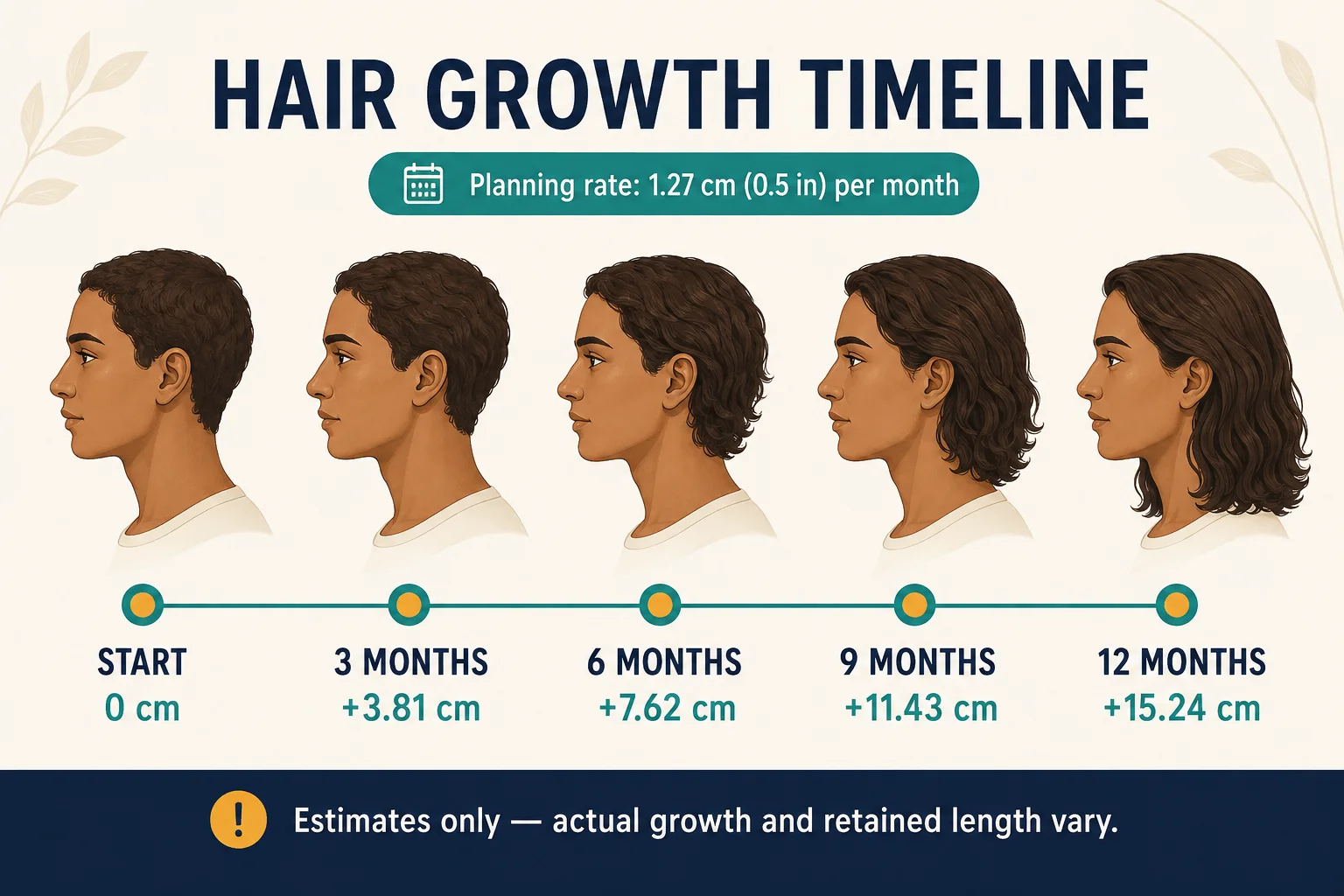
This timeline illustrates the fixed planning rate used by the Hair Growth Calculator. At 1.27 cm per month, estimated new growth would be approximately 3.81 cm after three months, 7.62 cm after six months, 11.43 cm after nine months, and 15.24 cm after one year. These figures estimate growth from the roots and do not account for trims, breakage, natural shrinkage, health factors, or differences in individual growth rates.
What Does the Hair Growth Calculator Estimate?
The Hair Growth Calculator offers three calculation modes. You can estimate new hair growth over time, calculate the approximate time required to reach a growth goal, or add estimated growth to your current hair length.
- Growth over time: Estimates how much new length may grow during a selected period.
- Time to reach a goal: Estimates how long a desired amount of growth may take.
- Estimated final length: Adds the expected new growth to your current hair length.
Results can be displayed in centimeters or inches. Time can also be entered and displayed using the available time units.
How to Use the Hair Growth Calculator
- Select the calculation mode that matches your goal.
- Enter the requested time span, desired growth, or current hair length.
- Select the correct length and time units.
- Click Calculate to display the estimated result.
- Use Reset to clear the inputs and begin another calculation.
For final-length estimates, measure your hair consistently from the same starting point. Changing the measuring position can make it difficult to compare your actual progress with the estimate.
How the Hair Growth Calculator Works
The calculator converts the selected time into months and the selected length into centimeters before applying its fixed planning rate:
Planning growth rate = 1.27 cm per month ≈ 0.5 inches per month
To estimate new growth:
Estimated growth = growth rate × time in months
To estimate the time needed for a target:
Time needed = desired growth ÷ growth rate
To estimate final hair length:
Final length = current length + estimated growth
The result is a mathematical projection. It assumes the same growth rate continues throughout the selected period and does not subtract length lost through trims, breakage, or damage.
Hair Growth Calculation Example
Suppose you want to estimate how much your hair could grow over six months using the calculator’s fixed rate:
Estimated growth = 1.27 × 6 = 7.62 cm
The Hair Growth Calculator would therefore estimate approximately 7.62 cm, or 3 inches, of new growth. If your current measured hair length were 30 cm, the estimated final length would be:
Final length = 30 + 7.62 = 37.62 cm
This is a planning estimate. Your visible length after six months may be higher or lower.
How Fast Does Hair Normally Grow?
Published references commonly report scalp-hair growth at around 1 cm per month. One study reviewing variation in human head-hair growth calculated an average of approximately 1.06 cm per month and found a considerable range between individuals.
The calculator’s 1.27 cm monthly rate represents the commonly used simplified estimate of half an inch per month. Because this is slightly higher than the averages reported in those references, results should be treated as general growth goals rather than precise biological predictions.
Why Actual Hair Growth May Be Different
Hair follicles move through active growth, transition, and resting phases. Not every hair remains in the active growth phase at the same time. Actual growth and visible length retention may also be influenced by:
- Age and genetics
- Hormonal and general health factors
- Nutrition and certain medications
- Hair texture and natural shrinkage
- Trimming frequency
- Heat, chemical, or mechanical damage
- Breakage at the ends of the hair
Hair may grow at the root while showing little visible length gain when breakage occurs at a similar rate.
Important Limitations
- The calculator does not measure your personal biological growth rate.
- It cannot diagnose hair loss, nutritional deficiencies, or scalp conditions.
- It does not predict the effects of supplements, medication, or hair treatments.
- Results become less certain over longer calculation periods.
- Hair growth and retained hair length are not always the same.
Consider speaking with a qualified healthcare professional or dermatologist if you notice sudden excessive shedding, persistent thinning, bald patches, scalp inflammation, or another significant change. The American Academy of Dermatology explains that excessive shedding and progressive hair loss can have different causes.
When choosing a hairstyle for your proportions, you can also use the Face Shape Calculator. To work out a future target date from your estimated growth period, try the Add Time Calculator.
Frequently Asked Questions
How much does hair grow in a month?
Scalp hair is commonly reported to grow around 1 cm per month, although rates vary. This calculator uses a simplified planning rate of 1.27 cm, or approximately half an inch, per month.
How long does it take to grow six inches of hair?
At the calculator’s rate of 0.5 inches per month, six inches would take approximately 12 months. Actual time may be shorter or longer.
Does cutting hair make it grow faster?
Trimming removes damaged ends but does not change growth at the follicle. Regular trims may help retain a healthier-looking length by reducing split ends and breakage.
Why is my hair not reaching the estimated length?
Growth rate, trimming, shrinkage, split ends, and breakage can all affect visible length. The calculator estimates growth from the root and cannot predict how much length you will retain.
Can the Hair Growth Calculator diagnose slow hair growth?
No. The Hair Growth Calculator provides mathematical estimates only. A dermatologist or other qualified healthcare professional should assess persistent thinning, shedding, or suspected growth problems.
Sources
- NCBI Bookshelf — Physiology, Hair
- Forensic Science International — Variations in Human Hair Growth Rate
- American Academy of Dermatology — Hair Loss or Hair Shedding?
Hair Growth Varies by Person and by Strand
Scalp hair is often estimated to grow around a typical monthly rate, but genetics, age, health, nutrition, hormones, hair cycle, breakage, and chemical or heat damage create wide variation. Measure from the same landmark and distinguish new growth from retained length. Sudden shedding, patchy loss, scalp symptoms, or a major change deserves assessment by a qualified healthcare professional.