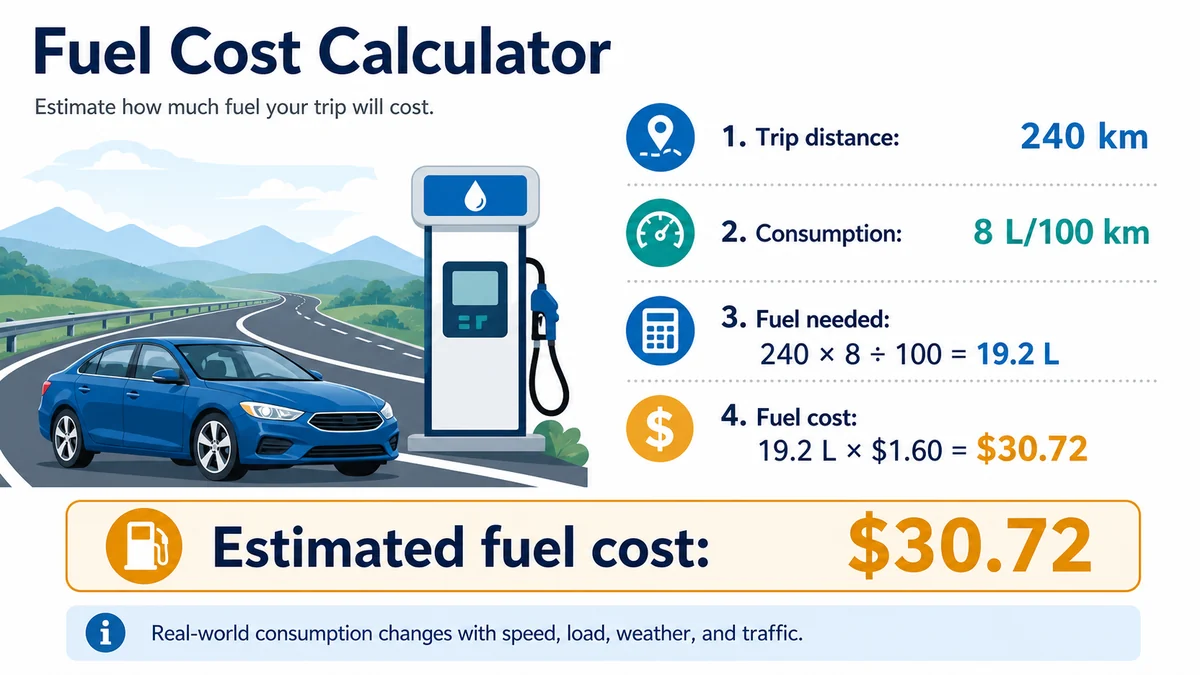
Fuel Cost Calculator
Estimate fuel needed and trip cost with simple inputs.
Trip inputs
Results
Use this Fuel Cost Calculator to estimate how much fuel a trip may use and how much that fuel may cost. Enter the travel distance, choose a fuel-efficiency format, enter the fuel price, and the calculator estimates fuel amount and trip cost.
The calculator supports common fuel-efficiency systems, including miles per US gallon, miles per UK gallon, kilometers per liter, and liters per 100 kilometers. It also supports fuel amount outputs in liters, US gallons, and UK gallons.
Important Note: This Fuel Cost Calculator estimates fuel amount and trip cost from distance, fuel efficiency, fuel price, and fuel unit. It supports mpg (US), mpg (UK), km/L, and L/100 km, plus fuel amount in liters, US gallons, and UK gallons.
The result is a planning estimate only. Actual fuel used and total cost can vary because of driving style, traffic, speed, weather, terrain, vehicle load, tire pressure, maintenance, idling, air conditioning, fuel type, fuel blend, route choice, and local pump prices.
Use this calculator for road-trip planning, commute cost checks, delivery estimates, route comparison, and fuel-budget planning. For business reimbursement, tax records, official mileage claims, fleet reporting, or accounting, verify distance, fuel price, fuel unit, mileage rate, receipts, and applicable policy before relying on the result.
Reviewed by: AjaxCalculators Editorial Team
Last updated: May 27, 2026
Method source: Standard distance, fuel-efficiency, and fuel-cost relationships
Editorial standards: AjaxCalculators Editorial Policy
What This Fuel Cost Calculator Calculates
This calculator estimates fuel needed and trip fuel cost from three inputs: distance, fuel efficiency, and fuel price.
- Distance: how far you plan to travel
- Fuel efficiency: how much fuel your vehicle uses, entered as L/100 km or mpg (US)
- Fuel price: the cost of fuel per liter or per US gallon
The calculator then estimates the amount of fuel required and the total fuel cost for the trip.
What Fuel Cost Means
Fuel cost is the estimated amount you will spend on fuel for a selected trip distance. It depends mainly on how far you drive, how efficiently your vehicle uses fuel, and the price of fuel.
A longer trip, lower fuel efficiency, or higher fuel price will increase the estimated fuel cost. A shorter trip, better fuel efficiency, or lower fuel price will reduce it.
Unit Constants Used by This Calculator
| Item | Value | Use Note |
|---|---|---|
| 1 mile | 1.609344 km | Used when converting miles and kilometers. |
| 1 US gallon | 3.785411784 L | Used for mpg (US), US gallons, and price per US gallon. |
| 1 UK gallon | 4.54609 L | Used for mpg (UK), UK gallons, and price per UK gallon. |
| Fuel amount | Distance ÷ efficiency | Distance and efficiency must be interpreted in matching units. |
| Trip cost | Fuel amount × fuel price | The fuel amount unit and price unit must match. |
How the Fuel Cost Calculator Works
1) Fuel Needed with L/100 km
If distance is entered in kilometers and fuel efficiency is entered as liters per 100 kilometers, the calculator estimates fuel needed like this:
Fuel needed (liters) = distance (km) × L/100 km ÷ 100
For example, if a trip is 300 km and the vehicle uses 7 L/100 km:
Fuel needed = 300 × 7 ÷ 100 = 21 liters
2) Fuel Needed with MPG
If distance is entered in miles and fuel efficiency is entered as miles per US gallon, the calculator estimates fuel needed like this:
Fuel needed (US gallons) = distance (miles) ÷ mpg
For example, if a trip is 240 miles and the vehicle gets 30 mpg:
Fuel needed = 240 ÷ 30 = 8 US gallons
3) Fuel Cost Formula
After fuel needed is calculated, the calculator multiplies the fuel volume by the fuel price.
Fuel cost = fuel needed × fuel price
If fuel needed is in liters, use the price per liter. If fuel needed is in US gallons, use the price per US gallon.
What This Fuel Cost Calculator Estimates
This calculator estimates the amount of fuel needed for a trip and the estimated fuel cost based on your entered values.
| Input or Result | Meaning | Common Units |
|---|---|---|
| Distance | How far you plan to travel. | mi, km |
| Fuel efficiency | How much distance the vehicle travels per fuel unit, or how much fuel it uses per 100 km. | mpg (US), mpg (UK), km/L, L/100 km |
| Fuel amount | The estimated volume of fuel needed for the trip. | L, US gal, UK gal |
| Fuel price | The price of fuel per selected fuel unit. | per L, per US gal, per UK gal |
| Trip cost | The estimated fuel amount multiplied by fuel price. | Your entered currency |
| Step-by-step derivation | The calculation path used by the calculator. | Formula explanation |
Fuel Cost Formula Summary
| What You Want to Find | Formula | Use Note |
|---|---|---|
| Fuel used with mpg (US) | US gallons = miles ÷ mpg (US) | Use with fuel price per US gallon. |
| Fuel used with mpg (UK) | UK gallons = miles ÷ mpg (UK) | Use with fuel price per UK gallon. |
| Fuel used with km/L | Liters = kilometers ÷ km/L | Higher km/L means better fuel efficiency. |
| Fuel used with L/100 km | Liters = kilometers × L/100 km ÷ 100 | Lower L/100 km means better fuel efficiency. |
| Trip cost | Cost = fuel amount × fuel price | The fuel amount unit and fuel price unit must match. |
| Miles to kilometers | km = mi × 1.609344 | Used when converting distance units. |
| US gallons to liters | L = US gal × 3.785411784 | Used for US gallon conversion. |
| UK gallons to liters | L = UK gal × 4.54609 | Used for UK imperial gallon conversion. |
Fuel Efficiency Units Explained
The calculator supports four common fuel-efficiency formats. Choose the one that matches your vehicle, country, fuel-economy record, or trip-planning source.
| Fuel Efficiency Unit | Meaning | Better Direction | Example |
|---|---|---|---|
| mpg (US) | Miles traveled per US gallon. | Higher is better. | 30 mpg (US) |
| mpg (UK) | Miles traveled per UK imperial gallon. | Higher is better. | 36 mpg (UK) |
| km/L | Kilometers traveled per liter. | Higher is better. | 14 km/L |
| L/100 km | Liters used per 100 kilometers. | Lower is better. | 7 L/100 km |
Do not enter L/100 km as mpg or mpg as L/100 km. These formats work in opposite directions: higher mpg is better, while lower L/100 km is better.
US Gallons vs UK Gallons
US gallons and UK imperial gallons are different fuel-volume units. This is why mpg (US) and mpg (UK) are not the same measurement.
| Fuel Unit | Equivalent in Liters | Common Use |
|---|---|---|
| 1 US gallon | 3.785411784 L | United States fuel economy and fuel price contexts. |
| 1 UK gallon | 4.54609 L | UK imperial gallon contexts and some older fuel-economy references. |
Because a UK gallon is larger than a US gallon, the same vehicle can show a higher mpg number in UK mpg than in US mpg even when the real fuel use is unchanged.
Unit Conversions Used by the Calculator
The calculator can work with kilometers, miles, liters, and US gallons by converting values when needed.
| Conversion | Value |
|---|---|
| 1 mile | 1.609344 kilometers |
| 1 kilometer | 0.621371 miles |
| 1 US gallon | 3.785411784 liters |
| 1 liter | 0.264172 US gallons |
These conversions help the calculator estimate fuel cost even when distance, efficiency, and price use different measurement systems.
Worked Example: Kilometers and L/100 km
Suppose you plan a 300 km trip. Your vehicle uses 7 L/100 km, and fuel costs $1.50 per liter.
Step 1: Calculate fuel needed
Fuel needed = distance × L/100 km ÷ 100
Step 2: Substitute the values
Fuel needed = 300 × 7 ÷ 100
Step 3: Calculate fuel volume
Fuel needed = 21 liters
Step 4: Calculate trip fuel cost
Fuel cost = 21 × 1.50
Step 5: Calculate the result
Fuel cost = $31.50
So, a 300 km trip at 7 L/100 km and $1.50 per liter would need about 21 liters of fuel and cost about $31.50.
Worked Example: Miles and MPG
Suppose you plan a 240-mile trip. Your vehicle gets 30 mpg, and fuel costs $3.75 per US gallon.
Step 1: Calculate fuel needed
Fuel needed = distance ÷ mpg
Step 2: Substitute the values
Fuel needed = 240 ÷ 30
Step 3: Calculate fuel volume
Fuel needed = 8 US gallons
Step 4: Calculate trip fuel cost
Fuel cost = 8 × 3.75
Step 5: Calculate the result
Fuel cost = $30.00
So, a 240-mile trip at 30 mpg and $3.75 per gallon would need about 8 gallons of fuel and cost about $30.00.
How to Use This Fuel Cost Calculator
- Enter the trip distance.
- Select the distance unit: mi or km.
- Enter your fuel efficiency.
- Select the fuel-efficiency unit: mpg (US), mpg (UK), km/L, or L/100 km.
- Select the fuel amount unit you want to display: liters, US gallons, or UK gallons.
- Enter the fuel price.
- Select the matching fuel price unit: per liter, per US gallon, or per UK gallon.
- Review the estimated fuel amount and trip cost.
- Check the step-by-step derivation to confirm the formula path.
- Use Refresh / Reset to clear the calculator and start again.
The calculator states that currency is not enforced. Enter the fuel price in your local currency and read the trip cost in the same currency.
Worked Example: Estimate Fuel Cost
Suppose you plan a 300-mile trip. Your vehicle gets 30 mpg (US), and fuel costs 3.50 per US gallon.
| Step | Calculation | Result |
|---|---|---|
| Find fuel used | US gallons = 300 miles ÷ 30 mpg | 10 US gallons |
| Find trip cost | Cost = 10 × 3.50 | 35.00 |
| Optional liter conversion | Liters = 10 × 3.785411784 | 37.854 L |
The estimated fuel cost is 35.00 in the currency used for the fuel price input.
How to Interpret the Result
| Result | What It Means | Important Caution |
|---|---|---|
| Fuel amount | The estimated fuel volume needed for the entered trip distance. | Real fuel use may differ from the entered fuel-efficiency value. |
| Trip cost | The estimated fuel amount multiplied by fuel price. | It includes fuel only, not tolls, parking, maintenance, vehicle wear, or other trip expenses. |
| Fuel efficiency | The vehicle’s distance-per-fuel or fuel-per-distance value. | Make sure the selected unit matches the value you entered. |
| Fuel price | The price per liter, US gallon, or UK gallon. | The price unit must match the fuel amount unit used for cost calculation. |
| Step-by-step derivation | The formula path used by the calculator. | Use it to check distance conversion, efficiency conversion, fuel amount, and cost. |
Fuel Cost vs Gas Cost
This page focuses on basic fuel cost: distance, vehicle efficiency, fuel price, fuel needed, and total trip cost.
Fuel cost can apply to gasoline, petrol, diesel, or other vehicle fuels when the same distance-efficiency-price relationship is used. The exact fuel type does not change the basic math, but it can change the price per liter or gallon and the vehicle’s real-world fuel efficiency.
If you need to split the cost between passengers, calculate the total fuel cost first, then divide it by the number of people sharing the trip.
Why Real Fuel Cost Can Vary
The calculator uses your entered distance, fuel efficiency, and fuel price. Real-world fuel cost can still vary because fuel economy and fuel prices are not fixed.
| Factor | How It Can Affect Fuel Cost |
|---|---|
| Aggressive driving | Rapid acceleration, hard braking, and speeding can reduce fuel economy. |
| High speeds | Higher speeds can increase aerodynamic drag and reduce mpg. |
| Idling | Uses fuel without adding distance. |
| Cold weather and short trips | The engine may operate less efficiently before warming up. |
| Cargo, roof racks, and towing | Extra weight and aerodynamic drag can increase fuel use. |
| Air conditioning and accessories | Electrical and cooling loads can reduce fuel economy. |
| Terrain and road surface | Hilly, mountainous, or unpaved roads can increase fuel use. |
| Maintenance and tire condition | Poor tuning, tire pressure, alignment, or brake drag can reduce fuel economy. |
| Fuel price changes | Fuel price can vary by station, region, tax rate, grade, season, and market conditions. |
Fuel Cost vs Total Trip Cost
This calculator estimates fuel cost only. A full trip budget may include other expenses.
| Cost Type | Included in This Calculator? | Use Note |
|---|---|---|
| Fuel cost | Yes | Calculated from fuel amount × fuel price. |
| Tolls | No | Add toll-road, bridge, tunnel, or congestion charges separately. |
| Parking | No | Add parking fees separately. |
| Vehicle wear and maintenance | No | Fuel cost is not the same as total vehicle operating cost. |
| Insurance, depreciation, and registration | No | These are not included in fuel-only trip cost. |
| Food, lodging, and travel extras | No | Add travel expenses separately for full budgeting. |
| Passenger cost sharing | No, unless manually divided | This tool estimates total fuel cost; divide by passengers separately if needed. |
Fuel Price Factors
Fuel prices can change by location and over time. The price you enter should match the fuel price you expect to pay for the trip.
| Fuel Price Factor | Why It Matters |
|---|---|
| Crude oil price | Crude oil is a major part of gasoline cost and can change with global supply and demand. |
| Taxes and fees | Fuel taxes can vary by country, state, region, or city. |
| Refining costs and profits | Fuel formulation, refinery operations, and seasonal requirements can affect prices. |
| Distribution and marketing | Transport, station costs, local competition, and retail margins can affect pump prices. |
| Fuel grade | Regular, midgrade, premium, diesel, and alternative fuels may have different prices. |
| Local market conditions | Prices can differ between nearby stations and regions. |
Tips for a More Accurate Fuel Cost Estimate
- Use your real-world fuel efficiency if you know it.
- Use the fuel price from your actual route, not only your local station.
- Use round-trip distance if you want the cost of going and returning.
- Add extra distance for detours, pickup stops, parking searches, or scenic routes.
- Use city fuel efficiency for stop-and-go trips and highway efficiency for long highway drives.
- Use a lower efficiency estimate if the vehicle is heavily loaded or towing.
- Check that the calculator is set to the correct fuel price unit: per liter or per US gallon.
Common Mistakes to Avoid
| Mistake | Why It Causes Problems |
|---|---|
| Entering mpg (US) when the value is mpg (UK) | US and UK gallons are different sizes, so the fuel estimate changes. |
| Entering mpg as L/100 km | These units work in opposite directions and produce incorrect results if mixed. |
| Entering L/100 km as km/L | Lower L/100 km is better, while higher km/L is better. |
| Using price per liter with fuel amount in gallons | The fuel price unit must match the fuel amount unit. |
| Using one-way distance when planning a round trip | A round trip usually needs twice the one-way distance unless the return route differs. |
| Using highway mpg for city driving | City traffic, stops, and idling can reduce real-world fuel economy. |
| Ignoring traffic, terrain, or vehicle load | These can change real fuel use compared with the estimate. |
| Treating fuel cost as full trip cost | The calculator does not include tolls, parking, maintenance, or other travel expenses. |
| Forgetting that currency is not enforced | The calculator uses the number you enter; it does not convert currencies. |
Formula Summary
| What You Want to Find | Formula |
|---|---|
| Fuel needed using L/100 km | Liters = kilometers × L/100 km ÷ 100 |
| Fuel needed using mpg | US gallons = miles ÷ mpg |
| Trip fuel cost | Fuel cost = fuel needed × fuel price |
| Miles to kilometers | Kilometers = miles × 1.609344 |
| Kilometers to miles | Miles = kilometers × 0.621371 |
| US gallons to liters | Liters = US gallons × 3.785411784 |
| Liters to US gallons | US gallons = liters × 0.264172 |
Practical Uses
This Fuel Cost Calculator is useful for quick trip-cost and fuel-use estimates.
| Use Case | How the Calculator Helps |
|---|---|
| Road-trip budgeting | Estimate expected fuel spend before a long drive. |
| Commute planning | Estimate weekly or monthly commuting fuel cost by repeating the trip distance. |
| Delivery planning | Estimate fuel cost for pickup, delivery, or courier routes. |
| Route comparison | Compare fuel cost between shorter and longer route options. |
| Vehicle comparison | Compare estimated fuel cost between vehicles with different fuel efficiency values. |
| Fuel price sensitivity | See how trip cost changes when fuel price rises or falls. |
| Travel reimbursement checks | Estimate fuel-only cost before applying official reimbursement rules. |
When You May Need More Than This Calculator
This calculator is best for fuel-only estimates. You may need another tool or official method when the calculation requires live data, accounting rules, or full vehicle operating costs.
| Need | Better Tool or Method |
|---|---|
| Live fuel prices | Use a current fuel-price app, station price board, or official price source. |
| Live route distance | Use a map or navigation tool with current route data. |
| Traffic-adjusted cost estimate | Use navigation data and realistic fuel economy for stop-and-go conditions. |
| Business reimbursement | Follow employer, tax authority, or reimbursement-policy rules. |
| Full vehicle operating cost | Add maintenance, tires, depreciation, insurance, parking, tolls, and other costs. |
| Electric vehicle travel cost | Use an EV cost calculator with kWh/100 km, miles/kWh, charging price, and charging losses. |
| Fleet reporting | Use recorded mileage, actual fuel purchase data, receipts, and fleet-management software. |
Frequently Asked Questions
How do I calculate fuel cost for a trip?
Estimate the fuel amount needed, then multiply it by the fuel price. For example, if a trip uses 10 gallons and fuel costs 3.50 per gallon, the fuel cost is 35.00.
How do I calculate fuel used with mpg?
Divide distance in miles by miles per gallon. For example, 300 miles ÷ 30 mpg = 10 gallons.
How do I calculate fuel used with L/100 km?
Multiply distance in kilometers by L/100 km, then divide by 100. For example, 400 km × 7 L/100 km ÷ 100 = 28 liters.
How do I calculate fuel used with km/L?
Divide distance in kilometers by kilometers per liter. For example, 280 km ÷ 14 km/L = 20 liters.
Is mpg (US) the same as mpg (UK)?
No. A US gallon and a UK imperial gallon are different sizes, so mpg (US) and mpg (UK) are not the same measurement.
Why does L/100 km work differently from mpg?
L/100 km measures fuel used over a fixed distance, so lower is better. MPG measures distance traveled per gallon, so higher is better.
Does this calculator convert currencies?
No. Currency is not enforced. Enter the fuel price in your own currency and read the cost in that same currency.
Does the calculator include tolls or parking?
No. It estimates fuel cost only. Add tolls, parking, maintenance, and other trip expenses separately.
Why can my real fuel cost be different?
Real cost can differ because of traffic, speed, idling, weather, terrain, driving style, vehicle load, maintenance, fuel blend, and pump price changes.
References
- FuelEconomy.gov — Many Factors Affect Fuel Economy
- FuelEconomy.gov — Gas Mileage Tips: Driving More Efficiently
- U.S. Energy Information Administration — Factors Affecting Gasoline Prices
- NIST Guide to the SI — Appendix B.9: Conversion Factors by Quantity
- NIST — Approximate Conversions from U.S. Customary Measures to Metric
Related Calculators
- Gas Cost Calculator
- Mileage Calculator
- Electricity Cost Calculator
- Car Finance Calculator
- Loan Calculator
- Percent Off Calculator
- Sales Tax Calculator
- Time Calculator
Fuel Cost Calculator Disclaimer
This Fuel Cost Calculator provides planning estimates only. It estimates fuel amount and trip cost from the distance, fuel-efficiency value, fuel price, and units entered by the user.
Actual fuel use can vary because of traffic, speed, acceleration, braking, idling, weather, terrain, road surface, route choice, vehicle load, towing, roof racks, tire pressure, maintenance, air conditioning, fuel type, fuel blend, and driving conditions. Actual fuel price can vary by station, location, taxes, fuel grade, market conditions, and date.
This calculator estimates fuel cost only. It does not include tolls, parking, maintenance, tires, depreciation, insurance, registration, repairs, lodging, meals, driver pay, tax rules, reimbursement policies, or full vehicle operating cost. For official claims, business accounting, fleet reporting, or tax records, use actual receipts, official mileage records, and the applicable policy or professional guidance.