

Topsoil Calculator
Estimate topsoil volume, cubic yards, cubic feet, cubic meters, bag quantity, and optional material cost for garden beds, lawns, raised areas, and landscaping projects.
Results
Topsoil estimates are approximate. Actual needs can vary because of soil settling, compaction, grading, slope, uneven ground, existing soil level, bed shape, and supplier bag or bulk-yard fill accuracy.
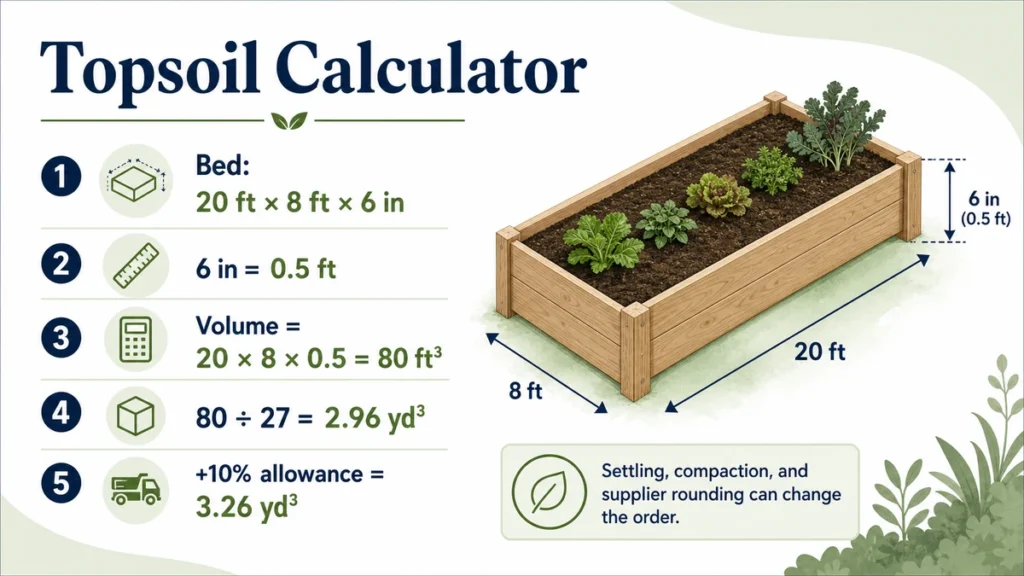
A Topsoil Calculator estimates how much soil is needed to raise, fill, or improve a defined area such as a lawn, garden bed, raised bed, or grading section.
Enter the surface dimensions and the average depth of soil you want to add. The calculator converts that into cubic feet, cubic yards, or cubic metres and can also estimate bags when the package volume is known.
If reliable density information is available for the actual soil being supplied, the volume can also be converted into an approximate weight.
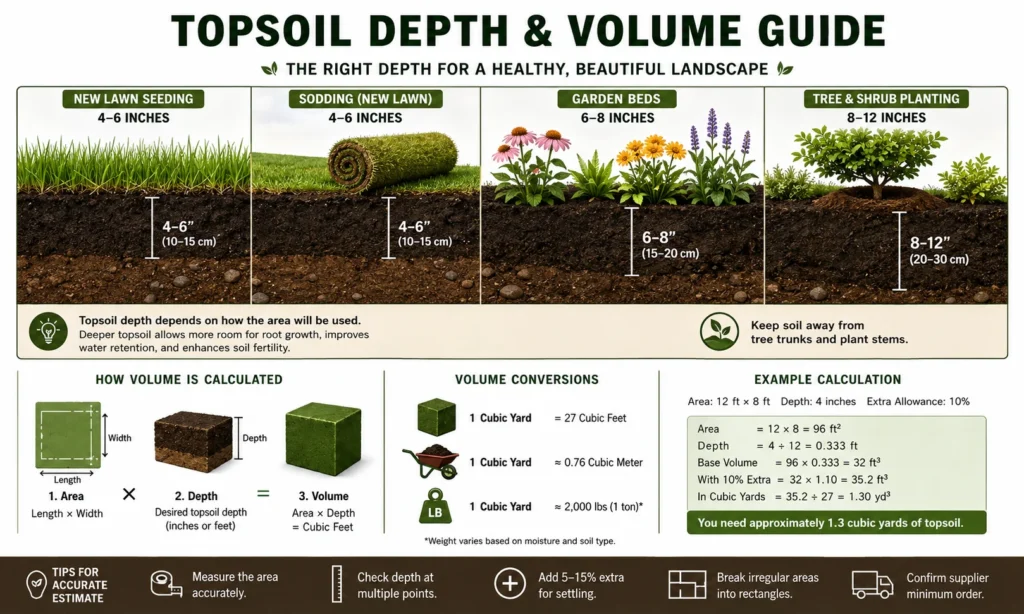
Calculate the finished soil volume first, then adjust the order for settling, packaging, and supplier increments.
Start With the Depth You Actually Need to Add
The basic calculation is:
Topsoil volume = Surface area × Added depth
For a rectangle:
Surface area = Length × Width
If the depth is entered in inches while the length and width are in feet, convert the depth first:
Depth in feet = Depth in inches ÷ 12
For example:
6 inches ÷ 12 = 0.5 ft
Then multiply using compatible units.
Worked Topsoil Example
Suppose a garden bed measures:
20 ft long
8 ft wide
and you want to add:
6 inches of topsoil
Surface area:
20 × 8 = 160 ft²
Convert the depth:
6 ÷ 12 = 0.5 ft
Now calculate volume:
160 × 0.5 = 80 ft³
Convert to cubic yards:
80 ÷ 27 ≈ 2.96 yd³
| Step | Result |
|---|---|
| Area | 160 ft² |
| Added depth | 6 in |
| Depth in feet | 0.5 ft |
| Volume | 80 ft³ |
| Volume in cubic yards | About 2.96 yd³ |
That is the calculated finished volume before any project-specific allowance for settlement or handling.
How to Use the Topsoil Calculator
- Measure the area that will actually receive soil.
- Enter the length and width, or calculate separate sections for an irregular area.
- Measure the average depth you need to add.
- Keep all units consistent.
- Calculate the finished volume.
- Add an appropriate allowance only if site conditions or the supplier’s material justify one.
- Convert the result into bags, cubic yards, cubic metres, or estimated weight as needed.
- Round the final order according to what the supplier actually sells.
If some areas need much deeper fill than others, calculate them separately rather than using one rough average across the whole site.
One Inch of Soil Over 1,000 Square Feet
A useful reference is:
1,000 ft² × 1/12 ft = 83.33 ft³
Convert that to cubic yards:
83.33 ÷ 27 ≈ 3.09 yd³
So one inch of soil over 1,000 square feet requires approximately:
3.09 cubic yards
before any allowance for settlement or project conditions.
Quick Depth Reference
For a 1,000 ft² area:
| Added Depth | Approximate Volume |
|---|---|
| 1 in | 3.09 yd³ |
| 2 in | 6.17 yd³ |
| 3 in | 9.26 yd³ |
| 4 in | 12.35 yd³ |
| 6 in | 18.52 yd³ |
This shows why even a small increase in depth can add several cubic yards across a large lawn or garden.
Finished Depth and Delivered Volume Are Not Always Identical
The calculator gives you the volume represented by the dimensions entered.
Delivered topsoil may be loose when it arrives and then settle after:
- spreading;
- watering;
- rainfall;
- foot traffic;
- light compaction; or
- natural consolidation.
The amount of settling depends on the material.
Screened mineral soil, compost-rich planting mix, and loose organic soil can behave differently.
There is no single settlement percentage that works for every product.
Ask the supplier how the specific material normally behaves if final elevation matters.
Do Not Automatically Add a Large Settlement Allowance
It can be tempting to add a fixed percentage to every topsoil calculation.
That can create unnecessary over-ordering.
A better approach is to ask:
- Is the soil being placed loosely or compacted?
- Is the final grade critical?
- How much organic matter is in the mix?
- Is the material already screened and settled?
- Is this a lawn top-dressing or deep fill?
- Does the supplier recommend an allowance?
Use the project and product information rather than one universal percentage.
Existing Grade Matters
Suppose one part of a lawn is already close to the desired elevation while another area is several inches low.
Using the deepest required fill across the entire lawn can greatly overstate the quantity.
Measure several points.
For example:
Zone A needs 1 inch
Zone B needs 3 inches
Zone C needs 5 inches
Calculate those zones separately.
This is more reliable than calling the whole site a 5-inch fill.
Raised Beds Need the Inside Dimensions
For a raised garden bed, calculate the internal planting volume rather than the outside dimensions of the structure.
Suppose the inside dimensions are:
8 ft × 4 ft
and the soil depth required is:
18 inches
Convert 18 inches:
18 ÷ 12 = 1.5 ft
Volume:
8 × 4 × 1.5 = 48 ft³
Convert to cubic yards:
48 ÷ 27 ≈ 1.78 yd³
If part of the bed is filled with another material, calculate only the volume that will actually contain the topsoil or planting mix.
Topsoil and Planting Mix Are Not Always the Same Product
The name on the supplier’s price list matters.
You might see:
- screened topsoil;
- garden soil;
- planting mix;
- compost blend;
- fill dirt;
- lawn mix; or
- amended topsoil.
These materials can differ in:
- mineral content;
- organic matter;
- drainage;
- particle size;
- nutrient content;
- density; and
- intended use.
A calculator can estimate volume, but it cannot tell you whether the material is suitable for the plants or grading work.
Do Not Use a Generic Soil Density as a Guarantee
Topsoil weight varies considerably.
Wet soil can weigh much more than dry soil.
Density can also change with:
- clay content;
- sand content;
- organic matter;
- screening;
- moisture;
- compaction; and
- material source.
If you need an estimate in tons or tonnes, use:
Estimated mass = Volume × Density
but use a density supplied for the actual material whenever possible.
A generic internet density may be useful for a rough estimate but should not be treated as a delivery guarantee.
Why Weight Matters for Delivery
A supplier may sell soil by volume while the delivery truck is limited by weight.
For example, a truck may have enough physical space for a certain number of cubic yards but be unable to carry that full volume safely when the soil is very wet.
That can affect:
- number of deliveries;
- delivery price;
- load size; and
- scheduling.
If the order is large, ask the supplier about both volume and payload limits.
Bagged Topsoil Uses Package Volume
For bagged products, use the net volume printed on the bag.
Suppose you need:
24 ft³
and each bag contains:
1.5 ft³
Then:
24 ÷ 1.5 = 16 bags
So you need:
16 bags
If the result is:
16.4 bags
round upward to:
17 bags
when the product is sold only in complete bags.
Do Not Convert Bag Weight Directly Into Volume
A 40-pound bag and another 40-pound bag do not necessarily contain the same volume.
The relationship depends on density.
Use the bag’s stated:
cubic feet
litres
or another volume measure.
Only convert from weight when the manufacturer provides enough information to do so reliably.
Compost Is a Different Calculation From Grade Fill
Suppose you are adding:
1 inch of compost
to improve the surface before incorporation.
That is a very different project from filling a raised bed:
6 inches deep
with planting soil.
The calculator can estimate both volumes.
But they should not automatically use the same material.
Keep:
soil amendment
and:
grade or bed fill
as separate jobs when they have different purposes.
Irregular Areas Can Be Divided Into Simple Shapes
A garden or lawn does not need to be perfectly rectangular.
Break it into manageable shapes such as:
- rectangles;
- triangles;
- circles;
- semicircles; or
- separate zones.
Calculate each area first.
Then:
Total soil volume = Combined area × Added depth
If the depth changes substantially between zones, calculate each zone’s volume separately before adding them.
Sloped Areas Need Careful Interpretation
On a slope, you need to know what the specified depth actually means.
If the project calls for a certain vertical fill depth, a plan-view area may be appropriate.
If the job is a thin surface treatment following the slope, actual surface area may matter more.
For significant grading work, use site elevations or professional grading information rather than relying on a simple rectangular estimate.
Keep Soil Away From Problem Areas
Adding soil can change drainage and finished elevation around buildings.
Before increasing grade, check conditions near:
- siding;
- foundations;
- doors;
- vents;
- drainage outlets;
- paved surfaces;
- retaining walls; and
- tree root flares.
Adding too much soil in the wrong place can create problems even when the volume calculation is correct.
Quantity and grading design are different tasks.
Be Careful Around Trees
Adding deep soil over existing tree roots can affect root conditions and trunk flare visibility.
Do not assume a tree bed can simply be filled to match a nearby grade.
If substantial soil is being added around established trees, use species- and site-appropriate guidance.
The Topsoil Calculator does not assess tree health or acceptable grade changes.
Soil Testing Can Matter More Than Quantity
A project can have exactly the right volume of soil and still perform poorly if the soil is unsuitable.
Depending on the use, relevant factors may include:
- pH;
- drainage;
- texture;
- salinity;
- organic matter;
- contaminants; and
- nutrient status.
For garden or lawn work, local extension services or soil-testing resources can help interpret these characteristics.
Delivery Access Is Part of the Plan
Several cubic yards of soil require somewhere to go.
Before ordering, check:
- truck access;
- driveway strength;
- gate width;
- overhead wires;
- dumping area;
- slopes;
- drainage;
- distance to the work area; and
- weather conditions.
A correctly calculated order can still become difficult to handle if the soil is dumped in the wrong place.
Weather Can Change the Job
Wet topsoil can be:
- heavier;
- harder to spread;
- more likely to compact; and
- difficult to grade cleanly.
Very dry material may behave differently.
If placement conditions matter, coordinate delivery with the supplier and project schedule instead of treating the calculator quantity as the only planning decision.
Common Topsoil Calculation Mistakes to avoid
Forgetting to Convert Inches to Feet
Six inches is:
6 ÷ 12 = 0.5 ft
not 6 feet.
Applying the Deepest Fill Across the Whole Site
Calculate areas with different depths separately.
Using a Generic Density as Exact
Soil weight changes with moisture and composition.
Using Bag Weight Instead of Bag Volume
Use the net volume on the package.
Treating Topsoil and Compost as Interchangeable
They may serve different purposes and have very different properties.
Adding a Universal Settlement Percentage
Use supplier and project information instead.
Ignoring Existing Grade
Measure how much soil actually needs to be added.
Mixing Loose and Finished Volume Without Noting It
Know whether the supplier’s quoted volume and your project depth refer to the same condition.
Before Ordering Topsoil
A useful final check is:
Area
Have all lawn, bed, or grading sections been measured?
Depth
Is the number the actual additional depth needed?
Material
Is the supplier providing topsoil, planting mix, compost blend, or fill?
Settlement
Does the supplier recommend extra material for the intended use?
Sales unit
Is the material sold by cubic yard, cubic metre, bag, ton, or tonne?
Delivery
Can the truck reach the unloading area?
Finished grade
Will the added soil maintain safe drainage and clearances?
Related Yard Calculators
Use the Mulch Calculator for surface mulch placed over the finished soil.
The Gravel Calculator can help estimate aggregate quantities for drainage, paths, or base material.
After the bed is prepared, the Plant Spacing Calculator can help estimate planting layouts.
FAQ
How do I calculate how much topsoil I need?
Multiply the surface area by the depth of soil being added.
For a rectangle:
Volume = Length × Width × Depth
Make sure the dimensions use compatible units.
How many cubic yards are needed for one inch over 1,000 square feet?
Approximately:
3.09 cubic yards
before any allowance.
How much topsoil do I need for 6 inches over 160 square feet?
Six inches is 0.5 ft.
So:
160 × 0.5 = 80 ft³
or:
80 ÷ 27 ≈ 2.96 yd³
Should I add extra for settling?
Possibly, but there is no universal settlement factor.
Use the supplier’s guidance and the actual material and project conditions.
Can topsoil weight be calculated exactly?
Not from volume alone.
You need the density of the actual material, and even that can change with moisture.
Should I measure depth in inches or feet?
Either is fine as long as it is converted consistently before multiplication.
When length and width are in feet, divide inches by 12 to convert depth to feet.
How do I calculate bagged topsoil?
Divide the required volume by the volume printed on one bag.
Round upward to a complete bag.
Is garden soil the same as topsoil?
Not necessarily.
Products with similar names may have different blends, organic content, drainage characteristics, and intended uses.
Can I use the calculator for raised beds?
Yes.
Use the inside dimensions of the bed and the actual soil depth required.
Does the calculator tell me whether the soil is suitable for plants?
No.
It estimates quantity only. Soil suitability may require product specifications, testing, or local horticultural guidance.
Soil Resources
For information about soils, soil properties, conservation, and educational resources, see:
USDA Natural Resources Conservation Service — Soil Resources
For garden and landscape projects, local cooperative extension services can also provide region-specific soil-testing and interpretation guidance.
Calculate the Finished Volume Before Deciding the Order
A Topsoil Calculator is most reliable when the dimensions describe what the site actually needs.
Measure the area.
Check the added depth at several locations.
Separate shallow and deep zones.
Then calculate the finished volume.
After that, consider settlement, bag size, supplier increments, density, and delivery.
That order keeps the basic quantity calculation clear while still accounting for the messy realities of loose soil, uneven grade, and real-world delivery.