
Elevation Grade Calculator
Calculate grade, percent grade, angle of elevation, and 1 in N ratio from rise and run.
Elevation grade describes how quickly a surface rises or falls over a horizontal distance. This Elevation Grade Calculator converts vertical rise and horizontal run into a decimal grade ratio, percent grade, angle of elevation, and 1-in-N ratio. It accepts centimeters, meters, inches, and feet independently, converts mixed units internally, and identifies the result as uphill, downhill, or flat.
How to Use the Elevation Grade Calculator
- Measure the vertical elevation change between the two endpoints.
- Enter a positive rise for an uphill grade or a negative rise for a downhill grade.
- Select centimeters, meters, inches, or feet beside the rise value.
- Measure and enter the horizontal run, using a value greater than zero.
- Select the run unit. It may differ from the rise unit.
- Choose degrees, radians, or π radians for the angle result.
- Select Calculate and compare the four slope expressions and direction summary.
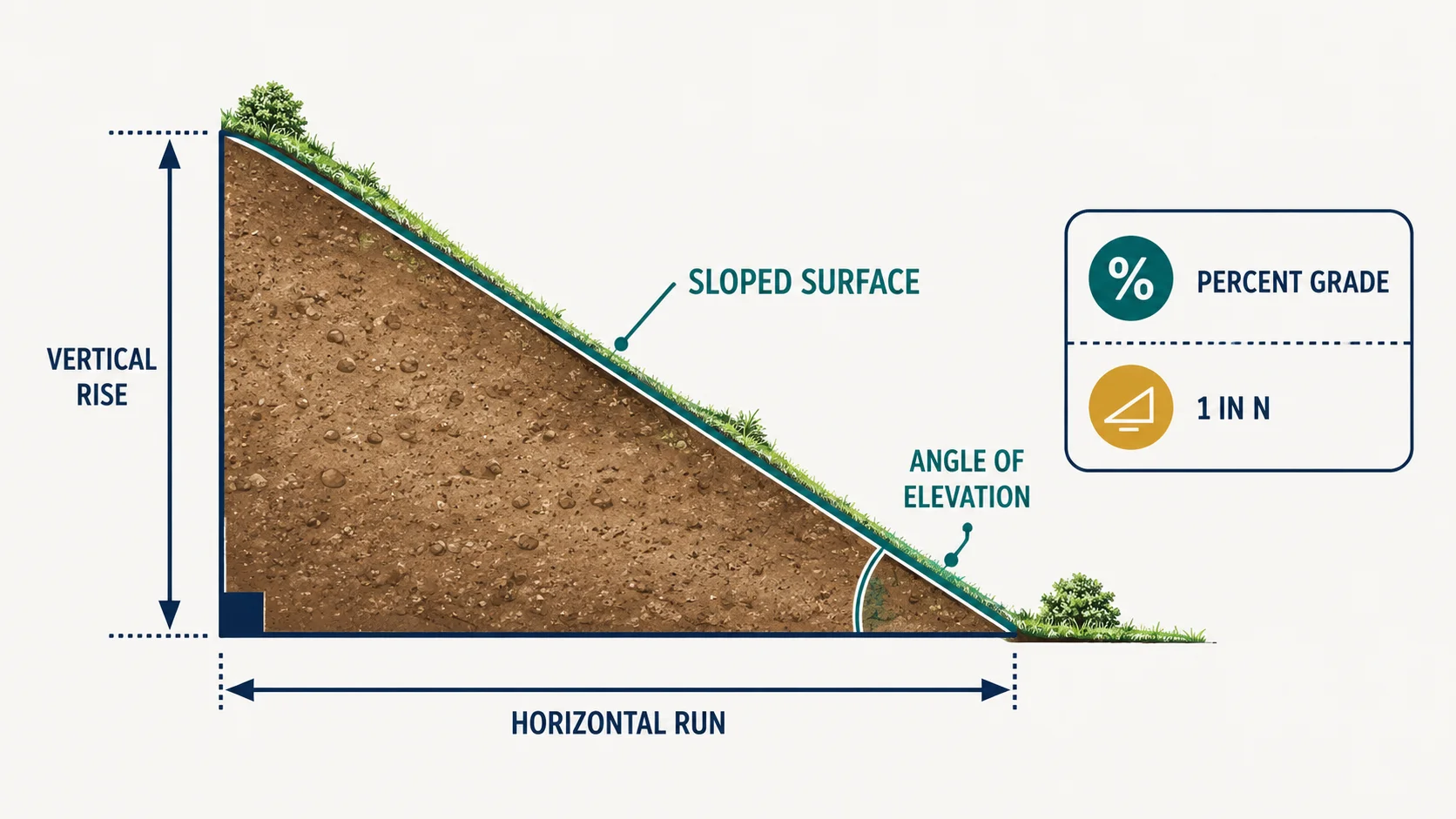
Use the horizontal plan distance rather than the length along the sloped surface. On a drawing, map, or site profile, the run is the level distance between vertical projections of the endpoints. Using the diagonal surface length as run produces an incorrect grade.
Elevation Grade Formulas
The calculator first converts rise and run to compatible internal units. The numerical slope relationships are then:
- Grade ratio = rise ÷ horizontal run
- Percent grade = (rise ÷ horizontal run) × 100
- Angle of elevation = arctan(rise ÷ horizontal run)
- 1 in N: N = absolute value of horizontal run ÷ rise
The grade-ratio output is a decimal. A ratio of 0.05 means the elevation changes by 0.05 unit for each horizontal unit. Multiplying by 100 expresses the same relationship as 5%. The U.S. Geological Survey describes percent slope as elevation change divided by horizontal distance and multiplied by 100, and calculates angle using the inverse tangent of rise divided by run.
Worked Elevation Grade Example
Suppose a path rises 1.5 meters across a horizontal run of 30 meters. The grade ratio is 1.5 ÷ 30 = 0.05. Percent grade is 0.05 × 100 = 5%.
The angle is arctan(0.05), which is approximately 2.8624°. Expressed in radians, it is approximately 0.04996 rad; in π-radian form, it is approximately 0.01590π rad. The reciprocal expression is 30 ÷ 1.5 = 20, so the slope is 1 in 20.
These results describe the same incline: a 0.05 grade ratio, 5% grade, approximately 2.86°, or 1 unit of rise for every 20 units of horizontal run. If the rise were entered as −1.5 meters, the decimal grade, percentage, and angle would be negative and the summary would identify a downhill grade. The calculator displays the 1-in-N magnitude as 1 in 20.
Percent Grade Versus Angle
Percent grade and angle are related, but the numbers are not interchangeable. A 45° slope has rise equal to run and therefore equals a 100% grade. A 10% grade has a much smaller angle of approximately 5.71°. Treating 10% as 10° would overstate the incline.
Angle is calculated with the inverse tangent function because rise and run are the opposite and adjacent sides of a right triangle. Degrees are familiar in construction drawings, radians are common in engineering calculations, and π radians express the angle as a multiple of π. Changing the angle-unit selector changes only the displayed angle, not the physical slope.
Understanding the 1 in N Ratio
A 1-in-N ratio states how many horizontal units correspond to one vertical unit. A 1 in 12 slope rises or falls 1 inch for every 12 horizontal inches, or 1 meter for every 12 horizontal meters. The units cancel when rise and run are compatible.
A larger N means a gentler incline. For example, 1 in 20 equals 5%, while 1 in 10 equals 10%. The calculator uses the absolute value for N, so direction comes from the sign of the rise, grade percentage, angle, and summary rather than from a negative reciprocal value.
Flat, Uphill, and Downhill Results
A positive rise produces an uphill result. A negative rise produces a downhill result. When rise is zero, grade ratio, percentage, and angle are all zero. The reciprocal is displayed as 1 in infinity because no finite horizontal distance produces one unit of rise on a perfectly flat line.
Horizontal run must be greater than zero. A zero run would represent a vertical line, for which rise divided by run and percent grade are undefined. Use a different method when the feature is vertical or nearly vertical.
Measuring Rise and Horizontal Run
Rise can be obtained from surveyed elevations, a laser level, builder’s level, total station, digital level, or reliable contour data. Subtract the starting elevation from the ending elevation while preserving the intended direction. Run should be measured horizontally between the same endpoints, not along the ground surface.
For short projects, keep the tape level and use a plumb measurement for the vertical change. For long or uneven sites, surveying equipment reduces errors caused by sag, obstacles, and changing ground. Round only after calculating because small measurement errors can noticeably affect short runs or gentle drainage slopes.
Using Grade for Ramps and Construction
Grade calculations support preliminary planning for driveways, roads, accessible routes, drainage, landscaping, earthwork, pipes, and ramps. They do not determine whether a design complies with regulations. Requirements can also cover cross slope, landings, width, handrails, drainage, transitions, surface condition, and allowable rise per run.
For example, the U.S. Access Board ramp guide explains a 1:12 maximum running slope for many ADA ramp applications, equivalent to approximately 8.33%, together with other requirements. Confirm the currently applicable standard, jurisdiction, project type, and site conditions before construction.
Limitations of the Estimate
- The calculator models one straight, uniform slope between two endpoints.
- It does not evaluate cross slope, compound slopes, curves, grade breaks, or vertical curves.
- Surface length, earthwork volume, drainage capacity, and material quantities are not calculated.
- Measurement accuracy depends on using the same endpoints for rise and horizontal run.
- Displayed rounding may hide small differences in very shallow grades.
- The result does not certify compliance with accessibility, roadway, drainage, or building requirements.
Related Calculators
Use the Ramp Calculator for ramp run and length, the Roof Pitch Calculator for roofing slope, the Stair Calculator for risers and stair angle, or the Asphalt Calculator for driveway and path material estimates.
Frequently Asked Questions
How do I calculate percent grade?
Divide vertical rise by horizontal run and multiply by 100. Ensure both measurements represent compatible units before dividing.
Is a 100% grade equal to 100 degrees?
No. A 100% grade means rise equals run, which forms an angle of 45 degrees.
What does a 1 in 12 slope mean?
It means one unit of vertical change for every 12 units of horizontal run. It equals approximately 8.33%.
Can the rise be negative?
Yes. A negative rise produces a negative ratio, percentage, and angle and is identified as a downhill grade.
Can I use different units for rise and run?
Yes. Select the correct unit beside each value. The calculator converts centimeters, meters, inches, and feet internally.
Should I enter the sloped surface length as run?
No. Run is the horizontal distance. The sloped surface is the triangle’s hypotenuse and will produce the wrong grade if entered as run.
Sources
Separate Grade Percent From Slope Angle
Grade percentage is rise divided by horizontal run multiplied by 100; it is not the same number as degrees. A 100% grade corresponds to a 45-degree angle. Use horizontal distance rather than sloped surface length unless the calculator specifically converts it, keep elevation units consistent, and note whether the route rises, falls, or contains changing segments.