Gravel Calculator

Estimate area, volume, weight, and cost. Price per mass and price per volume stay coupled through density.
Gravel Specification
Using density:
How much gravel do I need?
Enter dimensions, or enter area directly. Then add depth, or enter volume directly. Weight can also be entered directly.
If you edit Area directly, it becomes the source instead of Length × Width.
How much will the gravel cost me?
Edit either price field. The other side updates automatically from the current density and units.
After the first calculation, changing any input or unit recalculates automatically.
Step-by-step derivation
Enter your values, then click Calculate.
References
  • Area: A = length × width
  • Volume: V = A × depth
  • Weight: W = ρ × V
  • Price coupling: (Currency/volume) = (Currency/mass) × ρ, with proper unit conversions

Use this Gravel Calculator to estimate how much gravel you need for a driveway, path, patio base, drainage area, landscaping project, or construction fill. Enter the area dimensions or known area, choose the gravel depth and density, and optionally add pricing to estimate volume, weight, and total cost.

Important Note: This Gravel Calculator provides a planning estimate for gravel area, volume, weight, and optional cost. Results depend on accurate measurements, selected depth, gravel density, moisture content, compaction, waste allowance, and supplier measurement method.

Use this calculator for driveway, path, patio base, drainage, landscaping, and construction-fill estimates. For structural driveway bases, drainage systems, road subgrades, engineered fill, or code-controlled work, confirm material type, depth, density, compaction, and installation requirements with your supplier, project specification, contractor, engineer, or qualified professional.

Reviewed by: AjaxCalculators Editorial Team
Last updated: April 29, 2026
Method source: Standard gravel estimating formulas using area = length × width, volume = area × depth, weight = density × volume, and cost = quantity × unit price
Editorial standards: AjaxCalculators Editorial Policy

What This Gravel Calculator Calculates

This calculator estimates gravel quantity from project dimensions, gravel depth, and material density. It can also estimate cost when you enter a supplier price by mass or by volume.

The calculator can estimate:

  • Project area
  • Gravel volume
  • Gravel weight
  • Metric tons, kilograms, pounds, US short tons, and long tons
  • Cubic meters, cubic feet, and cubic yards
  • Total gravel cost
  • Price per mass and price per volume conversion
  • Step-by-step derivation

The live tool includes gravel density presets such as regular gravel, dry gravel, wet gravel, pit-run gravel, gravel and sand, gravel and clay, crushed stone, pea gravel, dolomite gravel, and a custom density option.

What a Gravel Calculator Is Used For

A gravel calculator helps estimate how much gravel is needed to cover an area to a selected depth. This is useful before ordering bulk gravel by the tonne, cubic yard, cubic meter, truckload, or bag.

Common uses include:

  • gravel driveways
  • garden paths
  • walkways
  • patio base layers
  • paver base preparation
  • drainage trenches
  • landscaping beds
  • yard fill
  • construction sub-base material

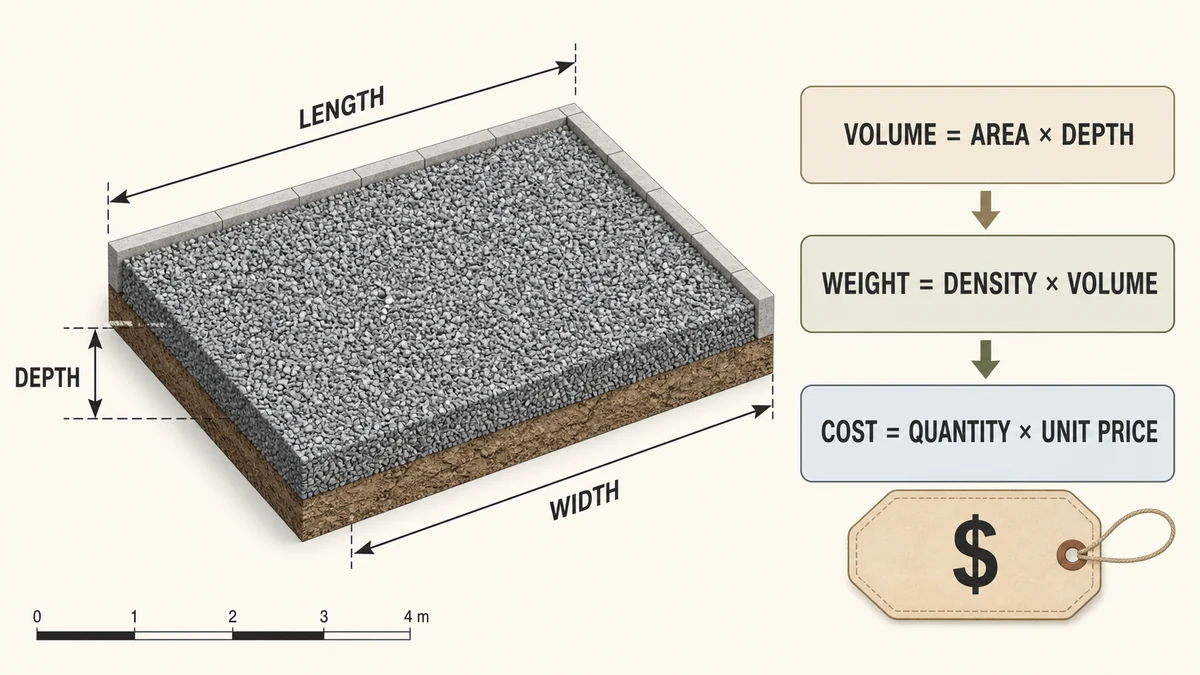
How the Gravel Calculator Works

1) Area Formula

If you enter length and width, the calculator finds the rectangular area.

Area = length × width

Using symbols:

A = L × W

In this formula:

  • A is the surface area
  • L is length
  • W is width

If you already know the area, you can enter the area directly and skip the length × width step.

2) Volume Formula

After the area is known, the calculator multiplies area by gravel depth.

Volume = area × depth

Using symbols:

V = A × d

In this formula:

  • V is gravel volume
  • A is project area
  • d is gravel depth

Depth must be converted into a compatible length unit before volume is calculated.

3) Weight Formula

To estimate weight, the calculator multiplies volume by gravel density.

Weight = density × volume

Using symbols:

W = ρ × V

In this formula:

  • W is estimated gravel weight
  • ρ is gravel density
  • V is gravel volume

4) Cost Formula

If pricing is enabled, the calculator estimates total cost from the gravel quantity and unit price.

Total cost = quantity × unit price

The live calculator can work with price per unit of mass or price per unit of volume. It can also convert between mass-based and volume-based pricing using the current density.

Gravel Formula Summary

What You Want to Find Formula Meaning
Rectangle area A = length × width Finds the surface area to be covered
Gravel volume V = A × depth Finds the three-dimensional gravel quantity
Gravel weight W = density × volume Converts gravel volume into estimated weight
Cost by weight Cost = weight × price per weight unit Used when supplier price is per kg, ton, lb, or similar mass unit
Cost by volume Cost = volume × price per volume unit Used when supplier price is per m³, yd³, ft³, or similar volume unit

Worked Example: Gravel Volume and Weight

Suppose you need gravel for a rectangular driveway area with:

  • Length: 10 m
  • Width: 4 m
  • Depth: 10 cm
  • Gravel density: 1680 kg/m³

Step 1: Calculate area
Area = length × width
Area = 10 × 4
Area = 40 m²

Step 2: Convert depth to meters
10 cm = 0.10 m

Step 3: Calculate volume
Volume = area × depth
Volume = 40 × 0.10
Volume = 4 m³

Step 4: Calculate weight
Weight = density × volume
Weight = 1680 × 4
Weight = 6720 kg

Step 5: Convert kilograms to metric tons
6720 kg ÷ 1000 = 6.72 t

So, this project needs about 4 m³ of gravel, or about 6.72 metric tons using a density of 1680 kg/m³.

Worked Example: Gravel in Cubic Yards

Suppose a project area is 300 ft², and the gravel depth is 3 inches.

Step 1: Convert depth to feet
3 inches = 3 ÷ 12 = 0.25 ft

Step 2: Calculate cubic feet
Volume = area × depth
Volume = 300 × 0.25
Volume = 75 ft³

Step 3: Convert cubic feet to cubic yards
1 cubic yard = 27 cubic feet
75 ÷ 27 = 2.78 yd³

So, a 300 ft² area covered 3 inches deep needs about 2.78 cubic yards of gravel before adding waste or overage.

Worked Example: Gravel Cost by Ton

Suppose the calculator estimates 6.72 metric tons of gravel, and the supplier price is $45 per metric ton.

Step 1: Use the cost formula
Total cost = weight × price per ton

Step 2: Substitute the values
Total cost = 6.72 × 45

Step 3: Calculate
Total cost = $302.40

So, if gravel costs $45 per metric ton, the estimated material cost is $302.40.

Worked Example: Gravel Cost by Cubic Yard

Suppose a project needs 3.5 yd³ of gravel, and the supplier price is $60 per yd³.

Step 1: Use the volume pricing formula
Total cost = volume × price per cubic yard

Step 2: Substitute the values
Total cost = 3.5 × 60

Step 3: Calculate
Total cost = $210

So, if gravel costs $60 per cubic yard, the estimated material cost is $210.

How to Use This Gravel Calculator

  1. Select the gravel type or choose a custom gravel density.
  2. If using a custom density, enter the density and select the density unit.
  3. Enter the project length and width, or enter the known area directly.
  4. Select the correct length, area, and depth units.
  5. Enter the gravel depth.
  6. If you want a cost estimate, enter price per unit of mass or price per unit of volume.
  7. Select the currency and price unit that match your supplier quote.
  8. Click Calculate to estimate area, volume, weight, total cost, and step-by-step derivation.
  9. Use Reset to clear the calculator and start again.

How to Interpret the Results

Result What It Means Important Caution
Area The surface area that will be covered by gravel. For irregular areas, break the space into smaller shapes or enter a known total area.
Volume needed The three-dimensional amount of gravel required before waste, compaction, or settling. Delivered loose volume may differ from compacted installed volume.
Weight needed The estimated gravel mass based on selected density. Real weight can vary with moisture, gradation, void space, and supplier material.
Total cost The estimated material cost from the entered supplier price. May not include delivery, taxes, spreading, labor, fuel surcharge, or minimum order fees.
Step-by-step derivation The formula path and unit conversions used by the calculator. Check the selected units, density, depth, and price basis before ordering.

Gravel Volume vs Gravel Weight

Gravel may be sold by volume or by weight. These measurements are related through density, but they are not the same.

Measurement What It Means Common Units Best Used When
Volume How much space the gravel fills m³, yd³, ft³ Your supplier quotes by cubic yard, cubic meter, or cubic foot
Weight / mass How heavy the gravel is kg, t, lb, US ton, long ton Your supplier quotes by ton, tonne, pound, or kilogram
Density Weight per unit volume kg/m³, t/m³, lb/ft³, lb/yd³ You need to convert between volume and weight pricing

If your supplier sells by the ton, focus on the weight result. If your supplier sells by cubic yard or cubic meter, focus on the volume result.

Why Gravel Density Matters

Density controls the conversion between gravel volume and gravel weight. Two projects with the same cubic yardage can have different weights if the gravel type, moisture, stone size, and compaction are different.

Density can vary because of:

  • stone type
  • particle size
  • gradation
  • void space between stones
  • moisture content
  • compaction
  • screened vs crushed material
  • supplier measurement method

Use your supplier’s bulk density when available. If you do not have a supplier density, use the calculator’s gravel type presets as planning estimates.

Common Gravel Density Examples

These values are general planning references. Real gravel density can vary by supplier, stone type, moisture, particle size, gradation, void space, and compaction.

Material Type Approximate Density Note Use Note
Dry gravel Often around 1500–1700 kg/m³ Common planning range for dry bulk gravel
Wet gravel Often heavier than dry gravel Moisture increases delivered weight
Pit-run gravel Can be denser than loose dry gravel May include mixed particle sizes
Sand and gravel mix Varies by sand/gravel ratio and moisture Can compact differently than clean gravel
Crushed stone Varies by stone type, gradation, and compaction Useful for base layers, drainage, and structural fill planning

Use your supplier’s bulk density when available. If you do not have supplier density data, use the calculator presets as planning estimates only.

How Much Extra Gravel Should You Order?

Most real projects need a small overage because gravel can settle, compact, spill, spread unevenly, or vary from the measured depth.

Common planning overages include:

  • 5% for simple, accurately measured, low-waste projects
  • 10% for typical landscaping, driveway, and path projects
  • 15% or more for uneven ground, deep fill, compaction, irregular shapes, or uncertain measurements

For construction specifications, follow the project plan, engineer’s requirement, or supplier recommendation.

Common Gravel Depths

Gravel depth depends on project purpose, load, soil condition, drainage, compaction, and base preparation. The examples below are general planning ranges only.

Project Type Typical Gravel Depth Important Note
Decorative landscape gravel About 2–3 inches Use landscape fabric or edging when appropriate
Walking path About 2–4 inches Depth depends on traffic, soil, and base condition
Driveway top layer Often 2–4 inches May require a compacted base below
Driveway base Often 4–8 inches or more Depends on soil, drainage, vehicle load, and local practice
Drainage trench Project-specific Follow drainage design and pipe bedding requirements
Paver base Project-specific Follow paver manufacturer and local base recommendations

Price Per Ton vs Price Per Cubic Yard

Gravel suppliers may quote prices by weight or by volume. This calculator can help compare both pricing styles when density is known.

Pricing Method Use When Supplier Quotes Formula Check Before Ordering
Price per weight per kg, t, lb, US ton, or long ton Cost = weight × unit price Confirm whether the quoted ton is metric, US short ton, or long ton
Price per volume per m³, yd³, ft³, dm³, cm³, or in³ Cost = volume × unit price Confirm whether volume is loose, delivered, or compacted volume

When comparing quotes, check whether delivery, taxes, spreading, minimum order quantity, fuel surcharges, and waste allowance are included.

Useful Gravel Unit Conversions

Conversion Value
1 m³ 35.3147 ft³
1 yd³ 27 ft³
1 yd³ 0.764555 m³
1 ft³ 0.0283168 m³
1 metric ton 1000 kg
1 US short ton 2000 lb
1 US short ton 907.18474 kg
1 pound 0.45359237 kg

Gravel for Driveways

Driveway gravel estimates depend on driveway size, layer depth, traffic, vehicle weight, and base condition. A driveway may use multiple layers, such as a larger base stone below and a smaller top layer above.

For driveway planning, consider:

  • soil stability
  • drainage
  • base layer depth
  • top layer material
  • compaction
  • slope and runoff
  • edge containment
  • expected vehicle load

The calculator estimates material quantity, but it does not design a driveway structure.

Gravel for Landscaping

For landscaping, gravel depth is usually chosen for coverage, appearance, weed control, and stability. Decorative gravel is often spread shallower than structural base gravel.

When using gravel for landscaping, consider:

  • desired finished appearance
  • stone size and color
  • weed barrier or landscape fabric
  • edging
  • drainage
  • maintenance and raking
  • sloped areas where gravel may migrate

Gravel for Drainage

Drainage gravel is often used around pipes, French drains, trenches, and low spots. The correct gravel type and depth depend on the drainage design.

For drainage work, consider:

  • pipe diameter
  • trench width
  • required gravel envelope
  • filter fabric
  • soil type
  • water flow direction
  • local drainage requirements

Use this calculator for quantity estimates only. Follow the drainage design or local construction specification for material selection and installation.

How to Estimate Irregular Areas

If your project area is not a simple rectangle, break it into smaller shapes and add the areas together.

For example:

  • Split an L-shaped area into two rectangles.
  • Approximate a curved area with several rectangles or triangles.
  • Use a separate area calculator if you need circle, triangle, or polygon area first.
  • Enter the total known area directly into the gravel calculator.

For irregular ground, use an average depth rather than only the shallowest or deepest point.

Common Mistakes to Avoid

  • Do not forget to convert depth correctly, especially inches to feet or centimeters to meters.
  • Do not assume every gravel type has the same density.
  • Do not compare supplier prices without checking whether they are per ton, per cubic yard, or per truckload.
  • Do not ignore compaction, settling, and waste.
  • Do not use decorative gravel depth for structural driveway base design.
  • Do not forget delivery fees, taxes, minimum order sizes, or spreading costs.
  • Do not enter outside dimensions if the area has borders, edging, or excluded sections.
  • Do not use this calculator as a substitute for engineering or construction specifications.

Important Assumptions and Limitations

  • This calculator estimates gravel quantity from area, depth, density, and optional price.
  • Rectangle mode assumes the project area is length × width.
  • Known-area mode assumes the entered area is accurate.
  • Weight is estimated from selected density, not directly measured.
  • Density can vary by gravel type, stone size, gradation, void space, moisture content, compaction, and supplier measurement method.
  • Loose delivered volume may differ from compacted installed volume.
  • The result may not include waste, spillage, overage, settling, delivery fees, taxes, minimum order quantities, spreading, labor, equipment, or fuel surcharges.
  • The currency selector labels the price result only; it does not convert exchange rates.
  • This calculator does not design structural driveway bases, road subgrades, engineered fill, retaining systems, drainage systems, or code-controlled construction details.
  • For construction, driveway, drainage, paver-base, or engineering work, follow project specifications, supplier guidance, contractor recommendations, or qualified professional advice.

Practical Uses

This Gravel Calculator can be useful for:

  • estimating gravel for driveways
  • calculating cubic yards of gravel
  • estimating gravel tons
  • calculating gravel cost
  • planning landscaping beds
  • estimating path or walkway gravel
  • planning patio or paver base material
  • estimating drainage trench gravel
  • comparing supplier prices by ton and cubic yard
  • checking volume and weight before ordering bulk material

When You May Need a Different Calculator

This calculator is best for gravel spread over a rectangular or known area. You may need another calculator if your project uses a different material, shape, or engineering method.

  • Use a sand calculator for sand fill, bedding, or leveling sand.
  • Use a concrete calculator for slabs, footings, or columns.
  • Use a cubic yard calculator for general bulk-material volume.
  • Use a square footage calculator if you need to find the project area first.
  • Use a volume calculator for tanks, cylinders, or irregular shapes.
  • Use a drainage or pipe calculator for hydraulic design, not just material quantity.

References

  1. Caterpillar — Material Density Tables to Help Estimate Earthwork Volumes
  2. NIST — Approximate Conversions from U.S. Customary Measures to Metric
  3. NIST SP 1038 — SI Units and Conversion Factors for General Use
  4. National Stone, Sand & Gravel Association — Aggregates Overview

Related Calculators

Gravel Estimate Disclaimer

This Gravel Calculator provides a planning estimate only. Actual gravel quantity, weight, delivered volume, installed depth, and cost can vary because of density, moisture, compaction, gradation, void space, settling, uneven ground, waste, spillage, supplier measurement method, delivery charges, taxes, minimum order rules, and local material availability.

For driveways, drainage systems, paver bases, construction fill, road bases, engineered work, or code-controlled projects, confirm the required material type, layer depth, density, compaction, drainage, and installation method with your supplier, project specification, contractor, engineer, or qualified professional before ordering or installing gravel.

More of our calculators...

Elevation Grade Calculator

Use our Elevation Grade Calculator to find slope ratio, percent grade, angle of elevation, and 1 in N ratio from rise and run with mixed-unit support.

Roof Pitch Calculator

Roof Pitch Calculator helps you find roof pitch, slope, angle, and rise-to-run values quickly for roofing, planning, and construction work.

Square Footage Calculator

Square Footage Calculator helps you measure room area, total square feet, and material cost quickly with accurate results.

Tank Volume Calculator

Tank Volume Calculator helps you find tank capacity in gallons, liters, and cubic units with fast, accurate results.

Taper Calculator

Use our Taper Calculator to find taper per length, taper ratio, half-angle, and included angle from large diameter, small diameter, and taper length.

Sand Calculator

Use our Sand Calculator to estimate sand area, volume, weight, and optional total cost from length, width, depth, density, and price.

Ramp Calculator

Use our Ramp Calculator to find ramp slope angle, grade percent, run, and ramp length from rise, ratio, or accessibility ramp presets.

Pipe Volume Calculator

Calculate pipe volume from inner diameter and length. Get capacity in m³, liters, and US gallons (plus per-length). Supports mm/in and ft/m. Shows formula and steps; instant results & PDF.

Framing Calculator

Free wall framing calculator: enter wall length/height, stud spacing (16″/24″ o.c.) & openings to get studs, plates, headers, sheathing and cost. Metric/imperial with waste %, steps & PDF.