
Mulch Calculator
Estimate mulch volume, cubic yards, cubic feet, bag quantity, and optional material cost for garden beds, landscape areas, and planting borders.
Results
Mulch estimates are approximate. Actual needs can vary because of bed shape, uneven ground, settling, slope, existing mulch, edging, and how deeply the mulch is spread.
The Mulch Calculator finds the volume needed to cover a landscape bed at a chosen finished depth. Enter the bed dimensions, convert depth to the same unit, and the tool reports cubic feet, cubic yards or cubic metres plus an estimated number of bags. Existing mulch and settled grade should be considered before ordering.
The mulch formula is area times depth
For a rectangle:
Volume = length × width × depth
When measurements are in feet and mulch is sold by the cubic yard, divide cubic feet by 27. Convert inches of depth to feet by dividing by 12. A 20 ft by 10 ft bed at 3 in deep needs 50 ft³, or about 1.85 yd³, before any practical adjustment.
Measure curved beds without pretending they are rectangles
Split irregular beds into smaller rectangles, circles, semicircles, or triangles and add their areas. For a long curving border, measure average width at several points and multiply by centreline length. Subtract large rocks, paved areas, trunks, and structures only when their occupied area is meaningful.
Choose depth for the site and material
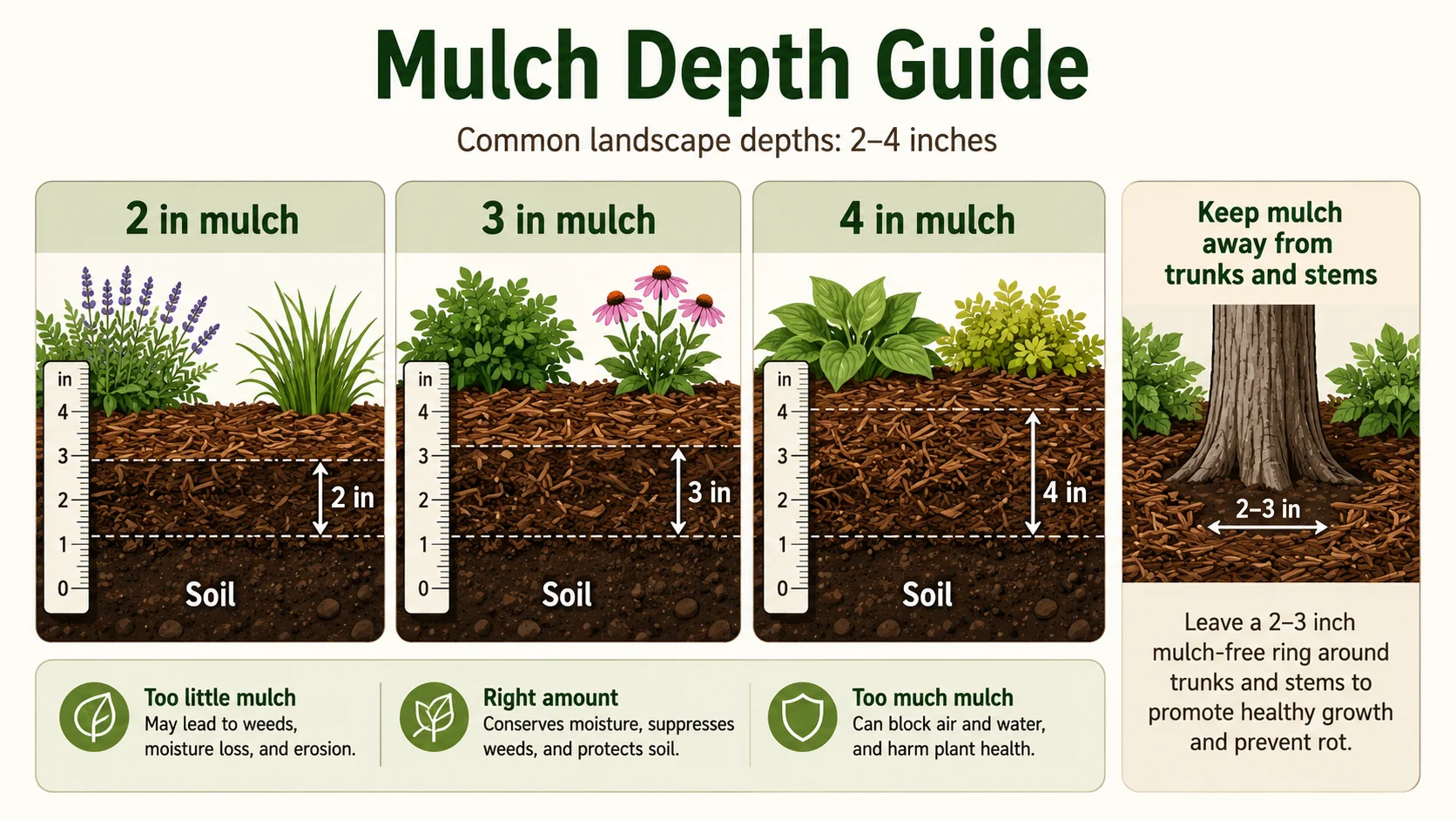
Depth is not merely a purchasing preference. Fine composted mulch and coarse wood chips behave differently. Too little may fail to provide the intended surface coverage; piling material too deeply can restrict water and air. Keep mulch away from direct contact with trunks and building materials where moisture or pests are a concern.
Existing mulch reduces the new volume
If a bed already has a usable 1 in layer and the target finished depth is 3 in, calculate the additional 2 in rather than ordering a new full 3 in layer. Probe several locations because weathering and displacement are uneven. The Mulch Calculator cannot detect compaction from the surface appearance.
Convert volume to bags accurately
Use the cubic volume printed on the bag, not its weight. Divide required volume by volume per bag and round up to a whole bag. Bulk mulch may be sold in half-yard or full-yard increments. Confirm whether the supplier uses a level or heaped measure and whether delivery access can handle the quantity.
Ordering and placement checklist
- Record net bed area rather than the entire property area.
- Measure current depth before adding material.
- Use a finished depth suitable for the mulch and planting.
- Keep units consistent and round only at the purchasing step.
- Check bulk minimums, bag volume, delivery, and storage.
Related landscape estimates
For soil added beneath planting, use the Topsoil Calculator. Plan hardscape with the Paver Calculator, or measure a rectangular outdoor area with the Area Calculator.
Adjust depth for the condition of the bed
A new bed, a yearly top-up, and a path do not necessarily need the same depth. Check the existing layer before ordering; decomposed material may be incorporated into soil while intact mulch may only need a thin refresh. Keep mulch away from trunks, stems, siding, and drainage openings, and do not create deep “volcano” piles around trees. Irregular beds can be divided into rectangles, circles, or triangles and added before applying depth.
Mulch Calculator FAQ
How many cubic feet are in one cubic yard?
There are 27 cubic feet in a cubic yard.
Should old mulch be removed?
That depends on condition, material, pests, contamination, and the intended finished depth. Measure what remains before adding more.
Why does bag count round upward?
Suppliers sell whole bags, so a fractional mathematical result must become the next purchasable unit.
Use site-appropriate practices and species guidance. The Penn State Extension guidance on mulching landscape trees explains placement and common problems.