Roofing Shingle Calculator

Estimate roof shingles, roofing squares, bundles, waste allowance, purchased coverage, and optional bundle cost using roof footprint size and pitch.

in / 12
%
$

Planning a shingle order starts with the roof’s sloped surface rather than the flat floor area of the building. The Roofing Shingle Calculator converts a rectangular roof footprint and an x-in-12 pitch into estimated roof area, adds a selected waste allowance, and calculates roofing squares, whole bundles, purchased coverage, and optional material cost.

The result is intended for preliminary material planning. Roofs with hips, valleys, dormers, intersecting planes, skylights, chimneys, overhangs, or different pitches require section-by-section measurements. Always compare the estimate with the approved roof plan, product wrapper, manufacturer instructions, local requirements, and a qualified roofing professional before ordering or installation.

What the Roofing Shingle Calculator Estimates

The calculator begins with roof footprint length and width. It applies a pitch multiplier based on the entered rise per 12 inches of horizontal run, then multiplies by the number of same-size roof sections. After adding waste, it reports the following planning values:

  • Bundles needed: whole shingle bundles required after coverage and waste calculations.
  • Roofing squares: shingle area divided by 100 square feet.
  • Shingle area needed: calculated sloped roof area plus waste allowance.
  • Estimated bundle cost: rounded bundle quantity multiplied by price per bundle.
  • Base footprint area: flat rectangular area for all repeated sections.
  • Pitch multiplier: factor used to convert horizontal footprint area into sloped area.
  • Total purchased coverage: whole bundles multiplied by the entered coverage per bundle.
  • Extra coverage after rounding: purchased coverage remaining beyond calculated shingle area.
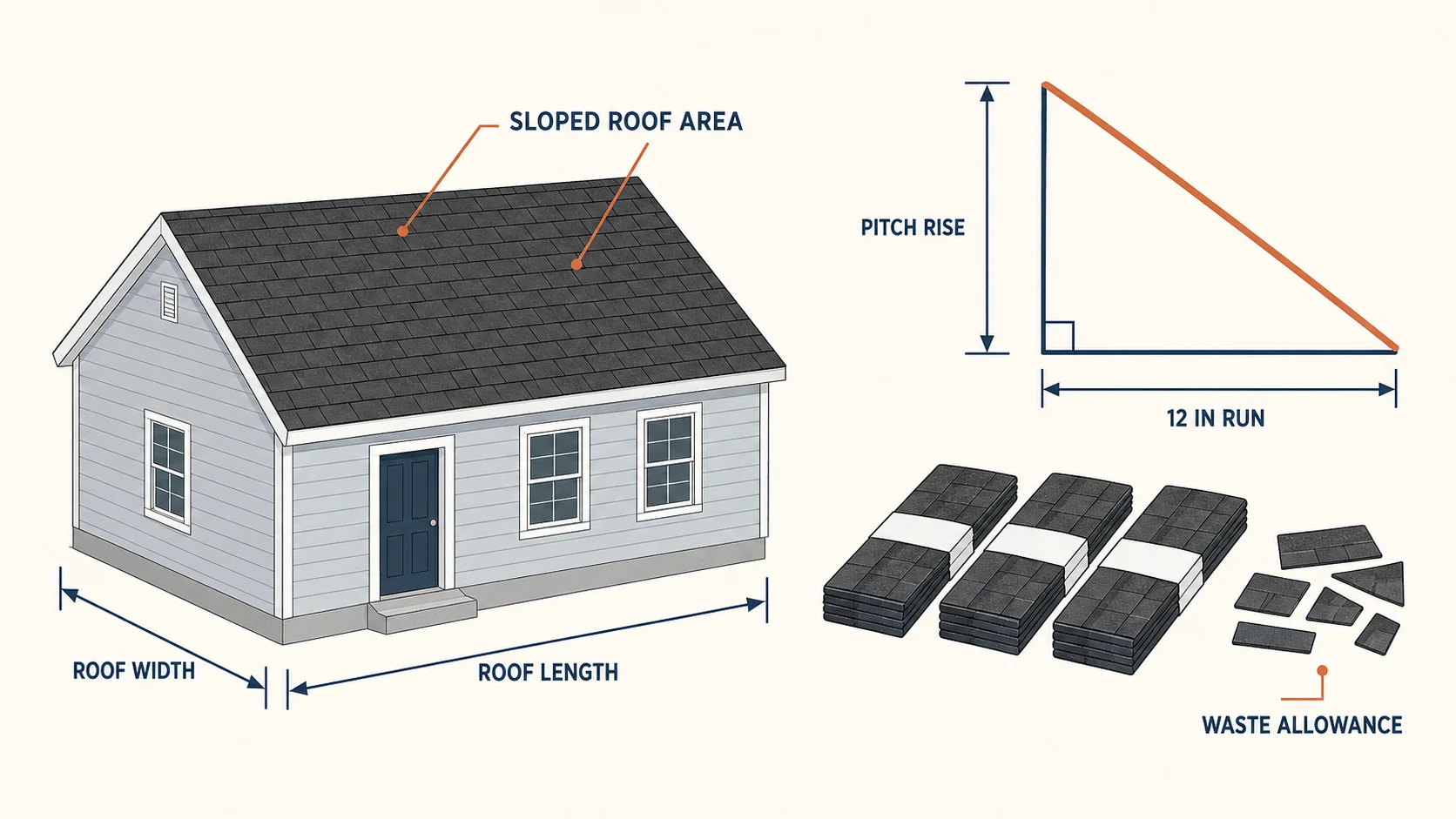
Roofing shingle measurement diagram showing roof length, roof width, pitch rise, 12-inch run, sloped roof area and waste allowance
Measure the roof footprint, identify the rise per 12 inches of run, and allow for cuts and complex roof details.

Roofing Shingle Calculation Formulas

The base footprint area represents the horizontal projection of all identical roof sections:

Footprint area = roof length × roof width × number of sections

For a pitch entered as rise per 12 inches of horizontal run, the calculator uses the Pythagorean relationship to find the slope factor:

Pitch multiplier = √(rise² + 12²) ÷ 12

The multiplier converts the footprint projection to the estimated sloped surface:

Sloped roof area = footprint area × pitch multiplier
Shingle area needed = sloped roof area × (1 + waste percentage ÷ 100)
Roofing squares = shingle area needed ÷ 100
Bundles needed = shingle area needed ÷ bundle coverage

The bundle quantity is rounded upward to a whole package. Purchasing outputs then use:

Total purchased coverage = rounded bundles × coverage per bundle
Extra coverage = purchased coverage − shingle area needed
Estimated cost = rounded bundles × price per bundle

How to Use the Calculator

  1. Measure the horizontal roof footprint length and width, including overhangs when they are part of the roof area.
  2. Select the correct unit for both footprint dimensions.
  3. Enter the roof pitch rise. A 6/12 pitch rises 6 inches for every 12 inches of horizontal run.
  4. Enter the number of identical roof sections. Calculate sections separately when their sizes or pitches differ.
  5. Choose a waste percentage appropriate for roof complexity, cuts, valleys, hips, and installation conditions.
  6. Read the actual installed coverage printed on the selected shingle wrapper or specification and enter it as bundle coverage.
  7. Optionally enter the current price per bundle to obtain a shingles-only cost estimate.
  8. Review the detailed area, pitch, waste, coverage, rounding, and cost results before discussing the order with a supplier or contractor.

Worked Example: 6/12 Roof Pitch

Suppose a rectangular roof footprint measures 40 ft by 30 ft and has a 6/12 pitch. Waste is 10%, each shingle bundle covers 33.3 ft², and the bundle price is $38.

Footprint area: 40 × 30 = 1,200 ft²
Pitch multiplier: √(6² + 12²) ÷ 12 ≈ 1.118
Sloped roof area: 1,200 × 1.118 ≈ 1,341.6 ft²
Shingle area with waste: 1,341.6 × 1.10 ≈ 1,475.76 ft²
Roofing squares: 1,475.76 ÷ 100 ≈ 14.76 squares
Bundles: 1,475.76 ÷ 33.3 ≈ 44.32, rounded up to 45 bundles
Purchased coverage: 45 × 33.3 = 1,498.5 ft²
Extra coverage: 1,498.5 − 1,475.76 = 22.74 ft²
Estimated bundle cost: 45 × $38 = $1,710

This example estimates field shingles only. Starter strips, hip and ridge shingles, underlayment, leak barrier, flashing, drip edge, fasteners, ventilation products, delivery, tax, removal, disposal, equipment, and labour are separate.

Roofing Squares and Bundle Coverage

A roofing square is an area of 100 ft²; it is not the same as one physical bundle. Many common products are packaged at roughly three bundles per square, but coverage varies by shingle type and manufacturer. Some specialty shingles cover substantially less per bundle. For that reason, the calculator accepts actual bundle coverage instead of assuming that every package covers 33.3 ft².

Use installed coverage from the exact product wrapper or technical sheet. Do not estimate coverage from the number of shingles inside a bundle because shingle dimensions, exposure, and package quantities vary. Whole-bundle rounding may create a small surplus beyond the selected waste factor.

Selecting a Waste Allowance

Waste depends on roof geometry and installation layout. A simple gable roof generally has fewer cuts than a design with multiple valleys, hips, dormers, skylights, chimneys, and short intersecting planes. Shingle style, course alignment, damaged pieces, starter requirements, and installer practice can also affect the order.

The calculator applies one percentage to the entire sloped area. It cannot inspect individual facets or predict usable offcuts. A professional takeoff may use different waste factors for different roof sections and may calculate hips, ridges, valleys, eaves, and rakes separately.

Assumptions and Limitations

  • The footprint method assumes a rectangular horizontal projection and a consistent pitch for the entered sections.
  • Different pitches or irregular roof planes should be measured and calculated separately, then combined.
  • The calculation does not automatically add overhangs unless they are included in the entered footprint dimensions.
  • Waste is a percentage allowance, not a detailed cutting plan for hips, valleys, dormers, or penetrations.
  • Bundle coverage and permitted roof slopes are product-specific; follow the manufacturer’s current instructions.
  • The estimated cost includes bundles only and excludes accessories, services, labour, tax, delivery, and disposal.
  • Measuring or working on a roof can involve serious fall hazards. Do not access a roof without suitable training and safety controls.

Frequently Asked Questions

How many square feet are in one roofing square?

One roofing square equals 100 square feet of roof surface. Divide the shingle area, including waste, by 100 to find roofing squares.

How many bundles of shingles are in a square?

Many common shingles use about three bundles per square, but this is not universal. Enter the exact coverage shown for the selected product.

Does roof pitch increase the shingle area?

Yes. The sloped surface is larger than its horizontal footprint. The calculator uses the rise per 12 inches to determine the pitch multiplier.

Should roof overhangs be included?

Yes, when they are not already included in the footprint measurement. The calculator only uses the length and width entered.

Does the estimate include ridge caps and starter shingles?

No. Field shingle coverage is estimated. Starter strips and hip or ridge products are normally measured by relevant edge lengths and product coverage.

Why must bundle quantities be rounded up?

Shingles are normally purchased as whole bundles. Rounding upward ensures the purchased coverage is not less than the calculated shingle area.

Related Roofing and Measurement Calculators

References

View Sponsored Offers →

Related Tools

Asphalt Calculator

Use this asphalt calculator to estimate asphalt volume, cubic yards, short tons, metric tonnes, waste allowance, and material cost for driveways, paths, parking areas, and paving projects.

Insulation Calculator

Use this insulation calculator to estimate wall and ceiling insulation area, packages needed, waste allowance, purchased coverage, extra coverage, and material cost.

Air Conditioner Size Calculator

Use this air conditioner size calculator to estimate AC capacity in BTU/hr, tons, and kW from room size, ceiling height, sunlight, insulation, climate, occupants, and heat load.

Paver Calculator

Use this paver calculator to estimate pavers needed, boxes or pallets, project area, layout count, waste allowance, and optional material cost.

Decking Calculator

Use this decking calculator to estimate deck boards needed, board rows, boards per row, deck area, waste allowance, purchased board length, and optional material cost.

BTU Calculator

Use this BTU Calculator to estimate room heating or cooling capacity in BTU/hr from room size, temperature difference, insulation, exposure, extra heat load, and safety margin.

Concrete Calculator

Estimate concrete volume in cubic yards, feet, and meters, plus 40, 60, or 80 lb bags for slabs, pads, and rectangular pours with waste.

Fence Calculator

Use this fence calculator to estimate fence panels, posts, rails, net fence length, waste allowance, and optional material cost for straight runs or closed perimeter fencing.

Sand Calculator

Use our Sand Calculator to estimate sand area, volume, weight, and optional total cost from length, width, depth, density, and price.