Asphalt Calculator

Estimate asphalt volume, cubic yards, short tons, metric tonnes, waste allowance, and optional material cost for driveways, parking areas, paths, and paving sections.

%
$

Asphalt quantity depends on three physical measurements: paved area, compacted thickness, and mixture density. The Asphalt Calculator combines these values to estimate volume in cubic feet, cubic yards, and cubic meters, then converts the volume into short tons and metric tonnes. An allowance can be added for compaction, uneven grade, edge loss, and other practical ordering needs.

The calculated tonnage is a planning estimate rather than a pavement design or supplier quotation. Asphalt mixtures do not all have the same density, and final quantities can change with layer thickness, compaction, base condition, delivery rules, and the producer’s measurement method. Use the mix density supplied for the project whenever it is available.

What the Asphalt Calculator Estimates

The calculator accepts area length, area width, asphalt thickness, number of same-size areas, asphalt density, waste or compaction allowance, and an optional price per short ton. It reports:

  • Asphalt needed: estimated material weight in U.S. short tons.
  • Metric tonnes: the same estimated weight expressed in metric tonnes.
  • Cubic yards: total asphalt volume after the selected allowance.
  • Estimated material cost: short tons multiplied by price per short ton.
  • Cubic feet and cubic meters: total calculated paving volume in both systems.
  • Base volume: geometric volume before waste or compaction allowance.
  • Allowance volume: extra volume added by the entered percentage.
  • Base paved area and density: the area and material density used in the calculation.
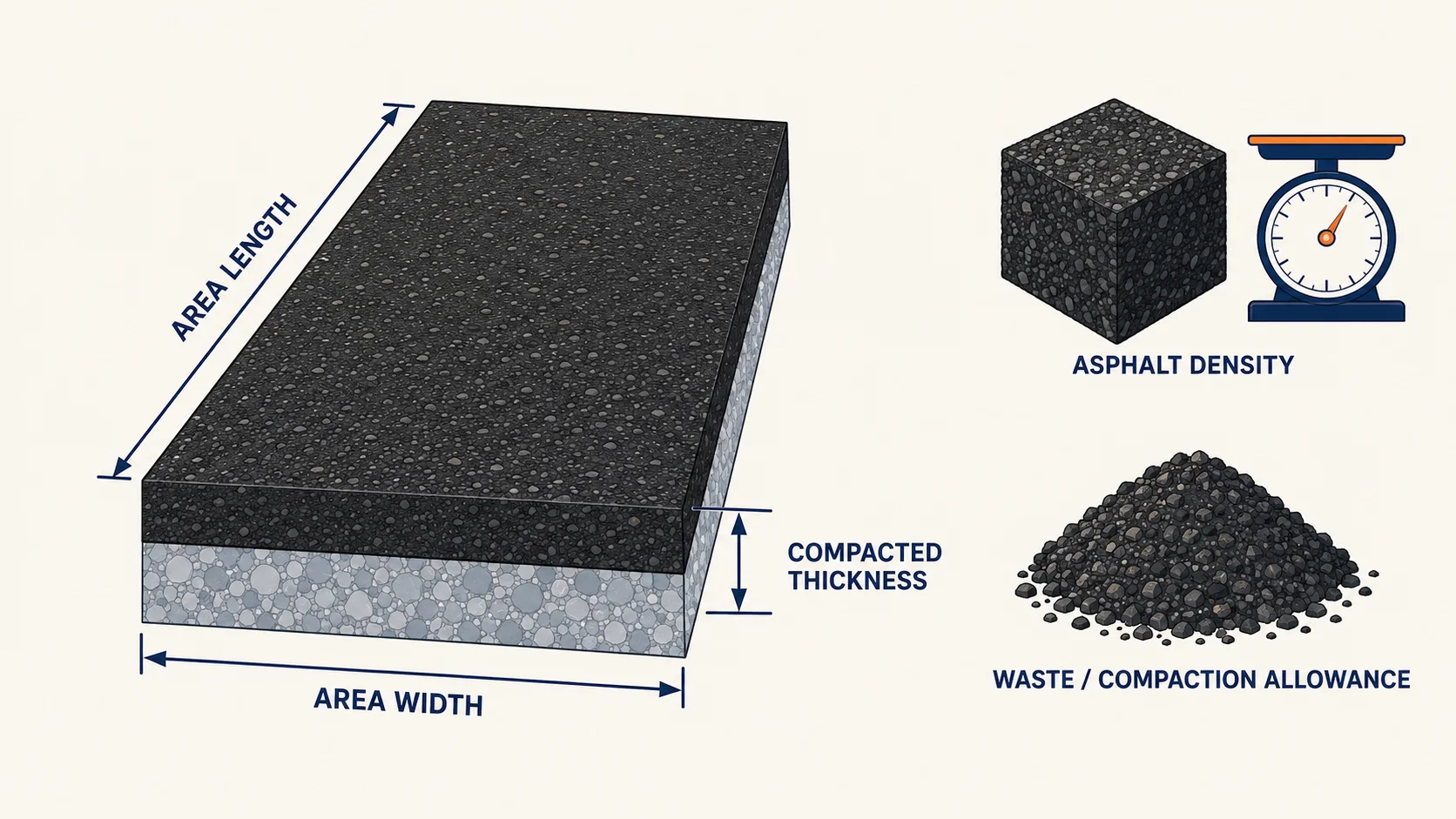
Asphalt paving measurement diagram showing area length, area width, compacted thickness, asphalt density and waste or compaction allowance
Measure the paving area and required compacted thickness, then use the project-specific asphalt density and a realistic ordering allowance.

Asphalt Calculation Formulas

The first step is the total rectangular area. When several areas have identical dimensions, the quantity multiplies the area:

Paved area = length × width × number of same-size areas

Thickness must be converted to the same length unit before finding volume. For measurements in feet and inches:

Thickness in feet = thickness in inches ÷ 12
Base volume = paved area × thickness

The selected allowance increases the base volume before weight is calculated:

Total volume = base volume × (1 + allowance percentage ÷ 100)
Allowance volume = total volume − base volume

Density converts volume to weight. The input density and volume must use compatible units:

Weight = total volume × asphalt density
Short tons = weight in pounds ÷ 2,000
Metric tonnes = weight in kilograms ÷ 1,000
Cubic yards = cubic feet ÷ 27
Estimated cost = short tons × price per short ton

How to Measure and Enter a Paving Area

  1. Measure the finished length and width of the rectangular driveway, parking section, path, or repair area.
  2. Select the correct unit for each dimension and enter the number of identical areas.
  3. Enter the required compacted asphalt thickness, not the loose depth before rolling.
  4. Obtain the expected compacted density from the asphalt producer, mix design, specification, or project professional.
  5. Enter an allowance for uneven grade, edge loss, small placement losses, and other project-specific uncertainty.
  6. Optionally enter the quoted price per short ton for an estimated asphalt-material cost.
  7. Review the calculation details and confirm the producer’s minimum load, delivery, rounding, and billing method before ordering.

Divide irregular paving into manageable rectangles and calculate each one separately. Areas with different compacted thicknesses or mixtures should also be estimated separately because their volume and density assumptions differ.

Worked Example: Asphalt for a Rectangular Area

Suppose a paving section is 20 ft long and 10 ft wide with a compacted asphalt thickness of 3 inches. The selected density is 145 lb/ft³, the allowance is 5%, and asphalt costs $120 per short ton.

Paved area: 20 × 10 = 200 ft²
Thickness in feet: 3 ÷ 12 = 0.25 ft
Base volume: 200 × 0.25 = 50 ft³
Allowance volume: 50 × 0.05 = 2.5 ft³
Total volume: 50 × 1.05 = 52.5 ft³
Cubic yards: 52.5 ÷ 27 ≈ 1.94 yd³
Weight: 52.5 × 145 = 7,612.5 lb
Short tons: 7,612.5 ÷ 2,000 ≈ 3.81 tons
Metric tonnes: approximately 3.45 tonnes
Estimated material cost: 3.80625 × $120 = $456.75

The example covers asphalt material only. Excavation, grading, aggregate base, geotextile, tack coat, drainage, equipment, traffic control, delivery charges, disposal, testing, tax, and labour are outside the cost estimate.

Why Asphalt Density Matters

Volume alone does not determine tonnage. Two mixtures occupying the same compacted volume can have different weights because aggregate type, gradation, binder content, air voids, and compaction affect density. A generic value can support early planning, but the producer’s expected density gives a better order estimate.

Do not treat the density field as a compaction percentage. Density is the weight per unit of compacted volume, while the calculator’s allowance separately adds material to the geometric requirement. Using an unsuitable density can change both tonnage and cost even when all dimensions remain unchanged.

Thickness, Compaction, and Allowance

The entered thickness should describe the intended compacted layer. Loose asphalt is placed thicker before rolling, but the exact relationship depends on the mixture, equipment, temperature, and construction procedure. The calculator does not convert a compacted thickness into a loose paving depth.

An allowance helps address ordinary estimating uncertainty, but it does not replace accurate surveying or base preparation. Low spots, an uneven existing surface, widening at edges, irregular shapes, construction joints, and producer delivery minimums can all affect the ordered quantity. Discuss the appropriate allowance with the paving contractor or supplier.

Assumptions and Limitations

  • The calculation models each entered area as a rectangular layer with uniform compacted thickness.
  • Sloped or uneven ground is not surveyed automatically; the calculator only uses the dimensions entered.
  • Density varies by asphalt mixture, aggregate, temperature, air-void content, and achieved compaction.
  • The allowance is a simple percentage and does not predict every placement or delivery loss.
  • Cost output uses short tons and excludes delivery minimums, surcharges, labour, equipment, tax, and base work.
  • The tool does not select the asphalt mix, design pavement thickness, assess drainage, or verify structural capacity.
  • Roadways, heavy-vehicle areas, regulated work, and difficult ground conditions require professional design and applicable specifications.

Frequently Asked Questions

How do I calculate how much asphalt I need?

Multiply paved area by compacted thickness, add the selected allowance, multiply by asphalt density, and convert the resulting weight into short tons or metric tonnes.

What asphalt density should I enter?

Use the compacted density supplied for the selected mixture whenever possible. A default planning value may not match the producer’s mix or achieved field density.

Should I enter loose or compacted thickness?

Enter the required finished compacted thickness. Loose placement depth depends on the mix and paving procedure and is not calculated automatically.

Why does the calculator add a compaction allowance?

The percentage adds extra material for estimating uncertainty, uneven grade, edge losses, and practical ordering needs. It does not model compaction mechanics.

How many pounds are in a short ton?

One U.S. short ton equals 2,000 pounds. The calculator divides the estimated weight in pounds by 2,000.

Does the cost include installation and base preparation?

No. It estimates asphalt material cost from short tons and price per ton. Base work, delivery, labour, equipment, tax, and related services are excluded.

Related Paving and Volume Calculators

References

View Sponsored Offers →

Related Tools

Door and Window Area Calculator

Use this door and window area calculator to find total opening area, door area, window area, perimeter, and average opening size for construction and material estimates.

Roof Pitch Calculator

Roof Pitch Calculator helps you find roof pitch, slope, angle, and rise-to-run values quickly for roofing, planning, and construction work.

Mulch Calculator

Calculate how much mulch you need in cubic yards, cubic feet and bags. Enter your bed size, mulch depth and bag size to estimate quantity and cost.

Gravel Calculator

Use our Gravel Calculator to estimate gravel volume, weight, tons, cubic yards, coverage, and total cost from area, depth, density, and price.

Wallpaper Calculator

Use this wallpaper calculator to estimate wallpaper rolls, strips, wall area, pattern repeat allowance, waste allowance, and material cost for room wallpaper projects.

Decking Calculator

Use this decking calculator to estimate deck boards needed, board rows, boards per row, deck area, waste allowance, purchased board length, and optional material cost.

Roofing Shingle Calculator

Use this roofing shingle calculator to estimate shingle bundles, roofing squares, roof area, waste allowance, purchased coverage, and optional bundle cost.

Tank Volume Calculator

Tank Volume Calculator helps you find tank capacity in gallons, liters, and cubic units with fast, accurate results.

Topsoil Calculator

Use this topsoil calculator to estimate topsoil volume, cubic yards, cubic feet, cubic meters, bags needed, extra allowance, and optional material cost.