Time Calculator

A simple calculator to add, subtract, multiply, divide, or find the difference between dates and times.

Live
Choose the type of time calculation you want.
This only changes how the main result is displayed.

First time value

Changing the unit resets this input to 0.

Second time value

Changing the unit resets this input to 0.

Time value

Unit

Changing the unit resets the time input to 0.

Factor

Start date

End date

Start date & time

End date & time

Use this Time Calculator to add time, subtract time, multiply time, divide time, or find the duration between two dates or date-times. It can return results in seconds, minutes, hours, days, weeks, approximate months, approximate years, and mixed time formats such as hours/minutes/seconds or days/hours/minutes.

Important Note: This Time Calculator estimates elapsed-time arithmetic and date/date-time durations from the values entered. It can add, subtract, multiply, and divide time values, or find the duration between two dates or two date-times.

Fixed units such as seconds, minutes, hours, days, and weeks can be converted consistently. Calendar-related units such as months and years are more complicated because months have different lengths and leap years can change calendar-year duration.

This calculator is for educational, planning, and general time arithmetic use only. Do not use it as the final source for payroll, legal deadlines, billing, contracts, service-level agreements, compliance records, time-zone-sensitive logs, travel documents, or official scheduling decisions. For official use, verify the result with the relevant system, rule, contract, or qualified professional.

Reviewed by: AjaxCalculators Editorial Team
Last updated: April 27, 2026
Method source: Standard duration arithmetic using seconds, minutes, hours, days, weeks, approximate month/year conversions, and exact calendar date/date-time differences when date inputs are used
Editorial standards: AjaxCalculators Editorial Policy

What This Time Calculator Calculates

This calculator supports several common time and duration operations. It is designed for elapsed-time math, not for every possible calendar, payroll, legal, or time-zone rule.

Mode What It Calculates Best Use
Add time values Adds two or more durations after converting them into compatible units. Work logs, study time, workouts, playlists, projects, and task totals.
Subtract time values Subtracts one duration from another. Remaining time, break deductions, countdowns, and duration adjustments.
Multiply time Multiplies a duration by a numeric factor. Repeated tasks, repeated intervals, production estimates, and workout sets.
Divide time Divides a duration by a numeric factor. Splitting time into equal parts, sessions, intervals, or shifts.
Find time between dates Finds the duration between a start date and an end date. Project timelines, waiting periods, age-style date gaps, and day counts.
Find time between dates and times Finds elapsed duration when both date and clock time matter. Shift length, event duration, service windows, travel duration, and time logs.
Convert result units Displays the same result in seconds, minutes, hours, days, weeks, or mixed formats. Making the result easier to read or use in another calculation.

How the Time Calculator Works

The calculator converts entered time values into a common base unit, performs the selected operation, and then formats the result in the selected output unit.

Operation Formula or Method Example
Add time Total = time value 1 + time value 2 + time value 3 + … 2 h + 45 min = 2 h 45 min
Subtract time Result = first time value − second time value 5 h − 1 h 20 min = 3 h 40 min
Multiply time Result = time value × factor 25 min × 6 = 150 min
Divide time Result = time value ÷ factor 3 h ÷ 4 = 45 min
Time between dates Duration = end date − start date Finds the calendar-date gap between two dates.
Time between date-times Duration = end date and time − start date and time Includes both date and clock-time difference.

Fixed Time Units vs Calendar Time

Some time units are fixed-duration units, while calendar-related units can vary depending on the calendar date.

Unit Type Examples How to Interpret It
Fixed-duration units Milliseconds, seconds, minutes, hours, days, weeks Useful for elapsed-time arithmetic and unit conversion.
Calendar-aware dates Start date and end date Useful when real calendar dates matter.
Calendar-aware date-times Start date/time and end date/time Useful when exact clock time matters.
Approximate months Month-style duration estimates Approximate only because real months can have 28, 29, 30, or 31 days.
Approximate years Year-style duration estimates Approximate only unless an exact calendar date calculation is used.

Approximate Months and Years

The calculator can show approximate month and year outputs for general duration estimates. These outputs should not be treated as exact calendar periods.

Output Calculator Meaning Important Limitation
Approximate month A duration estimate based on a standard average month value. Real calendar months can have 28, 29, 30, or 31 days.
Approximate year A duration estimate based on a standard year value. Leap years and exact calendar dates can change real date-to-date duration.
Exact date mode Uses start and end dates to calculate date duration. Better when actual calendar dates matter.
Exact date-time mode Uses start/end dates and start/end times. Better when exact elapsed time matters.

Use approximate month and year outputs for rough planning only. For payroll, billing, contracts, legal deadlines, or compliance records, use the exact rule required by the relevant authority or system.

Assumptions and Important Notes

  • This calculator supports time arithmetic and duration calculations.
  • Addition and subtraction combine time values after converting them into compatible units.
  • Subtraction uses the first row minus the sum of the other rows.
  • Multiplication uses time × factor.
  • Division uses time ÷ factor.
  • Milliseconds, seconds, minutes, hours, days, and weeks are fixed-duration units.
  • Month and year results may be approximate unless using exact date or date-time mode.
  • Calendar date and date-time calculations may depend on browser/device locale support.
  • This calculator is not a payroll, legal deadline, billing, or time-zone compliance tool.

Worked Example: Add Time

Suppose you want to add 2 hours 30 minutes and 1 hour 45 minutes.

Step Calculation Result
Add the hours 2 hours + 1 hour 3 hours
Add the minutes 30 minutes + 45 minutes 75 minutes
Convert 75 minutes 75 minutes = 1 hour 15 minutes 1 hour 15 minutes
Combine everything 3 hours + 1 hour 15 minutes 4 hours 15 minutes

So, 2 hours 30 minutes + 1 hour 45 minutes = 4 hours 15 minutes.

Worked Example: Subtract Time

Suppose you want to subtract 1 hour 20 minutes from 5 hours.

Step Calculation Result
Convert 5 hours to minutes 5 × 60 300 minutes
Convert 1 hour 20 minutes to minutes 1 × 60 + 20 80 minutes
Subtract 300 − 80 220 minutes
Convert back to hours and minutes 220 minutes = 3 hours 40 minutes 3 hours 40 minutes

So, 5 hours − 1 hour 20 minutes = 3 hours 40 minutes.

Worked Example: Multiply Time

Suppose one task takes 18 minutes and you need to repeat it 7 times.

Step Calculation Result
Start with one task duration 18 minutes 18 minutes
Multiply by the number of repeats 18 × 7 126 minutes
Convert to hours and minutes 126 minutes = 2 hours 6 minutes 2 hours 6 minutes

So, seven 18-minute tasks take about 2 hours 6 minutes.

Worked Example: Divide Time

Suppose you have 2 hours 30 minutes and want to divide it into 5 equal parts.

Step Calculation Result
Convert the total time to minutes 2 hours 30 minutes = 150 minutes 150 minutes
Divide by the number of parts 150 ÷ 5 30 minutes
Interpret the result Each part has equal duration. 30 minutes per part

So, each part is 30 minutes.

Worked Example: Duration Between Two Dates and Times

Suppose an event starts on April 10 at 9:30 AM and ends on April 12 at 2:00 PM.

Step Calendar or Time Count Result
Count full days April 10 at 9:30 AM to April 12 at 9:30 AM 2 days
Count remaining time 9:30 AM to 2:00 PM 4 hours 30 minutes
Combine the result 2 days + 4 hours 30 minutes 2 days 4 hours 30 minutes

So, the event duration is 2 days 4 hours 30 minutes.

How to Use This Time Calculator

  1. Select the type of time calculation: add, subtract, multiply, divide, find time between dates, or find time between dates and times.
  2. Choose the main result format, such as seconds, minutes, hours, days, weeks, hours and minutes, or days/hours/minutes.
  3. Enter the required time values, dates, or date-times.
  4. For multiplication or division, enter the factor.
  5. For subtraction, make sure the values are entered in the correct order.
  6. Click Calculate to view the result.
  7. Review the main result, total seconds, total minutes, total hours, and total days.
  8. Use Reset to clear the inputs and start again.

How to Interpret the Result

Result Item What It Means Important Caution
Main result The selected operation result shown in your chosen output format. The display format does not change the underlying duration.
Total seconds The full duration converted into seconds. Useful as a common base for exact duration conversion.
Total minutes The full duration converted into minutes. May include decimals for partial minutes.
Total hours The full duration converted into decimal hours. Remember that 1.5 hours means 1 hour 30 minutes.
Total days The full duration converted into days. This is elapsed duration, not always a calendar-day count.
Mixed formats Readable formats such as hours/minutes or days/hours/minutes. Best for practical everyday use.
Approximate months or years Duration shown using approximate month/year assumptions. Do not use for exact legal, payroll, billing, or contract calculations.

Elapsed Time vs Clock Time

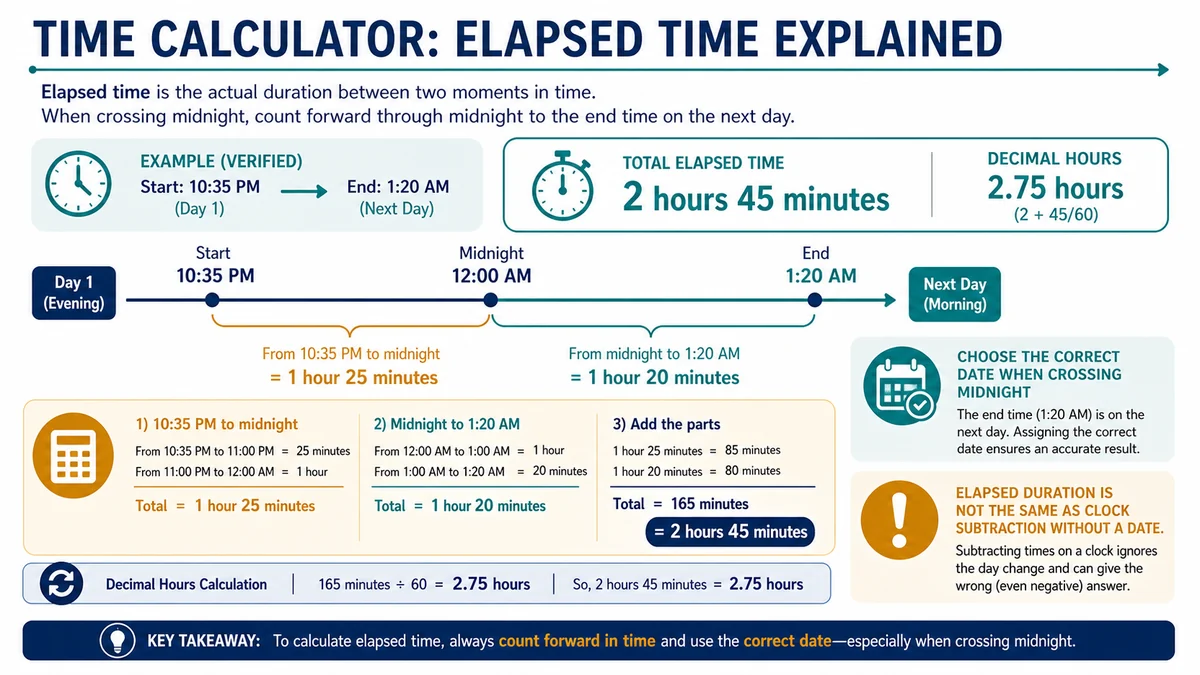
This calculator mainly works with elapsed durations. A duration is an amount of time, while clock time is a time of day.

Concept Example Use Note
Elapsed duration 2 hours + 30 minutes Handled by the time arithmetic modes.
Clock time 2:30 PM A time of day, not a duration by itself.
Date-time duration April 10, 9:30 AM to April 12, 2:00 PM Handled by date-time mode.
Time-zone-sensitive clock time 9:00 AM in New York vs 9:00 AM in London Requires time-zone-aware tools or official scheduling systems.

When a Time Calculator Is Useful

A time calculator is useful when you need to combine, compare, split, or convert durations.

Use Case How the Calculator Helps
Work hours Add task durations or subtract breaks from a work session.
Study planning Add lectures, reading blocks, revision sessions, and practice time.
Workout timing Multiply repeated intervals or divide total workout time into parts.
Project planning Add estimated task durations to plan total project time.
Meetings and events Find the duration between start and end date-times.
Travel planning Add travel segments, waiting periods, layovers, or transfer times.
Media production Add video clips, audio segments, voiceover sections, or editing blocks.
Cooking and baking Add preparation, cooking, resting, cooling, or proofing durations.

Common Mistakes to Avoid

Mistake Why It Causes Problems
Treating approximate months as exact calendar months Real calendar months do not all have the same number of days.
Treating approximate years as exact calendar years Leap years and exact dates can change date-to-date duration.
Entering subtraction values in the wrong order Subtracting A from B is different from subtracting B from A.
Mixing elapsed duration with clock time 2 hours is a duration; 2:00 PM is a clock time.
Using decimal hours incorrectly 1.5 hours means 1 hour 30 minutes, not 1 hour 50 minutes.
Ignoring time zones Date-time results may be wrong when start and end times are in different locations.
Using the result for payroll without verification Payroll may require rounding rules, break rules, overtime rules, and employer policy.
Using the result for legal or contract deadlines Legal and contract deadlines may require exact calendar rules and jurisdiction-specific interpretation.
Forgetting daylight-saving-time changes Some real-world date-time spans can be affected by local clock changes.

Time Conversion Quick Reference

Conversion Equivalent Value Use Note
1 millisecond 0.001 seconds 1,000 milliseconds = 1 second.
1 second 1 second Base unit used for many duration conversions.
1 minute 60 seconds Standard time conversion.
1 hour 60 minutes = 3,600 seconds Useful for work logs, study sessions, travel, and events.
1 day 24 hours = 86,400 seconds Useful for fixed elapsed-day conversion.
1 week 7 days Useful for longer elapsed-time estimates.
Approximate month About 30.5 days Approximate only; not an exact calendar month.
Approximate year About 365 days Approximate only; not a full legal or calendar-year rule.

Formula Summary

What You Want to Find Formula Use Note
Add time Total = time value 1 + time value 2 + time value 3 + … Add all compatible durations.
Subtract time Result = first time value − second time value Input order matters.
Multiply time Result = time value × factor Useful for repeated durations.
Divide time Result = time value ÷ factor Useful for splitting a duration into equal parts.
Duration between dates Duration = end date − start date Use date mode when calendar dates matter.
Duration between date-times Duration = end date/time − start date/time Use date-time mode when clock time matters.
Minutes from hours Minutes = hours × 60 Standard fixed-unit conversion.
Hours from minutes Hours = minutes ÷ 60 May produce decimal hours.
Seconds from minutes Seconds = minutes × 60 Standard fixed-unit conversion.
Days from hours Days = hours ÷ 24 Elapsed-day conversion, not always calendar-day logic.

When You May Need a Different Tool

This calculator is useful for general time arithmetic, but some situations require a specialized or official system.

Situation Better Tool or Method
Payroll and timesheets Use employer-approved timekeeping software and official rounding rules.
Legal or contract deadlines Use the exact rule in the contract, statute, court rule, or jurisdiction.
Billing or service-level agreements Use the billing system or SLA definition required by the agreement.
Time-zone conversion Use a time-zone-aware converter or scheduling system.
Daylight-saving-time-sensitive records Use software that handles local daylight-saving-time transitions correctly.
Travel itineraries Use airline, railway, booking, or official travel schedule data.
Exact calendar-month or calendar-year intervals Use date-aware calculation rules rather than approximate month/year outputs.

Frequently Asked Questions

What does this Time Calculator do?

It can add, subtract, multiply, and divide time values. It can also find the duration between two dates or between two date-times.

How do I add hours and minutes?

Select the add-time mode, enter the first and second time values, choose the correct units, and click Calculate. The result can be shown in seconds, minutes, hours, days, weeks, or mixed formats.

How do I subtract time?

Select the subtract-time mode, enter the starting time value and the value you want to subtract, then click Calculate. Input order matters.

How do I multiply time by a number?

Select the multiply mode, enter the time value and factor, then calculate. For example, 25 minutes × 6 = 150 minutes.

How do I divide time into equal parts?

Select the divide mode, enter the total time and factor, then calculate. For example, 2 hours 30 minutes ÷ 5 = 30 minutes per part.

What is the difference between elapsed time and clock time?

Elapsed time is a duration, such as 2 hours. Clock time is a time of day, such as 2:00 PM. Date-time mode is better when the start and end clock times matter.

Are month and year results exact?

Approximate month and year outputs are not exact calendar calculations. Use date or date-time mode when exact calendar dates matter.

Can I use this calculator for payroll?

Use it only for rough planning. Payroll may require employer rules, legal rules, rounding rules, break rules, overtime rules, and official timekeeping records.

Does this calculator handle time zones?

It is not a dedicated time-zone converter. If start and end times are in different locations, use a time-zone-aware tool or official scheduling system.

References

  1. BIPM — SI Base Unit: Second
  2. NIST Guide to the SI, Chapter 5 — Units Outside the SI
  3. NIST SP 330, Section 4 — Non-SI Units Accepted for Use with the SI
  4. NIST — Time and Frequency from A to Z: Leap Day, Leap Year, Leap Second
  5. BIPM — SI Brochure
  6. Microsoft Support — Add or Subtract Time

Related Calculators

Time Calculator Disclaimer

This Time Calculator is for educational, planning, and general time arithmetic use only. It estimates time totals, differences, products, quotients, and date/date-time durations from the values entered.

Fixed-duration outputs such as seconds, minutes, hours, days, and weeks are general duration conversions. Approximate month and year outputs should not be treated as exact calendar months or exact calendar years. Calendar and date-time calculations may also depend on the date, time, browser/device handling, and local time settings.

This calculator does not replace official payroll systems, billing records, legal deadline rules, contract terms, compliance systems, time-zone-aware scheduling software, travel schedules, or professional advice. For payroll, legal, billing, contract, travel, compliance, or time-zone-sensitive use, verify the result with the relevant official system, rule, document, or qualified professional.

More of our calculators...

Calorie Deficit Calculator

Use our Calorie Deficit Calculator to estimate BMR, maintenance calories, TDEE, calorie deficit, target calories, and weekly weight-change estimate.

SLEEP CALCULATOR

Use our Sleep Calculator to find the best bedtime or wake-up time based on sleep cycles, fall-asleep time, and total hours in bed for a smoother morning.

Face Shape Calculator

Use our Face Shape Calculator to estimate your likely face shape from forehead, cheekbone, jawline, and face length measurements plus chin shape.

Age Difference Calculator

Use our Age Difference Calculator to find the exact age gap between two dates of birth in years, months, days, total months, total days, and approximate years.

Bikini Calculator

Use our Bikini Calculator to estimate your body shape from bust, waist, high hip, and hip measurements, then get bikini style suggestions that fit your shape.

Body Shape Calculator

Body Shape Calculator helps you identify your body type from key measurements and understand which shape category fits you best.

Helium Balloons Calculator

Use our Helium Balloons Calculator to estimate lift per balloon, total helium volume, and how many helium balloons you need to lift a given weight.

RPM Calculator

Use our RPM Calculator to find engine RPM from speed or vehicle speed from RPM using overall gear ratio and tire diameter, plus wheel RPM and tire circumference.

Reading Time Calculator

Use our Reading Time Calculator to estimate how long it takes to read a book, daily pages read, and time needed to finish from pages and reading speed.