
Pipe Volume Calculator
- Cylinder volume:
V = πd²L / 4 - Cross-sectional area:
A = πd² / 4 - Liquid mass:
m = ρ × V
A pipe can look large from the outside yet hold less liquid than expected because capacity is controlled by the inner diameter, not the nominal label or outside diameter. This pipe volume calculator turns the usable bore and pipe length into cross-sectional area, internal volume, gallons, liters, cubic feet, and estimated liquid mass. It is useful for filling a new line, sizing a storage or flushing job, checking how much treatment chemical is needed, and comparing alternative pipe runs without repeating unit conversions by hand.
How to use the pipe volume calculator
Enter the pipe’s actual inside diameter, then enter the length of the section you want to fill. Choose the unit beside each input rather than converting measurements beforehand. If you also want liquid weight or mass, select a density or enter the density that matches the fluid and its operating condition. The results update to show area, volume in several common units, and mass.
Use the full developed length of the pipe, including vertical and horizontal portions. For a run made from several sections, add their centerline lengths or calculate each section separately and total the volumes. Fittings, valves, meters, reducers, and equipment can add or remove internal capacity, so include their manufacturer-stated volumes when a high-accuracy fill estimate matters.
Pipe volume formula
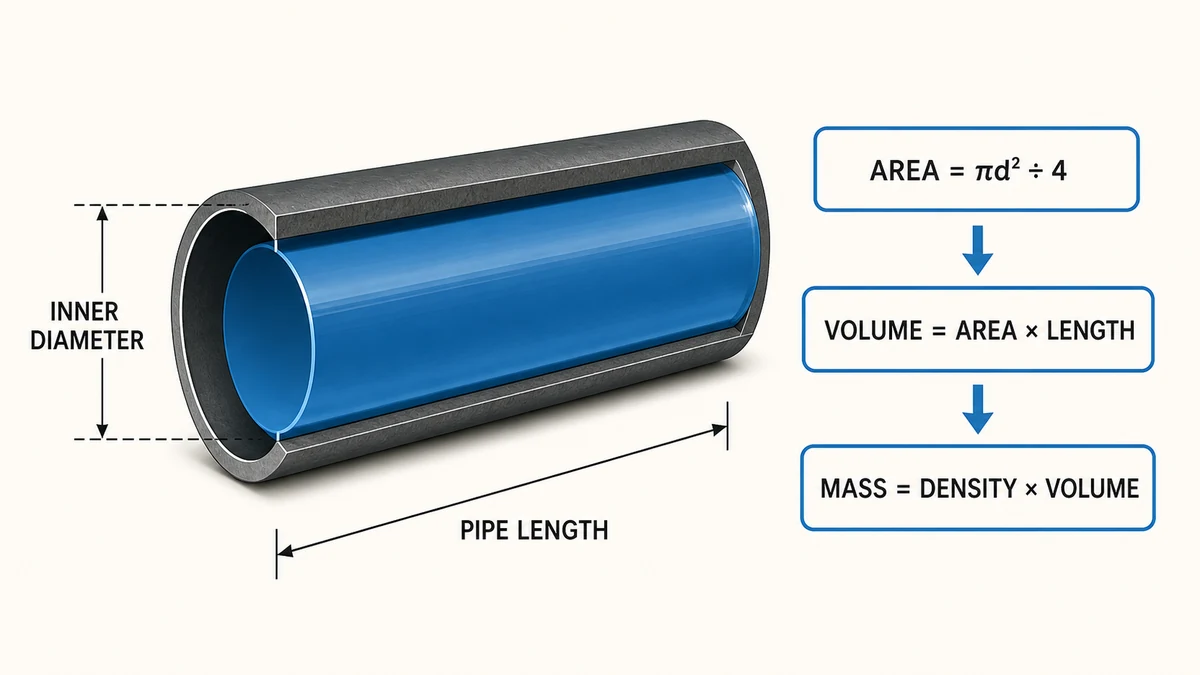
A straight pipe is treated as a cylinder. First find the internal circular area:
A = πd² ÷ 4
where A is internal area and d is the inner diameter. Then multiply by internal length:
V = A × L = πd²L ÷ 4
where V is volume and L is pipe length. This is the same cylinder relationship used in standard geometry; see the OpenStax explanation of cylinder volume. The calculator converts all inputs to consistent base units before applying the equation, then converts the answer into liters, cubic meters, cubic feet, and U.S. gallons.
Why inner diameter matters so much
Diameter is squared in the formula. A small change in bore therefore causes a much larger change in capacity. Doubling the inside diameter while keeping length unchanged produces four times the volume. This is why an estimate based on nominal pipe size can be misleading: nominal size is a naming system, while actual inside diameter varies with schedule, wall thickness, material, lining, and manufacturing standard.
Use a manufacturer data sheet, recognized pipe dimension chart, or a direct measurement of the bore. For lined or scaled pipe, use the remaining open diameter if you are estimating real operating capacity. If the pipe is not circular, this calculator is not the right model; calculate the true internal cross-sectional area and multiply it by length instead.
Worked pipe capacity example
Suppose a straight pipe has a 100 mm inside diameter and is 25 m long. Its area is π × 0.100² ÷ 4, or about 0.007854 m². Multiplying by 25 m gives about 0.19635 m³. That equals approximately 196.35 liters, before allowing for fittings or trapped air. If the liquid density is 1,000 kg/m³, the contained liquid mass is about 196.35 kg.
The example also illustrates a useful reasonableness check: a 100 mm bore contains about 7.85 liters per meter. Multiplying that figure by 25 gives the same result. When planning multiple similar runs, volume per unit length is often the fastest way to audit the total.
From volume to liquid mass
When density is supplied, the calculator uses m = ρV, where m is mass, ρ is density, and V is volume. Density can change with fluid composition, concentration, temperature, and pressure. Water is often approximated near 1,000 kg/m³ for rough planning, but process liquids, fuels, brines, and slurries need an appropriate technical data value.
Mass is not the same as force or support load, and contained fluid is only part of an installed pipe system’s weight. Structural or support design may also need pipe wall weight, insulation, fittings, valves, dynamic loads, and code-required factors. Use qualified engineering data when a result affects supports, pressure systems, hazardous materials, or safety.
Unit conversions and gallons
Keep diameter and length units explicit. Mixing millimeters with meters without conversion is a common source of errors because the diameter is squared. The calculator handles that conversion internally. For audit work, the NIST conversion factors provide traceable relationships among SI and U.S. customary volume units.
Also distinguish U.S. liquid gallons from imperial gallons. This calculator reports U.S. gallons. If specifications use another gallon definition, convert from the displayed liters or cubic meters with the required standard. Round only the final answer; early rounding of diameter or area can noticeably distort a long-run total.
Planning a complete piping job
For a complete material estimate, calculate each bore size separately, include branches that will be filled, and decide whether tanks or vessels belong in the total. The tank volume calculator can estimate common tank shapes, while the cylinder volume calculator is helpful for other cylindrical containers. If the project requires pump sizing, pressure-loss analysis, thermal expansion, or surge assessment, pipe volume is only one input to a broader engineering calculation.
Record the source of every diameter, length, and density value. A clear input list makes the estimate easier to review and update after field measurements. For purchasing or charging fluid, add an explicit allowance only when the project requires it; do not hide an assumed percentage inside the measured length.
Common mistakes to avoid
- Entering outside diameter instead of the clear inside diameter.
- Using nominal pipe size as though it were a measured bore.
- Forgetting branches, risers, fittings, or equipment volumes.
- Mixing millimeters, inches, feet, and meters without consistent conversion.
- Using a generic density for a temperature-sensitive or concentrated liquid.
- Assuming calculated geometric volume equals immediately usable delivered volume when air pockets or incomplete drainage are possible.
Frequently asked questions
How do I calculate the volume of a pipe?
Square the inside diameter, multiply by π, divide by four, and multiply by pipe length. Keep all dimensions in compatible units before converting the final volume.
Should I use inner or outer diameter?
Use inner diameter for liquid capacity. Outside diameter includes the pipe wall and will overstate the space available to the fluid.
How many gallons are in a pipe?
Calculate the cylinder volume from inside diameter and length, then convert it to U.S. gallons. The calculator performs both steps and also reports liters and cubic feet.
Does pipe schedule change volume?
Yes. For a given nominal size, a thicker wall generally means a smaller inside diameter and less capacity. Confirm the actual bore for the selected material and schedule.
Can the calculator estimate water weight?
Yes. Enter an appropriate water density and the tool multiplies it by volume. Treat the result as liquid mass; total installed load needs the rest of the system components.
Does the result include fittings and valves?
No. The straight-pipe calculation covers the entered cylindrical length. Add verified internal volumes for fittings, valves, meters, and connected equipment when needed.
Pipe Capacity Uses the Internal Diameter
Fluid volume is based on the pipe’s inside diameter, not the nominal size or outside diameter. Wall schedule, lining, fittings, slope, and whether the pipe is completely full affect practical capacity. Convert length and diameter to compatible units before applying the cylindrical formula, and consult engineering standards for pressurized, structural, or drainage design.