Board Foot Calculator

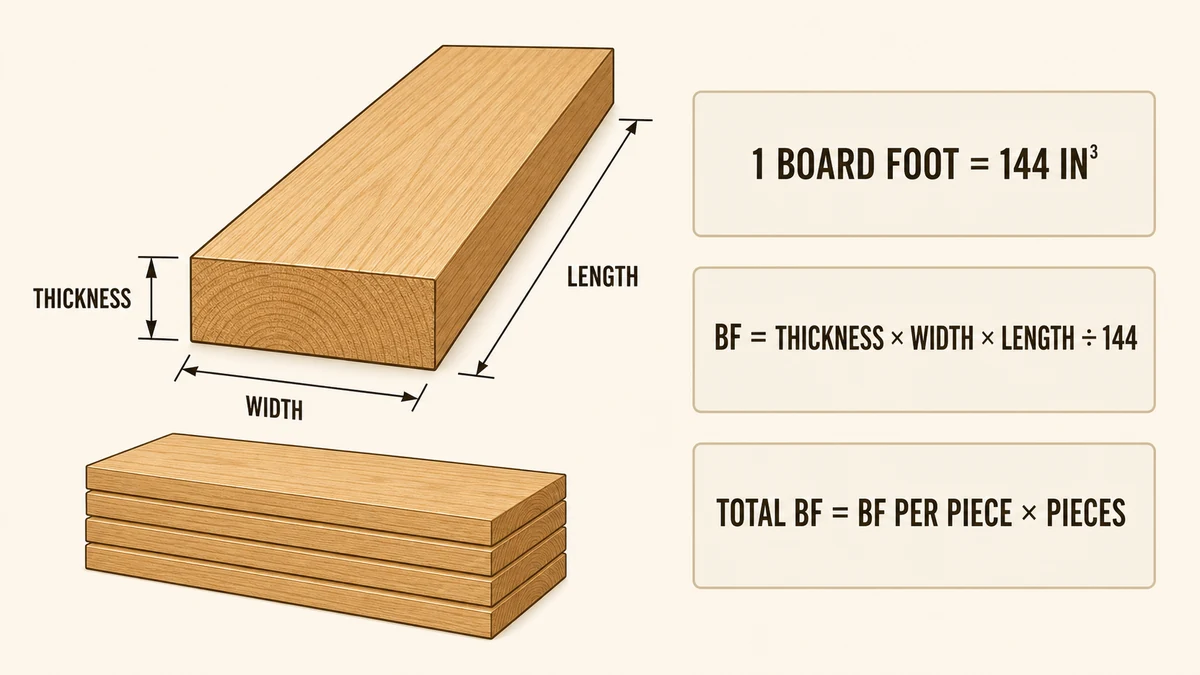
1 board foot = 144 in³ = 1/12 ft³. Formula: BF = (L × W × T) / 144 (all dimensions in inches).

Pieces
Enter how many identical pieces you’re calculating.
Price per board foot
Optional. Used to calculate the total cost.
Thickness
Width
Length
Per Piece
Calculated from one piece only.
Total
Shows total board feet for all pieces.
Total Cost
Price per board foot × total board feet.
Step-by-step derivation
Enter your pieces and dimensions, then click Calculate.
References
  • Board foot definition: 1 BF = 144 in³ = 1/12 ft³.
  • Formula: BF = (Length × Width × Thickness) / 144 when all dimensions are in inches.
  • Mixed ft/in and m/cm inputs are converted to inches first, then used in the standard formula.

Important Note: Board feet measure lumber volume, not surface area or linear length. One board foot equals a board that is 12 inches long, 12 inches wide, and 1 inch thick, or 144 cubic inches. Results depend on whether you enter actual lumber dimensions or nominal lumber dimensions, so always check how your supplier prices the wood.

Use this Board Foot Calculator to estimate lumber volume and optional material cost from thickness, width, length, number of pieces, and price per board foot. It is useful for woodworking, hardwood buying, sawmill planning, cabinet projects, furniture making, and rough lumber estimates.

Reviewed by: AjaxCalculators Editorial Team
Last updated: May 2026
Method source: Standard board foot volume formula
Editorial standards: AjaxCalculators Editorial Policy

What This Board Foot Calculator Calculates

This calculator estimates:

  • Board feet per piece
  • Total board feet for multiple identical pieces
  • Total cost when price per board foot is entered
  • Step-by-step formula substitution
  • Unit-converted dimensions when non-inch units are selected

The calculator supports common length, width, and thickness units such as millimeters, centimeters, meters, inches, feet, ft/in, and m/cm. It converts the dimensions to inches before applying the standard board foot formula.

Board Foot Formula

A board foot is a volume measurement used for lumber. The standard formula is:

Board feet = Length × Width × Thickness ÷ 144

Where all three dimensions are measured in inches.

Variable Meaning Required Unit in Formula
Length Length of the board Inches
Width Width of the board Inches
Thickness Thickness of the board Inches
144 Cubic inches in one board foot 12 × 12 × 1

If the length is entered in feet and the width and thickness are entered in inches, the formula can also be written as:

Board feet = Length in feet × Width in inches × Thickness in inches ÷ 12

How the Board Foot Calculator Works

The calculator follows these steps:

  1. Converts thickness, width, and length into inches.
  2. Multiplies length × width × thickness to find cubic inches per piece.
  3. Divides cubic inches by 144 to find board feet per piece.
  4. Multiplies board feet per piece by the number of pieces.
  5. If a price per board foot is entered, multiplies total board feet by the price.
Result Formula
Board feet per piece (Length × Width × Thickness) ÷ 144
Total board feet Board feet per piece × number of pieces
Total cost Total board feet × price per board foot

Worked Example

Suppose you want to calculate the board footage for 6 boards. Each board is:

  • Thickness: 2 inches
  • Width: 8 inches
  • Length: 10 feet
  • Number of pieces: 6
  • Price: $7.50 per board foot

First, convert length to inches:

10 feet × 12 = 120 inches

Now calculate board feet per piece:

Board feet = 120 × 8 × 2 ÷ 144

Board feet = 1,920 ÷ 144 = 13.33 board feet per piece

Now multiply by 6 pieces:

Total board feet = 13.33 × 6 = 80 board feet

Now calculate cost:

Total cost = 80 × $7.50 = $600

So, the project needs approximately 80 board feet of lumber, with an estimated cost of $600.

Board Feet vs Linear Feet vs Square Feet

Board feet, linear feet, and square feet are not the same measurement. Choosing the wrong unit can cause major lumber-ordering mistakes.

Measurement What It Measures Example Use
Board feet Lumber volume Hardwood boards, rough lumber, sawmill pricing
Linear feet Length only Trim, moulding, boards sold by length
Square feet Surface area Flooring, plywood coverage, wall area

A board can have the same linear footage as another board but a very different board-foot volume if the width or thickness is different.

Nominal vs Actual Lumber Dimensions

Board foot calculations can be affected by whether you use nominal or actual lumber dimensions.

Dimension Type Meaning Why It Matters
Nominal dimensions The common trade size, such as 2 × 4 May not match the board’s actual measured size
Actual dimensions The real measured thickness, width, and length Gives a more direct physical volume estimate
Rough lumber dimensions Dimensions before surfacing or planing Often used in hardwood and sawmill contexts

For accurate purchasing, check whether the lumber seller prices board feet using rough, nominal, or actual dimensions.

Common Board Foot Examples

Board Size Length Approximate Board Feet
1 in × 6 in 8 ft 4 board feet
1 in × 12 in 8 ft 8 board feet
2 in × 4 in 8 ft 5.33 board feet
2 in × 6 in 10 ft 10 board feet
2 in × 8 in 10 ft 13.33 board feet
4 in × 4 in 8 ft 10.67 board feet

How to Use This Board Foot Calculator

  1. Enter the number of identical pieces.
  2. Optionally enter the price per board foot if you want a cost estimate.
  3. Enter the board thickness and select the correct unit.
  4. Enter the board width and select the correct unit.
  5. Enter the board length and select the correct unit.
  6. Click Calculate to estimate board feet per piece, total board feet, and total cost.
  7. Use Reset to clear the fields and start again.
  8. Use Download PDF if you want to save or print the calculation.

How to Interpret the Results

Result Meaning Important Caution
Board feet per piece The lumber volume of one board or piece. Only valid for the dimensions entered.
Total board feet Total lumber volume for all pieces. Add waste allowance for cutting, defects, trimming, and mistakes.
Total cost Estimated material cost based on price per board foot. Actual prices may vary by species, grade, moisture, surfacing, supplier, and location.

When to Add a Waste Allowance

The calculated board footage is the mathematical volume of the pieces entered. Real projects often need more lumber than the exact calculated amount.

Project Type Possible Waste Allowance Reason
Simple straight cuts 5% to 10% Trimming, saw kerf, minor mistakes
Furniture or cabinetry 10% to 20% Grain selection, joinery, defects, matching parts
Rough lumber 15% to 30% or more Warp, checks, knots, milling, drying, and surfacing loss

The right waste allowance depends on wood species, board quality, project layout, cutting plan, and how much matching or defect removal is needed.

Practical Uses

  • Estimating hardwood lumber purchases
  • Planning woodworking and furniture projects
  • Comparing lumber prices from different suppliers
  • Checking sawmill or rough lumber quantities
  • Estimating project cost from board-foot pricing
  • Converting mixed units into standard board-foot volume

Common Mistakes

  • Using feet for every dimension without converting to inches first.
  • Confusing board feet with square feet.
  • Confusing board feet with linear feet.
  • Entering nominal dimensions when the seller uses actual dimensions, or the other way around.
  • Forgetting to multiply by the number of pieces.
  • Forgetting waste allowance for cutting, milling, defects, or mistakes.
  • Assuming the lowest price per board foot always gives the lowest usable project cost.

Assumptions and Limitations

  • The calculator assumes rectangular boards or pieces.
  • It assumes the dimensions entered represent the lumber dimensions you want to calculate.
  • It converts all dimensions to inches before applying the board-foot formula.
  • It does not account for saw kerf, trimming, milling loss, defects, knots, checking, cupping, bowing, twist, or waste.
  • It does not evaluate wood grade, moisture content, species, strength, appearance, or suitability for a project.
  • It does not determine whether a board is priced by nominal, actual, rough, or surfaced dimensions.
  • Total cost is an estimate only and depends on the price entered by the user.

References

  1. Ohio State University Extension — Measuring Standing Trees and Board Foot Definition
  2. University of Tennessee Extension — Estimating Weight of Logs and Standing Timber
  3. NIST — SI Units and Unit References

Related Calculators

Frequently Asked Questions

What is a board foot?

A board foot is a lumber volume measurement. One board foot equals 144 cubic inches, which is the volume of a board 12 inches long, 12 inches wide, and 1 inch thick.

How do I calculate board feet?

Multiply length, width, and thickness in inches, then divide by 144. If length is in feet while width and thickness are in inches, multiply length in feet by width in inches by thickness in inches, then divide by 12.

Is board foot the same as square foot?

No. A square foot measures area, while a board foot measures lumber volume. Board feet include thickness, but square feet do not.

Is board foot the same as linear foot?

No. A linear foot measures length only. Board feet include length, width, and thickness.

Should I use nominal or actual dimensions?

Use the dimensions that match how the lumber is being priced or measured. Hardwood and rough lumber may be sold using rough or actual dimensions, while some retail lumber is commonly described with nominal dimensions.

Does this calculator include waste?

No. The calculator gives the mathematical board footage for the dimensions entered. Add extra lumber for cutting waste, defects, milling loss, grain selection, and mistakes.

Why is price per board foot optional?

Price is optional because the calculator can estimate lumber volume without cost. If you enter a price per board foot, it also estimates total material cost.

Can I use this for logs or standing trees?

This calculator is best for rectangular boards or lumber pieces. Logs and standing trees require log rules, taper assumptions, sawmill yield estimates, and waste factors, so they should not be calculated the same way as rectangular boards.

Disclaimer

This Board Foot Calculator provides general lumber-volume and cost estimates only. It does not account for waste, saw kerf, milling loss, defects, moisture content, grade, species, surfacing, nominal-versus-actual pricing rules, or supplier-specific measurement practices. Always confirm measurements, pricing method, waste allowance, and material requirements with your lumber supplier, sawmill, contractor, or project plan before purchasing materials.

More of our calculators...

Elevation Grade Calculator

Use our Elevation Grade Calculator to find slope ratio, percent grade, angle of elevation, and 1 in N ratio from rise and run with mixed-unit support.

Roof Pitch Calculator

Roof Pitch Calculator helps you find roof pitch, slope, angle, and rise-to-run values quickly for roofing, planning, and construction work.

Square Footage Calculator

Square Footage Calculator helps you measure room area, total square feet, and material cost quickly with accurate results.

Tank Volume Calculator

Tank Volume Calculator helps you find tank capacity in gallons, liters, and cubic units with fast, accurate results.

Taper Calculator

Use our Taper Calculator to find taper per length, taper ratio, half-angle, and included angle from large diameter, small diameter, and taper length.

Sand Calculator

Use our Sand Calculator to estimate sand area, volume, weight, and optional total cost from length, width, depth, density, and price.

Ramp Calculator

Use our Ramp Calculator to find ramp slope angle, grade percent, run, and ramp length from rise, ratio, or accessibility ramp presets.

Pipe Volume Calculator

Calculate pipe volume from inner diameter and length. Get capacity in m³, liters, and US gallons (plus per-length). Supports mm/in and ft/m. Shows formula and steps; instant results & PDF.

Gravel Calculator

Use our Gravel Calculator to estimate gravel volume, weight, tons, cubic yards, coverage, and total cost from area, depth, density, and price.