Wallpaper Calculator

Estimate wallpaper rolls, wall area, strips, pattern repeat allowance, waste allowance, and optional material cost for room wallpaper projects.

%
$

Wallpaper is usually ordered by rolls, but the useful quantity inside each roll depends on more than its printed area. Wall height determines the length of every strip, roll width determines the coverage of each strip, and a repeating pattern may require each cut to be longer so adjacent strips align correctly. The Wallpaper Calculator combines these details to estimate strips, usable roll coverage, whole rolls, and optional material cost.

The result is a planning estimate for a rectangular room. Alcoves, sloping walls, half-drop matches, large motifs, trimming, and damaged strips can change the requirement. Check the product label before ordering.

What the Wallpaper Calculator Estimates

The calculator uses room length, room width, wall height, optional opening area, roll width, roll length, optional pattern repeat, waste allowance, and optional price per roll. Its results include:

  • Wallpaper rolls needed: the final quantity rounded up to whole rolls.
  • Estimated strips: the number of wall-height drops required for the net wall area.
  • Wallpaper area needed: estimated wallcovering requirement after the selected allowance.
  • Estimated roll cost: whole rolls multiplied by the entered price per roll.
  • Room perimeter: combined length around all four walls.
  • Gross and net wall area: wall area before and after deducting doors and windows.
  • Adjusted strip length: wall-height cut rounded to a complete pattern repeat.
  • Strips per roll and usable coverage: complete drops obtainable from one roll and the area they cover.
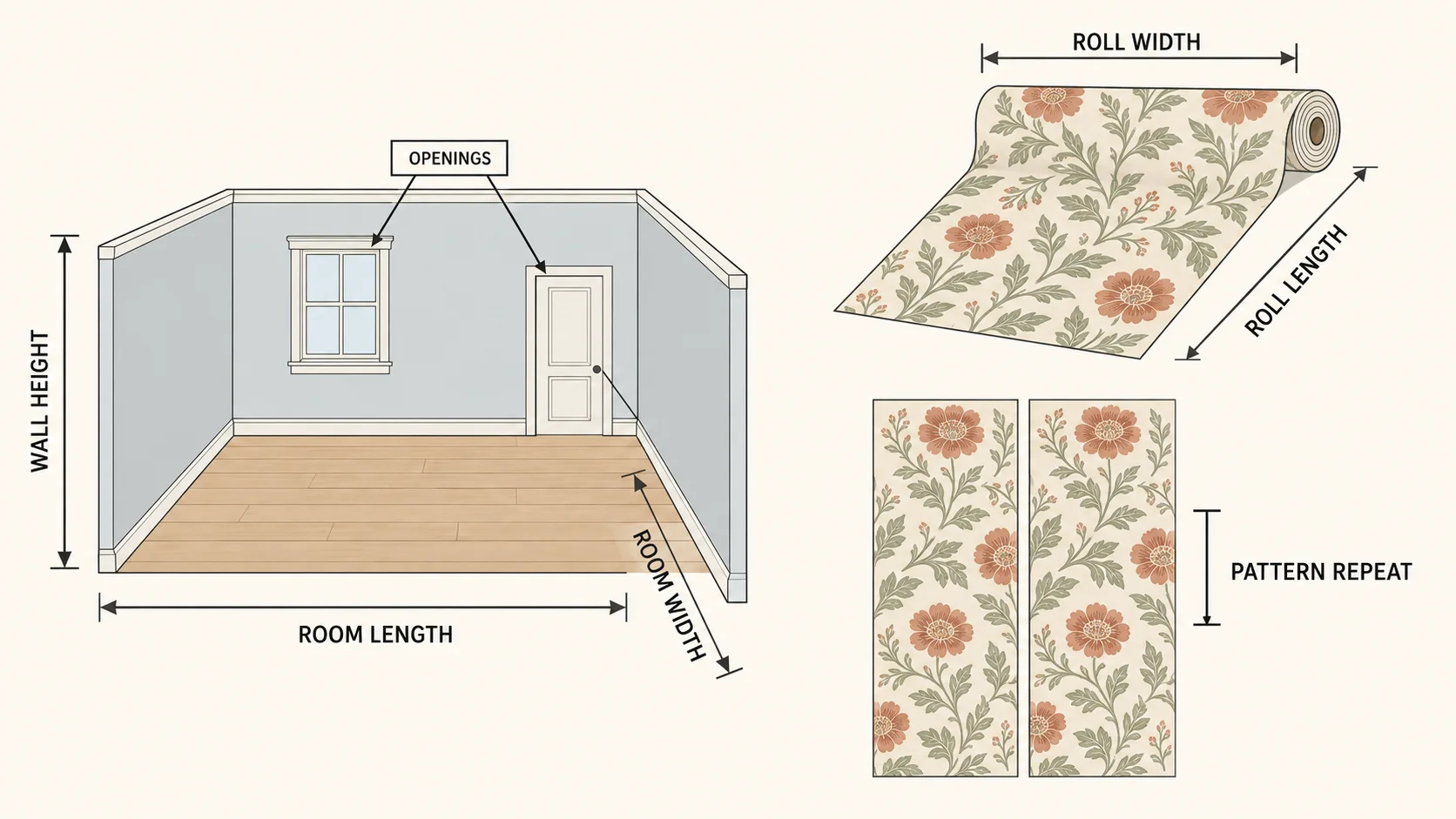
Wallpaper measurement diagram showing room length, room width, wall height, openings, roll width, roll length and pattern repeat
Measure the room and openings, then use the exact wallpaper roll dimensions and vertical pattern repeat shown on the product label.

Wallpaper Calculation Formulas

For a rectangular room, the calculator first finds the distance around the walls and multiplies by wall height:

Room perimeter = 2 × (room length + room width)
Gross wall area = room perimeter × wall height
Net wall area = gross wall area − door and window area

Patterned wallpaper must often be cut at a complete repeat so the same motif can align across neighboring strips. The ceiling function rounds upward:

Adjusted strip length = pattern repeat × ceiling(wall height ÷ pattern repeat)

When no pattern repeat is entered, the wall height is used as the base strip length. Roll yield is then determined with downward rounding because an incomplete strip cannot cover a full wall height:

Strips per roll = floor(roll length ÷ adjusted strip length)
Strip coverage area = roll width × adjusted strip length
Strips needed = ceiling(net wall area ÷ strip coverage area)
Rolls needed = ceiling((strips needed ÷ strips per roll) × (1 + waste percentage ÷ 100))
Estimated cost = rolls needed × price per roll

How to Measure and Enter the Room

  1. Measure the room length and width at wall level and select the correct unit for each value.
  2. Measure the wall height from the ceiling line to the top of the baseboard or intended lower edge.
  3. Find the combined area of doors and windows you want to deduct. Avoid aggressive deductions where full strips are still needed around openings.
  4. Read the exact roll width and roll length from the selected wallpaper label or specification.
  5. Enter the vertical pattern repeat. Use zero only for wallpaper without a repeat allowance.
  6. Add a waste percentage for trimming, pattern matching, corners, damaged paper, and installation mistakes.
  7. Optionally enter the price per roll for a wallpaper-only material estimate.
  8. Review the adjusted strip length and strips per roll, then confirm the product’s match type and sale-unit description.

Worked Example: Patterned Wallpaper

Suppose a room is 12 ft long, 10 ft wide, and 8 ft high. Doors and windows total 40 ft². Each roll is 20.5 inches wide and 33 ft long, the vertical pattern repeat is 20 inches, waste is 10%, and each roll costs $35.

Room perimeter: 2 × (12 + 10) = 44 ft
Gross wall area: 44 × 8 = 352 ft²
Net wall area: 352 − 40 = 312 ft²
Adjusted strip length: ceiling(96 in ÷ 20 in) = 5 repeats, so 5 × 20 = 100 in, or about 8.33 ft
Strips per roll: floor(33 ÷ 8.33) = 3 complete strips
Strip coverage: (20.5 ÷ 12) × 8.33 ≈ 14.24 ft²
Estimated strips: ceiling(312 ÷ 14.24) = 22 strips
Rolls with waste: ceiling((22 ÷ 3) × 1.10) = 9 rolls
Estimated roll cost: 9 × $35 = $315

The estimate covers wallpaper rolls only. Adhesive, primer, lining paper, wall repairs, tools, delivery, tax, and professional installation require separate planning.

Why Pattern Repeat Changes Roll Yield

Pattern repeat is the vertical distance between identical points in the design. When wall height is not an exact multiple of that repeat, extra paper is added to each strip so the next usable motif position reaches or exceeds the required wall height. Even a small increase in adjusted strip length can reduce how many complete strips fit into one roll.

Match type also matters. Free match usually creates less waste, straight match aligns at the same height, and offset or half-drop designs shift between strips. Confirm the product’s match symbol and instructions.

Openings, Waste, and Batch Numbers

Subtracting every door and window by area can understate the amount of paper needed because installation still uses full or partial strips above, below, and beside openings. Large uninterrupted openings may justify a deduction, while small openings may simply provide useful offcuts. The calculator accepts one combined opening area, so the user must judge what is realistically reusable.

Waste covers trimming, matching, corners, damage, and mistakes. Ordering all rolls together helps keep the same batch or dye lot and reduces the risk of colour variation.

Assumptions and Limitations

  • The room is treated as a rectangle with one consistent wall height.
  • Openings are deducted as a combined area rather than modeled as individual strip layouts.
  • The pattern calculation uses a vertical repeat and does not fully model every offset or half-drop sequence.
  • Walls with different heights, sloped ceilings, alcoves, stairwells, or feature-wall layouts should be calculated separately.
  • Roll terminology varies; confirm whether the advertised product is a single, double, metric, or European-size roll.
  • Wallpaper width and length should come from the exact product, not an assumed standard roll.

Frequently Asked Questions

How do I calculate how many wallpaper rolls I need?

Measure the walls, deduct appropriate openings, calculate pattern-adjusted strips, determine complete strips per roll, add waste, and round upward to whole rolls.

What is wallpaper pattern repeat?

It is the vertical distance between identical points in a printed design. The repeat can increase each strip’s cutting length and reduce roll yield.

Should I subtract doors and windows?

Large openings may be deducted, but avoid subtracting small openings too aggressively because full strips and usable pieces may still be needed around them.

What does strips per roll mean?

It is the number of complete pattern-adjusted wall-height drops that can be cut from one roll. Any remainder shorter than one strip is excluded.

Does half-drop wallpaper need more material?

It often creates additional matching waste. The calculator uses vertical repeat, so verify the manufacturer’s recommendation for offset and half-drop designs.

Should all wallpaper rolls have the same batch number?

Yes, when possible. Rolls from different production batches may show slight colour or print variations even when the product name is identical.

Related Room and Decorating Calculators

References

View Sponsored Offers →

Related Tools

Board Foot Calculator

Use our Board Foot Calculator to estimate board feet per piece, total lumber board footage, and total cost from thickness, width, length, pieces, and price.

Tile Calculator

Estimate tiles and boxes for floors or walls from project size, tile dimensions, grout gap, layout, and waste allowance with formulas and an example.

Roofing Shingle Calculator

Use this roofing shingle calculator to estimate shingle bundles, roofing squares, roof area, waste allowance, purchased coverage, and optional bundle cost.

Paver Calculator

Use this paver calculator to estimate pavers needed, boxes or pallets, project area, layout count, waste allowance, and optional material cost.

Square Footage Calculator

Square Footage Calculator helps you measure room area, total square feet, and material cost quickly with accurate results.

Door and Window Area Calculator

Use this door and window area calculator to find total opening area, door area, window area, perimeter, and average opening size for construction and material estimates.

Gravel Calculator

Use our Gravel Calculator to estimate gravel volume, weight, tons, cubic yards, coverage, and total cost from area, depth, density, and price.

Decking Calculator

Use this decking calculator to estimate deck boards needed, board rows, boards per row, deck area, waste allowance, purchased board length, and optional material cost.

Taper Calculator

Use our Taper Calculator to find taper per length, taper ratio, half-angle, and included angle from large diameter, small diameter, and taper length.