Electricity Cost Calculator

Estimate energy use and electricity cost after clicking Calculate

Enter device power rating
/ kWh
Local tariff per kilowatt-hour
hrs /
Average hours in chosen period

Results

Power consumed
kWh / day
Cost
$ / day
Annual cost
$ / year

Step-by-step derivation

References
  • Energy in kWh: E = (P in W ÷ 1000) × t (hours).
  • Period cost: Cost = E × price per kWh.
  • Annualization: multiply period cost by 365.25 (day), 52 (week), 12 (month), or 1 (year).

Use this Electricity Cost Calculator to estimate how much electricity an appliance, device, or piece of equipment uses and how much it may cost to run. Enter the power consumption, electricity price per kWh, and usage time, then calculate estimated energy use, period cost, and annual cost.

Important Note: This Electricity Cost Calculator estimates appliance or device energy use and running cost from power consumption, usage time, and electricity price per kilowatt-hour.

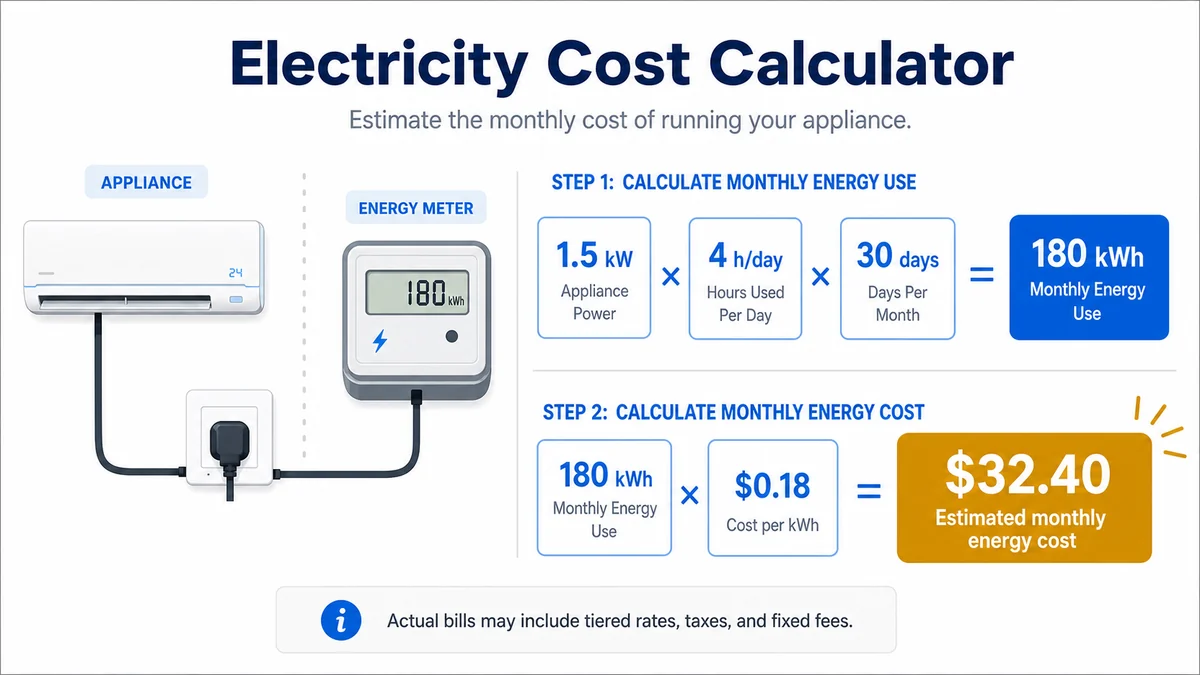
The calculator uses the standard relationship: energy use in kWh = power in kW × hours used. If power is entered in watts, the calculator first converts watts to kilowatts by dividing by 1,000.

This calculator estimates the energy-use portion of running a device. It does not calculate a full electricity bill because real bills may include tiered tariffs, time-of-use rates, demand charges, fixed service fees, delivery charges, taxes, fuel adjustment charges, minimum bills, solar credits, appliance cycling, standby power, inverter losses, or meter-based adjustments.

Reviewed by: AjaxCalculators Editorial Team
Last updated: April 28, 2026
Method source: Standard electricity-cost formula using watts, kilowatt-hours, usage time, and price per kWh
Editorial standards: AjaxCalculators Editorial Policy

What This Electricity Cost Calculator Calculates

This calculator estimates how much energy an electrical device uses and how much that energy may cost based on your entered power rating, electricity price, and usage time.

Input or Result Meaning Use Note
Power consumption The device power rating. Can be entered in watts or kilowatts.
Electricity price The cost per kilowatt-hour charged by your provider or used for your estimate. Enter your local tariff or estimated rate.
Usage time How many hours the device runs during the selected period. Can be per day, week, month, or year.
Energy used The estimated electricity consumption in kilowatt-hours. Calculated from power × time.
Selected-period cost The estimated cost for the selected usage period. Calculated from kWh × price per kWh.
Annual cost The selected-period cost scaled to one year. Useful for comparing yearly running costs.
Step-by-step derivation The formula path used by the calculator. Use it to check watts, kW, kWh, period cost, and annualization.

What Electricity Cost Means

Electricity cost is the estimated amount you pay to run a device based on how much energy it uses and how much your electricity provider charges per kilowatt-hour.

A high-wattage appliance usually costs more to run than a low-wattage device if both are used for the same amount of time. However, total cost also depends on usage duration. A small device used all day can sometimes cost more over time than a larger device used only briefly.

Key Terms Used by the Calculator

Term Meaning Example
Watt A unit of power showing how much power a device uses at a moment. A 100 W bulb has a power rating of 100 watts.
Kilowatt 1 kilowatt equals 1,000 watts. 1,500 W = 1.5 kW.
Kilowatt-hour A unit of energy use over time. A 1 kW device running for 1 hour uses 1 kWh.
Price per kWh The electricity rate used to calculate cost. If electricity costs $0.15/kWh, then 10 kWh costs $1.50.
Usage time The number of hours the device runs. 4 hours per day, 20 hours per week, or 300 hours per year.
Annual cost Estimated yearly running cost if the same usage pattern continues. A daily cost of $1 becomes about $365.25 per year.

How the Electricity Cost Calculator Works

1) Convert Watts to Kilowatts

If the power rating is entered in watts, the calculator first converts watts into kilowatts.

Power in kW = power in W ÷ 1,000

For example:

1,500 W ÷ 1,000 = 1.5 kW

2) Calculate Energy Used

Energy use is calculated by multiplying power in kilowatts by usage time in hours.

Energy used (kWh) = power (kW) × time (hours)

If using watts directly, the formula is:

Energy used (kWh) = power (W) ÷ 1,000 × time (hours)

3) Calculate Electricity Cost

After energy use is calculated, the calculator multiplies kWh by the electricity price per kWh.

Electricity cost = energy used (kWh) × price per kWh

Selected Usage Period Annualization Method

The calculator scales the selected-period cost into an estimated annual cost.

Selected Usage Period Annualization Method Example Meaning
Per day Daily cost × 365.25 Assumes the same daily use pattern across the year.
Per week Weekly cost × 52 Assumes the same weekly use pattern across the year.
Per month Monthly cost × 12 Assumes the same monthly use pattern across the year.
Per year Yearly cost × 1 Uses the entered yearly usage directly.

Annualized results are estimates. Seasonal appliances such as heaters, air conditioners, dehumidifiers, pool pumps, and holiday lighting may not run with the same pattern all year.

Worked Example: Daily Electricity Cost

Suppose you want to estimate the daily cost of running a 1,500 W heater for 4 hours per day at an electricity price of $0.16 per kWh.

Step Calculation Result
Convert watts to kilowatts 1,500 W ÷ 1,000 1.5 kW
Calculate daily energy use 1.5 kW × 4 hours 6 kWh per day
Calculate daily cost 6 kWh × $0.16 $0.96 per day
Estimate annual cost $0.96 × 365.25 About $350.64 per year

So, running a 1,500 W heater for 4 hours per day at $0.16/kWh would cost about $0.96 per day and about $350.64 per year, assuming the same use every day.

Worked Example: Monthly Electricity Cost

Suppose a fan uses 75 W and runs for 8 hours per day. The electricity price is $0.15 per kWh.

Step Calculation Result
Convert watts to kilowatts 75 W ÷ 1,000 0.075 kW
Calculate daily energy use 0.075 kW × 8 hours 0.6 kWh per day
Estimate monthly energy use 0.6 kWh × 30 days 18 kWh per month
Calculate monthly cost 18 kWh × $0.15 $2.70 per month

So, this fan would cost about $2.70 per month under those assumptions.

How to Use This Electricity Cost Calculator

  1. Enter the device power consumption.
  2. Select whether the power value is in W or kW.
  3. Enter your local electricity price per kWh.
  4. Select the currency symbol you want to display.
  5. Enter the usage time in hours.
  6. Select whether the usage time is per day, week, month, or year.
  7. Click Calculate.
  8. Review the estimated energy used, cost for the selected period, and annual cost.

How to Interpret the Result

Result What It Means Important Caution
Power consumed The estimated energy use in kWh for the selected usage period. This is based on the entered wattage and usage time, not a meter reading.
Cost The estimated cost for the selected period. It uses only the price per kWh entered by the user.
Annual cost The estimated yearly running cost if the same usage pattern continues. Seasonal or irregular usage may make the real annual cost different.
Currency symbol The symbol displayed with the result. The calculator does not convert currencies or verify local tariffs.
Step-by-step derivation The formula path used by the calculator. Use it to verify W-to-kW conversion, kWh calculation, cost, and annualization.

Why kWh Matters

Electric bills are usually based on kilowatt-hours because kWh measures how much electricity is used over time. Wattage alone does not tell the full cost. You also need to know how many hours the device runs and the local price per kWh.

For example, a 2,000 W appliance used for 10 minutes may cost less than a 100 W appliance used all day. Total cost depends on both power and time.

Common Appliance Power Examples

Actual wattage varies by model, size, age, efficiency rating, settings, operating mode, and usage pattern. Always check the appliance label, manual, EnergyGuide label, manufacturer specification, or a plug-in energy meter when accuracy matters.

Device or Appliance Typical Power Range Cost Note
LED light bulb 5 W to 15 W Low cost per bulb, but many bulbs and long hours can add up.
Ceiling fan 30 W to 100 W Cost depends heavily on speed setting and hours used.
Laptop 30 W to 100 W Charging, screen brightness, and workload affect usage.
Desktop computer 100 W to 500 W Gaming and high-performance systems may use more.
Television 50 W to 300 W Screen size, brightness, display type, and settings affect consumption.
Refrigerator Varies by model and duty cycle Because it cycles on and off, annual kWh label data or meter readings are often better.
Electric heater 750 W to 2,000 W Often expensive to run because resistance heating uses high wattage.
Air conditioner Varies widely Cooling capacity, climate, thermostat setting, insulation, and efficiency rating affect cost.
Washing machine Varies by cycle and water heating Hot-water use can increase total energy cost.
Electric oven or cooktop 1,000 W to 5,000 W+ High wattage, but often used for shorter periods.

Important Billing Limitations

This calculator estimates the energy-cost portion of running a device. A real electricity bill may include several charges that are not part of simple kWh × price math.

Billing Factor Why It Matters
Fixed monthly service charge Your bill may include a fixed charge even before energy use is counted.
Taxes and government fees Local taxes, VAT, levies, or fees may be added separately.
Tiered electricity rates The price per kWh may change after you pass a usage threshold.
Time-of-use pricing Electricity may cost more during peak hours and less during off-peak hours.
Demand charges Some bills charge based on peak demand, not only total kWh.
Fuel adjustment charges Some utilities adjust bills based on changing generation fuel costs.
Delivery or distribution charges Some bills separate energy supply from delivery or network charges.
Minimum bill amount Your bill may not fall below a minimum charge even with low usage.
Solar credits or net metering Credits can reduce the final bill but are not modeled by this calculator.

Because of these billing factors, the calculator result may not match your full utility bill exactly.

Appliance Cycling and Real-World Usage

Some appliances do not use their rated wattage continuously. The nameplate wattage may show maximum power, but real average energy use can be higher or lower depending on how the device operates.

Appliance or Load Type Why Actual Usage Can Differ Better Estimate Method
Refrigerator or freezer Cycles on and off to maintain temperature. Use annual kWh label data or a plug-in energy meter when possible.
Air conditioner or heat pump Cycles based on thermostat, weather, room size, insulation, and efficiency. Use manufacturer data, seasonal energy estimates, or measured usage.
Electric heater May cycle if thermostat-controlled, but can draw high power while active. Estimate active hours carefully.
Computer or gaming system Power changes with workload, screen brightness, graphics load, and sleep mode. Measure typical use with an energy monitor.
Washing machine or dishwasher Energy use changes by cycle, water heating, drying mode, and load size. Use label data or appliance-specific energy information.
Standby loads Some electronics use small amounts of power even when “off.” Measure with a plug-in meter or switch off at a power strip.
Inverter, UPS, or battery system Conversion losses can make input energy higher than device output use. Include efficiency losses if estimating total supply-side energy.

How to Reduce Electricity Cost

You can reduce electricity cost by lowering power use, reducing usage time, improving efficiency, or shifting usage to cheaper tariff periods when available.

Action How It Can Help
Use LED lighting LED bulbs usually use less power than inefficient incandescent or halogen bulbs.
Turn off devices when not needed Reducing usage hours directly reduces kWh.
Unplug or switch off standby loads Can reduce small but continuous background power use.
Use timers, smart plugs, or power strips Helps control repeated or forgotten usage patterns.
Choose efficient appliances when replacing equipment Lower kWh use can reduce long-term running cost.
Clean filters and maintain equipment Heating, cooling, ventilation, and refrigeration equipment may run more efficiently when maintained.
Use high-wattage appliances for shorter periods Total cost depends on both wattage and time.
Check off-peak or time-of-use rates Some utilities charge lower rates at certain times.

Common Mistakes to Avoid

Mistake Why It Causes Problems
Confusing watts with kilowatt-hours Watts measure power; kWh measures energy used over time.
Entering watts as kilowatts without converting 1,000 W is 1 kW, so entering 1,000 as kW would overstate energy use by 1,000×.
Forgetting that 1 kW equals 1,000 W Incorrect W-to-kW conversion creates incorrect kWh and cost results.
Assuming nameplate wattage is always real average usage Many appliances cycle, change load, or use different power at different settings.
Ignoring usage time A low-wattage device used all day can cost more than a high-wattage device used briefly.
Using a single appliance estimate as the whole-home bill Whole-home bills include many devices plus fixed charges and other billing factors.
Ignoring tiered or time-of-use pricing The actual price per kWh may change depending on usage level or time of day.
Using annualized cost for seasonal appliances without adjusting usage Heaters, air conditioners, dehumidifiers, and pool pumps may not run the same way year-round.
Assuming the currency symbol converts money The calculator only changes the displayed symbol; it does not convert exchange rates.

Formula Summary

What You Want to Find Formula Use Note
Watts to kilowatts kW = W ÷ 1,000 Use when the power rating is entered in watts.
Kilowatts to watts W = kW × 1,000 Use when converting a kW rating back to watts.
Energy used kWh = power in kW × time in hours Core energy-use formula.
Energy used from watts kWh = power in W ÷ 1,000 × time in hours Shortcut when power is given in watts.
Electricity cost Cost = kWh × price per kWh Estimates the energy-use cost for the selected period.
Annual cost from daily cost Annual cost = daily cost × 365.25 Useful for daily-use estimates.
Annual cost from weekly cost Annual cost = weekly cost × 52 Useful for weekly-use estimates.
Annual cost from monthly cost Annual cost = monthly cost × 12 Useful for monthly-use estimates.
Annual cost from yearly cost Annual cost = yearly cost × 1 Uses the entered yearly period directly.

Practical Uses

This Electricity Cost Calculator is useful for quick appliance and device running-cost estimates.

Practical Use How the Calculator Helps
Estimate appliance running cost Calculate how much a device may cost for a selected usage period.
Compare devices Compare two devices with different wattages or usage times.
Estimate heater or fan cost Check how high-wattage or long-hour devices affect cost.
Plan home office energy use Estimate laptop, monitor, router, printer, and lighting energy cost.
Check usage-time impact See how running a device longer changes kWh and cost.
Estimate standby or background loads Approximate the cost of devices that run continuously or remain plugged in.
Understand watts, kWh, and cost Connect device power ratings with real energy-use estimates.

When You May Need More Than This Calculator

This calculator is best for simple device-level energy-cost estimates. You may need a different method when billing rules, measured use, or whole-home energy analysis matters.

Need Better Tool or Method
Actual appliance energy use Use a plug-in electricity usage monitor or manufacturer energy data.
Whole-home electricity use Use utility meter data, smart meter data, or a whole-house energy monitor.
Full electricity bill estimate Use your utility tariff, fixed charges, taxes, tiered rates, and billing rules.
Time-of-use bill planning Use the exact peak, off-peak, and shoulder rates from your utility.
Solar or net-metering analysis Use solar production, import/export rates, credits, and battery behavior.
Inverter, UPS, or battery energy use Include conversion losses and system efficiency.
Appliance replacement savings Use model-specific annual kWh ratings, purchase cost, and expected lifespan.
Business or industrial electricity cost Include demand charges, power factor, service class, taxes, and tariff details.

Frequently Asked Questions

How do I calculate electricity cost?

First calculate energy use in kWh, then multiply by the electricity price per kWh. For example, 6 kWh × $0.16/kWh = $0.96.

How do I convert watts to kilowatts?

Divide watts by 1,000. For example, 1,500 W ÷ 1,000 = 1.5 kW.

How do I calculate kWh from watts and hours?

Use kWh = watts ÷ 1,000 × hours. For example, 1,500 W used for 4 hours equals 1,500 ÷ 1,000 × 4 = 6 kWh.

What is a kilowatt-hour?

A kilowatt-hour is a measure of energy used over time. A 1 kW device running for 1 hour uses 1 kWh.

Why does my result not match my electricity bill?

Your bill may include fixed charges, taxes, delivery fees, tiered rates, time-of-use pricing, demand charges, minimum bills, or credits that are not included in this simple calculator.

Does the calculator convert currencies?

No. The currency selector changes the displayed symbol only. It does not convert exchange rates or verify local electricity prices.

Should I use nameplate wattage?

You can use nameplate wattage for a rough estimate, but real average usage may differ. For more accuracy, use a plug-in energy meter, EnergyGuide label, manufacturer data, or actual utility data.

Why can refrigerators and air conditioners be hard to estimate?

They cycle on and off. Their real energy use depends on temperature, thermostat setting, room conditions, insulation, age, and equipment efficiency.

Can this calculator estimate whole-home electricity cost?

It is better for one appliance or device at a time. Whole-home electricity cost should be checked with meter data, utility bills, or a whole-house energy monitor.

References

  1. U.S. Department of Energy — Estimating Appliance and Home Electronic Energy Use
  2. U.S. Energy Information Administration — Measuring Electricity
  3. U.S. Department of Energy — Appliances and Electronics
  4. ENERGY STAR — Product Finder
  5. Energy.gov.au — Energy Ratings
  6. NREL — Basics of Electricity, Energy Access, and Off-Grid Solar

Related Calculators

Electricity Cost Calculator Disclaimer

This Electricity Cost Calculator provides educational and planning estimates only. It estimates device energy use and running cost from power consumption, usage time, and electricity price per kilowatt-hour.

It does not calculate a complete electricity bill. Actual bills may differ because of tiered rates, time-of-use pricing, demand charges, fixed service fees, delivery charges, taxes, government fees, fuel adjustment charges, minimum bills, solar credits, net metering, appliance cycling, standby power, inverter losses, meter data, seasonal usage, and local utility rules.

For more accurate results, use the actual appliance label, EnergyGuide label, manufacturer specification, plug-in energy meter, smart meter data, utility bill, or official tariff. For business, industrial, solar, battery, or regulated billing calculations, use the full applicable tariff and qualified professional guidance where needed.

More of our calculators...

SLEEP CALCULATOR

Use our Sleep Calculator to find the best bedtime or wake-up time based on sleep cycles, fall-asleep time, and total hours in bed for a smoother morning.

Calorie Deficit Calculator

Use our Calorie Deficit Calculator to estimate BMR, maintenance calories, TDEE, calorie deficit, target calories, and weekly weight-change estimate.

Face Shape Calculator

Use our Face Shape Calculator to estimate your likely face shape from forehead, cheekbone, jawline, and face length measurements plus chin shape.

Age Difference Calculator

Use our Age Difference Calculator to find the exact age gap between two dates of birth in years, months, days, total months, total days, and approximate years.

Bikini Calculator

Use our Bikini Calculator to estimate your body shape from bust, waist, high hip, and hip measurements, then get bikini style suggestions that fit your shape.

Body Shape Calculator

Body Shape Calculator helps you identify your body type from key measurements and understand which shape category fits you best.

Helium Balloons Calculator

Use our Helium Balloons Calculator to estimate lift per balloon, total helium volume, and how many helium balloons you need to lift a given weight.

RPM Calculator

Use our RPM Calculator to find engine RPM from speed or vehicle speed from RPM using overall gear ratio and tire diameter, plus wheel RPM and tire circumference.

Reading Time Calculator

Use our Reading Time Calculator to estimate how long it takes to read a book, daily pages read, and time needed to finish from pages and reading speed.