
Body Shape Calculator
Enter your bust, waist, high hip and hip measurements to estimate your body shape and waist–hip ratio.
Measurements
Use the same side of the body for all measurements. Units can be in or cm.
Results
Classification is based on published 7-type body shape rules. Results are approximate and for informational purposes only.
Use this Body Shape Calculator to compare shoulder, bust, waist, and hip measurements and obtain a descriptive proportion estimate. The labels are simplified clothing and styling conventions, not medical categories, and no result is better, healthier, or more attractive than another.
How the Body Shape Calculator works
The Body Shape Calculator is designed to turn shoulder, bust, waist, and hip circumferences into relative measurement ratios and a descriptive shape category without making you rebuild the arithmetic each time. Enter the values you know, choose the matching units or options, and calculate. The output is most useful when the inputs describe the same scenario and were measured or recorded at roughly the same level of precision.
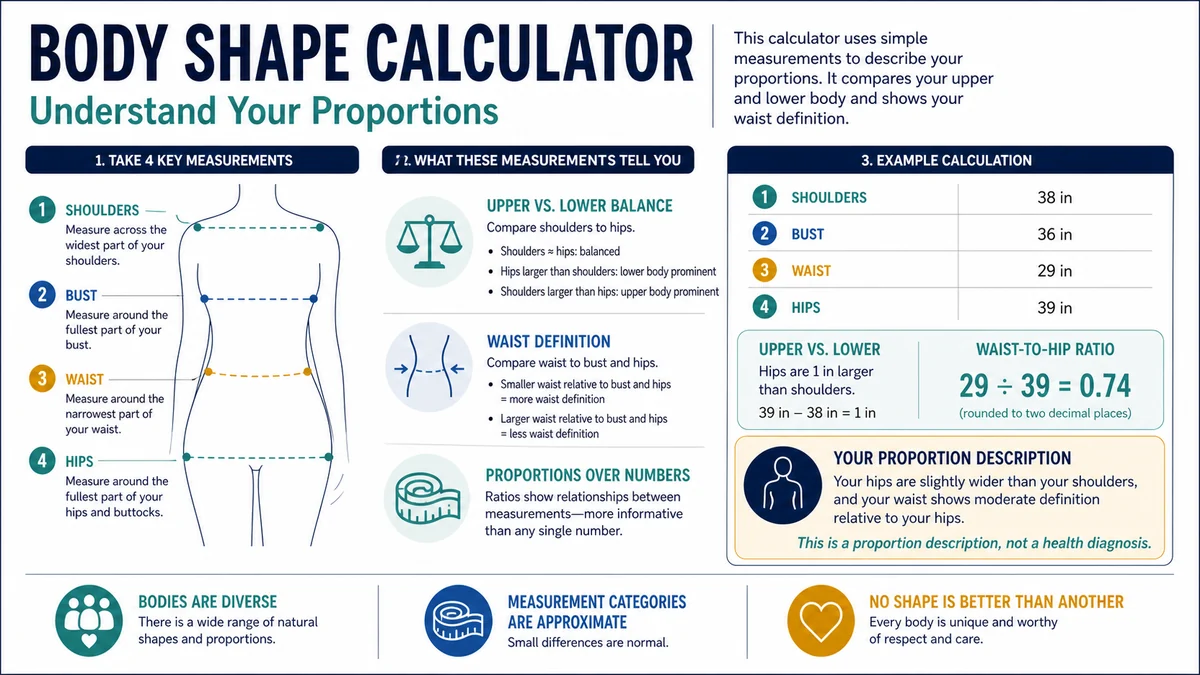
The tool evaluates which measurements are similar, which is largest, and how strongly the waist differs from the upper and lower body. Thresholds turn continuous measurements into broad descriptive labels.
Formula and required inputs
Classification is based on measurement ratios and percentage differences; waist-to-hip ratio = waist ÷ hips.
Use one unit for every field, measure at the landmarks named in the form, keep the tape horizontal, and repeat the process. Do not mix garment dimensions with body dimensions.
Write the units beside the numbers before calculating. That simple check prevents a value in minutes, centimeters, liters, kilograms, miles, or another unit from being treated as if it belonged to a different scale. The calculator handles its displayed conversion options, but it cannot detect a number typed into the wrong field.
Worked example
Measurements of 38-inch shoulders, 36-inch bust, 29-inch waist, and 39-inch hips produce a waist-to-hip ratio of about 0.74. The category depends on the calculator’s thresholds, but the raw numbers remain more informative for fitting.
A worked example is a reasonableness test as well as a demonstration. Estimate the likely size of the answer first, run the calculator, and compare. If the calculator returns an order of magnitude you did not expect, look for a misplaced decimal, reversed value, incorrect date, or unit selection before using the result.
How to use this calculator
- Read every field label and decide which values belong to the same calculation.
- Enter measured or documented numbers rather than optimistic guesses.
- Select the correct unit, format, date convention, or calculation mode.
- Calculate and review both the main result and any supporting breakdown.
- Change one input at a time to understand which assumption has the greatest effect.
- Record the inputs with the answer if you need to reproduce or explain it later.
Scenario testing is often more informative than a single result. Try a realistic low value, expected value, and high value for the most uncertain input. The resulting range shows how sensitive the answer is and helps avoid false confidence in a perfectly formatted but assumption-dependent number.
Understanding the result
A label summarizes a range of ratios and can change with a small measurement difference near a boundary. Treat the measurements and fit preferences as primary.
Posture, tape placement, breathing, muscle distribution, and natural asymmetry affect measurements. The result cannot determine health risk or garment size.
A calculator cannot correct an inaccurate measurement. Use the same unit throughout, measure the object or body at the stated points, avoid pulling a tape too tight, and repeat the measurement when the result will guide a purchase or a cut.
Accuracy, rounding, and assumptions
Repeat measurements under similar conditions and average close readings. Classification thresholds are conventions rather than laws of anatomy.
Round at the end rather than after every intermediate step. For a practical answer, report only as many digits as the least precise input can support. Extra decimals can help with further calculation, but they do not make a rough measurement more certain. When a calculator displays several units, tiny differences can appear because of conversion and rounding.
Also distinguish a mathematical result from a real-world recommendation. A formula describes the relationship among the values entered; it does not automatically account for regulations, product tolerances, professional judgment, comfort, risk, or personal preference. Use the result as a transparent starting point and apply the relevant context.
Common mistakes to avoid
- Mixing shoulder width with shoulder circumference.
- Using clothing measurements in place of body measurements.
- Interpreting the category as a medical or value judgment.
- Rounding an intermediate value too aggressively and carrying that error forward.
- Copying the result without saving the input units, date, rate, or assumptions.
When an answer looks wrong, reset the form and re-enter the values slowly. Confirm the direction of each ratio or time interval, and perform a quick reverse check if possible. For example, multiply a per-unit result by the quantity, add the calculated duration to the start time, or substitute the result back into the original formula.
Practical uses
Use it for learning proportion terminology, organizing measurements for sewing or shopping, and comparing how small measurement changes affect the category.
Related calculators
Continue the calculation with Bikini Calculator, Circle Skirt Calculator, Desk Height Calculator. Related tools can provide a useful cross-check, but use the same definitions and units across the calculations.
Authoritative references
The explanation and cautions above are aligned with NIST SI units, CDC body measurement data overview. These references provide definitions, measurement conventions, safety information, or planning context; the calculator remains an independent educational tool.
Frequently asked questions
What does the Body Shape Calculator calculate?
Body Shape Calculator converts shoulder, bust, waist, and hip circumferences into relative measurement ratios and a descriptive shape category. It applies the stated formula consistently and is useful for checking hand calculations. The result should still be interpreted in context because the tool cannot observe conditions that were not entered.
What formula does the Body Shape Calculator use?
Classification is based on measurement ratios and percentage differences; waist-to-hip ratio = waist ÷ hips. The calculator performs the unit conversions needed for the selected options, then rounds the displayed answer. Keeping every input in a compatible unit is essential; mixing units without conversion is a common reason for an implausible result.
How accurate is the Body Shape Calculator?
Repeat measurements under similar conditions and average close readings. Classification thresholds are conventions rather than laws of anatomy. Numerical precision does not guarantee real-world accuracy. Recheck the inputs, assumptions, and units, especially when the answer will affect safety, health, cost, material ordering, or a firm schedule.
Can I use different units?
Use any units offered by the calculator, but match each number to its unit selector. If a needed unit is not available, convert it first and keep more precision than you expect to report. Convert the final answer only after the core calculation whenever possible.
Why is my result different from another calculator?
Another tool may use a different convention, default value, rounding rule, calendar rule, or definition. Compare the formulas and assumptions before deciding that either answer is wrong. A small difference is often rounding; a large difference usually points to units, dates, or an unstated assumption.
When should I recalculate?
Recalculate whenever measurements or the intended clothing fit changes. Save the inputs with the result so the estimate can be reproduced. For decisions with meaningful financial, health, or safety consequences, verify the answer with measurements, records, manufacturer instructions, or a qualified professional.
Body-Shape Categories Are Descriptive, Not Prescriptive
Bust, waist, high-hip, and hip proportions can suggest a styling category, but small measurement changes may move a borderline result. Measure at consistent landmarks with the tape level and relaxed, then consider adjacent categories if ratios are close. The label does not measure health or attractiveness; it is simply one way to explore garment balance and fit.