Beam Deflection Calculator (Max δ)
Choose a beam and load case, enter inputs with units, and calculate the maximum deflection.
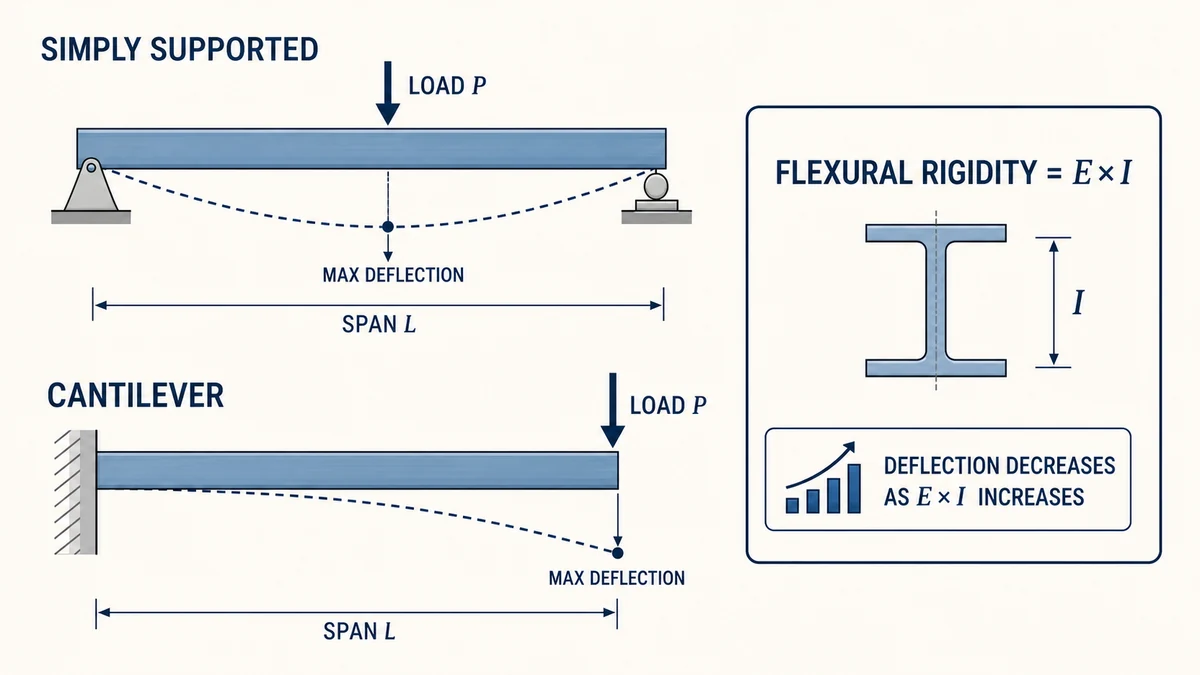
- Euler–Bernoulli beam theory for small deflections: deflection varies inversely with E·I.
- Standard closed-form max-deflection cases are used for simply supported and cantilever beams.
- The off-center simply supported point-load case evaluates the valid stationary point to get the true maximum deflection.
Important Note : Deflection limits are serviceability checks, not full structural design approval. AISC’s serviceability guidance discusses customary deflection limits such as L/360, L/240, and L/180 depending on supported elements and serviceability requirements.
Use this Beam Deflection Calculator to estimate the maximum deflection of common simply supported and cantilever beam cases. Choose the beam and load type, enter span length, Young’s modulus, moment of inertia, and the applied load, then calculate maximum deflection and its location with a step-by-step derivation.
Important Engineering Note: This Beam Deflection Calculator provides educational and preliminary deflection estimates for selected standard beam/load cases only. It is not a complete structural design tool and does not verify beam strength, shear capacity, support reactions, connections, stability, load combinations, vibration, creep, code compliance, or safety factors.
Use this calculator for learning, checking formulas, and preliminary serviceability estimates. For real buildings, platforms, equipment supports, bridges, safety-critical structures, or permit/code-controlled work, have the beam checked by a qualified structural engineer using the applicable design codes, loads, material properties, and project specifications.
Reviewed by: AjaxCalculators Editorial Team
Last updated: April 29, 2026
Method source: Standard Euler-Bernoulli small-deflection beam formulas for common simply supported and cantilever load cases
Editorial standards: AjaxCalculators Editorial Policy
What This Beam Deflection Calculator Calculates
This calculator estimates the maximum vertical deflection of a beam under selected loading conditions. It supports common textbook-style beam cases where closed-form elastic deflection formulas are available.
The calculator can estimate:
- Maximum beam deflection δmax
- Location of maximum deflection
- Simply supported beam deflection
- Cantilever beam deflection
- Point load deflection
- Uniformly distributed load deflection
- End moment deflection for cantilevers
- Step-by-step SI substitution
- Downloadable PDF result
The live calculator includes six beam/load modes: simply supported point load at midspan, simply supported uniform load, simply supported point load at distance a, cantilever end point load, cantilever uniform load, and cantilever end moment.
What Beam Deflection Means
Beam deflection is the displacement of a beam from its original position under load. In this calculator, deflection usually means the vertical downward movement caused by bending.
For example, a beam supporting a point load or distributed load bends under that load. The greatest downward movement is called the maximum deflection, often written as δmax.
Beam deflection matters because excessive bending can cause:
- visible sagging
- cracking of finishes
- misalignment of supported elements
- door or window operation problems
- ponding or drainage issues
- occupant discomfort
- serviceability failure even when strength is adequate
Important Engineering Safety Note
This calculator estimates elastic deflection only. It does not perform a full structural design check.
It does not check:
- bending stress
- shear stress
- beam strength
- support reactions
- connection capacity
- bearing capacity
- buckling
- lateral-torsional buckling
- vibration
- load combinations
- long-term creep
- code compliance
- safety factors
Use this calculator for educational estimates, preliminary checks, and formula verification only. For real structural work, verify the design with applicable codes, load combinations, material standards, and a qualified structural engineer.
How the Beam Deflection Calculator Works
The calculator uses standard closed-form beam deflection equations. These equations relate deflection to the applied load, span length, material stiffness, and beam section stiffness.
Most formulas follow the same basic pattern:
Deflection increases with load and span length.
Deflection decreases as E × I increases.
Where:
- E is Young’s modulus, which represents material stiffness
- I is area moment of inertia, which represents cross-section bending stiffness
- E × I is flexural rigidity
A beam with a larger E or larger I deflects less under the same load and span.
Key Beam Deflection Variables
| Symbol | Meaning | Common Units |
|---|---|---|
| L | Beam span length | m, mm, cm, in, ft |
| E | Young’s modulus, or material stiffness | GPa, MPa, Pa, psi, ksi |
| I | Area moment of inertia, or section bending stiffness | m4, mm4, cm4, in4 |
| P | Point load | N, kN, lbf |
| w | Uniformly distributed load | N/m, kN/m, lbf/ft |
| a | Distance of an off-center point load from the left support | m, mm, cm, in, ft |
| M | Applied end moment | N·m, kN·m, lbf·ft |
| δmax | Maximum vertical deflection | mm, m, in |
Supported Beam and Load Cases
| Mode | Typical Formula | Maximum Deflection Location |
|---|---|---|
| Simply supported beam — point load at midspan | δmax = PL3 / 48EI | Midspan |
| Simply supported beam — uniform load | δmax = 5wL4 / 384EI | Midspan |
| Simply supported beam — point load at distance a | Calculated from the deflection curve and valid stationary point | Depends on load position |
| Cantilever beam — end point load | δmax = PL3 / 3EI | Free end |
| Cantilever beam — uniform load | δmax = wL4 / 8EI | Free end |
| Cantilever beam — end moment | δmax = ML2 / 2EI | Free end |
Simply Supported Beam with Point Load at Midspan
For a simply supported beam with a point load at the center, the maximum deflection occurs at midspan.
δmax = PL³ / (48EI)
In this formula:
- P is the point load
- L is the beam span
- E is Young’s modulus
- I is area moment of inertia
This case is useful for simple educational examples, center-loaded beams, and quick checks where a load is applied at the beam midpoint.
Simply Supported Beam with Uniform Load
For a simply supported beam with a uniformly distributed load across the full span, the maximum deflection occurs at midspan.
δmax = 5wL⁴ / (384EI)
In this formula:
- w is the uniform load per unit length
- L is the span length
- E is Young’s modulus
- I is area moment of inertia
This case is common for beams carrying distributed floor loads, roof loads, self-weight, or other loads spread evenly along the span.
Simply Supported Beam with Off-Center Point Load
For a point load located at a distance a from the left support, maximum deflection does not always occur at midspan. The maximum location depends on where the load is placed.
The calculator evaluates the valid stationary point from the deflection curve to find the true maximum deflection and its location.
This mode is useful when a concentrated load is not located at the center of the span, such as machinery, a wheel load, a bracket load, or a point reaction from another member.
Cantilever Beam with End Point Load
For a cantilever beam with a point load applied at the free end, maximum deflection occurs at the free end.
δmax = PL³ / (3EI)
This case is useful for projecting beams, brackets, shelves, balconies, arms, and other fixed-end members with a concentrated load at the free end.
Cantilever Beam with Uniform Load
For a cantilever beam with a uniformly distributed load across the full span, maximum deflection occurs at the free end.
δmax = wL⁴ / (8EI)
This case is common for cantilevered members carrying self-weight, uniformly spread load, or distributed surface load.
Cantilever Beam with End Moment
For a cantilever beam with an applied end moment, maximum deflection occurs at the free end.
δmax = ML² / (2EI)
This case is useful when the main action is an applied moment rather than a transverse point load or distributed load.
Beam Deflection Formula Summary
| Beam Case | Maximum Deflection Formula | Location |
|---|---|---|
| Simply supported, center point load | δmax = PL3 / 48EI | L / 2 |
| Simply supported, full uniform load | δmax = 5wL4 / 384EI | L / 2 |
| Simply supported, off-center point load | Calculated from the elastic deflection curve and valid stationary point | Depends on a and L |
| Cantilever, end point load | δmax = PL3 / 3EI | Free end |
| Cantilever, full uniform load | δmax = wL4 / 8EI | Free end |
| Cantilever, end moment | δmax = ML2 / 2EI | Free end |
Worked Example: Simply Supported Beam with Center Point Load
Suppose a simply supported beam has:
- Span length L: 3.5 m
- Point load P: 25 kN
- Young’s modulus E: 200 GPa
- Area moment of inertia I: 8000 cm⁴
Step 1: Convert values to SI units
P = 25 kN = 25,000 N
E = 200 GPa = 200,000,000,000 Pa
I = 8000 cm⁴ = 0.00008 m⁴
Step 2: Use the center point load formula
δmax = PL³ / (48EI)
Step 3: Substitute the values
δmax = 25,000 × 3.5³ / (48 × 200,000,000,000 × 0.00008)
Step 4: Calculate
3.5³ = 42.875
Numerator = 25,000 × 42.875 = 1,071,875
Denominator = 48 × 200,000,000,000 × 0.00008 = 768,000,000
δmax ≈ 0.001396 m
Step 5: Convert to millimeters
0.001396 m × 1000 = 1.40 mm
So, the maximum deflection is about 1.40 mm at midspan.
Worked Example: Simply Supported Beam with Uniform Load
Suppose a simply supported beam has:
- Span length L: 4 m
- Uniform load w: 5 kN/m
- Young’s modulus E: 200 GPa
- Area moment of inertia I: 6000 cm⁴
Step 1: Convert values to SI units
w = 5 kN/m = 5000 N/m
E = 200 GPa = 200,000,000,000 Pa
I = 6000 cm⁴ = 0.00006 m⁴
Step 2: Use the uniform load formula
δmax = 5wL⁴ / (384EI)
Step 3: Substitute the values
δmax = 5 × 5000 × 4⁴ / (384 × 200,000,000,000 × 0.00006)
Step 4: Calculate
4⁴ = 256
Numerator = 5 × 5000 × 256 = 6,400,000
Denominator = 384 × 200,000,000,000 × 0.00006 = 4,608,000,000
δmax ≈ 0.001389 m = 1.39 mm
So, the maximum deflection is about 1.39 mm at midspan.
Worked Example: Cantilever Beam with End Point Load
Suppose a cantilever beam has:
- Length L: 2 m
- End point load P: 2 kN
- Young’s modulus E: 200 GPa
- Area moment of inertia I: 1000 cm⁴
Step 1: Convert values to SI units
P = 2 kN = 2000 N
E = 200 GPa = 200,000,000,000 Pa
I = 1000 cm⁴ = 0.00001 m⁴
Step 2: Use the cantilever end load formula
δmax = PL³ / (3EI)
Step 3: Substitute the values
δmax = 2000 × 2³ / (3 × 200,000,000,000 × 0.00001)
Step 4: Calculate
2³ = 8
Numerator = 2000 × 8 = 16,000
Denominator = 3 × 200,000,000,000 × 0.00001 = 6,000,000
δmax ≈ 0.002667 m = 2.67 mm
So, the maximum deflection is about 2.67 mm at the free end.
How to Use This Beam Deflection Calculator
- Select the beam and load case.
- Enter the span length L.
- Select the span unit, such as m, mm, cm, in, or ft.
- Enter Young’s modulus E.
- Select the E unit, such as GPa, MPa, Pa, psi, or ksi.
- Enter the area moment of inertia I.
- Select the I unit, such as cm⁴, mm⁴, m⁴, or in⁴.
- Enter the required load input for the selected case, such as point load P, uniform load w, point load distance a, or end moment M.
- Click Calculate.
- Review maximum deflection, deflection location, and the step-by-step derivation.
- Use Download PDF if you want to save the result.
- Click Reset to clear the calculator.
How to Interpret the Results
| Result | What It Means | Important Caution |
|---|---|---|
| Maximum deflection δmax | The largest calculated vertical displacement for the selected beam and load case. | Lower deflection generally means a stiffer beam, but it does not prove the beam is structurally safe. |
| Location of δmax | The position where maximum deflection occurs. | For simply supported off-center loads, maximum deflection may not occur at midspan. |
| Step-by-step derivation | The formula, unit conversions, SI substitutions, and calculated result. | Check that the selected load case matches the real support and loading condition. |
| Deflection ratio check | A comparison of deflection against a span-based limit such as L/240, L/360, or L/480. | The correct allowable limit depends on code, material, finish, use, and project specification. |
Why Young’s Modulus E Matters
Young’s modulus measures material stiffness. A higher Young’s modulus means the material stretches or bends less under the same stress.
Typical rough values include:
- Steel: about 200 GPa
- Aluminum: about 69 GPa
- Concrete: often about 25–35 GPa, depending on mix and strength
- Wood: varies widely by species, grade, direction, and moisture
Use the actual material value from your design specification, manufacturer data, material standard, or engineering reference when accuracy matters.
Why Area Moment of Inertia I Matters
Area moment of inertia, often called the second moment of area, describes how a cross-section resists bending. It depends strongly on the shape and orientation of the beam section.
A deeper beam usually has a much larger moment of inertia than a shallow beam of the same material and weight. This is why I-beams, rectangular beams turned on edge, and deeper sections are often much stiffer in bending.
Do not confuse area moment of inertia with mass moment of inertia. In beam deflection formulas, I refers to the cross-section property with units such as m⁴, mm⁴, cm⁴, or in⁴.
Flexural Rigidity: E × I
The product E × I is called flexural rigidity. It combines material stiffness and section stiffness.
Higher E × I = lower deflection
Lower E × I = higher deflection
If deflection is too large, common ways to reduce it include:
- using a stiffer material
- using a beam with a larger moment of inertia
- reducing the span length
- adding intermediate supports
- reducing the applied load
- changing the load arrangement
- using a different structural system
Deflection and Span Length
Span length has a very large effect on beam deflection. Many beam deflection formulas contain L³ or L⁴.
This means deflection can increase quickly as span increases. For example:
- Point-load deflection often varies with L³.
- Uniform-load deflection often varies with L⁴.
Doubling the span can increase deflection by much more than double, especially for distributed-load cases.
Point Load vs Uniform Load
A point load and a uniform load affect a beam differently. Choose the load case that best matches the physical situation.
| Load Type | Meaning | Example |
|---|---|---|
| Point load P | Load concentrated at one location | Wheel load, machine foot, post reaction, hanging load |
| Uniform load w | Load spread evenly along the beam | Floor load, roof load, self-weight, distributed storage load |
| End moment M | Applied bending moment at the beam end | Bracket moment, rotational loading, frame-action approximation |
If the real loading is more complex than the available cases, use a more detailed structural analysis method instead of forcing the load into the nearest simple case.
Simply Supported Beam vs Cantilever Beam
| Beam Type | Support Condition | Typical Deflection Behavior |
|---|---|---|
| Simply supported beam | Supported at both ends and free to rotate at the supports | Maximum deflection often occurs near midspan for symmetric loads |
| Cantilever beam | Fixed at one end and free at the other end | Maximum deflection usually occurs at the free end |
Cantilever beams usually deflect more than similarly sized simply supported beams under comparable loading and span because one end is unsupported.
Common Unit Conversions for Beam Deflection
| Conversion | Value |
|---|---|
| 1 m | 1000 mm |
| 1 cm | 10 mm |
| 1 in | 25.4 mm |
| 1 ft | 12 in = 0.3048 m |
| 1 kN | 1000 N |
| 1 GPa | 1,000,000,000 Pa |
| 1 MPa | 1,000,000 Pa |
| 1 cm4 | 0.00000001 m4 |
| 1 mm4 | 0.000000000001 m4 |
Allowable Deflection and L/Ratio Checks
Beam deflection is often compared with an allowable deflection limit. These limits are commonly written as a span ratio, such as:
- L/180
- L/240
- L/360
- L/480
- L/600
For example, if a beam span is 3600 mm and the allowable limit is L/360:
Allowable deflection = 3600 / 360 = 10 mm
If the calculated deflection is less than 10 mm, it meets that selected deflection limit. If it is greater than 10 mm, it fails that selected deflection limit.
The correct deflection limit depends on the material, code, member use, supported finishes, load type, and project specification. This calculator does not choose or verify the required limit for you.
Deflection Is Not the Same as Strength
A beam can be strong enough but too flexible, or stiff enough but not strong enough. Deflection and strength are different checks.
| Check Type | What It Evaluates | Example Concern |
|---|---|---|
| Deflection check | How much the beam bends under service loads | Sagging, cracked finishes, serviceability problems |
| Bending stress check | Whether bending stress exceeds material or section capacity | Yielding, rupture, overstress |
| Shear check | Whether shear demand exceeds capacity | Web shear, splitting, shear failure |
| Stability check | Whether the member can remain stable under load | Lateral-torsional buckling, local buckling |
| Connection and support check | Whether reactions can be safely transferred | Bearing failure, connection failure, inadequate support |
Use a full structural design process when safety, code compliance, or real construction decisions matter.
Typical Reasons Deflection May Be Too High
- The span is too long for the selected beam.
- The load is too high.
- The beam section has too small an area moment of inertia.
- The material has a low Young’s modulus.
- The selected support condition is less stiff than assumed.
- The beam has creep, cracking, or long-term deformation effects.
- Loads are more concentrated than expected.
- The beam is not laterally braced or installed as assumed.
- The actual section differs from the entered section property.
Common Mistakes to Avoid
- Do not mix units without converting them correctly.
- Do not enter moment of inertia in cm⁴ when your source gives mm⁴ unless you convert it correctly.
- Do not confuse point load P with uniform load w.
- Do not use kN/m as if it were kN.
- Do not use the wrong beam support condition.
- Do not assume maximum deflection occurs at midspan for every load case.
- Do not use deflection alone as proof that a beam is safe.
- Do not ignore self-weight if it is significant.
- Do not ignore long-term creep for wood, concrete, or other time-dependent materials.
- Do not use this calculator for complex continuous beams, fixed-fixed beams, frames, trusses, or nonstandard load patterns.
Important Assumptions and Limitations
- This calculator assumes linear elastic beam behavior.
- It uses small-deflection Euler-Bernoulli beam theory for selected standard cases.
- It assumes the selected beam/load case matches the real support condition and load arrangement.
- It assumes constant Young’s modulus E along the beam.
- It assumes constant area moment of inertia I along the beam.
- It assumes loads are static and applied as entered.
- It does not calculate support reactions, bending moment diagrams, shear force diagrams, bending stress, shear stress, or design capacity.
- It does not account for shear deformation, unless a separate method is used. Standard Euler-Bernoulli formulas typically neglect shear deformation.
- It does not account for cracking, yielding, creep, shrinkage, temperature effects, connection flexibility, settlement, vibration, fatigue, buckling, or lateral-torsional instability.
- It does not choose code-approved deflection limits or verify structural safety.
- Displayed results may be rounded for readability.
Practical Uses
This Beam Deflection Calculator can be useful for:
- checking textbook beam deflection examples
- estimating maximum deflection for a simple beam
- comparing simply supported and cantilever behavior
- checking sensitivity to E and I values
- understanding why span length affects deflection strongly
- estimating serviceability deflection for preliminary design
- checking unit conversions for beam problems
- saving a beam calculation as a PDF
- learning common closed-form beam formulas
When You Need More Than This Calculator
This calculator is best for standard single-span beam/load cases. You may need a more advanced structural analysis method if your beam has:
- multiple spans
- fixed-fixed end conditions
- partial distributed loads
- multiple point loads
- triangular or trapezoidal loads not covered by the selected cases
- moving loads
- spring supports
- continuous framing
- composite action
- nonprismatic sections
- large deflections
- nonlinear material behavior
- time-dependent creep or cracking
- code-controlled structural design requirements
References
- Iowa State University — Beam Deflection Formulae
- National Tsing Hua University OpenCourseWare — Deflections of Beams
- AISC Engineering Journal — Serviceability Design Considerations
- NIST — SI Units and Unit References
- Engineering Toolbox — Young’s Modulus Reference Values
Related Calculators
- Force Calculator
- Work Calculator
- Power Calculator
- Ramp Calculator
- Roof Pitch Calculator
- Framing Calculator
- Length Converter
- Volume Calculator
Disclaimer: This Beam Deflection Calculator provides educational and preliminary estimates for selected standard simply supported and cantilever beam cases. It does not verify structural safety, code compliance, bending strength, shear strength, support reactions, bearing, connections, buckling, lateral-torsional stability, vibration, fatigue, creep, long-term serviceability, or load combinations.
Do not use this calculator as the sole basis for construction, repair, equipment support, building design, bridge design, permit drawings, or safety-critical decisions. For real structural work, have the beam checked by a qualified structural engineer using applicable codes, project loads, material standards, section properties, and serviceability requirements.