Percent Yield Calculator

Compute percent yield from actual and theoretical yield.
Inputs
Formula used: Percent yield = (actual yield / theoretical yield) × 100
Results
Percent yield
Actual ÷ theoretical
Difference from theoretical
Interpretation
Step-by-step derivation
  1. Convert both yields into grams internally.
  2. Apply the formula % yield = (actual / theoretical) × 100.
  3. Substitute values:
  4. Result:
References
  • Percent yield = (actual yield ÷ theoretical yield) × 100.
  • Unit switching is local to each field and recalculates from the saved source value.

Use this Percent Yield Calculator to calculate chemistry percent yield from actual yield and theoretical yield. Enter the product amount actually obtained, enter the theoretical yield predicted by stoichiometry, choose matching units, and calculate the percent yield with a step-by-step explanation.

Important Note: This Percent Yield Calculator provides educational chemistry calculations from actual yield and theoretical yield. The actual yield and theoretical yield must refer to the same product and must be converted into compatible units before applying the percent-yield formula.

Percent yield compares the amount of product actually obtained with the theoretical maximum predicted by stoichiometry. A result above 100% usually suggests a measurement issue, wet product, retained solvent, impurities, contamination, unreacted material, or incomplete drying rather than a reaction producing more than the theoretical maximum.

This calculator does not calculate theoretical yield from a balanced equation, identify the limiting reagent, verify product purity, account for side reactions, or replace lab instructions, safety procedures, instructor guidance, or professional chemical analysis.

Reviewed by: AjaxCalculators Editorial Team
Last updated: April 29, 2026
Method source: Standard chemistry percent yield formula: percent yield = (actual yield ÷ theoretical yield) × 100
Editorial standards: AjaxCalculators Editorial Policy

What This Percent Yield Calculator Calculates

This calculator finds percent yield from actual yield and theoretical yield. It is useful for chemistry homework, stoichiometry practice, lab reports, and reaction-yield analysis.

The calculator can calculate:

  • Percent yield
  • Actual ÷ theoretical ratio
  • Difference from theoretical yield
  • Yield interpretation
  • Step-by-step derivation

The live tool supports actual yield and theoretical yield in milligrams (mg), grams (g), and kilograms (kg). It converts both values into grams internally before applying the formula.

What Percent Yield Means

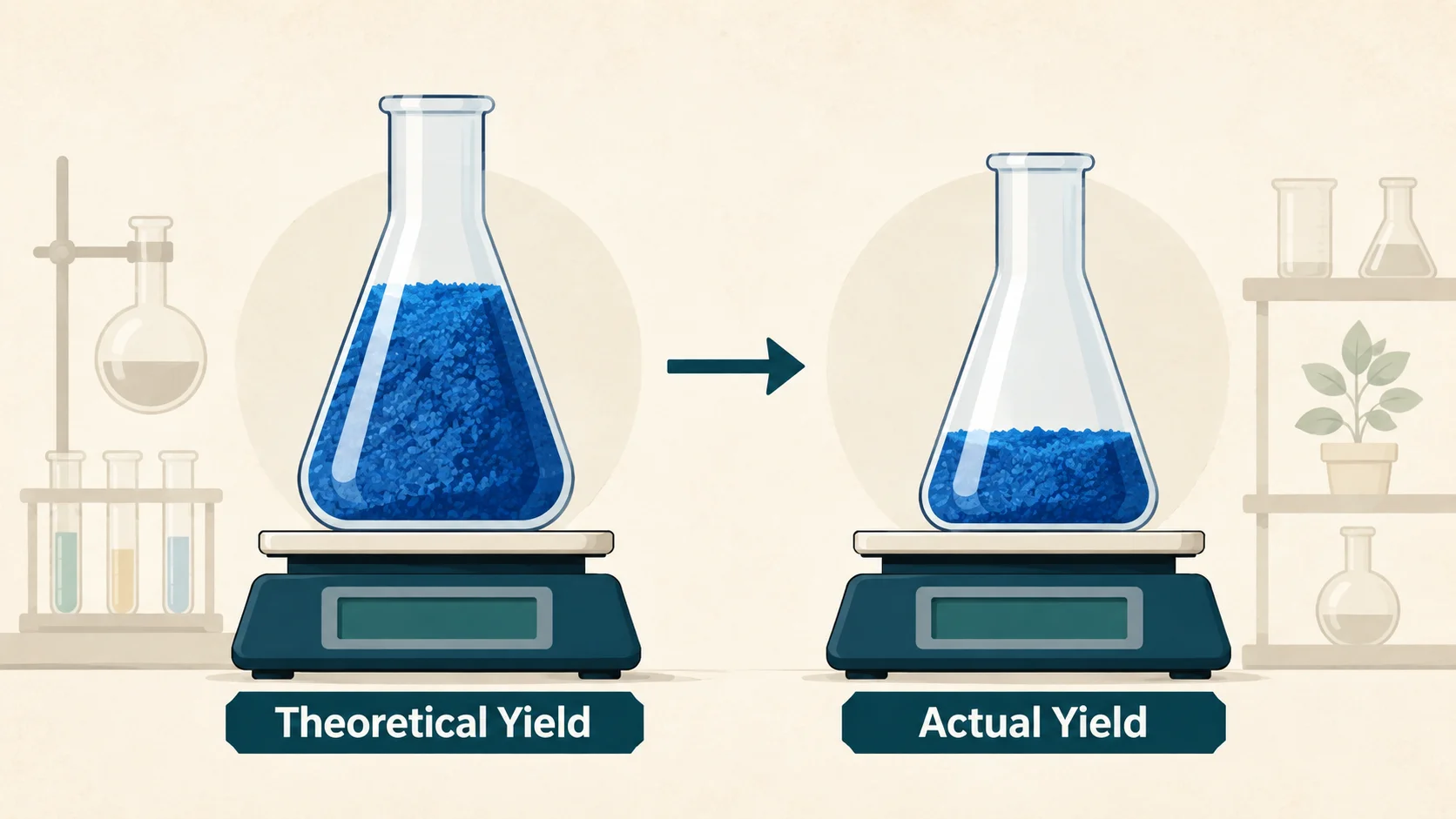
Percent yield compares the actual amount of product obtained in an experiment with the theoretical maximum amount of product predicted by stoichiometry.

The formula is:

Percent yield = (actual yield ÷ theoretical yield) × 100

A percent yield of 100% means the actual yield equals the theoretical yield. A percent yield below 100% means less product was obtained than expected. A percent yield above 100% usually suggests measurement error, impurities, wet product, incomplete drying, contamination, or another experimental issue.

Actual Yield vs Theoretical Yield

Actual yield and theoretical yield are related, but they are not the same measurement. Both values must refer to the same product before percent yield is calculated.

Term Meaning How It Is Found
Actual yield The amount of product actually collected in an experiment. Measured in the lab after the reaction, separation, purification, or drying step.
Theoretical yield The maximum product amount predicted by stoichiometry. Calculated from the balanced equation and limiting reagent.
Percent yield The actual yield compared with the theoretical yield. (actual yield ÷ theoretical yield) × 100

The actual yield and theoretical yield must use compatible units before the formula is applied. The calculator converts mg, g, and kg into grams internally.

How the Percent Yield Calculator Works

1) Convert Both Yields into the Same Unit

The calculator first converts actual yield and theoretical yield into the same internal unit. The live tool uses grams internally.

Common mass conversions include:

  • 1 g = 1000 mg
  • 1 kg = 1000 g
  • 1 mg = 0.001 g

This step is important because actual yield and theoretical yield must be compared in the same unit.

2) Divide Actual Yield by Theoretical Yield

Next, the calculator divides actual yield by theoretical yield.

Actual ÷ theoretical = actual yield ÷ theoretical yield

This ratio shows what fraction of the theoretical amount was actually obtained.

3) Convert the Ratio to a Percentage

The ratio is multiplied by 100 to express the result as a percentage.

Percent yield = (actual yield ÷ theoretical yield) × 100

4) Calculate Difference from Theoretical Yield

The calculator can also show the difference between actual yield and theoretical yield.

Difference from theoretical = actual yield − theoretical yield

A negative difference means the actual yield was lower than theoretical yield. A positive difference means the actual yield was greater than theoretical yield.

Percent Yield Formula Summary

What You Want to Find Formula Use When
Percent yield Percent yield = (actual yield ÷ theoretical yield) × 100 You know actual yield and theoretical yield.
Actual ÷ theoretical ratio Ratio = actual yield ÷ theoretical yield You want the decimal fraction before converting to percent.
Difference from theoretical Difference = actual yield − theoretical yield You want to see how far the lab result is above or below the theoretical amount.
Actual yield from percent yield Actual yield = theoretical yield × percent yield ÷ 100 You know theoretical yield and percent yield.
Theoretical yield from actual and percent yield Theoretical yield = actual yield ÷ (percent yield ÷ 100) You know actual yield and percent yield.

Worked Example: Calculate Percent Yield

Suppose a reaction has:

  • Actual yield: 12.5 g
  • Theoretical yield: 15 g

Step 1: Use the percent yield formula
Percent yield = (actual yield ÷ theoretical yield) × 100

Step 2: Substitute the values
Percent yield = (12.5 ÷ 15) × 100

Step 3: Divide actual by theoretical
12.5 ÷ 15 = 0.833333…

Step 4: Convert to percent
0.833333… × 100 = 83.33%

So, the percent yield is approximately 83.33%.

Worked Example: Actual Yield in mg and Theoretical Yield in g

Suppose a lab result gives:

  • Actual yield: 850 mg
  • Theoretical yield: 1.2 g

Step 1: Convert actual yield to grams
850 mg = 850 ÷ 1000 = 0.85 g

Step 2: Use the percent yield formula
Percent yield = (0.85 ÷ 1.2) × 100

Step 3: Calculate
0.85 ÷ 1.2 = 0.708333…

Step 4: Convert to percent
0.708333… × 100 = 70.83%

So, the percent yield is approximately 70.83%.

Worked Example: Percent Yield Above 100%

Suppose the actual yield is 10.8 g and the theoretical yield is 10.0 g.

Step 1: Apply the formula
Percent yield = (10.8 ÷ 10.0) × 100

Step 2: Calculate
10.8 ÷ 10.0 = 1.08

Step 3: Convert to percent
1.08 × 100 = 108%

A percent yield above 100% usually does not mean the reaction produced more product than chemically possible. It often suggests that the product may contain solvent, water, impurities, leftover reactant, filter paper residue, or measurement error.

Worked Example: Find Actual Yield from Percent Yield

Suppose the theoretical yield is 25 g and the percent yield is 72%. You want to find the actual yield.

Step 1: Convert percent yield to decimal
72% = 72 ÷ 100 = 0.72

Step 2: Multiply by theoretical yield
Actual yield = theoretical yield × 0.72

Step 3: Calculate
Actual yield = 25 × 0.72 = 18 g

So, if the theoretical yield is 25 g and the percent yield is 72%, the actual yield is 18 g.

Worked Example: Find Theoretical Yield from Actual Yield and Percent Yield

Suppose the actual yield is 6.4 g and the percent yield is 80%. You want to find the theoretical yield.

Step 1: Convert percent yield to decimal
80% = 80 ÷ 100 = 0.80

Step 2: Rearrange the formula
Theoretical yield = actual yield ÷ 0.80

Step 3: Calculate
Theoretical yield = 6.4 ÷ 0.80 = 8 g

So, if 6.4 g is an 80% yield, the theoretical yield is 8 g.

How to Use This Percent Yield Calculator

  1. Enter the actual yield, which is the amount of product actually obtained.
  2. Select the actual yield unit: mg, g, or kg.
  3. Enter the theoretical yield, which is the maximum expected product amount from stoichiometry.
  4. Select the theoretical yield unit: mg, g, or kg.
  5. Click Calculate.
  6. Review the percent yield, actual ÷ theoretical ratio, difference from theoretical, and interpretation.
  7. Use the step-by-step derivation to check the calculation path.
  8. Click Reset to clear the calculator and start again.

How to Interpret the Results

Percent yield shows how much of the theoretical product amount was actually obtained.

Result What It Means Important Caution
Percent yield The actual product amount expressed as a percentage of theoretical yield. Depends on accurate actual yield, theoretical yield, and unit conversion.
Actual ÷ theoretical The decimal ratio before multiplying by 100. A ratio of 0.80 equals 80% yield.
Difference from theoretical The actual yield minus the theoretical yield. A negative value means less product than theoretical; a positive value needs review.
Interpretation A plain-language summary of the yield result. It does not explain the experimental cause of the yield result.

Percent Yield General Interpretation

Percent Yield General Meaning What to Check
Less than 100% Actual yield is lower than theoretical yield. Check incomplete reaction, product loss, side reactions, purification loss, or measurement uncertainty.
About 100% Actual yield is close to theoretical yield. Check rounding, measurement precision, and whether the product was properly dried and purified.
Greater than 100% Actual yield is higher than theoretical yield. Check for wet product, retained solvent, impurities, contamination, unreacted material, or weighing error.

Common Percent Yield Examples

Actual Yield Theoretical Yield Percent Yield Interpretation
5 g 10 g 50% Half of the theoretical product amount was obtained.
8 g 10 g 80% Actual yield is lower than theoretical yield.
9.5 g 10 g 95% Actual yield is close to theoretical yield.
10 g 10 g 100% Actual yield equals theoretical yield.
10.5 g 10 g 105% Review for wet product, impurities, or measurement error.
12.5 g 15 g 83.33% Actual yield is below theoretical yield.

Why Percent Yield Is Usually Less Than 100%

In many real experiments, the actual yield is lower than theoretical yield. This can happen even when the reaction is performed carefully.

Common reasons include:

  • incomplete reaction
  • side reactions
  • equilibrium limitations
  • product lost during transfer
  • product lost during filtering or washing
  • product remaining dissolved in solution
  • loss during drying, recrystallization, or purification
  • impure reactants
  • measurement uncertainty

Percent yield helps quantify how close the experiment came to the theoretical maximum.

Why Percent Yield Can Be Greater Than 100%

A percent yield above 100% usually means the measured actual yield is larger than the theoretical maximum. In most chemistry contexts, this suggests something is affecting the mass measurement.

Possible causes include:

  • product was not fully dried
  • solvent remained in the product
  • water was absorbed by the product
  • unreacted starting material remained mixed with the product
  • impurities or side products were included in the mass
  • filter paper, container residue, or other material was weighed accidentally
  • balance or recording error

When percent yield is above 100%, review the lab procedure, product purity, drying step, and measurement method before accepting the result.

Percent Yield vs Theoretical Yield

Percent yield and theoretical yield are related, but they answer different questions.

Quantity Question It Answers Example
Theoretical yield How much product should form at most? 15 g expected
Actual yield How much product was actually obtained? 12.5 g collected
Percent yield What percentage of the theoretical amount was obtained? 83.33%

This calculator finds percent yield after actual yield and theoretical yield are already known. If you still need to calculate theoretical yield from a limiting reagent, use a theoretical yield calculator first.

Unit Consistency in Percent Yield

The actual yield and theoretical yield must use compatible units. If one value is in grams and the other is in milligrams, convert them to the same unit before dividing.

Actual Yield Theoretical Yield Before Calculating
12.5 g 15 g Units already match.
850 mg 1.2 g Convert 850 mg to 0.85 g.
0.025 kg 20 g Convert 0.025 kg to 25 g.

The live calculator handles mg, g, and kg unit conversion for you, but both values still need to describe the same product.

Percent Yield in Lab Reports

Percent yield is often included in chemistry lab reports to compare experimental results with stoichiometric predictions.

A typical lab-report yield section may include:

  • balanced chemical equation
  • limiting reagent calculation
  • theoretical yield
  • actual yield measured in the lab
  • percent yield calculation
  • discussion of possible sources of error

Percent yield by itself does not explain why a reaction gave a particular result. It should usually be discussed together with experimental conditions, product purity, and possible procedural losses.

Common Mistakes to Avoid

  • Do not divide theoretical yield by actual yield; the formula uses actual yield divided by theoretical yield.
  • Do not use different units without converting them first.
  • Do not compare yields for different products.
  • Do not use percent yield before theoretical yield has been calculated correctly.
  • Do not assume a percent yield over 100% means the reaction exceeded the theoretical maximum.
  • Do not forget to multiply the ratio by 100.
  • Do not use zero or negative theoretical yield; theoretical yield must be positive.
  • Do not ignore product purity, drying, and transfer losses when interpreting the result.

Important Assumptions and Limitations

  • This calculator assumes actual yield and theoretical yield refer to the same product.
  • It assumes both yields are positive quantities.
  • It converts mg, g, and kg into compatible mass units before calculating.
  • It does not calculate theoretical yield from a balanced chemical equation.
  • It does not identify the limiting reagent.
  • It does not verify the balanced equation, mole ratio, reagent purity, product identity, or stoichiometric setup.
  • It does not account for product purity, moisture, retained solvent, side reactions, incomplete reaction, equilibrium limitations, transfer loss, filtration loss, drying loss, or measurement uncertainty.
  • It does not replace lab instructions, safety procedures, instructor guidance, a safety data sheet, or professional chemical analysis.
  • Displayed values may be rounded for readability.

Practical Uses

This Percent Yield Calculator can be useful for:

  • chemistry homework
  • stoichiometry practice
  • lab report calculations
  • checking actual vs theoretical product amount
  • calculating reaction efficiency
  • comparing experimental product recovery
  • checking unit conversions between mg, g, and kg
  • reviewing possible experimental error when yield is low or above 100%

When You May Need a Different Calculator

This calculator is best when you already know the actual yield and theoretical yield. You may need another chemistry calculator or method if you need to solve a different part of the stoichiometry problem.

Need Better Tool or Method
Calculate theoretical yield from reactant amounts Use a theoretical yield calculator or stoichiometry setup.
Identify the limiting reagent Use a limiting reagent calculation from the balanced equation.
Convert moles to grams Use molar mass and the formula mass = moles × molar mass.
Calculate molarity Use a molarity calculator with moles and final solution volume.
Calculate dilution Use the dilution equation M1V1 = M2V2.
Calculate percent composition Use molar mass and element mass contributions.
Convert ppm to molarity Use ppm, molar mass, and solution assumptions.

References

  1. OpenStax Chemistry 2e — Reaction Yields
  2. Khan Academy — Limiting Reagents and Percent Yield
  3. Chemistry LibreTexts — Calculating Reaction Yields
  4. Chemistry LibreTexts — Reaction Yields
  5. Encyclopaedia Britannica — Stoichiometry

Related Calculators

Chemistry Disclaimer

This Percent Yield Calculator provides educational chemistry calculations from actual yield and theoretical yield. It assumes both yield values refer to the same product and are converted into compatible units before applying the formula.

This calculator does not calculate theoretical yield, identify the limiting reagent, verify a balanced equation, confirm product identity, assess product purity, account for moisture, retained solvent, impurities, side products, incomplete reactions, equilibrium limitations, transfer loss, filtration loss, drying loss, or measurement uncertainty. It does not replace lab instructions, safety procedures, instructor guidance, a safety data sheet, or professional chemical analysis.

More of our calculators...

Bird Age Calculator

Use our Bird Age Calculator to convert bird years to human years or human age back to bird age by species or custom lifespan.

Plant Spacing Calculator

Use our Plant Spacing Calculator to estimate how many plants fit in a garden bed, crop row, or square-foot layout from area and spacing.

Hamster Age Calculator

Use our Hamster Age Calculator to convert hamster years to human years or human age back to hamster age with chart-based interpolation.

Dog Age Calculator

Convert dog years to human years by breed size. Get a clear age estimate for puppies, adults, and seniors.

Ideal Gas Law Calculator

Use our Ideal Gas Law Calculator to solve pressure, volume, moles, or temperature with PV = nRT. Supports SI and L·atm gas constants with unit conversion.

Atom Calculator

Use our Atom Calculator to find protons, neutrons, electrons, atomic number, mass number, and ionic charge quickly from standard atomic relationships.

Dihybrid Cross (Punnett Square) Calculator

Use our Dihybrid Cross Calculator to build a 4×4 Punnett square for two traits, see gametes, genotype probabilities, and phenotype ratios fast.

Dog Pregnancy (Due Date) Calculator

Use our Dog Pregnancy (Due Date) Calculator to estimate your dog’s due date, safe whelping window, and pregnancy progress from mating, ovulation, LH surge, or diestrus.

Dog Size & Adult Weight Calculator

Use our Dog Size & Adult Weight Calculator to estimate your puppy’s adult weight from age and current weight. Quick size prediction with pet category output.