Dog Size & Adult Weight Calculator
Enter age & weight to see the derivation…
A puppy that fits comfortably in your arms today may grow into a very different-sized adult. The Dog Size & Adult Weight Calculator gives a preliminary adult-weight projection from the puppy’s exact age and current weight, then places the estimate into a general size category.
The result is best treated as a planning estimate for space, equipment and future care—not as a growth target. Breed, sex, inherited traits, nutrition, health and the size of the parents can all affect a dog’s final weight.
How the Dog Size & Adult Weight Calculator Works
The calculator combines the entered months, weeks and days into an age measured in weeks. It then projects the puppy’s current average weekly weight across a 52-week period:
Estimated adult weight = (current weight ÷ age in weeks) × 52
The calculation keeps the selected weight unit, so a weight entered in pounds produces a result in pounds and a weight entered in kilograms produces a result in kilograms. You can change the result unit when a converted value is more convenient.
This is a straight-line projection. Real puppy growth is not linear: weight usually rises rapidly during the early months and then slows as the dog approaches skeletal maturity. This is why the result should be read as an approximate forecast rather than a guaranteed final weight.
Worked Puppy Weight Example
Suppose a puppy is 16 weeks old and currently weighs 20 lb.
Estimated adult weight = (20 ÷ 16) × 52
Estimated adult weight = 65 lb
The projected adult weight is approximately 65 lb. The puppy would therefore be expected to mature into one of the larger adult-size groups. The actual adult weight could be lower or higher if the puppy’s growth rate changes.
Understanding the Predicted Dog Size
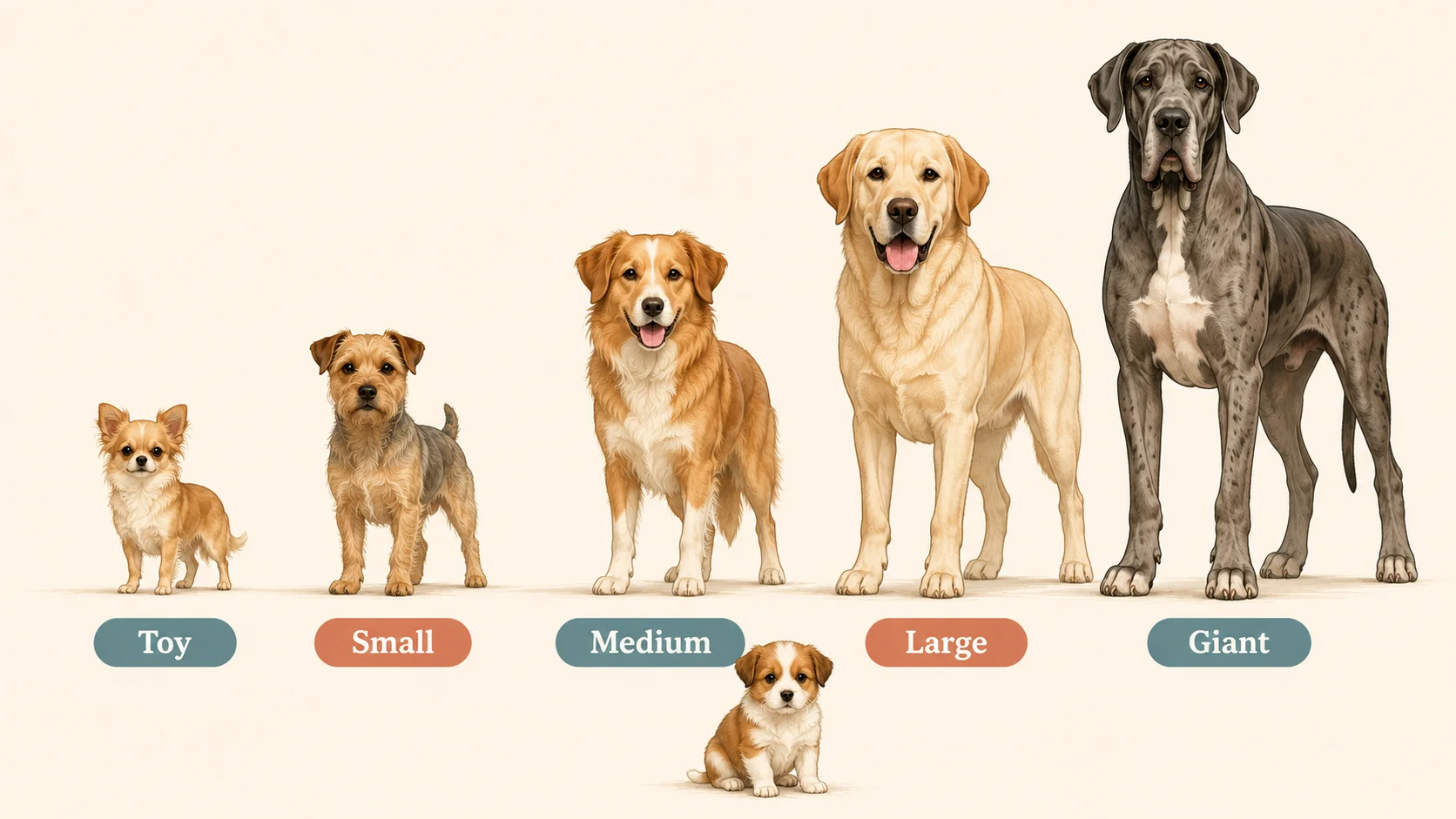
The pet category provides a quick interpretation of the projected weight. Size labels and their exact weight boundaries can differ among veterinary charts, breed organizations and pet-food systems, so the category should be viewed as a broad planning guide.
| Size category | General interpretation |
|---|---|
| Toy | The smallest adult size group; these puppies often approach mature size earlier. |
| Small | A compact adult dog that generally completes rapid growth sooner than larger dogs. |
| Medium | A middle adult-weight group with a growth period that commonly extends through much of the first year. |
| Large | A heavier adult dog that may continue developing after smaller dogs have reached full size. |
| Giant | The largest adult group; skeletal and physical development may continue well beyond one year. |
How to Get a More Useful Estimate
- Enter the puppy’s age as precisely as possible, including extra weeks or days.
- Use a recent weight measured on reliable scales without a collar, harness or lead.
- Measure under similar conditions each time, because meals and hydration can cause small fluctuations.
- Record several weights over time instead of relying on a single measurement.
- Compare the estimate with breed standards and the adult weights of the puppy’s parents when those details are known.
Repeated measurements give more context than one calculation. Veterinary puppy growth charts are more informative because they plot multiple weights over time and account for expected adult-size groups.
Important Assumptions and Limitations
- The formula assumes an approximately 52-week growth pattern.
- Small dogs may reach mature size earlier, while large and giant dogs may continue developing for 18 months or longer.
- The estimate does not directly include breed, sex, parental size, body condition or previous weight records.
- Very young puppies can produce unstable projections because a small age or weight difference has a large effect on the result.
- Mixed-breed puppies may be harder to predict when their ancestry and expected adult size are unknown.
- The result cannot determine whether a puppy is underweight, overweight or growing normally.
Do not increase or restrict food simply to make a puppy reach the predicted number. A veterinarian can assess growth using the puppy’s history, body condition, breed characteristics and a suitable growth chart.
Frequently Asked Questions
How accurate is a puppy adult weight calculator?
It provides a rough projection, not an exact prediction. Accuracy depends on the puppy’s age, breed size, current growth stage and whether its future growth resembles the formula’s 52-week assumption.
At what age do dogs stop growing?
There is no single age for every dog. Small breeds commonly finish sooner, while large and giant breeds may continue growing and filling out for 18 to 24 months.
Can the calculator estimate the size of a mixed-breed puppy?
Yes, but the uncertainty may be greater when the breed mix and parental sizes are unknown. Several recorded weights and veterinary growth-chart tracking can improve the assessment.
Why does the predicted adult weight change as my puppy gets older?
The calculation uses the puppy’s current average weight per week. Because real growth speeds up and slows down at different stages, a new age-and-weight measurement can produce a different projection.
Should I choose puppy food from the predicted weight alone?
No. The estimate can provide context, but food choice and portions should also reflect breed, body condition, activity, health and professional veterinary guidance—especially for large and giant breeds.
Related Dog Calculators
- Dog Age Calculator – compare a dog’s calendar age with a human-equivalent age using multiple methods.
- Dog Pregnancy Due Date Calculator – estimate a likely whelping date and delivery window.
- Benadryl Dosage Calculator for Dogs – review a weight-based estimate with important veterinary safety guidance.
References
- VCA Animal Hospitals – Puppy Growth and Maturity
- Royal Canin Academy – Puppy Growth Charts
- American Kennel Club – When Do Dogs Stop Growing?
Growth Rate Varies Widely by Breed and Life Stage
Small dogs often approach adult size sooner than large and giant breeds, so the same puppy-age multiplier does not fit every dog. Breed mix, sex, nutrition, health, and the reliability of the current weight affect the projection. Recheck the estimate as the puppy grows and use body-condition guidance from a veterinarian rather than feeding solely toward a predicted number.