Hamster Age to Human Age Calculator
Enter ages
Results
Action
Use this Hamster Age Calculator to estimate your hamster’s age in human years or convert a human-equivalent age back into hamster age. Enter your hamster’s age in years, months, or both, and the calculator converts the input into total months for a smoother age comparison.
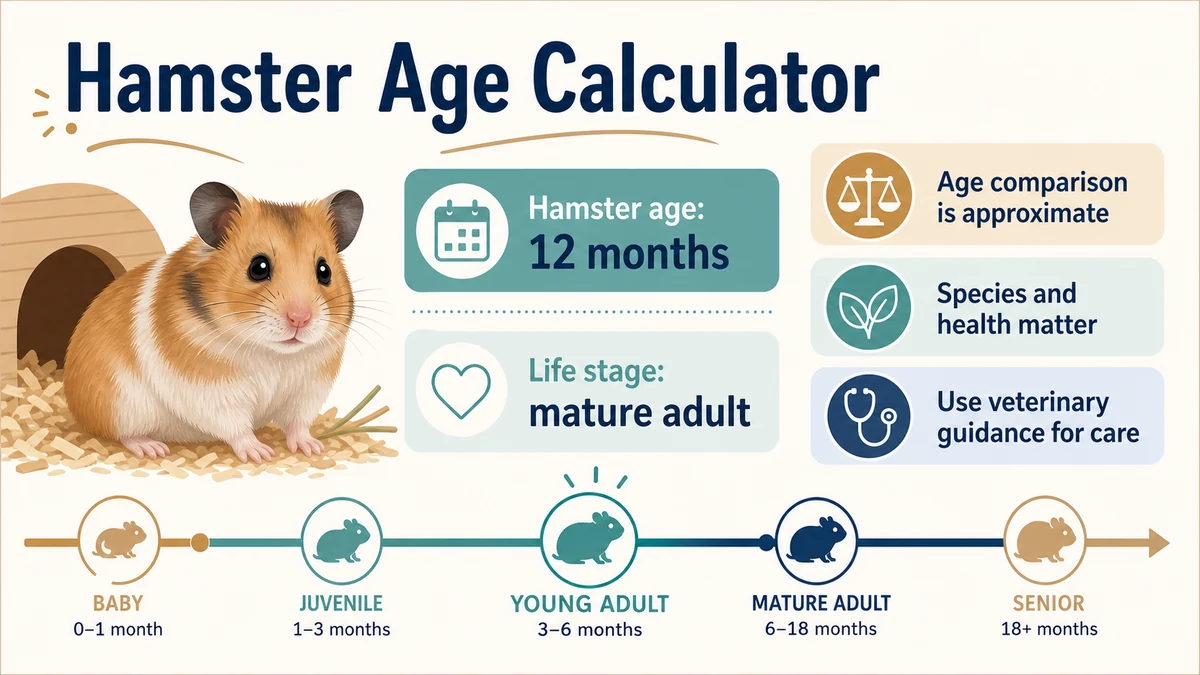
Hamsters have short lifespans compared with humans, so months matter a lot. A hamster that is only 12 months old may already be a mature adult, while a hamster around 18 to 24 months may be entering an older or senior life stage depending on species, genetics, care, and health.
Reviewed by: AjaxCalculators Editorial Team
Last updated: July 10, 2026
Method used: Chart-based hamster age to human-equivalent age mapping with month-based interpolation and reverse interpolation.
Important note: This calculator gives an estimated hamster-to-human age comparison only. It does not measure your hamster’s health, predict remaining lifespan, identify species, diagnose illness, or replace veterinary advice. Hamster lifespan varies by species, genetics, housing, diet, stress, enrichment, injury risk, dental health, and veterinary care.
If your hamster has sudden appetite changes, weight loss, diarrhea or wetness around the tail, breathing trouble, a hunched posture, overgrown teeth, overgrown nails, eye discharge, swelling, wounds, bite injuries, severe lethargy, or unusual behavior, contact a veterinarian familiar with small mammals. Small animals can decline quickly, so symptoms should not be dismissed as “just old age.”
What This Hamster Age Calculator Does
This calculator converts between hamster age and human-equivalent age using a chart-based comparison method. It helps owners understand whether a hamster is roughly in a young, adult, mature, senior, or very senior life stage.
| Calculator Feature | What It Does | Why It Helps |
|---|---|---|
| Hamster age to human age | Converts hamster years and months into an estimated human-equivalent age. | Helps explain life stage in familiar human-age terms. |
| Human age to hamster age | Back-calculates an approximate hamster age from a human-equivalent age. | Useful for reverse comparison and education. |
| Total hamster months | Converts years and months into one month-based value. | Months are important because hamsters age quickly. |
| Total human-equivalent months | Shows the estimated human-equivalent result in total months. | Makes chart interpolation easier to understand. |
| Chart-based interpolation | Estimates values between age points on the conversion chart. | Gives smoother results than only using whole-year jumps. |
| Reverse interpolation | Works backward from human-equivalent age to hamster age. | Supports both common user questions. |
| Quick summary | Shows a simple plain-language result. | Helps users understand the estimate quickly. |
How the Hamster Age Calculator Works
The live calculator uses a chart-based method. It first converts hamster age into total months, then maps that value to a human-equivalent age chart. If the entered age falls between two chart points, the calculator estimates the in-between value using interpolation.
| Step | What Happens | Why It Matters |
|---|---|---|
| Step 1 | Years and months are converted into total hamster months. | Month-based input is more useful than rounding to whole years. |
| Step 2 | The calculator checks the hamster age chart. | The chart represents a general hamster-to-human life-stage comparison. |
| Step 3 | If the age is between chart points, interpolation is used. | This gives smoother estimates for ages like 7 months, 15 months, or 22 months. |
| Step 4 | The result is converted into human-equivalent years and months. | This makes the estimate easier to read. |
| Step 5 | If human age is entered, the process runs in reverse. | This estimates the hamster age that roughly matches the human-equivalent age. |
Hamster Age Formula Summary
| Calculation | Formula or Method | Purpose |
|---|---|---|
| Hamster total age | total hamster months = years × 12 + months | Combines hamster years and months into one value. |
| Human total age | total human months = years × 12 + months | Combines human-equivalent years and months into one value. |
| Hamster to human conversion | chart lookup + interpolation | Estimates human-equivalent age from hamster age. |
| Human to hamster conversion | reverse chart interpolation | Estimates hamster age from human-equivalent age. |
| Years and months display | total months converted back into years and remaining months | Makes results easier to read. |
Why Hamster Age Is Not a Simple Multiplier
Hamster age should not be converted with one fixed multiplier for every month of life. Hamsters mature quickly during early life, then move through adulthood and senior age over a short calendar period.
| Reason | Why It Matters | Calculator Approach |
|---|---|---|
| Hamsters mature quickly. | A few months can represent a major development change. | Uses month-based age rather than only whole years. |
| Hamsters have short lifespans. | One month is a larger share of life than it is for humans. | Shows total months for better context. |
| Species differ. | Syrian, Chinese, Russian dwarf, and Roborovski hamsters may not age identically. | Provides a general estimate, not a species-specific diagnosis. |
| Health and care matter. | Diet, habitat, stress, injury, and dental health can affect real aging and welfare. | Includes a veterinary disclaimer and care guidance. |
| Human and hamster biology differ. | A human-equivalent age is only a comparison, not a medical measurement. | Uses chart-based interpretation instead of claiming exact equivalence. |
Hamster Lifespan Context
Most pet hamsters have short lifespans. Lifespan depends on species, genetics, breeding, diet, habitat, stress level, enrichment, injury risk, and medical care. The table below gives general context only.
| Hamster Type | Common Lifespan Context | Age-Conversion Note |
|---|---|---|
| Syrian hamster | Often listed around 18–36 months in veterinary references. | A 1-year-old Syrian hamster is already a mature adult in practical owner terms. |
| Chinese hamster | Often listed around 24–36 months in veterinary references. | May have a slightly longer typical range than some dwarf references. |
| Russian dwarf hamster | Often listed around 18–24 months in veterinary references. | Shorter lifespan means each month represents a larger share of life. |
| Roborovski dwarf hamster | Often discussed as one of the longer-lived dwarf hamster types in pet references. | Individual lifespan still varies widely with care, genetics, and health. |
| Generic hamster | Many pet hamsters live roughly around 2 years, but ranges vary. | Use the calculator as a broad life-stage comparison only. |
Because different hamster types can age differently, a hamster age calculator should be treated as a rough comparison tool rather than an exact biological clock.
Hamster Life Stages
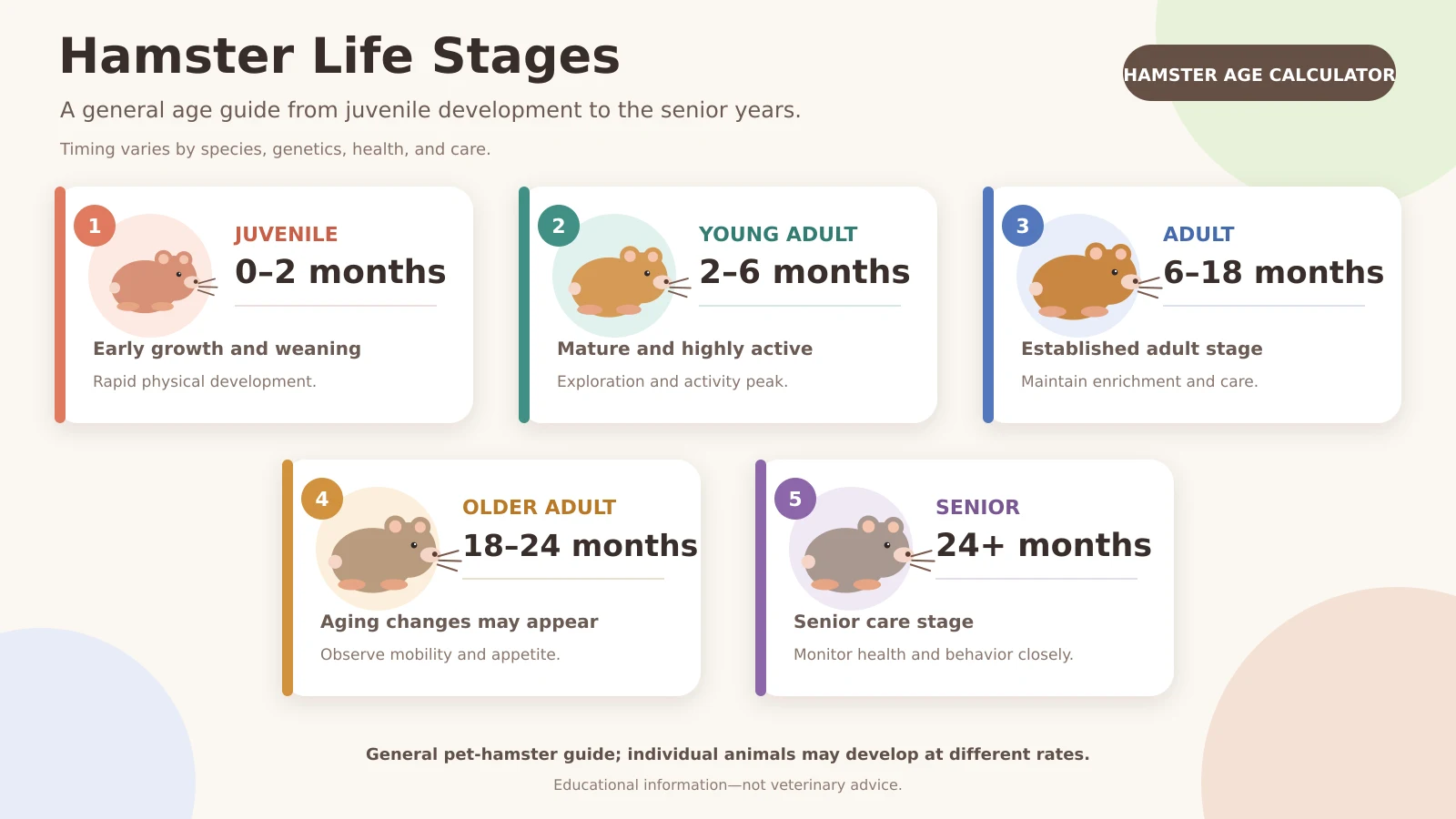
Hamster life stages vary by species and individual condition, but a practical owner-focused guide can help interpret the calculator result.
| Approximate Age | Practical Life Stage | Care Focus |
|---|---|---|
| 0–2 months | Young / juvenile | Gentle handling, proper diet, safe housing, low stress, and careful supervision. |
| 2–6 months | Young adult | Activity, enrichment, stable routine, safe wheel, bedding depth, and trust-building. |
| 6–18 months | Adult | Weight monitoring, dental health, clean habitat, normal activity tracking, and safe enrichment. |
| 18–24 months | Older adult / senior monitoring stage | Closer observation for appetite, movement, coat condition, breathing, teeth, nails, and weight changes. |
| 24+ months | Senior / very senior for many hamsters | Comfort, easy access to food and water, careful handling, and prompt veterinary advice for symptoms. |
This table is a general guide. A hamster’s true health status depends on individual condition, not age alone.
Common Hamster Age Examples
| Hamster Age | Total Months | General Owner Interpretation |
|---|---|---|
| 1 month | 1 month | Very young. |
| 3 months | 3 months | Young and rapidly maturing. |
| 6 months | 6 months | Young adult for many hamsters. |
| 1 year | 12 months | Adult / mature adult. |
| 1 year 6 months | 18 months | Older adult or senior monitoring stage. |
| 2 years | 24 months | Senior for many hamsters. |
| 2 years 6 months | 30 months | Very senior for many hamsters. |
Suggested Visible Age Chart Section
For stronger transparency, the page should show the actual conversion chart used by the calculator. The values in the visible chart should match the calculator’s internal chart exactly.
| Hamster Age | Life Stage | Human-Equivalent Meaning |
|---|---|---|
| 1 month | Very young | Early development comparison. |
| 3 months | Young adult | Rapid maturity stage. |
| 6 months | Young adult / adult | Established adult behavior for many hamsters. |
| 12 months | Adult / mature adult | Middle-age comparison in a short-lived pet. |
| 18 months | Older adult | Senior monitoring becomes more important. |
| 24 months | Senior | Late-life stage for many pet hamsters. |
| 30+ months | Very senior | Advanced age for many hamsters. |
Method transparency note: This calculator uses a chart-based hamster-to-human age estimate. Ages between chart points are calculated with linear interpolation. The result is a general comparison only, not a veterinary diagnosis.
How to Use This Hamster Age Calculator
- Enter your hamster’s age in years, months, or both.
- Or enter a human-equivalent age if you want to back-calculate hamster age.
- Review the quick summary.
- Check the hamster total age in months.
- Check the human-equivalent total age in months.
- Review the method output to understand whether the tool converted from hamster age or human age.
- Use the result as a general life-stage estimate.
- Click Reload / Reset to clear the calculator and start again.
Worked Example: Convert Hamster Age to Human Age
Suppose your hamster is 1 year and 6 months old.
| Step | Calculation or Action | Result or Meaning |
|---|---|---|
| Step 1 | Convert years to months. | 1 year = 12 months. |
| Step 2 | Add remaining months. | 12 + 6 = 18 hamster months. |
| Step 3 | Use the calculator’s age chart. | The tool finds where 18 months falls on the chart. |
| Step 4 | Interpolate if needed. | If 18 months falls between chart points, the calculator estimates the in-between value. |
| Step 5 | Show the human-equivalent result. | The calculator displays the estimated human-equivalent age in years and months. |
This result is useful for understanding life stage, but it is not a medical measurement.
Worked Example: Convert Human Age Back to Hamster Age
Suppose you enter a human-equivalent age of 34 years.
| Step | Calculation or Action | Result or Meaning |
|---|---|---|
| Step 1 | Convert human years to months. | 34 × 12 = 408 human-equivalent months. |
| Step 2 | Use reverse interpolation. | The calculator finds where 408 human-equivalent months falls on the chart. |
| Step 3 | Back-calculate hamster age. | The tool estimates the matching hamster age in total months. |
| Step 4 | Convert months into years and months. | The result is shown as a practical hamster age estimate. |
Reverse conversion is helpful when you want to understand what hamster age roughly matches a familiar human age.
Worked Example: A 6-Month-Old Hamster
Suppose your hamster is 6 months old.
| Step | Calculation or Interpretation | Result |
|---|---|---|
| Total hamster age | 0 years × 12 + 6 months | 6 months. |
| Life-stage context | Many hamsters are no longer babies by this age. | Often a young adult stage in practical pet-care terms. |
| Calculator use | Enter 0 years and 6 months. | The tool returns a chart-based human-equivalent estimate. |
| Care takeaway | Watch activity, eating, weight, chewing, and handling response. | Age estimate should be combined with daily observation. |
The exact human-equivalent result depends on the calculator’s internal age chart, but the main takeaway is that hamsters mature quickly compared with humans.
Worked Example: A 2-Year-Old Hamster
Suppose your hamster is 2 years old.
| Step | Calculation or Interpretation | Result |
|---|---|---|
| Convert years to months | 2 years × 12 | 24 hamster months. |
| Compare with common lifespan context | Many pet hamsters have short lifespans. | 24 months is already a later-life age for many hamsters. |
| Use the calculator | Enter 2 years and 0 months. | The tool returns a human-equivalent estimate. |
| Care takeaway | Monitor weight, coat, appetite, movement, breathing, and behavior. | Do not dismiss symptoms as normal aging without veterinary advice. |
A 2-year-old hamster should usually be treated as an older pet, especially if changes in weight, movement, coat, appetite, teeth, droppings, or behavior appear.
Syrian Hamster Age in Human Years
Syrian hamsters, also called golden hamsters, are among the most common pet hamsters. They are generally solitary and should not be assumed to enjoy living with another hamster.
| Topic | Syrian Hamster Context | Owner Note |
|---|---|---|
| Common lifespan context | Often listed around 18–36 months in veterinary references. | A 1-year-old Syrian hamster is already mature in practical care terms. |
| Social housing | Syrian hamsters are generally solitary. | Do not house Syrian hamsters together unless following expert veterinary or welfare guidance in a very specific context. |
| Age interpretation | 18 to 24 months may be an older stage. | Watch appetite, activity, coat, teeth, nails, and breathing. |
| Calculator use | Use the result as a broad life-stage comparison. | Daily behavior and health signs are more important than the calculated age alone. |
Dwarf Hamster Age in Human Years
Dwarf hamsters include several types, such as Russian dwarf hamsters, winter white dwarf hamsters, Campbell’s dwarf hamsters, and Roborovski dwarf hamsters. Lifespan and behavior can vary by type.
| Dwarf Hamster Context | Why It Matters | Owner Note |
|---|---|---|
| Small body size | Small changes in weight, appetite, or activity can be important. | Track body condition and behavior regularly. |
| Short lifespan | Each month represents a meaningful life-stage change. | Use months rather than only whole years. |
| Species differences | Russian dwarf, Campbell’s, winter white, and Roborovski hamsters may not age identically. | Use species-specific care guidance when available. |
| Group housing caution | Some dwarf species may be kept together only under suitable conditions, while conflict can still occur. | Watch carefully for fighting, stress, bite injuries, or bullying. |
Chinese Hamster Age in Human Years
Chinese hamsters can have a lifespan range that differs from some other common pet hamster types. They are also not the same as Russian dwarf or Roborovski hamsters.
| Topic | Chinese Hamster Context | Owner Note |
|---|---|---|
| Common lifespan context | Often listed around 24–36 months in veterinary references. | Still a short-lived pet compared with humans. |
| Species distinction | Chinese hamsters are not the same as all dwarf hamster types. | A future species selector could improve calculator precision. |
| Age estimate | The current calculator gives a general hamster age estimate. | Use the result as a broad comparison only. |
What Affects a Hamster’s Real Aging?
A hamster age calculator cannot measure all the factors that affect real health, comfort, and lifespan. It can only provide an approximate age comparison.
| Factor | How It Can Matter | Owner Reminder |
|---|---|---|
| Species or type | Different hamster types may have different typical lifespan ranges. | Know whether your hamster is Syrian, Chinese, Russian dwarf, Roborovski, or another type. |
| Genetics and breeding | Inherited health and lifespan tendencies can vary. | A healthy-looking young hamster can still develop problems. |
| Diet quality | Poor diet can affect weight, teeth, digestion, and overall health. | Use species-appropriate feeding guidance. |
| Habitat size and bedding depth | Housing affects activity, burrowing, stress, and welfare. | Provide safe bedding, enrichment, and room to move. |
| Stress level | Frequent disturbance, unsafe handling, or unsuitable housing can harm welfare. | Avoid waking a sleeping hamster suddenly. |
| Exercise and enrichment | Safe activity supports normal behavior. | Use a safe wheel size and appropriate enrichment. |
| Dental health | Rodent incisors keep growing and can become overgrown. | Watch eating, drooling, weight loss, and tooth appearance. |
| Veterinary care | Early advice can be important because hamsters may hide illness. | Contact a small-mammal veterinarian for concerning symptoms. |
Signs of Aging in Hamsters
Older hamsters may show gradual changes over time. Some changes may be age-related, while others can indicate illness.
| Possible Change | Could Be Age-Related? | When to Be Concerned |
|---|---|---|
| Sleeping more | May happen with age. | Concern if combined with weakness, not eating, or labored breathing. |
| Reduced activity | May happen gradually. | Concern if sudden, severe, or paired with weight loss. |
| Slower movement | May happen in older hamsters. | Concern if the hamster appears painful, hunched, or unable to move normally. |
| Thinner coat | Can occur with age. | Concern if there are wounds, parasites, swelling, or severe hair loss. |
| Weight changes | Older hamsters may lose condition. | Rapid weight loss or gain should be checked. |
| Changes in grooming | May occur with reduced mobility or illness. | Rough coat, dirty bottom, or poor grooming can signal a problem. |
| Changes in appetite | Can happen with age, dental disease, or illness. | Not eating or drinking requires prompt attention. |
When to Contact a Veterinarian
Do not rely on an age calculator if your hamster appears unwell. Contact a veterinarian familiar with small mammals if you notice concerning symptoms.
| Symptom or Situation | Why It Matters |
|---|---|
| Not eating or drinking | Small animals can decline quickly without food or water. |
| Rapid weight loss | May indicate dental disease, illness, stress, or other problems. |
| Diarrhea or wetness around the tail | Wet tail or diarrhea can be serious and may need urgent care. |
| Labored breathing | Breathing problems can be urgent. |
| Hunched posture or severe lethargy | May indicate pain, illness, or weakness. |
| Rough or unkempt coat | Can be a sign of illness, stress, or reduced grooming. |
| Swelling, lumps, wounds, or bite injuries | May need veterinary assessment and treatment. |
| Overgrown teeth or nails | Can interfere with eating, movement, and comfort. |
| Eye discharge or closed eye | Can indicate infection, injury, dental issues, or irritation. |
| Sudden aggression or unusual hiding | Behavior change can be linked to pain, stress, or illness. |
Hamster Age vs Hamster Health
Age and health are related, but they are not the same thing. A young hamster can become ill, and an older hamster may still be active and comfortable.
| What to Track | Why It Helps | Owner Tip |
|---|---|---|
| Body weight | Weight change may be one of the earliest signs of trouble. | Use a small digital scale if possible. |
| Food intake | Eating less can indicate dental or health problems. | Check hidden food stores, not just the bowl. |
| Water intake | Changes can suggest illness or environmental issues. | Confirm the bottle or bowl is working. |
| Droppings | Changes can indicate digestive problems. | Watch for diarrhea, wetness, or unusual absence of droppings. |
| Activity level | Reduced activity may indicate aging, stress, or illness. | Compare with your hamster’s normal routine. |
| Coat and grooming | A rough coat can signal poor health or reduced self-care. | Watch for matting, bald patches, wounds, or parasites. |
| Breathing | Breathing changes can be serious. | Seek veterinary advice for labored breathing. |
| Normal hiding and burrowing | Hamsters naturally hide and burrow, but changes can matter. | Look for sudden pattern changes rather than isolated behavior. |
A calculated human-equivalent age is useful for context, but daily observation is more useful for health monitoring.
Hamster Care Tips by Life Stage
| Life Stage | Care Priority | Owner Reminder |
|---|---|---|
| Young hamster | Gentle handling and low stress. | Build trust slowly and avoid sudden waking. |
| Adult hamster | Stable diet, enrichment, and exercise. | Provide safe chewing, burrowing, and activity options. |
| Mature hamster | Weight and behavior monitoring. | Look for subtle changes in routine. |
| Senior hamster | Comfort, easy access, and health checks. | Keep food, water, bedding, and nesting areas easy to reach. |
| Very senior hamster | Close observation and prompt care for symptoms. | Do not assume illness signs are normal aging. |
Hamster Age and Children
Hamsters are often a child’s first pet, but their short lifespan can be surprising for families. A hamster age calculator can help explain why a hamster may move from young adult to senior life stage quickly.
| Family Care Topic | Why It Matters | Practical Reminder |
|---|---|---|
| Adult responsibility | Children may not be able to manage all care needs alone. | An adult should supervise handling, feeding, cleaning, and health checks. |
| Gentle handling | Hamsters are small and can be injured by falls, squeezing, or rough handling. | Handle close to a safe surface and avoid sudden grabbing. |
| Sleep schedule | Hamsters are often active at night and may sleep during the day. | Do not wake a sleeping hamster suddenly just to play. |
| Short lifespan | Hamsters may become senior pets within a short calendar time. | Use age estimates to set realistic expectations. |
| Health observation | Small changes can matter. | Adults should check eating, weight, droppings, teeth, coat, and behavior. |
Why the Calculator Supports Reverse Conversion
Reverse conversion is useful because users may ask both questions: “How old is my hamster in human years?” and “What hamster age is similar to a certain human age?”
| User Question | Calculator Direction | Example |
|---|---|---|
| How old is my hamster in human years? | Hamster age to human-equivalent age. | Enter 1 year and 6 months. |
| What hamster age matches a human age? | Human-equivalent age to hamster age. | Enter 34 human-equivalent years. |
| Why does age change so quickly? | Compare total months and life stage. | See why 18 months can be an older stage for many hamsters. |
Recommended Calculator Upgrade Idea
The current calculator is useful, but it would be stronger if it added a hamster type selector. This would make the page more accurate for users searching for Syrian hamster age, dwarf hamster age, Chinese hamster age, and Roborovski hamster age.
| Suggested Option | Why It Would Help |
|---|---|
| Syrian hamster | Common pet type with specific lifespan and social-housing context. |
| Chinese hamster | Can have a different lifespan range from some dwarf hamsters. |
| Russian dwarf hamster | Common dwarf type with shorter lifespan context in veterinary references. |
| Roborovski dwarf hamster | Often discussed as a longer-lived dwarf hamster type. |
| Generic hamster | Useful when the owner does not know the exact type. |
How to Interpret the Results
| Result Field | Meaning | How to Use It |
|---|---|---|
| Hamster total age | The entered hamster age converted into total months. | Useful because months matter more for short-lived pets. |
| Human total age | The estimated human-equivalent age converted into total months. | Shows the scale used for comparison. |
| Method | Explains whether the result came from hamster age, human age, or interpolation. | Helps users understand how the tool produced the estimate. |
| Quick summary | A plain-language version of the result. | Useful for quick understanding. |
| Human-equivalent age | A comparison to familiar human life stages. | Use as context, not a diagnosis. |
| Reverse-converted hamster age | An approximate hamster age based on a human-equivalent input. | Use for education and comparison only. |
Common Mistakes to Avoid
| Mistake | Why It Causes Problems | Better Approach |
|---|---|---|
| Treating hamster age in human years as exact. | Hamsters and humans do not age in the same biological pattern. | Use the result as a rough life-stage comparison. |
| Ignoring months. | A few months can represent a major life-stage change for a hamster. | Enter years and months when possible. |
| Assuming every hamster type has the same lifespan. | Species and type can affect lifespan and behavior. | Use species-specific care information when available. |
| Using age conversion to diagnose illness. | Age comparison cannot identify disease, pain, dental problems, or infection. | Contact a veterinarian for symptoms. |
| Assuming older symptoms are “just age.” | Illness can be treatable or urgent even in older hamsters. | Watch sudden changes carefully. |
| Waking a sleeping hamster suddenly. | Hamsters can be startled and stressed. | Respect their sleep cycle and handle gently when awake. |
| Housing Syrian hamsters together. | Syrian hamsters are generally solitary and may fight. | Use species-appropriate housing guidance. |
| Delaying help for wet tail, breathing trouble, weight loss, or injury. | Small animals can decline quickly. | Seek veterinary advice promptly. |
Important Assumptions and Limitations
- This calculator gives a general hamster age comparison only.
- It uses chart-based interpolation, not a veterinary examination.
- It assumes the entered hamster age or human-equivalent age is accurate.
- It does not identify hamster species automatically.
- It does not predict remaining lifespan.
- It does not diagnose illness, pain, dental problems, wet tail, tumors, infection, respiratory disease, injury, or age-related disease.
- It does not account for genetics, breeding, diet, housing, bedding depth, enrichment, stress, temperature, injury risk, or veterinary care.
- Individual hamsters can age faster or slower than the chart estimate suggests.
- A human-equivalent age should not be used to decide whether a hamster is healthy.
- For symptoms or care decisions, contact a veterinarian familiar with small mammals.
Practical Uses of a Hamster Age Calculator
- Estimate hamster years to human years.
- Understand a hamster’s general life stage.
- Compare young, adult, mature, senior, and very senior hamster ages.
- Explain hamster aging to children and family members.
- Track pet age in months instead of only years.
- Convert a human-equivalent age back into hamster age.
- Add context to pet records.
- Understand why hamster months matter.
- Plan better observation for older hamsters.
- Prepare better questions for a small-mammal veterinarian.
When You May Need More Than This Calculator
| Situation | Why More Help Is Needed |
|---|---|
| Real health status | Only a veterinary exam can assess health properly. |
| Weight loss or weight gain | Can indicate illness, dental issues, diet problems, or stress. |
| Wet tail or diarrhea | Can be serious and should not be delayed. |
| Breathing changes | Respiratory symptoms can become urgent. |
| Overgrown teeth or nails | Can affect eating, movement, and comfort. |
| Eye, skin, or coat problems | May indicate injury, infection, irritation, parasites, or other conditions. |
| Lumps, swelling, wounds, or tumors | Need professional evaluation. |
| Senior hamster care | Older hamsters may need comfort adjustments and closer observation. |
| Safe diet and habitat needs | Species-appropriate husbandry matters for welfare. |
| Species-specific behavior | Social housing, handling, activity patterns, and care vary by hamster type. |
Frequently Asked Questions
What does the Hamster Age Calculator do?
It estimates a hamster’s age in human years and can also convert a human-equivalent age back into hamster age using a chart-based method.
How do I calculate hamster age in human years?
Enter your hamster’s age in years and months. The calculator converts the age into total months and applies a chart-based conversion method with interpolation.
Is hamster age in human years exact?
No. It is an estimate. Hamsters and humans age differently, and hamster lifespan varies by species, genetics, care, housing, diet, stress, and health.
Why does the calculator use months?
Hamsters have short lifespans, so a few months can represent a major life-stage change. Month-based input gives a more useful estimate than whole years only.
Can I enter human age instead of hamster age?
Yes. The calculator supports reverse conversion. Enter a human-equivalent age, and it estimates the matching hamster age using inverse chart interpolation.
Does hamster species matter?
Yes. Syrian, Chinese, Russian dwarf, Roborovski, and other hamster types can have different lifespan patterns. The current calculator gives a general estimate, so species-specific context is still important.
When is a hamster considered senior?
Many hamsters are considered older or senior around 18 months or later, but this depends on species, individual health, care, and lifespan context.
Is a 2-year-old hamster old?
For many pet hamsters, 2 years is a senior or late-life age. Some hamsters live longer, but a 24-month-old hamster should usually be monitored closely for changes in weight, appetite, movement, teeth, coat, and behavior.
Can this calculator tell me if my hamster is healthy?
No. The calculator only estimates age comparison. For health concerns, contact a veterinarian familiar with small mammals.
Can this calculator predict how long my hamster will live?
No. It cannot predict remaining lifespan. Lifespan depends on species, genetics, care, diet, housing, stress, injury, and medical conditions.
Why does my hamster seem to age suddenly?
Hamsters have short lifespans, so a few months can represent a large part of life. Changes between 12, 18, and 24 months can feel sudden compared with human aging.
What is the average lifespan of a pet hamster?
Many pet hamsters live roughly around 2 years, but lifespan varies by species and individual health. Veterinary references list different ranges for Syrian, Chinese, and Russian dwarf hamsters.
What hamster type usually lives longest?
Lifespan varies widely, but some references discuss Chinese hamsters and Roborovski dwarf hamsters as having longer ranges than some other common hamster types. Individual care and genetics still matter.
Are Syrian hamsters solitary?
Yes, Syrian hamsters are generally solitary and should not be assumed to enjoy living with another hamster. Housing Syrian hamsters together can lead to fighting and injury.
Can dwarf hamsters live together?
Some dwarf hamster species may live together under suitable conditions, but fighting and stress can still occur. Watch carefully for bite injuries, bullying, or separation needs.
What signs of aging should I watch for?
Watch for reduced activity, sleeping more, slower movement, coat changes, grooming changes, appetite changes, and weight changes. Sudden or severe changes should be discussed with a veterinarian.
What symptoms need veterinary help?
Seek veterinary advice for not eating or drinking, rapid weight loss, diarrhea or wet tail, labored breathing, lethargy, overgrown teeth or nails, wounds, bite injuries, swelling, eye discharge, or sudden behavior changes.
Can I use this calculator for gerbils, mice, or rats?
No. It is designed for hamsters. Other small pets have different lifespans and should use species-specific age guidance.
Why should I convert hamster years to human years?
It can make your hamster’s life stage easier to understand and explain, especially because hamsters age much faster than humans.
Should children care for hamsters alone?
No. Hamsters are delicate and have complex care needs. Adults should supervise handling, cleaning, feeding, and health monitoring.
Report an Issue
If you notice an incorrect result, unclear age explanation, broken input field, reverse-conversion issue, chart interpolation issue, formatting problem, outdated reference, or confusing output with this Hamster Age Calculator, please contact us through the Contact Us page. Include the hamster age entered, human-equivalent age entered if used, result shown, device/browser if relevant, and a short description of the issue so our editorial team can review it.
References
- Merck Veterinary Manual — Introduction to Hamsters
- MSD Veterinary Manual — Biological Data of Pet Rodents
- Royal Veterinary College VetCompass — Disorders and Lifespan of Pet Hamsters
- Journal of Small Animal Practice / PMC — Demography, Disorders and Mortality of Pet Hamsters Under Primary Veterinary Care in the UK
- RSPCA — Keeping Hamsters as Pets
Related Calculators
- Bird Age Calculator
- Dog Age Calculator
- Cat Age Calculator
- Horse Age Calculator
- Age Calculator
- Date Duration Calculator
- Time Calculator
- Dog Pregnancy Calculator
- Dog Size & Adult Weight Calculator
- Percentage Calculator
Hamster Age Calculator Disclaimer
This Hamster Age Calculator provides educational and general hamster-to-human age comparison estimates only. Results depend on the entered hamster age, entered human-equivalent age, chart assumptions, interpolation method, rounding choices, and whether the hamster’s actual species and health status match the general chart assumptions.
The calculator does not diagnose health, measure biological age, identify species, predict remaining lifespan, detect pain, evaluate dental health, diagnose wet tail, diagnose tumors, assess injury, measure respiratory health, or replace a veterinary examination. Hamster lifespan varies by species, genetics, breeding, habitat, bedding, diet, stress, enrichment, exercise, injury risk, dental condition, temperature, handling, and veterinary care.
Use this calculator as general life-stage context only. For appetite changes, weight loss, wet tail, diarrhea, breathing problems, injury, overgrown teeth, overgrown nails, lumps, eye discharge, severe lethargy, sudden aggression, or unusual hiding, contact a veterinarian familiar with small mammals.