
Insulation Calculator
Estimate insulation area, packages needed, waste allowance, purchased coverage, and optional material cost for walls and ceilings.
Results
This estimate is for simple rectangular rooms. Actual insulation needs can vary because of stud spacing, joist spacing, cavities, framing members, openings, compression, offcuts, thermal bridging, local code, and manufacturer package coverage.
The Insulation Calculator estimates net surface area and converts it into full packages using the coverage printed on the selected product. It does not choose the required R-value or assembly. Climate zone, code, cavity depth, air sealing, moisture control, and existing construction must be evaluated separately.
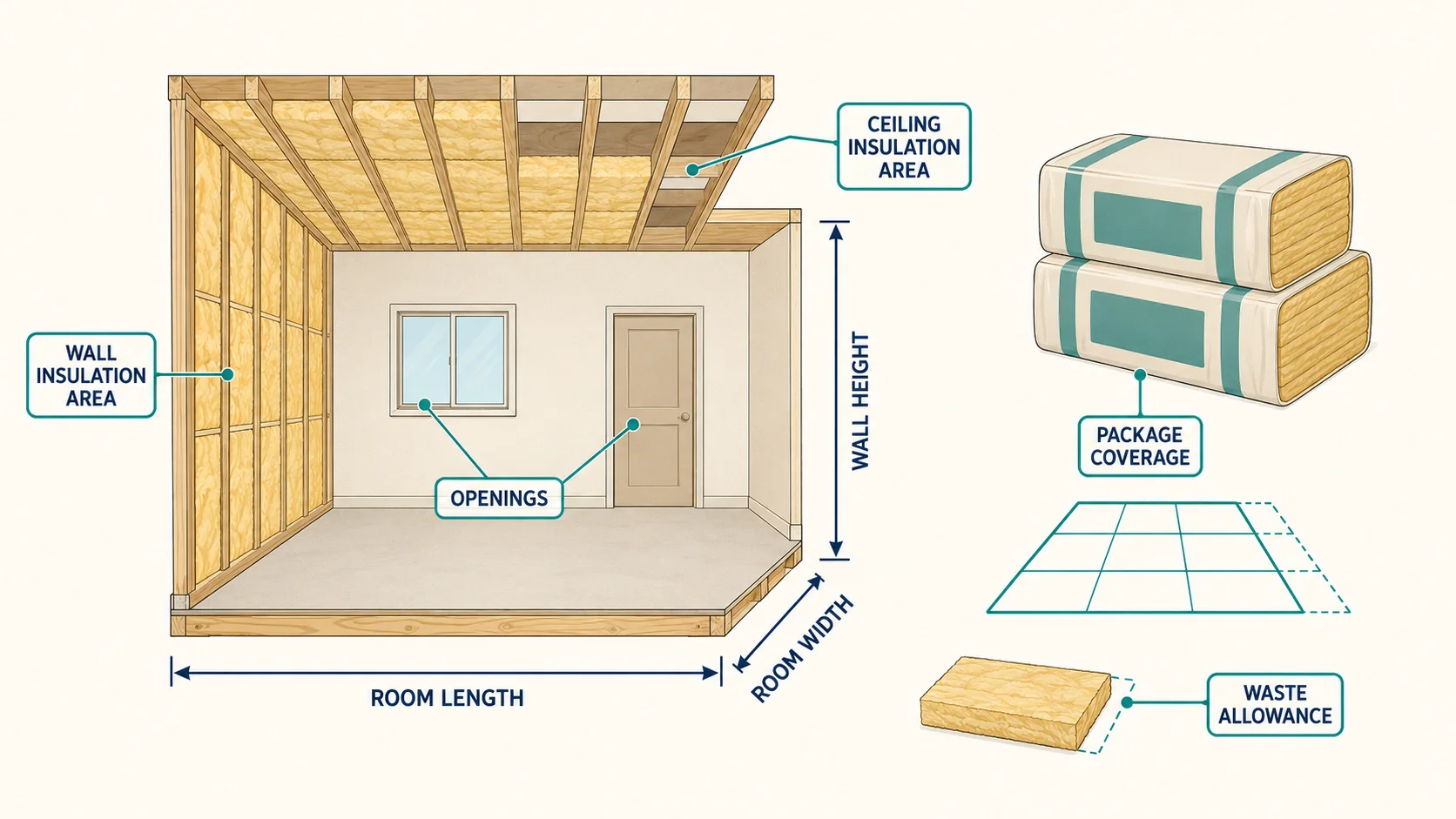
Measure each thermal boundary
For rectangular exterior walls:
Net wall area = 2 × (length + width) × height − openings
Ceiling or attic area is usually length times width when the insulated boundary is horizontal. Sloped rooflines, kneewalls, rim joists, floors over unconditioned space, and additions should be measured as separate assemblies with their own product.
Package count comes from label coverage
Packages = ceiling(net area × allowance factor ÷ coverage per package)
If 1,200 ft² requires one product and each package covers 88 ft², the base result is 13.64 packages. A small project-appropriate allowance may raise the order, and the final number must be rounded to whole packages.
R-value is not calculated from square footage
R-value describes resistance to heat flow; surface area describes quantity. Batts with the same face dimensions can have different R-values, thicknesses, and applications. Confirm the required assembly and product for the location. Do not compress thick fibrous insulation into a shallow cavity and assume the labeled R-value remains unchanged.
Batts, rolls and loose fill require different planning
Batts depend on cavity width, height, obstructions, and count. Rolls depend on usable coverage and cutting. Loose-fill products may be specified by installed thickness, settled thickness, coverage chart, and bags required for a target R-value. Use the manufacturer’s chart rather than converting all products by area alone.
Walls, ceilings, and lofts need separate measurements
Each assembly can have a different target R-value, cavity depth, product width, and package coverage. Separate walls, ceilings, and lofts instead of combining them into one generic square-foot result, then match each area to the product intended for that location.
Air and moisture paths can dominate performance
Gaps, bypasses, wind washing, wet material, thermal bridges, and incorrectly placed vapor control can reduce performance. The Insulation Calculator cannot inspect the assembly. Address bulk water and use climate-appropriate air-sealing and moisture details before concealing work.
Preparation checklist
- Identify the actual thermal boundary and every assembly type.
- Confirm local required R-value and permitted materials.
- Measure cavities, openings, obstructions, and access.
- Use exact package coverage or loose-fill chart data.
- Plan air sealing, ventilation clearances, fire safety, and protective equipment.
Related enclosure tools
Measure the room with the Room Size Calculator, subtract openings with the Door and Window Area Calculator, or explore load inputs with the BTU Calculator.
Measure the thermal boundary, not every building surface
An attic floor and the roof slope should not both be counted unless the design intentionally insulates both assemblies. Likewise, an attached garage wall, basement rim joist, knee wall, and conditioned crawlspace can sit on different parts of the thermal boundary. Trace that boundary on a section drawing, label each assembly, and measure it separately. This avoids double-counting while revealing small but important areas that need a different product or installation method.
Insulation Calculator FAQ
Does the calculator select an R-value?
No. Use local code, energy goals, and assembly-specific professional guidance.
Can I use package weight instead of coverage?
Only when the manufacturer’s application chart explicitly connects weight, area, installed thickness, and target R-value.
Should studs and joists be subtracted?
Usually not from a simple purchase estimate unless the product and method are being counted cavity by cavity.
The U.S. Department of Energy explains insulation basics and climate considerations in its Energy Saver insulation guide.