
Savings Goal Calculator
Calculate how long it may take to reach a savings goal, or estimate the monthly saving needed for a target time.
Savings Goal Results
This calculator provides an estimate only. Real savings growth can vary because of interest rates, investment returns, fees, taxes, inflation, contribution timing, and account rules.
The Savings Goal Calculator can solve the plan in either direction. Set a target date to find the recurring amount required, or enter a recurring contribution to estimate when the goal may be reached. Current savings and expected growth are included without hiding the amount still unfunded.
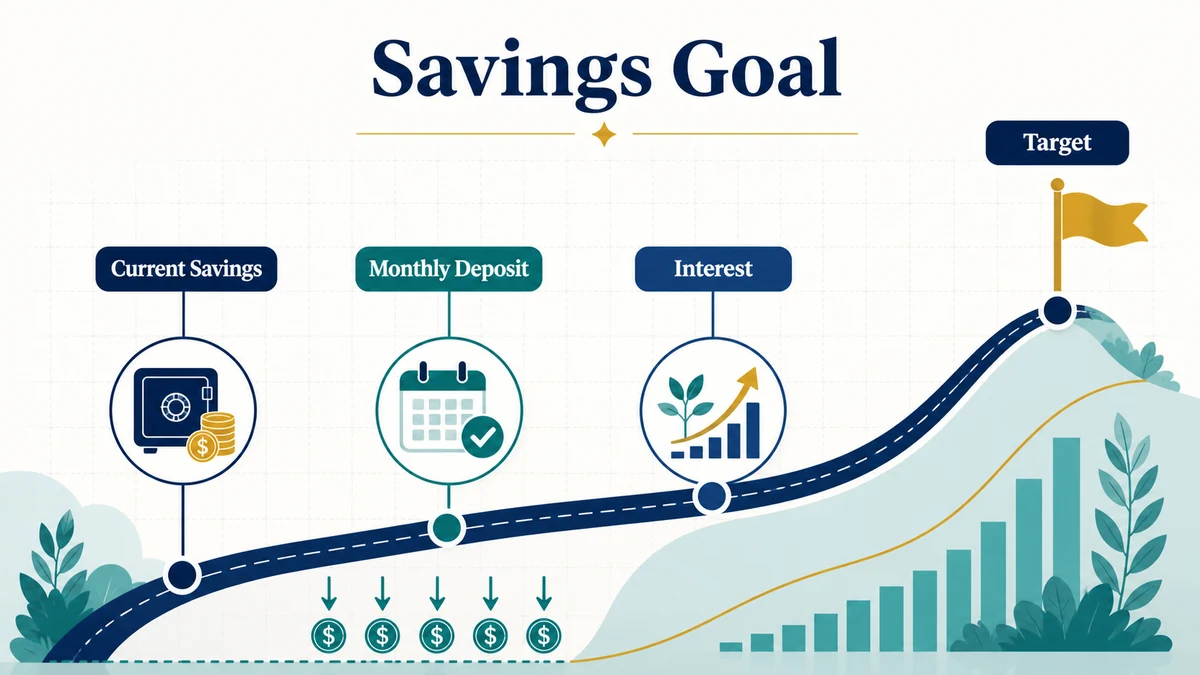
Define the finish line precisely
Name the goal, amount, currency, and date. A $12,000 emergency reserve needed in two years is a different problem from a $12,000 purchase with a flexible date. If the goal will become more expensive, increase the target or model inflation explicitly.
Two questions the calculator can answer
How much should I save each month?
The calculator finds the contribution that allows the starting balance and future deposits to reach the target within the selected time.
How long will my current pace take?
It projects the first period in which the balance reaches the goal, based on the contribution and assumed rate.
A no-interest example you can verify
For a $15,000 target with $3,000 already saved and 24 months remaining, the unfunded amount is $12,000. With no growth, required monthly savings are $500. If interest is modeled, the required deposit may be slightly lower, but the rate should match the account and time horizon.
Short-term cash and long-term investing are not identical
Money needed soon may require stability and access rather than a high assumed return. Longer goals may tolerate fluctuation, but investment values can fall. Select an assumption appropriate to where the money will actually be held; do not borrow an optimistic stock-return figure for cash savings.
Create milestones instead of waiting for the final date
After using the Savings Goal Calculator, divide the plan into monthly or quarterly checkpoints. Record actual balance, contributions, interest, fees, and withdrawals. If the plan falls behind, compare a later date, a larger deposit, or a revised target rather than silently changing all three.
Keep the contribution realistic
Check the proposed amount in the Budget Calculator. If the goal is specifically a financial buffer, use the Emergency Fund Calculator. For a market-return scenario, use the Investment Calculator.
Questions about savings goals
What if current savings exceed the target?
The goal is already funded mathematically, although access restrictions or taxes may still matter.
Should I include expected bonuses?
Use a separate scenario unless the amount and timing are sufficiently reliable.
Why did the finish date move?
Contribution timing, withdrawals, rate changes, and rounding can shift the first period in which the target is reached.
Further reading
Investor.gov financial planning tools explain compound interest and savings-goal calculations.
Model deposits at the frequency you can maintain
A weekly transfer and a monthly transfer with the same annual total can produce slightly different timing. Use the calculator’s supported frequency and convert consistently. Weekly × 52 ÷ 12 gives a monthly equivalent; it is more accurate than assuming every month has exactly four weeks.
Give windfalls a separate line of reasoning
A tax refund, annual bonus, or gift can shorten the plan, but a baseline should not depend on uncertain money. Run the Savings Goal Calculator once with recurring contributions only and again with a dated lump sum. The difference shows the value of the windfall without disguising the sustainable pace.
Before changing the target
- confirm whether the amount includes fees, tax, delivery, or setup costs;
- check whether current savings are truly available for this goal;
- keep emergency reserves separate from optional purchases;
- decide whether a delayed date is preferable to an unaffordable deposit;
- update the target when a reliable price changes.
A good plan states what will happen if the target rises, the contribution pauses, or the deadline moves. Reopen the Savings Goal Calculator after every material withdrawal or price revision.