
Retirement Calculator
Estimate your retirement savings, investment growth, inflation-adjusted value, and optional retirement income gap.
Retirement Results
This calculator provides an educational estimate only. Actual retirement outcomes depend on investment returns, taxes, fees, inflation, contribution timing, market volatility, pension income, Social Security or state benefits, and withdrawal strategy.
The Retirement Calculator turns a distant goal into a set of testable assumptions. Enter current savings, regular contributions, years until retirement, an estimated return, and an optional income target. The output compares a projected balance with the goal instead of presenting one number as a promise.
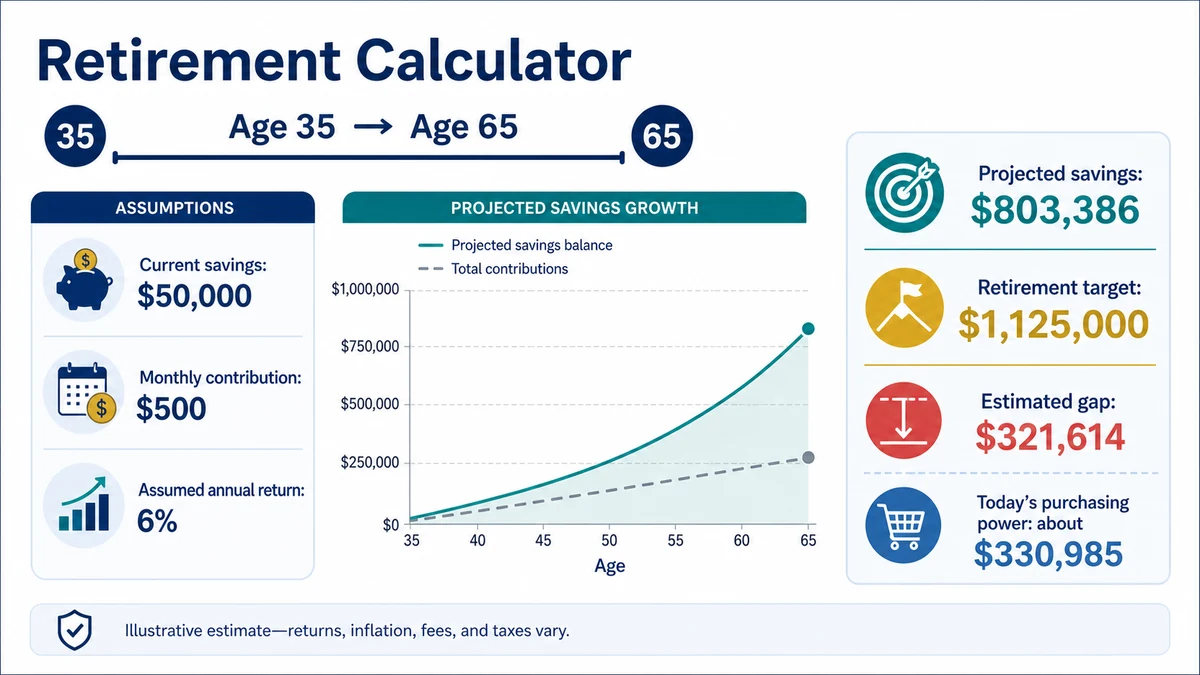
Build the projection in layers
Current savings compound for the full period. Each monthly contribution compounds only from the month it is added. The calculator combines those future values using a monthly rate derived from the annual assumption. When inflation is included, it also distinguishes future dollars from purchasing power in today’s dollars.
A planning example, not a forecast
Assume $40,000 already saved, $600 contributed monthly for 25 years, and a hypothetical 6% annual return. The projected value is roughly $572,000 before taxes and fees, depending on contribution timing and compounding assumptions. Lowering the return to 4% reduces the estimate substantially; raising the contribution provides a lever the saver can directly control.
Stress-test the Retirement Calculator
Create at least three cases:
- Cautious: lower return, higher inflation, and no increase in contributions.
- Middle: reasonable long-term assumptions and planned contribution increases.
- Optimistic: stronger returns, clearly labeled so it is not mistaken for a baseline.
Also test retiring earlier, pausing contributions, or paying an annual investment fee. Small ongoing fees reduce both the account balance and the future returns that balance could have earned.
Income targets require more than one account
Retirement income may come from workplace plans, personal accounts, pensions, government benefits, or other assets. Avoid double-counting. For U.S. Social Security, use an official estimate tied to the earnings record rather than guessing a benefit inside a general calculator.
Risks the projection cannot time
Markets do not deliver a smooth return every month. Taxes, withdrawal order, longevity, healthcare, inflation, and early losses can change the sustainable result. The calculator does not recommend investments or a withdrawal rate. Revisit the scenario after major changes and consider qualified advice for decisions with tax or legal consequences.
Connect the plan to today’s cash flow
Use the Budget Calculator to test an affordable contribution, the Investment Calculator for a standalone growth scenario, and the Savings Goal Calculator for a shorter, fixed target.
Retirement Calculator FAQ
Should I enter a guaranteed return?
No market return is guaranteed. Use a range and account for fees.
Does the result include Social Security?
Only if the tool explicitly provides an input for an external income estimate. Verify benefits through the official source.
Why use today’s dollars?
Inflation-adjusted values make a future balance easier to compare with current living costs.
Official planning resources
Contribution increases can be modeled explicitly
If contributions are expected to rise with salary, run year-by-year checkpoints or separate scenarios instead of entering a higher amount from day one. A planned contribution increase that never occurs can materially overstate the ending balance. Likewise, employer contributions should be included only when eligibility, vesting, and matching limits are understood.
Keep nominal and real assumptions consistent
A nominal return should be compared with a nominal future-dollar target. An inflation-adjusted return belongs with a target stated in today’s purchasing power. Mixing the two is a quiet but serious error. The Retirement Calculator may display both views, but the labels must be read carefully.
Review checkpoints
- update balances and contributions at least annually;
- replace guessed benefit income with official estimates;
- review investment fees and allocation changes;
- retest a longer lifespan and higher healthcare spending;
- keep beneficiaries, tax rules, and withdrawal requirements outside this simple projection.
A projection becomes more useful when its assumptions are dated and revisited rather than treated as a fixed destination.