
Investment Calculator
Estimate future investment value, total contributions, investment growth, inflation-adjusted value, and optional target gap.
Investment Results
This calculator provides an educational estimate only. Actual results can vary because of market performance, taxes, fees, contribution timing, inflation, exchange rates, and investment risk.
An Investment Calculator is a scenario engine, not a return guarantee. It combines an initial amount, recurring contributions, time, and an assumed rate to estimate a future balance. The most useful result separates money contributed from modeled growth, making the assumptions visible.
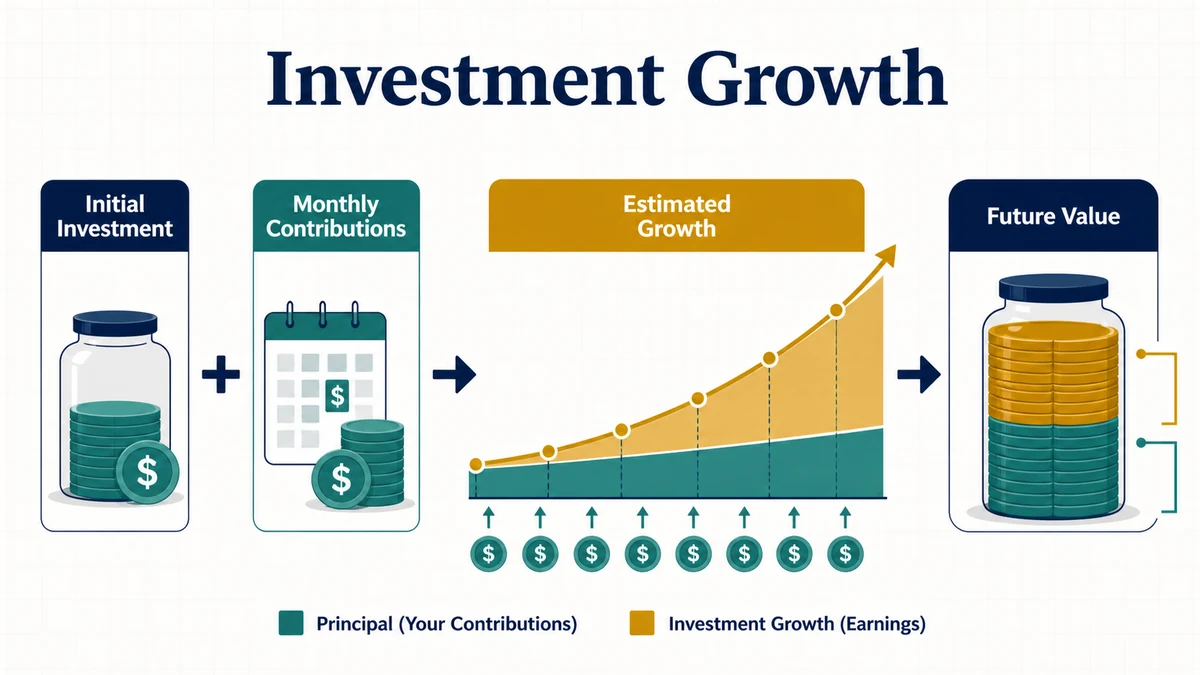
What compounds—and when
The starting balance can earn the assumed return for the entire period. Later deposits have less time to grow. With monthly compounding, the annual assumption is converted to a monthly rate and applied across the selected number of months. Contributions made at the beginning of a month produce a slightly different result from deposits made at the end.
Read a projection as four numbers
- Initial principal.
- Total recurring contributions.
- Estimated investment growth.
- Ending balance, optionally adjusted for inflation.
If $10,000 starts the account and $300 is added monthly for 15 years, deposits total $64,000. At a hypothetical 5% annual return, the future value is about $98,000, depending on timing. The difference is modeled growth, not cash deposited.
Fees deserve their own scenario
Run the same inputs with a lower net return to represent recurring costs. The SEC notes that even small ongoing fees can materially reduce a portfolio over time because the fee and its forgone growth leave the account. The Investment Calculator should therefore be tested with gross and fee-adjusted assumptions.
Inflation changes what the ending balance can buy
A large future-dollar figure may have less purchasing power than it appears. When an inflation assumption is available, compare nominal value with inflation-adjusted value. Do not subtract inflation from the return casually when the calculator already performs that adjustment.
Use a range instead of a magic rate
Try cautious, middle, and optimistic return cases. Then change one controllable input—monthly contribution or time horizon—while holding the others steady. This shows which decision has the greatest effect without pretending that market performance is predictable.
Boundaries of the estimate
The result does not model every tax, fee, contribution limit, market loss sequence, or product rule. It does not compare investment suitability. For regulated accounts or personalized investment decisions, review product disclosures and obtain appropriate professional guidance.
Related planning tools
Turn a fixed target into a required deposit with the Savings Goal Calculator. Model a long-term retirement gap with the Retirement Calculator, or first check available monthly cash flow using the Budget Calculator.
Investment Calculator FAQ
Is the assumed return an APR?
It is a modeling input. Match the rate and compounding convention described by the calculator.
Can I enter a negative contribution?
Only if withdrawals are supported and documented; otherwise model withdrawals separately.
Why is the inflation-adjusted result lower?
It expresses the future balance in equivalent current purchasing power.
Authoritative references
Annual return is not annual yield in every product
Quoted rates can use different compounding, fee, and tax conventions. Match the input to the product’s disclosure and the calculator’s assumption. If returns vary by year, one smooth average can hide sequence effects even when the long-run average looks reasonable.
Separate forecast error from contribution progress
Track the part you control: amount and timing of deposits. If the market balance falls below a projection, compare actual contributions with planned contributions before concluding that the saving behavior failed. The Investment Calculator can be rerun with the updated balance and a revised range of future returns.
A disciplined scenario table
Record the date, starting balance, monthly deposit, years, assumed return, fee adjustment, inflation assumption, and projected value for each case. Change one input at a time. That makes the reason for a different result visible and prevents an optimistic return, longer timeline, and larger contribution from being mixed into one misleading comparison.
For taxable accounts, taxes can depend on asset type, holding period, distributions, and jurisdiction; obtain appropriate guidance rather than applying one universal haircut.