Dividend Calculator
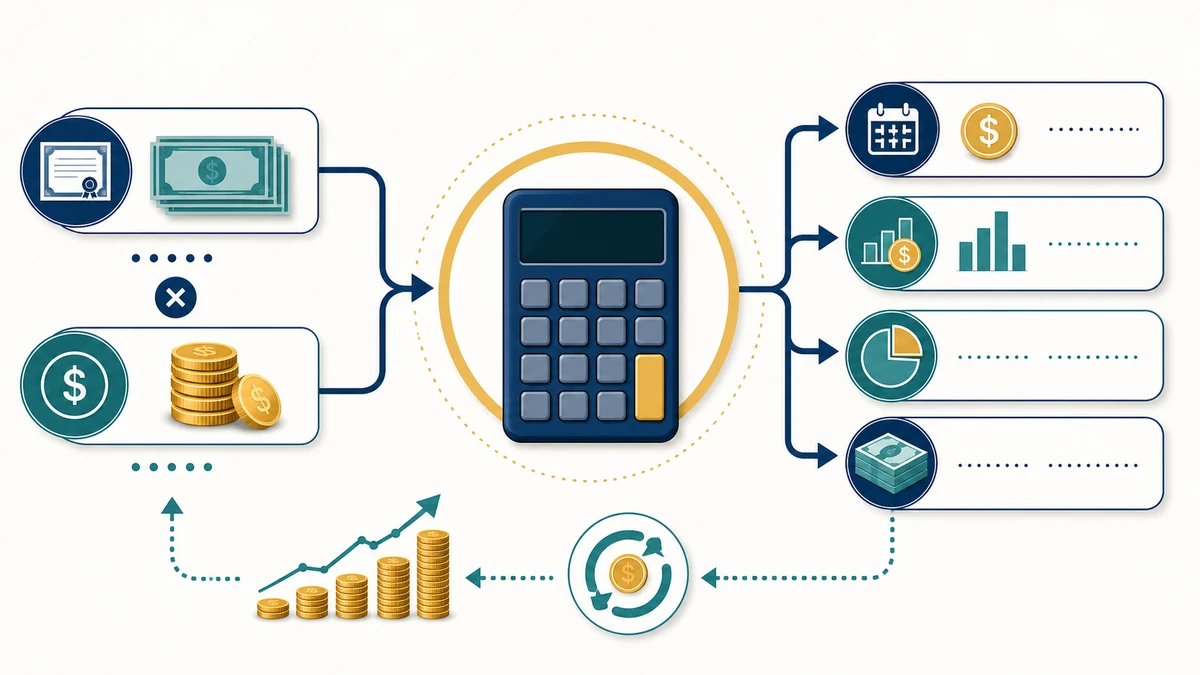
Calculate dividend yield, final balance, growth, and dividend profit using a simple DRIP model.
Inputs
Results
Use this Dividend Calculator to estimate dividend yield, final balance, overall growth, and dividend profit from share price, annual dividend per share, money invested, time period, and compounding frequency. It is useful for investors who want a quick estimate of dividend income and reinvested dividend growth using a simple DRIP-style model.
Important Note: This Dividend Calculator estimates dividend yield, starting shares, annual dividend income, final balance, overall growth, and dividend profit using a simplified dividend reinvestment model.
The calculator assumes the share price, annual dividend per share, dividend yield, reinvestment rate, and compounding frequency remain constant during the selected period. Real dividend investing can differ because of changing share prices, dividend increases, dividend cuts, dividend suspensions, taxes, brokerage fees, reinvestment prices, fractional-share rules, company performance, inflation, and market volatility.
Use this calculator for educational dividend-income and DRIP-style planning estimates only. It does not provide investment, tax, accounting, legal, or financial advice, and it does not guarantee future returns. For real investment decisions, review official company filings, broker terms, tax rules, and qualified professional guidance where needed.
Reviewed by: AjaxCalculators Editorial Team
Last updated: April 26, 2026
Method source: Standard dividend yield formula and simplified compound-growth model for reinvested dividends
Editorial standards: AjaxCalculators Editorial Policy
What This Dividend Calculator Calculates
This calculator estimates dividend yield and simplified reinvested-dividend growth from the values entered by the user.
| Input or Result | What It Means | Important Note |
|---|---|---|
| Share price | The price used to estimate dividend yield and starting shares. | Real share prices change over time. |
| Annual dividend per share | The total expected dividend per share over one year. | Dividends can increase, decrease, pause, or stop. |
| Money invested | The starting investment amount used in the calculation. | Brokerage fees, spreads, and taxes are not included unless manually adjusted. |
| Dividend yield | Annual dividend per share divided by share price. | A high yield is not automatically a better investment. |
| Estimated shares | Money invested divided by share price. | Actual share count may depend on fractional-share rules and execution price. |
| Annual dividend income | Estimated shares multiplied by annual dividend per share. | This is before taxes and assumes the dividend stays unchanged. |
| Final balance | Estimated ending value using the simplified compound-growth model. | It is not a market-value forecast. |
| Dividend profit | Final balance minus original money invested. | Represents model growth only, not guaranteed profit. |
| Overall growth | Dividend profit divided by money invested. | Does not include actual capital gains or losses. |
What Dividend Yield Means
Dividend yield shows the annual dividend income relative to the stock price. It helps investors compare how much dividend income a stock pays for each dollar invested.
For example, if a stock trades at $50 and pays $2 per share each year, the dividend yield is 4%.
Dividend yield can change when the stock price changes or when the company changes its dividend. A high dividend yield does not always mean a better investment, because it may also reflect a falling share price or an unsustainable dividend.
How the Dividend Calculator Works
The calculator combines a dividend yield calculation with a simplified compound-growth model.
| Calculation | Formula | Meaning |
|---|---|---|
| Dividend yield | Dividend yield = annual dividend per share ÷ share price | Shows annual dividend income relative to share price. |
| Dividend yield percentage | Dividend yield % = annual dividend per share ÷ share price × 100 | Displays the yield as a percentage. |
| Estimated shares | Estimated shares = money invested ÷ share price | Estimates starting share count from the investment amount. |
| Annual dividend income | Annual dividend income = estimated shares × annual dividend per share | Estimates yearly cash dividend income before taxes. |
| Final balance | Final balance = P × (1 + r ÷ m)m × t | Applies the simplified DRIP-style compound-growth model. |
| Dividend profit | Dividend profit = final balance − money invested | Shows estimated model growth above the starting investment. |
| Overall growth | Overall growth = dividend profit ÷ money invested × 100 | Shows estimated growth as a percentage of the starting investment. |
In this model, P is money invested, r is dividend yield as a decimal, m is compounding periods per year, and t is the number of years.
What Is a DRIP?
DRIP stands for dividend reinvestment plan. In a dividend reinvestment setup, cash dividends are used to buy more shares instead of being taken as cash.
Over time, reinvested dividends may increase the number of shares owned, and those additional shares may generate more dividends in future periods. This is why dividend reinvestment can create a compounding effect.
Compounding Frequency Options
The calculator lets you choose how often dividend growth is compounded in the simplified estimate.
| Compounding Option | Periods Per Year | Use Note |
|---|---|---|
| Yearly | 1 | Useful for a simple annual reinvestment assumption. |
| Half-yearly | 2 | Useful for semiannual dividend assumptions. |
| Quarterly | 4 | Common for many dividend-paying companies. |
| Monthly | 12 | Useful for monthly dividend assumptions. |
| Weekly | 52 | A modeling assumption, not a common stock-dividend schedule. |
| Daily | 365 | A theoretical compounding assumption, not a realistic dividend-payment schedule for most stocks. |
In real investing, dividend payment schedules vary by company, fund, market, and security type. The selected compounding frequency should be treated as a modeling assumption.
Assumptions and Important Notes
| Assumption or Limitation | What It Means |
|---|---|
| Simplified DRIP model | The calculator treats reinvested dividends like compound growth based on a fixed yield. |
| Constant share price | The model does not simulate changing market prices. |
| Constant annual dividend per share | The model does not include dividend increases, cuts, pauses, or suspensions. |
| Constant dividend yield | In real markets, yield changes when share price or dividend amount changes. |
| No capital gains or losses | The calculator does not model stock price appreciation or decline. |
| No tax calculation | Dividend taxes, reinvested dividend reporting, and account type are not included. |
| No brokerage or plan fees | DRIP fees, trading fees, spreads, and broker rules are not included. |
| No fractional-share guarantee | Actual reinvestment may depend on broker or plan rules. |
| No investment recommendation | The calculator does not decide whether a dividend stock, ETF, fund, or DRIP is suitable. |
Worked Example: Dividend Yield and Reinvested Dividend Growth
Suppose a stock has a share price of $50, an annual dividend of $2 per share, an investment amount of $5,000, a 5-year time period, and quarterly compounding.
| Step | Calculation | Result |
|---|---|---|
| Calculate dividend yield | $2 ÷ $50 | 0.04 |
| Convert yield to percentage | 0.04 × 100 | 4% |
| Estimate starting shares | $5,000 ÷ $50 | 100 shares |
| Estimate annual dividend income | 100 × $2 | $200 |
| Identify compounding periods | Quarterly compounding | m = 4 |
| Apply compound-growth formula | $5,000 × (1 + 0.04 ÷ 4)4 × 5 | $5,000 × (1.01)20 |
| Calculate final balance | $5,000 × (1.01)20 | About $6,100.95 |
| Calculate dividend profit | $6,100.95 − $5,000 | About $1,100.95 |
| Calculate overall growth | $1,100.95 ÷ $5,000 × 100 | About 22.02% |
Under these simplified assumptions, a $5,000 investment with a 4% dividend yield compounded quarterly for 5 years would grow to about $6,100.95. This is a model result, not a guaranteed investment outcome.
How to Use This Dividend Calculator
- Select the currency symbol you want to display.
- Choose the compound frequency.
- Enter the share price.
- Enter the annual dividend per share.
- Enter the amount of money invested.
- Enter the number of years.
- Click Calculate.
- Review dividend yield, final balance, overall growth, dividend profit, summary, and step-by-step output.
How to Interpret the Result
| Output | What It Means | Important Caution |
|---|---|---|
| Dividend yield | Annual dividend per share as a percentage of share price. | A high yield can reflect risk, a falling share price, or an unsustainable dividend. |
| Final balance | Estimated ending value from the simplified reinvestment model. | It does not forecast actual stock market value. |
| Overall growth | Estimated percentage increase over the original investment. | Does not include capital gains, capital losses, taxes, inflation, or fees. |
| Profit from dividend | Estimated model gain above the starting investment. | Not the same as realized profit from selling shares. |
| Summary | A plain-language overview of the calculated estimate. | Should be read with the assumptions and limitations. |
| Step-by-step result | Shows how the yield and compound-growth formula were applied. | Useful for checking inputs and assumptions. |
Dividend Yield vs Dividend Income
Dividend yield and dividend income are related, but they answer different questions.
| Metric | Formula | What It Tells You |
|---|---|---|
| Dividend yield | Annual dividend per share ÷ share price × 100 | The income rate relative to share price. |
| Estimated shares | Money invested ÷ share price | The approximate number of shares bought. |
| Dividend income | Estimated shares × annual dividend per share | The estimated annual cash dividend amount before tax. |
For example, a 4% dividend yield describes the income rate, but the actual money income depends on how much is invested and how many shares are owned.
Dividend Yield vs Total Return
Dividend yield does not show the full investment result. Total return includes both income and price movement.
| Metric | What It Includes | What It Excludes |
|---|---|---|
| Dividend yield | Annual dividend income relative to share price. | Stock price gains, stock price losses, taxes, inflation, and fees. |
| Dividend income | Cash dividends or dividends used for reinvestment. | Market price change and investment costs. |
| Capital gain or loss | Change in share value from purchase price to sale or current market price. | Dividend income unless included separately. |
| Total return | Dividends plus price change, usually adjusted for reinvestment. | May still need tax, inflation, and fee adjustments for personal results. |
A stock can have a high dividend yield but still produce a poor total return if its share price falls or the dividend is cut.
Dividend Taxes and Reinvested Dividends
This calculator does not calculate taxes. Dividend tax treatment can depend on dividend type, account type, holding period, country, filing status, income level, and tax law.
| Tax Topic | Why It Matters | What to Check |
|---|---|---|
| Ordinary dividends | May be taxed as ordinary income. | Check Form 1099-DIV or your local tax reporting document. |
| Qualified dividends | May qualify for lower tax rates in some tax systems. | Check holding-period rules and official tax guidance. |
| Reinvested dividends | Reinvesting does not automatically make dividends tax-free. | Check how reinvested dividends are reported for your account and jurisdiction. |
| Tax-advantaged accounts | Dividend tax timing may differ inside retirement or tax-sheltered accounts. | Check account rules before comparing after-tax returns. |
| Foreign dividends | Foreign withholding tax or treaty rules may apply. | Review broker statements and tax forms. |
| Net investment income tax or local taxes | Additional taxes may apply in some situations. | Consult official tax guidance or a tax professional. |
Practical Uses of a Dividend Calculator
This Dividend Calculator is useful for quick dividend-income and reinvestment planning estimates.
| Use Case | How the Calculator Helps |
|---|---|
| Estimate dividend yield | Calculates annual dividend per share as a percentage of share price. |
| Estimate annual dividend income | Uses money invested, share price, and annual dividend per share. |
| Model simplified DRIP growth | Shows how reinvested dividends can compound under fixed assumptions. |
| Compare dividend scenarios | Lets users test different yields, investment amounts, and time periods. |
| Understand compounding frequency | Shows how different compounding assumptions affect model results. |
| Prepare investment questions | Helps identify what to ask about dividend safety, payout history, fees, taxes, and reinvestment rules. |
Common Mistakes to Avoid
| Mistake | Why It Causes Problems |
|---|---|
| Assuming high dividend yield is always better | A high yield can reflect a falling share price, business stress, or an unsustainable payout. |
| Ignoring dividend cuts or suspensions | Companies are not required to maintain the same dividend forever. |
| Treating the final balance as guaranteed | The result is based on fixed assumptions and does not predict actual market performance. |
| Ignoring stock price changes | Capital gains or losses can dominate dividend income. |
| Ignoring taxes | Cash and reinvested dividends may still create tax reporting obligations. |
| Ignoring broker or DRIP rules | Fees, fractional-share rules, reinvestment timing, and execution prices can affect results. |
| Confusing dividend yield with total return | Total return includes both dividends and price change. |
| Using one stock as a complete income plan | Concentration risk can be high if income depends on one company or sector. |
Formula Summary
| What You Want to Find | Formula | Use Note |
|---|---|---|
| Dividend yield | Dividend yield = annual dividend per share ÷ share price | Shows annual dividend income relative to share price. |
| Dividend yield percentage | Dividend yield % = annual dividend per share ÷ share price × 100 | Displays yield as a percentage. |
| Estimated shares | Estimated shares = money invested ÷ share price | Estimates starting shares from the investment amount. |
| Annual dividend income | Annual dividend income = estimated shares × annual dividend per share | Estimates yearly dividend income before taxes. |
| Final balance | Final balance = P × (1 + r ÷ m)m × t | Uses a simplified compound-growth model. |
| Profit from dividend | Profit from dividend = final balance − money invested | Shows model growth above the starting investment. |
| Overall growth | Overall growth = profit from dividend ÷ money invested × 100 | Shows estimated growth as a percentage. |
When You May Need More Than This Calculator
This calculator is best for simple dividend yield and DRIP-style estimates. Real investment analysis needs more information.
| Need | Better Method or Additional Check |
|---|---|
| Total return analysis | Include share price gains or losses, dividends, taxes, inflation, and fees. |
| Dividend safety review | Review company earnings, payout ratio, cash flow, debt, dividend history, and official filings. |
| After-tax income planning | Include ordinary vs qualified dividends, account type, jurisdiction, and tax bracket. |
| Portfolio income planning | Model multiple holdings, sector exposure, dividend schedules, and concentration risk. |
| Broker-specific DRIP results | Check fractional-share rules, reinvestment price, fees, and timing. |
| Retirement income planning | Use a full financial plan that includes withdrawals, taxes, inflation, risk, and cash needs. |
| Investment suitability | Consider risk tolerance, goals, time horizon, diversification, and professional advice. |
Frequently Asked Questions
How do I calculate dividend yield?
Dividend yield is calculated as annual dividend per share divided by share price. To show it as a percentage, multiply by 100.
What is the formula for dividend yield?
The formula is dividend yield % = annual dividend per share ÷ share price × 100.
How do I estimate annual dividend income?
First estimate the number of shares by dividing money invested by share price. Then multiply the estimated shares by the annual dividend per share.
What is a DRIP?
A DRIP, or dividend reinvestment plan, lets dividends be reinvested into additional shares instead of being received as cash.
Does this calculator predict actual stock returns?
No. It uses a simplified fixed-yield model. Actual returns can differ because of share price changes, dividend changes, taxes, fees, inflation, and market risk.
Does the calculator include capital gains?
No. It does not model stock price gains or losses. It focuses on dividend yield and simplified reinvested-dividend growth.
Are reinvested dividends taxable?
They may still be taxable depending on account type, country, and tax rules. In the United States, reinvested dividends can still need to be reported with other dividends.
Is a high dividend yield always good?
No. A high yield can sometimes mean the share price has fallen or the dividend may be at risk. Review the company’s financial strength and dividend sustainability.
Does compounding frequency match real dividend payments?
Not always. The frequency selector is a modeling assumption. Actual dividend schedules depend on the company, fund, broker, and security type.
Can I use this calculator for investment advice?
No. Use it for educational estimates only. Real investment decisions should include risk, diversification, taxes, fees, company filings, and qualified professional guidance where needed.
References
- Investor.gov — Direct Investment Plans and Dividend Reinvestment Plans
- Investor.gov — Dividend Reinvestment Plan (DRIP)
- FINRA — Stocks
- IRS Topic No. 404 — Dividends and Other Corporate Distributions
- IRS — Reinvested Dividends Reporting FAQ
- SEC EDGAR — Company Filings Search
Related Calculators
- Stock Calculator
- ROI Calculator
- CAGR Calculator
- Compound Interest Calculator
- APY Calculator
- Interest Rate Calculator
- Inflation Calculator
- Pre & Post-Money Valuation Calculator
Dividend Calculator Disclaimer
This Dividend Calculator provides educational and planning estimates only. It estimates dividend yield, estimated shares, annual dividend income, final balance, overall growth, and dividend profit from the values entered by the user.
The calculator uses a simplified fixed-assumption dividend reinvestment model. It does not account for changing share prices, dividend increases, dividend cuts, dividend suspensions, taxes, brokerage fees, DRIP fees, reinvestment prices, bid-ask spreads, fractional-share rules, inflation, currency changes, company risk, market volatility, capital gains, capital losses, or the investor’s full portfolio.
This calculator does not provide investment, tax, accounting, legal, or financial advice. For real investment decisions, review official company filings, dividend history, payout ratio, cash flow, debt, broker terms, tax rules, risk tolerance, diversification, and qualified professional guidance where needed.