
Dog Pregnancy Due Date Calculator
Estimate your dog's due date, estimated whelping window and pregnancy progress from mating, ovulation, LH surge or diestrus.
Inputs
Results
A breeding date does not always reveal the exact day a dog becomes pregnant. Sperm may remain viable for several days, while ovulated eggs require additional time before fertilization. The Dog Pregnancy Due Date Calculator accounts for this uncertainty by using different timing windows for mating, ovulation, LH surge, and the first day of diestrus.
Select the most accurate reproductive date available to estimate the central due date, likely whelping window, pregnancy progress, and remaining gestation time.
Veterinary notice: This calculator provides a planning estimate only. It cannot confirm pregnancy, assess the mother or puppies, estimate litter size, determine fetal maturity, or replace veterinary reproductive care.
How to Use the Dog Pregnancy Due Date Calculator
- Select the type of reproductive date you know.
- Choose mating date, ovulation date, LH surge date, or first day of diestrus.
- Enter the corresponding calendar date.
- Review the estimated due date.
- Check the estimated whelping window.
- Review the gestation days, pregnancy weeks, progress, and days remaining.
- Use Reload or Reset before entering a different pregnancy date.
Use the date confirmed through veterinary reproductive monitoring whenever it is available. An estimated mating date generally produces a much wider delivery window than a confirmed ovulation or hormone-monitoring date.
Dog Pregnancy Due Date Methods
The calculation changes according to the selected base date.
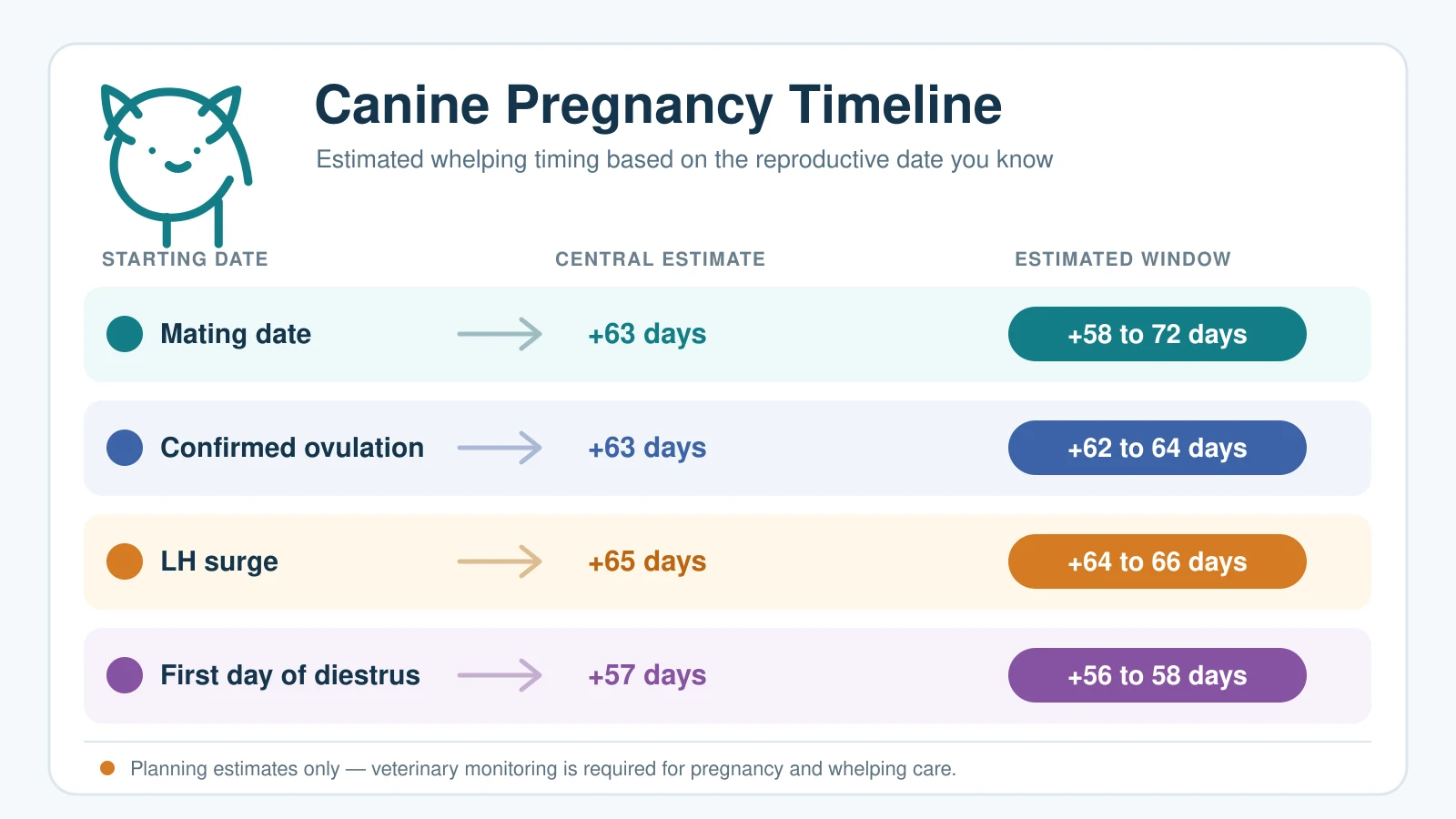
Due Date From Mating
When only the first breeding or mating date is known, the calculator uses:
Estimated due date = mating date + 63 days
The broader expected range is approximately:
Mating date + 58 to 72 days
This range is wide because mating, ovulation, and fertilization may occur on different days. Multiple mating dates can create additional uncertainty.
Due Date From Ovulation
When ovulation was identified through veterinary monitoring:
Estimated due date = ovulation date + 63 days
The expected range is approximately:
Ovulation date + 62 to 64 days
Ovulation timing generally provides a more precise estimate than breeding date alone.
Due Date From LH Surge
The luteinizing hormone surge occurs shortly before ovulation. When this date is known:
Estimated due date = LH surge date + 65 days
The expected range is approximately:
LH surge date + 64 to 66 days
Due Date From First Day of Diestrus
When the first day of cytological diestrus has been identified:
Estimated due date = first day of diestrus + 57 days
The expected range is approximately:
First day of diestrus + 56 to 58 days
These ranges describe typical reproductive timing. They are not guarantees that labor will begin or finish within the calculated window.
Which Starting Date Is Most Accurate?
The reliability of the result depends heavily on the date entered:
- Ovulation date: Usually provides one of the most precise estimates when confirmed through veterinary hormone monitoring.
- LH surge date: Provides a relatively narrow estimate when accurately identified.
- First day of diestrus: Can provide useful timing when determined through vaginal cytology.
- Mating date: Provides the widest range because breeding does not necessarily occur on the day of conception.
Veterinary monitoring may use progesterone testing, LH testing, vaginal cytology, physical examination, and imaging. The appropriate method depends on the individual dog and the veterinary reproductive plan.
Worked Dog Pregnancy Example
Suppose ovulation was confirmed on March 1.
Step 1: Calculate the central due date
March 1 + 63 days = approximately May 3
Step 2: Calculate the estimated whelping window
March 1 + 62 days = approximately May 2
March 1 + 64 days = approximately May 4
The calculator therefore estimates a central due date of May 3 and an expected whelping window of approximately May 2–4.
The dog may still require veterinary assessment before or during this period. The dates should be used for preparation rather than as guaranteed delivery dates.
Understanding the Results
Estimated due date is the central date calculated from the selected reproductive event.
Estimated whelping window shows the earliest and latest typical dates associated with that event.
Gestation days so far shows the number of days elapsed since the selected base date.
Weeks of pregnancy expresses the elapsed time in weeks.
Days remaining is the difference between the current date and the central estimated due date.
These values are calendar calculations. They do not confirm fetal development or determine whether the pregnancy has reached term safely.
Why the Actual Whelping Date May Differ
A dog may deliver earlier or later than the central estimate because of:
- Uncertainty about the true ovulation or conception date
- Multiple mating dates
- Sperm remaining viable for several days
- Egg maturation after ovulation
- Breed and individual variation
- Litter size
- Previous pregnancy history
- Maternal or fetal health complications
A mating-based calculation should therefore never be interpreted as one exact delivery appointment.
Confirming Pregnancy and Preparing for Whelping
The calculator cannot determine whether mating resulted in pregnancy. A veterinarian can discuss appropriate examination and imaging based on the suspected breeding and ovulation dates.
If pregnancy is confirmed, discuss the following with your veterinarian before the expected delivery period:
- Maternal health and pregnancy monitoring
- Expected litter size when it can be assessed
- Nutrition during pregnancy and nursing
- A suitable whelping area
- Normal stages of labor
- Breed-specific delivery risks
- Emergency contact and transport arrangements
- When veterinary intervention may be required
Do not use the calculated date alone to schedule medication, labor induction, or an elective cesarean section. Those decisions require veterinary assessment of reproductive timing and fetal maturity.
Possible Signs That Labor Is Approaching
Dogs may show nesting, restlessness, panting, appetite changes, or discomfort before labor. A temporary drop in rectal temperature can occur during the final 24 hours, but it is not detected in every dog and should not be used alone to make medical decisions.
Visible changes are not always specific. Contact your veterinarian if you are uncertain whether labor is progressing normally.
When to Contact a Veterinarian Urgently
Seek veterinary advice immediately if:
- Strong contractions continue for 20–30 minutes without producing a puppy
- Weak contractions continue for one to two hours without progress
- Green discharge appears and no puppy follows promptly
- There is heavy bleeding or foul-smelling discharge
- A puppy or fetal membrane appears stuck
- Several hours pass between puppies and more puppies are expected
- The mother appears severely painful, exhausted, weak, feverish, or unwell
- The pregnancy extends beyond the veterinarian’s expected range
Follow the emergency instructions provided by your veterinarian, as the appropriate response can depend on the dog, breed, litter, and stage of labor.
Assumptions and Limitations
- The entered reproductive date is assumed to be correct.
- Mating date may differ substantially from conception date.
- The calculator does not confirm pregnancy.
- It cannot estimate litter size or fetal maturity.
- It does not account for breed-specific obstetric risk.
- Pregnancy progress is calculated from calendar dates rather than examination findings.
- The estimated window cannot determine whether labor is normal or safe.
- Veterinary monitoring may change the expected delivery plan.
Dog Pregnancy Due Date Calculator FAQs
How long is a dog pregnant?
Canine pregnancy averages approximately 63 days from ovulation. The interval from mating can be much wider because mating and fertilization may occur on different days.
How accurate is a due date calculated from mating?
A mating-based date is a broad estimate. Veterinary references describe a possible range of approximately 58–72 days from breeding when the stage of estrus is unknown.
Is ovulation date more accurate than mating date?
Yes. A confirmed ovulation date generally provides a narrower estimate of approximately 62–64 days.
Can this calculator confirm that my dog is pregnant?
No. It only calculates calendar dates. Pregnancy confirmation requires appropriate veterinary assessment.
Can the calculator predict litter size?
No. It cannot determine whether puppies are present or how many puppies the dog may deliver.
What if my dog does not deliver on the estimated date?
Do not assume that a variation is automatically normal or abnormal. Contact your veterinarian, especially if the date was based on confirmed ovulation or if the dog appears unwell.
Can I use the calculated date to schedule a cesarean section?
No. Surgical timing requires veterinary assessment of ovulation history, gestational age, fetal maturity, maternal condition, and other clinical findings.
Related Dog Calculators
Sources
- MSD Veterinary Manual – Whelping in Dogs
- Cornell University College of Veterinary Medicine – Normal Whelping Process
- Cornell University College of Veterinary Medicine – Dystocia in Dogs
Canine Due Dates Are Estimates, Not Appointments
The interval from mating to birth varies because mating date and fertilization date are not always the same. Ovulation testing and veterinary assessment can improve dating, while litter size and maternal factors may influence timing. Prepare before the estimated window and contact a veterinarian about concerning symptoms, prolonged labor, or a pregnancy that appears substantially early or late.