Alcohol Dilution Calculator

Dilute a strong spirit to your target ABV.

Inputs

References & notes
  • Uses conservation of alcohol: Vs × A + Vw × B = (Vs + Vw) × C.
  • Rearranged for added weak liquid: Vw = Vs × (A − C) ÷ (C − B).
  • Target ABV must be between the weak ABV and the strong ABV.

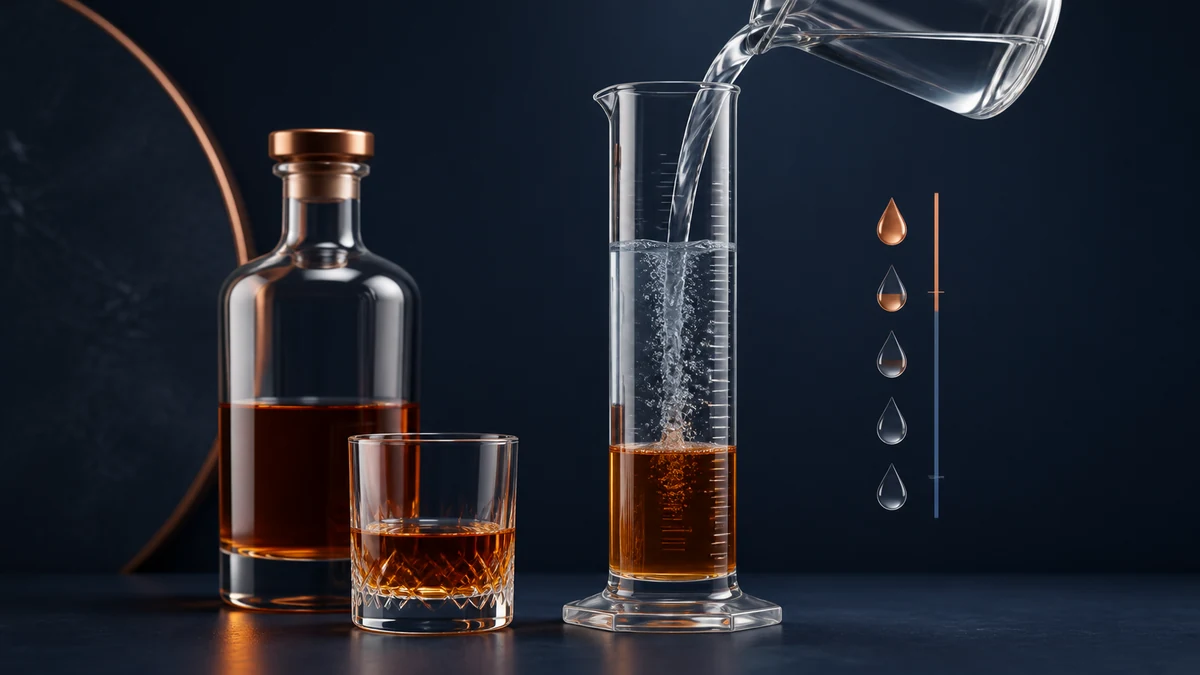
Use this Alcohol Dilution Calculator to estimate how much water or weaker alcohol to add to a stronger spirit to reach a target ABV. Enter the starting alcohol strength, weak liquid strength, target ABV, and starting volume to calculate the amount to add, final volume, and mixing ratio.

Important Note: This Alcohol Dilution Calculator estimates how much water or weaker alcoholic liquid to add to a stronger alcohol to reach a target ABV.

The calculator uses a simplified alcohol-conservation formula: the amount of pure alcohol before mixing is assumed to equal the amount of pure alcohol after mixing. It is useful for general planning, recipe-style dilution, and educational ABV math.

This is not a professional proofing, laboratory, regulatory, tax, commercial bottling, or legal labeling tool. Real alcohol-water mixtures can show volume contraction, and actual ABV can vary with temperature, density, measuring accuracy, hydrometer calibration, alcohol type, dissolved solids, labeling tolerance, and local regulations. Use only food-grade beverage ingredients, follow local alcohol laws, and verify any commercial or safety-critical result with official methods or qualified professionals.

Reviewed by: AjaxCalculators Editorial Team
Last updated: April 26, 2026
Method source: Standard alcohol-conservation dilution relationship using starting ABV, weak liquid ABV, target ABV, and starting volume
Editorial standards: AjaxCalculators Editorial Policy

Alcohol Dilution Formula Notes

Item Formula or Rule Use Note
Alcohol conservation Vs × A + Vw × B = (Vs + Vw) × C Pure alcohol amount is conserved in the simplified model.
Weak liquid to add Vw = Vs × (A − C) ÷ (C − B) Main formula used to find water or weak alcohol to add.
Water ABV B = 0 Use 0% ABV when the added liquid is plain water.
Target ABV rule B < C < A Target ABV must be between the weak-liquid ABV and strong-alcohol ABV.
Final volume estimate Final volume ≈ Vs + Vw Simplified estimate; real alcohol-water mixtures may contract slightly.
Mixing ratio Strong alcohol volume : weak liquid added Useful for practical recipe-style mixing.

What This Alcohol Dilution Calculator Calculates

This calculator estimates how to dilute a stronger alcohol with water or a weaker alcoholic liquid to reach a target alcohol by volume percentage.

Result What It Means Important Use Note
Water or weak alcohol to add The estimated volume of lower-strength liquid needed to reach the target ABV. Use 0% ABV when the added liquid is water.
Final volume The estimated total volume after dilution. Uses a simplified volume-sum estimate and does not correct for contraction.
Mixing ratio The relationship between starting strong alcohol and added weak liquid. Useful for recipe-style dilution and scale-up checks.
Target ABV validation Checks whether the target ABV is mathematically possible. The target must be between the strong-alcohol ABV and weak-liquid ABV.
Unit conversion Shows input and result volumes in mL or L. Keep units consistent when doing manual checks.

What ABV Means

ABV means alcohol by volume. It expresses the alcohol content of a beverage as a percentage of the beverage volume.

ABV Value Plain Meaning Example Interpretation
0% ABV No alcohol in the liquid for this calculator’s dilution model. Use for plain water.
20% ABV About 20% alcohol by volume. A weaker alcoholic liquid still contributes alcohol to the final mixture.
40% ABV About 40% alcohol by volume. A common distilled-spirit strength.
60% ABV About 60% alcohol by volume. Can be diluted to a lower target ABV by adding water or weaker alcohol.

For this calculator, ABV is treated as the concentration of alcohol in the liquid. A higher ABV means a stronger alcohol concentration, while a lower ABV means a weaker alcohol concentration.

How the Alcohol Dilution Calculator Works

The calculator uses the idea that pure alcohol is conserved during dilution. It converts ABV percentages into decimal concentration values, applies the dilution equation, and estimates how much weaker liquid to add.

Step Formula or Method Use Note
Convert percentages to decimals Decimal ABV = percentage ABV ÷ 100 Example: 60% = 0.60.
Identify strong alcohol Vs = starting strong alcohol volume; A = strong alcohol ABV Use the actual starting volume and strength.
Identify weak liquid Vw = weak liquid to add; B = weak liquid ABV For water, B = 0.
Identify target strength C = target ABV Target must be between A and B.
Apply alcohol conservation Vs × A + Vw × B = (Vs + Vw) × C Balances pure alcohol before and after mixing.
Solve for weak liquid to add Vw = Vs × (A − C) ÷ (C − B) Main calculator output.
Estimate final volume Final volume ≈ Vs + Vw Approximate only because alcohol-water mixtures can contract.

Target ABV Rule

The target ABV must be between the weak-liquid ABV and the strong-alcohol ABV. Adding a weaker liquid can lower alcohol strength, but it cannot make the mixture stronger than the starting strong alcohol.

Situation Possible? Reason
60% ABV spirit + 0% water → 40% target Yes 40% is between 0% and 60%.
60% ABV spirit + 0% water → 70% target No Adding water cannot make alcohol stronger than 60%.
50% ABV spirit + 10% weak alcohol → 30% target Yes 30% is between 10% and 50%.
50% ABV spirit + 10% weak alcohol → 5% target No Adding a 10% liquid cannot produce a final ABV below 10% in this two-liquid model.
Strong ABV equals target ABV No dilution needed The starting liquid is already at the target strength.
Weak ABV equals target ABV Mathematically unstable The denominator C − B becomes zero in the formula.

Water Dilution vs Weak Alcohol Dilution

The weak-liquid ABV changes the amount you need to add. Water has 0% ABV, while a weaker alcoholic liquid still contributes alcohol to the mixture.

Dilution Type Weak Liquid ABV Effect on Amount to Add
Diluting with water 0% Water lowers ABV fastest because it contributes no alcohol.
Diluting with weak alcohol Greater than 0% More weak liquid may be needed because it still contains alcohol.
Diluting with a liquid close to target ABV Near the target ABV The required added volume can become very large or impractical.
Diluting with a liquid stronger than target Above target ABV This may not dilute the mixture enough and can make the target impossible.

Assumptions and Important Notes

Assumption or Limitation What It Means
Simplified volume-based formula The calculator treats ABV as a simple concentration and uses volume arithmetic.
Alcohol amount is conserved The model assumes the amount of pure alcohol before and after mixing stays the same.
Entered ABV values are assumed accurate Wrong label readings, rounded labels, or measurement errors can change the result.
Final volume is approximate The calculator estimates final volume as strong alcohol volume plus added liquid volume.
No volume-contraction correction Alcohol and water can contract when mixed, so final measured volume may be slightly lower than the simple sum.
No temperature correction Professional alcohol measurement may require temperature correction and official proofing tables.
No density or hydrometer correction The calculator does not use density tables, hydrometer readings, or laboratory measurements.
No dissolved-solids correction Sugars, flavorings, botanicals, or other dissolved solids can affect apparent proof or measurement.
No safety verification The calculator does not verify that a liquid is food-grade, safe, legal, potable, or correctly labeled.
No commercial compliance It should not be used for commercial production, labeling, taxation, or regulatory submissions.

Worked Example: Dilute 60% ABV Alcohol to 40% ABV With Water

Suppose you have 1 L of alcohol at 60% ABV and want to dilute it to 40% ABV using water.

Step Calculation Result
Identify strong alcohol volume Vs = 1 L 1 L
Convert strong alcohol ABV A = 60 ÷ 100 0.60
Convert weak liquid ABV B = 0 ÷ 100 0.00
Convert target ABV C = 40 ÷ 100 0.40
Use the dilution formula Vw = Vs × (A − C) ÷ (C − B) Formula selected
Substitute values Vw = 1 × (0.60 − 0.40) ÷ (0.40 − 0.00) 1 × 0.20 ÷ 0.40
Calculate water to add 0.20 ÷ 0.40 0.5 L
Estimate final volume 1 L + 0.5 L 1.5 L

So, to dilute 1 L of 60% ABV alcohol to an estimated 40% ABV with water, add about 0.5 L of water. The simplified final volume estimate is about 1.5 L.

Worked Example: Dilute With Weak Alcohol Instead of Water

Suppose you have 500 mL of 70% ABV alcohol and want to dilute it to 50% ABV using a weaker alcoholic liquid that is 20% ABV.

Step Calculation Result
Identify strong alcohol volume Vs = 500 mL 500 mL
Convert strong alcohol ABV A = 70 ÷ 100 0.70
Convert weak liquid ABV B = 20 ÷ 100 0.20
Convert target ABV C = 50 ÷ 100 0.50
Use the formula Vw = Vs × (A − C) ÷ (C − B) Formula selected
Substitute values Vw = 500 × (0.70 − 0.50) ÷ (0.50 − 0.20) 500 × 0.20 ÷ 0.30
Calculate weak liquid to add 100 ÷ 0.30 333.33 mL
Estimate final volume 500 + 333.33 833.33 mL

So, you would add about 333.33 mL of the 20% ABV liquid to reach an estimated target of 50% ABV.

How to Use This Alcohol Dilution Calculator

  1. Enter the strong alcohol percentage ABV.
  2. Enter the water or weak alcohol percentage ABV. Use 0% if adding plain water.
  3. Enter the target percentage ABV.
  4. Enter the strong alcohol volume.
  5. Select the input volume unit, such as mL or L.
  6. Select the result unit, such as mL or L.
  7. Click Calculate.
  8. Review the amount to add, estimated final volume, and mixing ratio.
  9. Use Reset to clear the calculator and start again.

How to Interpret the Result

Result What It Means Important Caution
Water or weak alcohol to add The estimated amount of lower-strength liquid needed to reach the target ABV. Use accurate ABV and volume inputs for the best estimate.
Final volume The simplified estimated total after mixing. Real measured volume may differ because alcohol-water mixtures can contract.
Mixing ratio The ratio of strong alcohol volume to added weak liquid volume. Useful for scaling, but it is not a legal proofing method.
Impossible target warning The target ABV is outside the possible range. Target ABV must be between the strong-alcohol ABV and weak-liquid ABV.
mL or L result The same volume shown in the selected unit. Unit display does not change the actual calculated amount.

Why Volume Contraction Can Matter

When alcohol and water are mixed, the final measured volume may not equal the simple sum of the starting volumes. This is called volume contraction.

Use Case Is the Simple Estimate Usually Enough? Better Method When Precision Matters
Educational ABV math Usually yes Use the formula to understand dilution relationships.
Home recipe planning Often enough as a rough estimate Measure carefully and treat the result as approximate.
Professional proofing No Use calibrated instruments, temperature correction, density/proof tables, and official methods.
Commercial bottling No Use legal labeling, taxation, and production standards.
Laboratory or industrial alcohol work No Use lab-grade measurement, density tables, safety procedures, and qualified supervision.

The calculator is a practical estimate, not a substitute for official proofing or laboratory analysis.

Alcohol Dilution vs Standard Drink Calculation

This calculator estimates how to dilute alcohol to a target ABV. It does not calculate how many standard drinks are in the final mixture.

Calculator Type What It Calculates What It Does Not Tell You
Alcohol Dilution Calculator How much weaker liquid to add to reach a target ABV. Does not calculate health risk, intoxication, BAC, or standard drinks.
Standard drink calculator Pure alcohol per serving or number of standard drinks. Does not tell you how to dilute a mixture to a target ABV.
BAC calculator Estimated blood alcohol concentration. Requires body, time, drinking pattern, and absorption assumptions.
Public-health guidance Risk-based guidance about drinking less or not drinking. Should come from official health sources, not a dilution calculator.

If you need drinking guidance, standard drink estimates, or health-risk information, use official public-health resources instead of an alcohol dilution calculator.

Food-Grade and Legal Safety Note

Only use ingredients that are legally sold and intended for beverage use. A dilution calculator cannot make unsafe, contaminated, industrial, denatured, or non-food-grade alcohol safe to drink.

Safety Issue Why It Matters What to Do
Non-food-grade alcohol Industrial, denatured, fuel, cleaning, or sanitizer alcohol may contain toxic additives or contaminants. Do not use it for beverages.
Methanol contamination Methanol is dangerous and can cause severe poisoning. Use only legally produced, properly labeled beverage alcohol from reliable sources.
Unknown homemade or unlabeled alcohol ABV, purity, and safety may be uncertain. Do not rely on this calculator to verify safety.
Commercial production Alcohol production, blending, proofing, labeling, and tax rules are regulated. Follow the laws and official guidance in your jurisdiction.
Underage or restricted use Alcohol laws vary by country, state, and local area. Follow local legal-age and alcohol-use rules.

Practical Uses of an Alcohol Dilution Calculator

This calculator is useful when you need a quick estimate for lowering alcohol strength with water or weaker alcohol.

Practical Use How the Calculator Helps
Estimate water to add Finds how much 0% ABV water is needed to reach a lower target ABV.
Dilute a stronger spirit Estimates a target strength from starting ABV and volume.
Mix with weaker alcohol Accounts for alcohol already present in the added liquid.
Estimate final volume Shows approximate volume after adding the weak liquid.
Compare mL and L amounts Helps plan small or larger dilution batches.
Check target feasibility Shows whether a target ABV is mathematically possible from the entered strengths.
Understand ABV math Demonstrates alcohol-conservation and dilution relationships.

Common Mistakes to Avoid

Mistake Why It Causes Problems
Setting a target ABV higher than the strong alcohol ABV Adding weaker liquid cannot make the mixture stronger than the strongest input.
Setting a target ABV lower than the weak-liquid ABV A mixture of two liquids cannot be weaker than the weakest input in this model.
Forgetting to enter water as 0% ABV Using the wrong weak-liquid ABV changes the amount to add.
Mixing mL and L in manual calculations Unit inconsistency can make the result wrong by a factor of 1,000.
Treating final volume as exact Alcohol-water mixtures can contract, so real measured volume may differ.
Ignoring temperature and density Professional proofing may require corrected hydrometer or density measurements.
Using non-food-grade alcohol Dilution does not make unsafe alcohol safe to drink.
Assuming the result is legal for labeling or sale Commercial alcohol labeling, taxation, proofing, and production are regulated.
Using dilution as drinking-safety advice Lower ABV does not automatically mean low risk; alcohol consumption still carries health risks.

Formula Summary

What You Want to Find Formula Use Note
Alcohol conservation Vs × A + Vw × B = (Vs + Vw) × C Pure alcohol balance before and after mixing.
Weak liquid to add Vw = Vs × (A − C) ÷ (C − B) Main formula used by the calculator.
Final volume estimate Final volume ≈ Vs + Vw Approximate because real mixtures can contract.
Pure alcohol from strong liquid Strong pure alcohol = Vs × A A must be entered as a decimal.
Pure alcohol from weak liquid Weak pure alcohol = Vw × B B is 0 when the weak liquid is water.
Final ABV check Final ABV = (Vs × A + Vw × B) ÷ (Vs + Vw) Simplified volume-based ABV check.
Percent to decimal Decimal ABV = percent ABV ÷ 100 Example: 40% = 0.40.
mL to L L = mL ÷ 1,000 Use consistent units.
L to mL mL = L × 1,000 Use consistent units.

When This Calculator Is Not Enough

This calculator is best for simple educational or planning estimates. Some alcohol-related work requires official methods, testing, or professional guidance.

Situation Why This Calculator Is Not Enough Better Method
Commercial bottling Labels, tax, proof, volume, and production rules may be regulated. Use official alcohol-regulatory guidance and qualified compliance support.
Legal ABV labeling Actual alcohol content may need official measurement and allowed tolerance checks. Use approved measurement and labeling procedures.
Professional proofing Temperature, density, hydrometer readings, and proof tables matter. Use calibrated instruments and official proofing tables.
Laboratory dilution Lab work may require mass, density, uncertainty, and safety controls. Use laboratory protocols and qualified supervision.
Industrial alcohol handling Industrial alcohol may not be safe or legal for beverage use. Follow industrial safety rules and do not use it for drinking.
Health or drinking guidance Dilution math does not determine safe consumption. Use official public-health resources and local laws.

Frequently Asked Questions

What does this Alcohol Dilution Calculator do?

It estimates how much water or weaker alcoholic liquid to add to a stronger alcohol to reach a target ABV.

What formula does the calculator use?

It uses alcohol conservation: Vs × A + Vw × B = (Vs + Vw) × C. Rearranged for weak liquid to add, the formula is Vw = Vs × (A − C) ÷ (C − B).

What should I enter for water ABV?

Enter 0% for plain water. Water contributes no alcohol in this calculator’s dilution model.

Can I dilute 60% alcohol to 40% with water?

Yes. For 1 L of 60% ABV alcohol, the calculator estimates about 0.5 L of water to reach about 40% ABV using the simplified formula.

Why does the target ABV need to be between the two liquid strengths?

A mixture of two liquids cannot be stronger than the strongest input or weaker than the weakest input in this simplified model.

Does final volume equal strong alcohol plus water exactly?

Not always. The calculator uses a simplified volume-sum estimate, but alcohol-water mixtures can show volume contraction.

Can I use this calculator for commercial spirits labeling?

No. Commercial production, proofing, labeling, taxation, and compliance require official methods and regulatory guidance.

Does this calculator verify that alcohol is safe to drink?

No. It does not verify purity, food-grade status, legality, contamination, or safety. Use only legally produced, food-grade beverage alcohol from reliable sources.

Does this calculator tell me how many standard drinks are in the final mixture?

No. It estimates dilution to a target ABV only. A standard drink calculation requires serving size and pure alcohol amount.

Can lower ABV make alcohol risk-free?

No. Lower ABV can reduce alcohol concentration, but alcohol consumption can still carry health and legal risks.

References

  1. OpenStax Chemistry 2e — Molarity and Dilution Calculations
  2. Chemistry LibreTexts — Solution Dilution and M1V1 = M2V2
  3. TTB — Distilled Spirits Labeling: Alcohol Content
  4. eCFR — 27 CFR Part 30, Gauging Manual
  5. European Commission Knowledge Gateway — Alcoholic Beverages and ABV Labeling
  6. NIAAA — What Is a Standard Drink?
  7. CDC — Alcohol Use and Your Health

Related Calculators

Alcohol Dilution Calculator Disclaimer

This Alcohol Dilution Calculator is for educational, recipe-planning, and measurement-estimation use only. It estimates dilution using a simplified volume-based alcohol-conservation formula.

The calculator does not verify beverage safety, food-grade status, legality, purity, contamination, drinkability, labeling compliance, tax compliance, final ABV by laboratory measurement, or professional proofing accuracy. Real results can differ because of volume contraction, temperature, density, hydrometer calibration, dissolved solids, measurement precision, alcohol type, and labeling tolerance.

Use only legally produced, food-grade beverage ingredients for drinks. Do not use industrial, denatured, sanitizer, fuel, cleaning, unlabeled, contaminated, or non-food-grade alcohol for beverages. For commercial production, labeling, taxation, laboratory work, regulatory compliance, or safety-critical use, consult official regulations and qualified professionals.

Alcohol consumption carries health and legal risks. Follow local alcohol laws and official public-health guidance, and drink responsibly if you choose to drink.

More of our calculators...

ml to Grams Converter

mL to Grams Converter helps you convert milliliters into grams for water, flour, sugar, and more with ease.

Grams to Cups Converter

Use our Grams to Cups Converter to convert grams to cups or cups to grams for flour, sugar, butter, milk, water, honey, oats, rice, and custom ingredients.

Taco Bar Calculator

Taco Bar Calculator helps you estimate taco meat, shells, toppings, and servings for your party or event.

Grams To Calories Calculator

Use our Grams to Calories Calculator to estimate calories from grams of carbs, protein, fat, and alcohol using standard macro calorie factors.