Theoretical Yield Calculator
Use limiting reagent data to calculate product moles and theoretical yield.
Limiting reagent
Desired product
Step-by-step
Enter values, then click Calculate.
Use this Theoretical Yield Calculator to estimate the maximum amount of product that can form from a limiting reagent. Enter the limiting reagent amount, molar mass or moles, stoichiometric coefficients from the balanced equation, and product molar mass, then calculate product moles and theoretical yield.
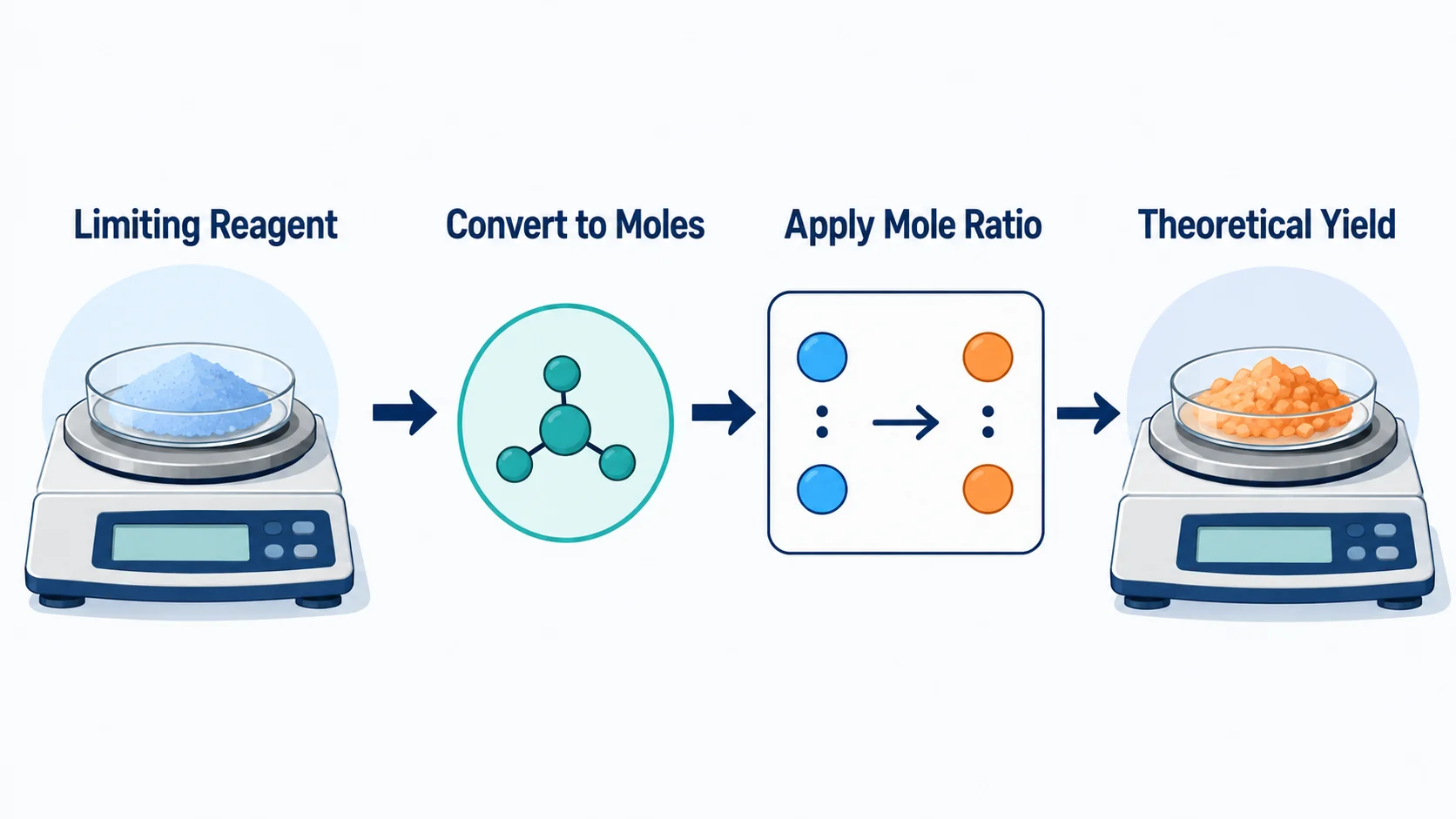
Important Note: This Theoretical Yield Calculator estimates the maximum possible product amount from a limiting reagent using stoichiometry from a balanced chemical equation. It converts limiting reagent mass to moles, applies the product-to-limiting-reagent mole ratio, and converts product moles into theoretical yield mass.
The result assumes the limiting reagent is correctly identified, the chemical equation is balanced, the stoichiometric coefficients are correct, the molar masses are accurate, and the reaction proceeds ideally. Real laboratory yield is often lower because of incomplete reaction, side reactions, transfer loss, purification loss, measurement uncertainty, or impure reactants.
This calculator is for educational chemistry and planning estimates only. It does not identify the limiting reagent from multiple reactants, balance chemical equations, verify chemical safety, account for purity, calculate percent yield from an actual yield, or replace a lab protocol, instructor guidance, SDS, or professional chemical procedure.
Reviewed by: AjaxCalculators Editorial Team
Last updated: April 28, 2026
Method source: Standard stoichiometry method using limiting reagent moles, balanced-equation mole ratios, and product molar mass
Editorial standards: AjaxCalculators Editorial Policy
What This Theoretical Yield Calculator Calculates
This calculator estimates theoretical product yield from one known limiting reagent. It is useful when you already know which reactant limits the reaction.
| Calculator Input or Result | Meaning | Common Unit |
|---|---|---|
| Limiting reagent mass | Mass of the reactant that limits product formation | kg, g, mg, µg |
| Limiting reagent molecular weight | Molar mass of the limiting reagent | g/mol |
| Limiting reagent moles | Amount of limiting reagent in moles | mol, mmol, µmol |
| Limiting reagent coefficient | Stoichiometric coefficient of the limiting reagent in the balanced equation | unitless |
| Product coefficient | Stoichiometric coefficient of the desired product in the balanced equation | unitless |
| Product moles | Theoretical moles of desired product | mol, mmol, µmol |
| Product molecular weight | Molar mass of the desired product | g/mol |
| Theoretical yield mass | Maximum predicted product mass under ideal stoichiometric conditions | kg, g, mg, µg |
What Theoretical Yield Means
Theoretical yield is the maximum amount of product that can form from a chemical reaction based on stoichiometry. It assumes the limiting reagent reacts completely according to the balanced chemical equation.
In real experiments, the actual yield is often lower than the theoretical yield because reactions may be incomplete, product may be lost during transfer or purification, side reactions may occur, or reactants may contain impurities.
Theoretical yield is usually calculated before percent yield. To calculate percent yield, you also need the actual yield from the experiment.
What a Limiting Reagent Means
The limiting reagent, also called the limiting reactant, is the reactant that runs out first and limits how much product can form.
Once the limiting reagent is fully consumed, the reaction cannot continue to make more product, even if other reactants are still present. That is why theoretical yield is calculated from the limiting reagent.
How the Theoretical Yield Calculator Works
1) Convert Limiting Reagent Mass to Moles
If you enter mass and molecular weight, the calculator first converts the limiting reagent mass into moles.
Limiting reagent moles = mass ÷ molecular weight
Using symbols:
nlimiting = mlimiting ÷ MWlimiting
In this formula:
- nlimiting is moles of limiting reagent
- mlimiting is the limiting reagent mass in grams
- MWlimiting is the limiting reagent molecular weight in g/mol
If you already know the limiting reagent moles, you can enter moles directly and skip the mass-to-moles step.
2) Apply the Stoichiometric Mole Ratio
The calculator uses the coefficients from the balanced chemical equation to convert limiting reagent moles into product moles.
Product moles = limiting reagent moles × product coefficient ÷ limiting reagent coefficient
Using symbols:
nproduct = nlimiting × cproduct ÷ climiting
In this formula:
- nproduct is moles of product
- nlimiting is moles of limiting reagent
- cproduct is the product coefficient from the balanced equation
- climiting is the limiting reagent coefficient from the balanced equation
3) Convert Product Moles to Theoretical Yield Mass
After product moles are known, the calculator converts product moles into mass using the product molecular weight.
Theoretical yield = product moles × product molecular weight
Using symbols:
mproduct = nproduct × MWproduct
In this formula:
- mproduct is theoretical product mass
- nproduct is product moles
- MWproduct is product molecular weight in g/mol
Theoretical Yield Formula Summary
| What You Want to Find | Formula | Meaning |
|---|---|---|
| Moles of limiting reagent | nlim = mlim ÷ Mlim | Limiting reagent mass divided by its molar mass |
| Moles of product | nprod = nlim × (cprod ÷ clim) | Uses the balanced-equation mole ratio |
| Theoretical yield mass | mprod = nprod × Mprod | Converts product moles into mass |
| Percent yield | % yield = actual yield ÷ theoretical yield × 100 | Compares real collected product with the theoretical maximum |
Worked Example: Calculate Theoretical Yield from Mass
Suppose the limiting reagent has:
- Mass: 25 g
- Molecular weight: 58.44 g/mol
- Limiting reagent coefficient: 1
- Product coefficient: 1
- Product molecular weight: 18.015 g/mol
Step 1: Convert limiting reagent mass to moles
n = mass ÷ molecular weight
n = 25 ÷ 58.44
n ≈ 0.4278 mol
Step 2: Apply the mole ratio
Product moles = 0.4278 × 1 ÷ 1
Product moles ≈ 0.4278 mol
Step 3: Convert product moles to grams
Theoretical yield = 0.4278 × 18.015
Theoretical yield ≈ 7.71 g
So, under these assumptions, the theoretical yield is about 7.71 grams of product.
Worked Example: Using a 2:3 Mole Ratio
Suppose the balanced equation shows that 2 moles of limiting reagent produce 3 moles of product. You have 0.50 mol of the limiting reagent, and the product molecular weight is 44.01 g/mol.
Step 1: Identify the coefficients
Limiting reagent coefficient = 2
Product coefficient = 3
Step 2: Calculate product moles
Product moles = 0.50 × 3 ÷ 2
Product moles = 0.75 mol
Step 3: Calculate theoretical yield
Theoretical yield = 0.75 × 44.01
Theoretical yield = 33.01 g
So, 0.50 mol of limiting reagent would theoretically produce about 33.01 grams of product.
Worked Example: Calculate Product Moles Only
Suppose you know the limiting reagent amount is 1.20 mol. The balanced equation has a limiting reagent coefficient of 3 and a product coefficient of 2.
Step 1: Use the product moles formula
Product moles = limiting moles × product coefficient ÷ limiting coefficient
Step 2: Substitute the values
Product moles = 1.20 × 2 ÷ 3
Step 3: Calculate
Product moles = 0.80 mol
So, the reaction can theoretically form 0.80 mol of product from 1.20 mol of limiting reagent.
How to Use This Theoretical Yield Calculator
- Start with a balanced chemical equation.
- Identify the limiting reagent from the reaction problem or lab setup.
- Enter the limiting reagent mass and select the correct mass unit.
- Enter the molecular weight of the limiting reagent.
- Enter or confirm the limiting reagent moles if using mole-based input.
- Enter the limiting reagent stoichiometric coefficient from the balanced equation.
- Enter the desired product stoichiometric coefficient from the balanced equation.
- Enter the desired product molecular weight.
- Read the product moles and theoretical yield mass result.
- Use Refresh to clear or restart the live-sync calculator if needed.
The calculator is designed for one known limiting reagent. If you have multiple reactants and do not know the limiting reagent, first compare the available moles divided by each reactant’s coefficient. The smallest stoichiometric extent identifies the limiting reagent.
Worked Example: Calculate Theoretical Yield
Suppose a reaction has this balanced relationship:
2A → 3B
You have 10.0 g of limiting reagent A. The molecular weight of A is 50.0 g/mol. The molecular weight of product B is 80.0 g/mol.
| Step | Calculation | Result |
|---|---|---|
| Convert limiting reagent mass to moles | nA = 10.0 g ÷ 50.0 g/mol | 0.200 mol A |
| Apply stoichiometric ratio | nB = 0.200 × (3 ÷ 2) | 0.300 mol B |
| Convert product moles to mass | mB = 0.300 mol × 80.0 g/mol | 24.0 g B |
The theoretical yield of product B is 24.0 g. If the actual collected product were 18.0 g, the percent yield would be 18.0 ÷ 24.0 × 100 = 75%.
How to Interpret the Result
Product moles show the amount of product predicted by the balanced equation from the limiting reagent amount.
Theoretical yield shows the maximum product amount, usually as mass, based on complete conversion of the limiting reagent.
If the selected output unit is mol, the theoretical yield is shown as product moles. If the selected output unit is g, kg, or mg, the calculator uses the product molecular weight to convert moles into mass.
Theoretical yield is a calculated maximum. It is not a guarantee that a lab reaction will produce that amount.
Why the Balanced Equation Matters
The balanced chemical equation provides the mole ratio between the limiting reagent and the desired product. Without the correct coefficients, the theoretical yield calculation will be wrong.
For example, if the balanced equation says:
2A + B → 3C
Then 2 moles of A can produce 3 moles of C. If A is the limiting reagent, the product moles are calculated from the ratio:
3 mol C ÷ 2 mol A
Using an unbalanced equation can produce incorrect mole ratios and incorrect yield results.
Limiting Reagent vs Excess Reagent
The limiting reagent is the reactant that runs out first according to the balanced chemical equation. It controls the maximum amount of product that can be formed. Any reactant present in more than the required stoichiometric amount is an excess reagent.
| Term | Meaning | Why It Matters |
|---|---|---|
| Limiting reagent | The reactant that restricts product formation | Theoretical yield is calculated from this reactant |
| Excess reagent | A reactant present in more than the stoichiometric amount needed | Some amount may remain after the limiting reagent is consumed |
| Stoichiometric coefficient | The number in front of a substance in the balanced equation | Used to calculate mole ratios between reactants and products |
| Desired product | The product whose theoretical yield is being calculated | Its coefficient and molar mass are needed for the final yield |
Theoretical Yield vs Actual Yield vs Percent Yield
Theoretical yield, actual yield, and percent yield are related, but they are not the same measurement.
| Yield Term | Meaning | Formula or Source |
|---|---|---|
| Theoretical yield | Maximum predicted product amount from stoichiometry | Calculated from the limiting reagent and balanced equation |
| Actual yield | Amount of product physically obtained in the lab | Measured experimentally |
| Percent yield | Actual yield compared with theoretical yield | % yield = actual ÷ theoretical × 100 |
Theoretical yield is usually higher than actual yield because real reactions may be incomplete, have side reactions, lose product during transfer or purification, or use impure starting materials.
Mass, Moles, and Molecular Weight
Theoretical yield problems usually move between mass and moles. Molecular weight connects those two values.
| Quantity | Unit | Role in the Calculation |
|---|---|---|
| Mass | g, kg, mg | Measured or requested amount of material |
| Moles | mol | Amount used for stoichiometric ratios |
| Molecular weight | g/mol | Converts between grams and moles |
| Coefficient | unitless | Gives the mole ratio from the balanced equation |
A common stoichiometry path is:
grams of limiting reagent → moles of limiting reagent → moles of product → grams of product
When to Use a Theoretical Yield Calculator
This calculator can be useful for:
- chemistry homework
- general chemistry stoichiometry problems
- limiting reagent calculations
- lab report preparation
- predicting product mass before an experiment
- checking balanced-equation mole ratios
- converting limiting reactant mass into expected product mass
- learning the difference between theoretical and actual yield
Important Assumptions and Limitations
| Assumption or Limitation | What It Means |
|---|---|
| Balanced equation required | The calculator relies on stoichiometric coefficients from a balanced reaction equation. |
| Known limiting reagent | The calculator assumes the entered limiting reagent is actually limiting. |
| One desired product | The result is for the selected desired product, not every product in the reaction. |
| Ideal reaction assumption | The theoretical yield assumes complete conversion according to the balanced equation. |
| No purity correction | The calculator does not adjust for reagent purity, assay percentage, solvent content, or impurities. |
| No hydrate correction | The correct molar mass must be entered for the exact chemical form used. |
| No equation balancing | The calculator does not balance chemical equations automatically. |
| No side-reaction model | Side products, incomplete reactions, equilibrium limits, and competing reactions are not modeled. |
| No lab loss correction | Transfer, filtration, drying, recrystallization, purification, and weighing losses are not included. |
| Not a chemical safety tool | The calculator does not check hazards, compatibility, PPE, ventilation, or SDS requirements. |
Common Mistakes to Avoid
| Mistake | Why It Causes Problems |
|---|---|
| Using an unbalanced chemical equation | Stoichiometric coefficients must come from the balanced equation. |
| Using the wrong limiting reagent | Theoretical yield must be calculated from the reactant that limits product formation. |
| Confusing molar mass with mass | Molar mass is g/mol; mass is the amount of material used or produced. |
| Forgetting the mole ratio | Product moles depend on the product-to-reactant coefficient ratio. |
| Using product molecular weight for the reactant | Each substance needs its own correct molecular weight. |
| Mixing grams, kilograms, milligrams, and micrograms incorrectly | Mass units must be converted consistently before calculation. |
| Assuming theoretical yield equals actual yield | Theoretical yield is an ideal maximum; real collected product can be lower. |
| Ignoring purity or hydration state | Impure reagents, hydrates, and different chemical forms can change the effective amount of reactant. |
Why Actual Yield May Be Lower
Actual yield is often lower than theoretical yield in real experiments. Reasons include:
- incomplete reaction
- side reactions
- equilibrium limitations
- impure reactants
- product lost during filtering, washing, transfer, drying, or purification
- measurement error
- moisture or solvent remaining in the product
- decomposition or evaporation of product
Because of these factors, theoretical yield is best understood as the calculated maximum under ideal stoichiometric assumptions.
Practical Uses
This Theoretical Yield Calculator can be useful for:
- finding expected product mass from a limiting reagent
- checking chemistry homework answers
- preparing a lab report calculation section
- planning reagent amounts before a reaction
- comparing expected product moles with expected product mass
- understanding mole ratios from balanced equations
- building the first step before a percent yield calculation
When You May Need a Different Calculator
This calculator is best when you already know the limiting reagent and want the theoretical product yield. You may need another calculator or method if your problem requires a different chemistry calculation.
| Need | Better Tool or Method |
|---|---|
| Find the limiting reagent from multiple reactants | Compare moles divided by stoichiometric coefficients for each reactant. |
| Calculate percent yield | Use actual yield ÷ theoretical yield × 100. |
| Calculate molarity | Use a Molarity Calculator. |
| Convert ppm to molarity | Use a PPM to Molarity Calculator. |
| Calculate moles from particles | Use Avogadro’s number relationships. |
| Balance a chemical equation | Use a chemical equation balancer or balance the equation manually. |
| Adjust for purity or assay percentage | Use reagent purity correction before theoretical yield calculation. |
| Plan a real lab procedure | Follow lab protocol, instructor guidance, SDS, and chemical safety procedures. |
References
- OpenStax Chemistry 2e — Reaction Yields
- OpenStax Chemistry 2e — Chapter 4 Summary
- Chemistry LibreTexts — Limiting Reactant, Theoretical Yield, and Percent Yield
- IUPAC Gold Book — Chemical Yield
Frequently Asked Questions
What is theoretical yield?
Theoretical yield is the maximum amount of product predicted from stoichiometry using a balanced chemical equation. It assumes the limiting reagent reacts completely and ideally.
What is the limiting reagent?
The limiting reagent is the reactant that restricts how much product can form. Once the limiting reagent is consumed, the reaction cannot make more of the selected product unless more limiting reagent is added.
Does this calculator find the limiting reagent automatically?
No. This calculator assumes you already know the limiting reagent. If multiple reactants are given, first identify the limiting reagent by comparing the available moles divided by each reactant’s stoichiometric coefficient.
Why is actual yield usually lower than theoretical yield?
Actual yield can be lower because of incomplete reaction, side reactions, purification loss, transfer loss, measurement uncertainty, equilibrium limitations, or impure starting materials.
Can theoretical yield be higher than actual yield?
Yes. Theoretical yield is an ideal maximum, while actual yield is the amount collected experimentally. In most real experiments, actual yield is lower than theoretical yield.
Can percent yield be over 100%?
Percent yield over 100% usually suggests product contamination, incomplete drying, weighing error, incorrect theoretical yield calculation, or another experimental issue. It should be checked carefully.
What units should I use?
Use matching mass and mole units carefully. The calculator supports kg, g, mg, µg, mol, mmol, and µmol, but the molar mass values should match the chemical substances used in the reaction.
Does this calculator balance chemical equations?
No. You must use coefficients from a correctly balanced chemical equation before calculating theoretical yield.
Related Calculators
- Percentage Calculator
- Dilution Ratio Calculator
- Alcohol Dilution Calculator
- mg to mL Calculator
- mL to Grams Converter
- Grams to Ounces Calculator
- Grams to Calories Calculator
- Ideal Gas Law Calculator
Theoretical Yield Calculator Disclaimer
This Theoretical Yield Calculator provides educational stoichiometry estimates only. It calculates theoretical yield from a known limiting reagent, stoichiometric coefficients, and molecular weights. It assumes a balanced chemical equation, correct limiting reagent identification, correct molar masses, and ideal reaction completion.
The calculator does not balance equations, identify limiting reagents from multiple reactants, verify chemical identity, adjust for purity, account for hydrates, model incomplete reactions, include side reactions, calculate purification losses, determine percent yield from actual yield, or provide chemical safety guidance. For real laboratory work, follow your lab protocol, instructor guidance, safety data sheet, institutional safety rules, and qualified professional procedures.