Half-Life Calculator

Enter known values, click Calculate, and the remaining values update automatically.
Inputs
λ is shown in per sec. T, t, and τ use the same selected time unit.
sec
sec
per sec
sec
After the first calculation, changing a value or the time unit recalculates automatically.
Step-by-step derivation
Enter your known values, then click Calculate.
References
  • Remaining quantity: N(t) = N(0) × 0.5^(t / T)
  • Exponential form: N(t) = N(0) × e^(−λt) = N(0) × e^(−t / τ)
  • Relations: T = ln(2) / λ = τ × ln(2)
  • Rearrangements: t = ln(N(0) / N(t)) / λ, λ = ln(2) / T, τ = 1 / λ

Use this Half-Life Calculator to solve exponential decay problems from known values such as initial quantity, remaining quantity, half-life, total time, decay constant, and mean lifetime. Enter the values you know, click Calculate, and the calculator updates the related decay values with a step-by-step derivation.

Important Note: This Half-Life Calculator assumes a single first-order exponential decay process with a constant decay rate. It can solve relationships between initial quantity, remaining quantity, half-life, elapsed time, decay constant, and mean lifetime.

This calculator is for educational math, chemistry, physics, and general science examples only. It does not calculate radiation dose, radioactive activity, shielding, isotope decay chains, medical dosing, drug accumulation, environmental transport, or safety-critical exposure. For laboratory, radiation, environmental, medical, or regulatory decisions, use the required standard method and qualified professional guidance.

Reviewed by: AjaxCalculators Editorial Team
Last updated: April 29, 2026
Method source: Standard exponential decay relationships using N(t) = N(0) × 0.5t/T, N(t) = N(0) × e−λt, T = ln(2) / λ, and τ = 1 / λ
Editorial standards: AjaxCalculators Editorial Policy

What This Half-Life Calculator Calculates

This calculator solves common half-life and exponential decay relationships. It can estimate how much of a quantity remains after a given time, how long decay takes, what the half-life is, what the decay constant is, and what the mean lifetime is.

The calculator can calculate:

  • Initial quantity N(0)
  • Remaining quantity N(t)
  • Half-life T
  • Total elapsed time t
  • Decay constant λ
  • Mean lifetime τ
  • Step-by-step exponential decay derivation

The live tool supports time units such as seconds, minutes, hours, days, weeks, months, and years. Half-life, total time, and mean lifetime use the selected time unit, while the decay constant is shown as a rate per selected unit of time.

What Half-Life Means

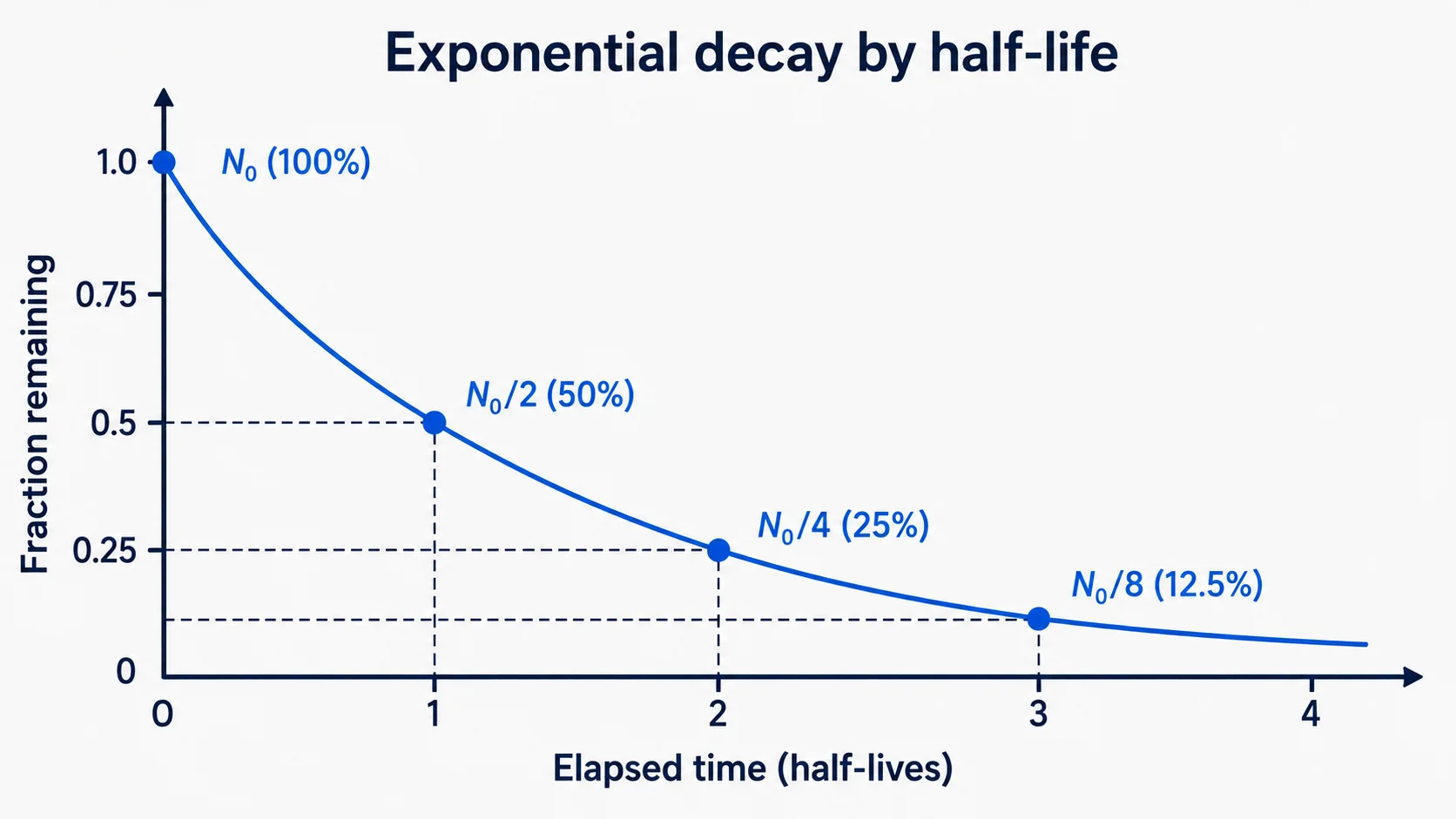
Half-life is the time required for a decaying quantity to fall to one-half of its starting amount. If a substance has a half-life of 5 days, then after 5 days half of the original amount remains. After another 5 days, half of that remaining amount remains.

For example, if the initial quantity is 100 and the half-life is 5 days:

  • After 1 half-life: 50 remains
  • After 2 half-lives: 25 remains
  • After 3 half-lives: 12.5 remains
  • After 4 half-lives: 6.25 remains

Half-life is commonly used for radioactive decay, first-order chemical reactions, environmental decay, pharmacokinetic estimates, and other exponential decay models.

How the Half-Life Calculator Works

1) Remaining Quantity from Half-Life

The half-life form of exponential decay is:

N(t) = N(0) × 0.5t/T

In this formula:

  • N(t) is the remaining quantity after time t
  • N(0) is the initial quantity
  • t is total elapsed time
  • T is half-life

The exponent t / T tells how many half-lives have passed. If t equals T, one half-life has passed. If t equals 3T, three half-lives have passed.

2) Exponential Decay Form

The same decay relationship can also be written using the decay constant λ.

N(t) = N(0) × e−λt

In this formula:

  • e is Euler’s number, approximately 2.71828
  • λ is the decay constant
  • t is elapsed time

A larger decay constant means faster decay. A smaller decay constant means slower decay.

3) Half-Life and Decay Constant

Half-life and decay constant describe the same decay rate in different ways.

T = ln(2) / λ

And:

λ = ln(2) / T

Since ln(2) is approximately 0.693, the formulas can also be written as:

T ≈ 0.693 / λ

λ ≈ 0.693 / T

4) Mean Lifetime

Mean lifetime, written as τ, is the reciprocal of the decay constant.

τ = 1 / λ

Because T = ln(2) / λ, mean lifetime and half-life are related by:

T = τ × ln(2)

And:

τ = T / ln(2)

Mean lifetime is longer than half-life because ln(2) is less than 1.

Half-Life Formula Summary

What You Want to Find Formula Use Case
Remaining quantity N(t) = N(0) × 0.5t/T Find the amount left after a known time
Exponential decay form N(t) = N(0) × e−λt Use the decay constant form of exponential decay
Half-life from decay constant T = ln(2) / λ Find half-life when λ is known
Decay constant from half-life λ = ln(2) / T Find λ when half-life is known
Mean lifetime τ = 1 / λ Find average lifetime in the exponential model
Mean lifetime from half-life τ = T / ln(2) Convert half-life into mean lifetime
Elapsed time from quantities t = ln(N(0) / N(t)) / λ Find time needed to reach a remaining amount

Worked Example: Remaining Quantity After Several Half-Lives

Suppose a sample starts with 100 units, has a half-life of 5 days, and decays for 15 days.

Step 1: Find the number of half-lives
Number of half-lives = t / T
Number of half-lives = 15 / 5
Number of half-lives = 3

Step 2: Use the half-life formula
N(t) = N(0) × 0.5t/T

Step 3: Substitute the values
N(t) = 100 × 0.53

Step 4: Calculate
0.53 = 0.125
N(t) = 100 × 0.125
N(t) = 12.5 units

So, after 15 days, about 12.5 units remain.

Worked Example: Find Half-Life from Initial and Remaining Quantity

Suppose a quantity decreases from 200 to 50 over 10 hours. You want to find the half-life.

Step 1: Find the remaining fraction
Remaining fraction = N(t) / N(0)
Remaining fraction = 50 / 200
Remaining fraction = 0.25

Step 2: Recognize the half-life pattern
0.25 = 1/4 = 0.52

That means 2 half-lives passed.

Step 3: Divide total time by number of half-lives
Half-life = 10 hours / 2
Half-life = 5 hours

So, the half-life is 5 hours.

Worked Example: Find Decay Constant from Half-Life

Suppose the half-life is 8 days.

Step 1: Use the decay constant formula
λ = ln(2) / T

Step 2: Substitute the half-life
λ = 0.693147 / 8

Step 3: Calculate
λ ≈ 0.0866 per day

So, a half-life of 8 days corresponds to a decay constant of about 0.0866 per day.

Worked Example: Find Mean Lifetime from Half-Life

Suppose the half-life is 10 years.

Step 1: Use the mean lifetime formula
τ = T / ln(2)

Step 2: Substitute the half-life
τ = 10 / 0.693147

Step 3: Calculate
τ ≈ 14.43 years

So, a half-life of 10 years corresponds to a mean lifetime of about 14.43 years.

Worked Example: Find Time Needed to Reach a Remaining Amount

Suppose a sample starts with 500 units, has a half-life of 6 hours, and you want to know how long it takes to reach 125 units.

Step 1: Find the remaining fraction
Remaining fraction = 125 / 500
Remaining fraction = 0.25

Step 2: Convert the fraction into half-lives
0.25 = 0.52

So, 2 half-lives are needed.

Step 3: Multiply by the half-life
Time = 2 × 6 hours
Time = 12 hours

So, it takes 12 hours for the quantity to decrease from 500 to 125.

How to Use This Half-Life Calculator

  1. Select the time unit, such as seconds, minutes, hours, days, weeks, months, or years.
  2. Enter the known values you have.
  3. Use Initial quantity N(0) for the starting amount.
  4. Use Remaining quantity N(t) for the amount left after decay.
  5. Enter half-life T if you know the time required for the quantity to halve.
  6. Enter total time t if you know the elapsed decay time.
  7. Enter decay constant λ if the decay rate is known.
  8. Enter mean lifetime τ if that value is known.
  9. Click Calculate.
  10. Review the updated values and the step-by-step derivation.

How to Interpret the Results

Result What It Means Important Caution
Initial quantity N(0) The starting amount before decay begins. Must be positive for standard decay calculations.
Remaining quantity N(t) The amount left after elapsed time t. For a decay-only model, this should not be greater than the initial quantity.
Half-life T The time required for the quantity to fall to half its starting value. Only constant for first-order or single-exponential decay models.
Total time t The elapsed time between the initial and remaining amounts. Must use the same time basis as half-life, mean lifetime, or decay constant.
Decay constant λ The continuous exponential decay rate per unit time. The unit changes when the selected time unit changes.
Mean lifetime τ The average lifetime in the exponential decay model, calculated as τ = 1 / λ. Mean lifetime is longer than half-life because T = τ × ln(2).

Half-Life vs Decay Constant vs Mean Lifetime

Half-life, decay constant, and mean lifetime describe the same exponential decay process from different angles.

Quantity Meaning Relationship
Half-life T Time required for the quantity to fall to half. T = ln(2) / λ
Decay constant λ Continuous decay rate per unit time. λ = ln(2) / T
Mean lifetime τ Average lifetime in the exponential decay model. τ = 1 / λ

A shorter half-life means a larger decay constant and faster decay. A longer half-life means a smaller decay constant and slower decay.

Remaining Fraction After Half-Lives

Each half-life cuts the remaining amount in half. The value approaches zero gradually but does not become zero instantly in the ideal exponential model.

Number of Half-Lives Fraction Remaining Percent Remaining
0 1 100%
1 1/2 50%
2 1/4 25%
3 1/8 12.5%
4 1/16 6.25%
5 1/32 3.125%
10 1/1024 About 0.0977%

Common Half-Life Use Cases

Half-life appears in several fields because many natural and scientific decay processes can be approximated with exponential decay.

Field How Half-Life Is Used Important Note
Radioactive decay Estimates how much radioactive material remains over time. Uses isotope-specific half-lives; this calculator does not estimate radiation dose or shielding.
Chemical kinetics Models first-order reactions. Only first-order half-life remains constant independent of concentration.
Environmental science Estimates degradation of substances over time. Real environments may involve transport, dilution, multiple pathways, and non-exponential behavior.
Pharmacokinetics Describes how drug concentration may decrease in the body. Real medication behavior can involve absorption, distribution, metabolism, excretion, and repeated dosing.
Physics and astronomy Used for isotope decay modeling and dating examples. Requires the correct isotope, assumptions, and measurement method.

Radioactive Decay and Half-Life

For radioactive decay, half-life tells how long it takes for half of the unstable nuclei in a sample to decay. The decay process is statistical for individual atoms, but large samples follow predictable exponential behavior.

The standard radioactive decay equation is:

N(t) = N(0) × e−λt

Where N(t) is the number of undecayed nuclei remaining at time t, and λ is the decay constant.

This calculator can be used for educational radioactive decay estimates, but it does not calculate radiation dose, activity in becquerels or curies, shielding, exposure risk, or nuclear safety requirements.

First-Order Reactions and Half-Life

For a first-order chemical reaction, half-life is constant under a fixed set of conditions. This means the same amount of time is needed for the reactant concentration to fall from 100% to 50%, from 50% to 25%, and from 25% to 12.5%.

For first-order reactions:

T = 0.693 / k

Where k is the first-order rate constant. This is mathematically the same form as the decay constant relationship T = ln(2) / λ.

Why Half-Life Does Not Mean “Gone After Two Half-Lives”

A common mistake is thinking that after two half-lives, the entire quantity is gone. That is not how exponential decay works.

After one half-life, 50% remains. After two half-lives, half of that remaining half remains, so 25% remains. The value keeps decreasing, but in the ideal exponential model it approaches zero gradually rather than instantly becoming zero.

Time Units and Decay Constant Units

Half-life, total time, and mean lifetime must use compatible time units. If half-life is in days, total time should also be handled in days unless converted.

The decay constant has reciprocal time units. For example:

  • If time is in seconds, λ is per second.
  • If time is in days, λ is per day.
  • If time is in years, λ is per year.

Changing time units changes the numeric value of λ, even though the physical decay process is the same.

Common Time Unit Conversions

Conversion Value
1 minute 60 seconds
1 hour 60 minutes = 3600 seconds
1 day 24 hours
1 week 7 days
1 year 365 days for many simple calculator estimates

For scientific, regulatory, astronomical, or legal work, use the exact time convention required by the relevant method or standard.

Half-Life in Medicine and Pharmacokinetics

Half-life is often mentioned in medicine and pharmacokinetics, but medical interpretation is more complex than a simple exponential decay calculation. Drug concentration can depend on absorption, distribution, metabolism, excretion, dosing schedule, organ function, age, body size, interactions, formulation type, and multi-compartment behavior.

Medical Warning: Do not use this calculator to start, stop, delay, repeat, increase, reduce, or time any medication dose. Do not use it to decide whether a drug is “out of your system” or whether a treatment is safe. Always follow your doctor, pharmacist, prescription label, or official medical guidance.

Common Mistakes to Avoid

  • Do not mix time units without converting them.
  • Do not confuse half-life T with total time t.
  • Do not confuse decay constant λ with mean lifetime τ.
  • Do not enter a negative or zero initial quantity.
  • Do not enter a remaining quantity greater than the initial quantity for a decay-only model.
  • Do not assume all decay processes follow a perfect single-exponential model.
  • Do not use radioactive half-life math to calculate radiation safety or dose.
  • Do not use drug half-life math as medical dosing advice.

Important Assumptions and Limitations

  • This calculator assumes a single exponential decay process.
  • It assumes a constant decay rate or first-order decay model.
  • It assumes the quantity only decreases over time.
  • It assumes half-life, total time, mean lifetime, and decay constant use compatible time units.
  • It does not model growth, production, replenishment, repeated dosing, accumulation, or multi-phase decay.
  • It does not calculate radioactive activity, becquerels, curies, radiation dose, exposure, shielding, isotope decay chains, or nuclear safety requirements.
  • It does not model non-first-order chemical reactions, changing environmental conditions, biological variability, or multi-compartment pharmacokinetics.
  • It does not replace laboratory procedures, radiation safety rules, medical guidance, environmental regulations, or professional analysis.
  • Displayed values may be rounded for readability.

Practical Uses

This Half-Life Calculator can be useful for:

  • radioactive decay homework
  • first-order chemistry kinetics
  • exponential decay examples
  • finding remaining quantity after a known time
  • finding elapsed time from initial and remaining amounts
  • converting between half-life and decay constant
  • converting between half-life and mean lifetime
  • checking isotope decay examples
  • learning how exponential decay formulas connect

When You May Need a Different Calculator

This calculator is best for single-process exponential decay. You may need a different calculator or model if you want to calculate:

  • radioactive activity in becquerels or curies
  • radiation dose or exposure
  • shielding thickness
  • multi-step decay chains
  • carbon dating from isotope ratios
  • drug accumulation from repeated dosing
  • multi-compartment pharmacokinetic decay
  • chemical reaction orders other than first order
  • growth and decay together

References

  1. Chemistry LibreTexts — Half-Life and First-Order Kinetics
  2. OpenStax Chemistry 2e — Radioactive Decay
  3. Encyclopaedia Britannica — Rates of Radioactive Transitions
  4. Lumen Physics — Half-Life and Activity
  5. NIST — Approximate Conversions from U.S. Customary Measures to Metric

Related Calculators

Half-Life Calculator Disclaimer

This Half-Life Calculator provides educational exponential decay estimates only. It assumes a single first-order decay process with a constant decay rate. Results depend on accurate input values, correct time units, and whether the real process is reasonably represented by a single exponential decay model.

This calculator does not calculate radiation dose, radioactive activity, isotope decay chains, shielding, nuclear safety, medical dosing, drug accumulation, drug clearance, environmental transport, legal compliance, laboratory uncertainty, or safety-critical exposure. For laboratory, radiation, environmental, medical, regulatory, or safety decisions, use the required standard method and qualified professional guidance.

More of our calculators...

Ideal Gas Law Calculator

Use our Ideal Gas Law Calculator to solve pressure, volume, moles, or temperature with PV = nRT. Supports SI and L·atm gas constants with unit conversion.

Atom Calculator

Use our Atom Calculator to find protons, neutrons, electrons, atomic number, mass number, and ionic charge quickly from standard atomic relationships.

Theoretical Yield Calculator

Theoretical Yield Calculator to find the maximum product yield from stoichiometry, limiting reagent, and molar relationships.

PPM to Molarity Calculator

PPM to Molarity Calculator to convert parts per million into molarity using molar mass and solution assumptions.

pH Calculator

Free pH calculator that syncs [H+], [OH−], pOH, concentration, and mass/volume. Supports strong/weak acids and bases, unit options, steps, and PDF.

Percent Yield Calculator

Use our Percent Yield Calculator to calculate chemistry percent yield from actual yield and theoretical yield in mg, g, or kg.

Molarity Calculator

Use our Molarity Calculator to find moles, mass concentration, and molarity from solute mass, molar mass, and solution volume.

Avogadro’s number calculator

Use our Avogadro Number Calculator to find molar mass and number of particles from mass, moles, and Avogadro’s constant.