Dog Age to Human Age Calculator

3 methods • Live sync • Ajax loading • Years + months
Live

Settings

You can switch methods anytime; ages stay synced.
Quick summary
Enter either dog age or human age to see the conversion.

Enter ages

Years
Months
Type years, months, or both. We convert internally to total months.
Years
Months
Edit human age too — it will back-calculate dog age.

Results

Dog total age
months
Human total age
months
Method used
Updating…

Action

Hard reset: cancels pending updates and clears everything on the first click.

Important Note : This Dog Age Calculator provides estimated human-equivalent dog age using common veterinary-style rules, a size-based age chart, and an epigenetic formula. Dog aging is not identical across breeds, sizes, health conditions, or lifestyles, so the result should be used as an educational estimate rather than a medical assessment. Larger dogs often reach mature and senior life stages earlier than smaller dogs, and individual dogs may age faster or slower depending on genetics, body condition, nutrition, activity level, and veterinary history. The epigenetic formula is based on research comparisons of DNA methylation patterns and may not match every breed or individual dog. For health decisions, senior-care planning, symptoms, diet changes, mobility concerns, or medication questions, use this calculator as general context only and consult a licensed veterinarian.

Use this Dog Age Calculator to estimate your dog’s age in human years using a quick veterinary-style rule, a research-based epigenetic formula, or a size-based canine age chart. Instead of relying only on the old “multiply by 7” myth, this calculator helps compare a dog’s life stage more realistically by considering method choice, age, and body-size category.

Reviewed by: AjaxCalculators Editorial Team
Last updated: May 1, 2026
Method sources: Veterinary-style 15/9/5 age rule, NHGRI epigenetic dog-aging research, and AAHA / Zoetis canine physiological age chart
Editorial standards: AjaxCalculators Editorial Policy

What This Dog Age Calculator Calculates

This calculator estimates a dog’s human-equivalent age using different age-conversion approaches. It is useful for understanding whether a dog is closer to a puppy, young adult, mature adult, senior, or geriatric life stage.

The calculator can estimate dog age using:

  • Vet guideline method: a quick 15 / 9 / 5 rule-of-thumb for everyday estimates
  • Epigenetic formula: a research-based logarithmic model from dog-to-human aging comparison research
  • AAHA size chart method: a size-aware comparison for small, medium, large, and giant dogs
  • Reverse conversion: an approximate dog-age estimate from a human-equivalent age when supported by the selected mode

The result is best understood as a life-stage estimate, not an exact biological measurement. Dogs do not age at the same rate throughout life, and dog aging is affected by breed, body size, genetics, health status, and lifestyle.

Why “Multiply Dog Age by 7” Is Too Simple

The old “1 dog year = 7 human years” rule is easy to remember, but it is not very accurate. Dogs mature much faster than humans during the first one to two years of life, then their aging rate changes. Larger dogs also tend to age faster in later life than smaller dogs.

A more useful dog-age estimate usually considers:

  • rapid puppy and adolescent development
  • slower adult-year aging after the first two years
  • body size and breed differences
  • life-stage changes such as adult, senior, and geriatric phases
  • research-based biological aging models when appropriate

For example, the American Kennel Club explains the common veterinary-style guideline that the first year of a medium-sized dog’s life is about 15 human years, the second year is about 9 more human years, and each later year is about 5 human years.

Dog Age Calculator Methods

1) Vet Guideline Method: 15 / 9 / 5 Rule

The vet guideline method is a simple rule-of-thumb often used for quick dog-to-human age estimates. It treats the first year of a medium-sized dog’s life as about 15 human years, the second year as about 9 additional human years, and every later year as about 5 human years.

Dog Age Range Human-Equivalent Estimate Meaning
First year About 15 human years Rapid puppy and adolescent development
Second year About 9 more human years Young adult development
Each year after age 2 About 5 human years per dog year Simplified adult-aging estimate

Formula for dogs older than 2 years:

Human age ≈ 24 + 5 × (dog age − 2)

Since 15 + 9 = 24, this can also be written as:

Human age ≈ 15 + 9 + 5 × (dog age − 2)

This method is easy to use, but it does not fully adjust for breed size. It is best for quick everyday estimates rather than detailed veterinary life-stage planning.

2) Epigenetic Formula Method

The epigenetic method uses a logarithmic formula based on research comparing dog and human aging patterns. The National Human Genome Research Institute describes the formula as:

Human age = 16 × ln(dog age) + 31

In this formula:

  • ln means natural logarithm
  • dog age is entered in years
  • human age is the estimated human-equivalent age

This formula reflects the idea that dogs age very quickly early in life and then the comparative aging curve slows. It may produce a noticeably higher estimate for some adult dogs compared with the simple 15 / 9 / 5 method.

The formula comes from research on biological aging markers, especially DNA methylation patterns. The underlying study, Quantitative Translation of Dog-to-Human Aging by Conserved Remodeling of the DNA Methylome, proposed the logarithmic relationship for comparing dog and human aging.

3) AAHA Size Chart Method

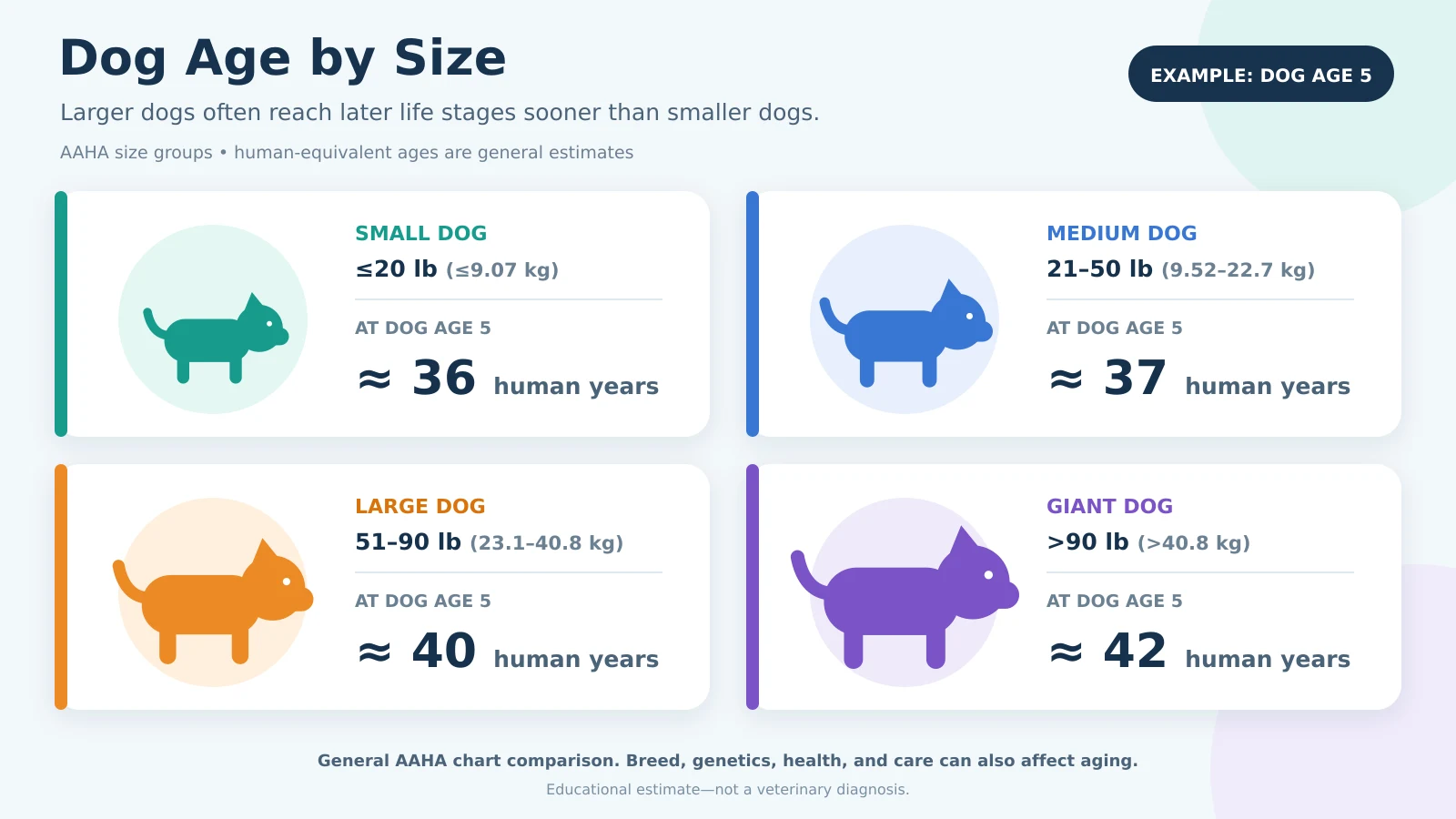
The AAHA size chart method uses body-size groups to estimate a dog’s physiological age in human years. This is important because small dogs and large dogs often do not age at the same rate, especially in later life.

The calculator’s size groups are based on the common chart categories used in the AAHA / Zoetis canine physiological age chart:

Dog Size Group Weight Range Why It Matters
Small 20 lb or less Small dogs often have longer average life expectancy than large dogs
Medium 21 to 50 lb Medium dogs are often used as a baseline for simple age rules
Large 51 to 90 lb Large dogs may reach senior stages earlier than smaller dogs
Giant Over 90 lb Giant breeds often have faster late-life aging patterns

The AAHA canine life-stage guidance emphasizes that preventive care should consider age, size, lifestyle, health status, and breed. This is why a size-aware chart can be more useful than a single universal dog-year formula.

Formula Summary

Method Main Formula or Rule Best For Main Limitation
15 / 9 / 5 vet guideline Age > 2: Human age ≈ 24 + 5 × (dog age − 2) Fast everyday estimate Does not fully adjust for size or breed
Epigenetic formula Human age = 16 × ln(dog age) + 31 Research-based biological aging comparison May not represent every breed or individual dog
AAHA size chart Uses age and weight-size category Size-aware life-stage comparison Still a chart-based estimate, not a diagnosis

Worked Example: 5-Year-Old Medium Dog

Suppose your dog is 5 years old and weighs 40 lb. A 40 lb dog falls into the medium size group.

Method 1: Vet Guideline

Formula: Human age ≈ 24 + 5 × (dog age − 2)

Step 1: Subtract 2 from the dog’s age:

5 − 2 = 3

Step 2: Multiply the remaining years by 5:

3 × 5 = 15

Step 3: Add the first two-year estimate:

24 + 15 = 39 human years

Method 2: Epigenetic Formula

Formula: Human age = 16 × ln(dog age) + 31

Step 1: Substitute the dog’s age:

Human age = 16 × ln(5) + 31

Step 2: Use ln(5) ≈ 1.609:

Human age ≈ 16 × 1.609 + 31

Step 3: Calculate:

Human age ≈ 25.74 + 31 = 56.74 human years

Method 3: AAHA Size Chart

Using the size chart method, a 5-year-old medium dog may be estimated differently from a small, large, or giant dog because body size affects the age comparison.

Result comparison:

Method Estimated Human-Equivalent Age What It Shows
Vet guideline About 39 human years Simple rule-of-thumb estimate
Epigenetic formula About 56.7 human years Research-based biological aging comparison
AAHA size chart Depends on size-group chart value Size-aware physiological age estimate

This example shows why dog-age calculators can return different numbers. Each method answers a slightly different question. A quick vet guideline estimates everyday age equivalence, an epigenetic formula compares biological aging patterns, and a size chart considers dog weight category.

Worked Example: 10-Year-Old Small Dog vs Giant Dog

Now suppose two dogs are both 10 years old, but one is a small dog and the other is a giant dog.

Dog Chronological Age Size Category Likely Life-Stage Meaning
Small dog 10 years 20 lb or less May be senior, but often not as advanced as a giant dog of the same age
Giant dog 10 years Over 90 lb Often much further into the senior or geriatric life stage

This is why body size matters. A 10-year-old Chihuahua and a 10-year-old Great Dane should not be interpreted the same way just because their calendar age is identical.

How to Use This Dog Age Calculator

  1. Select the dog-age conversion method you want to use.
  2. Choose the vet guideline method for a quick estimate.
  3. Choose the epigenetic formula method for a research-based logarithmic estimate.
  4. Choose the AAHA size chart method if you want a size-aware comparison.
  5. If using the size chart, select your dog’s size group: small, medium, large, or giant.
  6. Enter your dog’s age in years and months when available.
  7. If reverse conversion is supported, enter a human-equivalent age to estimate the related dog age.
  8. Review the calculated human-equivalent age.
  9. Compare methods when you want a broader view instead of a single number.

How to Interpret the Result

The result should be interpreted as an approximate life-stage comparison. It does not mean your dog has the same health status, disease risk, or physical condition as a human of that exact age.

Result Type How to Read It What Not to Assume
Human-equivalent age A general comparison to human life stages It is not an exact medical age
Vet guideline result A simple everyday estimate It does not fully account for breed and body size
Epigenetic result A research-based biological aging estimate It may not perfectly fit every breed or individual dog
AAHA size chart result A size-aware physiological age estimate It is still a chart estimate, not a veterinary exam

A dog’s human-equivalent age is most useful when thinking about general life stage, wellness checkups, activity level, mobility support, and age-appropriate care discussions with a veterinarian.

Dog Life Stages and Age Context

Veterinary life-stage planning is not based only on a single number. The AAHA canine life-stage guidelines describe preventive care as life-stage based, with attention to age, size, lifestyle, health status, and breed.

Life Stage General Meaning Care Topics to Consider
Puppy Growth and early development Vaccination schedule, training, nutrition, socialization
Young adult After rapid growth, before mature adulthood Exercise, weight control, behavior, preventive care
Mature adult Middle-life stage Routine wellness exams, dental care, weight management
Senior Later-life stage that varies by size and breed Mobility, lab screening, nutrition, pain signs, organ health
Geriatric Advanced age relative to expected lifespan Quality of life, chronic disease care, comfort, frequent monitoring

The American Veterinary Medical Association notes that dogs may be considered senior when they reach the last 25% of their estimated lifespan. Because lifespan varies by breed and size, senior status is not the same age for every dog.

Why Dog Size Changes the Age Estimate

Dog size is one of the biggest reasons dog-age estimates differ. Small dogs often live longer on average than giant dogs, so a large or giant dog may reach senior life stages at a younger calendar age.

That does not mean every large dog ages poorly or every small dog ages slowly. It means size is one of several important factors that can change the interpretation of age.

Factor How It Can Affect Dog Aging
Breed size Large and giant breeds often reach senior stages earlier
Genetics Inherited traits can influence lifespan and disease risk
Body condition Excess weight can affect mobility, joints, and overall health
Nutrition Appropriate diet supports growth, adult maintenance, and senior care
Activity level Exercise and conditioning can affect muscle, weight, and mobility
Veterinary history Preventive care and disease management can change quality of life

Common Dog Age Conversion Mistakes

  • Using only the multiply-by-7 rule: this ignores fast early development and size differences.
  • Comparing all dogs the same way: a 10-year-old small dog and a 10-year-old giant dog may be in different life-stage categories.
  • Treating human-equivalent age as a diagnosis: age conversion does not replace a veterinary exam.
  • Ignoring months for puppies: small age differences matter more during early growth.
  • Using the epigenetic formula for very young puppies without context: logarithmic models may not feel intuitive at very young ages.
  • Assuming a chart applies perfectly to every breed: charts are general estimates, not individual medical predictions.
  • Using age alone for senior-care decisions: symptoms, mobility, weight, behavior, lab work, and veterinary history also matter.

When a Dog Age Result May Be Useful

A dog age estimate can help owners understand general life stage and ask better care questions. It is especially useful when comparing dogs of different sizes or explaining a dog’s age to family members.

  • Estimating whether a dog is young adult, mature, senior, or geriatric
  • Understanding why large dogs may seem older than small dogs at the same calendar age
  • Planning age-appropriate wellness discussions with a veterinarian
  • Thinking about exercise intensity and recovery time
  • Considering senior-dog screening and mobility support
  • Teaching children or new pet owners how dog aging differs from human aging
  • Comparing the simple rule, chart method, and research formula side by side

Important Assumptions and Limitations

  • This calculator gives an estimated human-equivalent age, not an exact biological age.
  • The 15 / 9 / 5 method is a simplified rule-of-thumb and may not fit every dog.
  • The epigenetic formula is based on biological-aging research and may not represent all breeds equally.
  • The size chart method uses general weight categories and does not replace breed-specific veterinary guidance.
  • Individual aging can vary because of genetics, body condition, nutrition, disease history, dental health, exercise, and environment.
  • A human-equivalent age does not diagnose arthritis, cognitive decline, organ disease, dental disease, or any other condition.
  • For puppies, months can matter because early development happens quickly.
  • For senior dogs, symptoms and quality of life matter more than the calculator number alone.

When to Ask a Veterinarian

Use this calculator for educational context, but contact a veterinarian if your dog has health changes or age-related symptoms. This is especially important for senior dogs, giant breeds, dogs with chronic conditions, and dogs with sudden behavior or mobility changes.

Veterinary advice may be needed for:

  • unexplained weight loss or weight gain
  • limping, stiffness, or trouble standing
  • increased thirst or urination
  • major appetite changes
  • confusion, anxiety, or behavior changes
  • persistent vomiting or diarrhea
  • breathing difficulty
  • pain signs or reduced activity
  • new lumps, wounds, or skin changes
  • diet, supplement, medication, or senior-care decisions

Dog Age Method Comparison

Question Best Method to Try Reason
I want a fast estimate. Vet guideline Simple and easy to understand
I want a size-aware estimate. AAHA size chart Accounts for small, medium, large, and giant categories
I want a research-based biological comparison. Epigenetic formula Uses a logarithmic model from aging research
I want to understand senior life stage. AAHA size chart plus veterinary guidance Senior status depends on size, breed, and health

Practical Uses of a Dog Age Calculator

  • Compare dog years to human years more realistically
  • Understand why the “multiply by 7” method is incomplete
  • Estimate a dog’s life stage for general care planning
  • Compare small, medium, large, and giant dog age estimates
  • Explain a dog’s age to children or family members
  • Support conversations about senior wellness checks
  • Compare a quick rule, research formula, and size-based chart
  • Understand why two dogs of the same age may not be equally “old”

References

  1. American Animal Hospital Association: 2019 AAHA Canine Life Stage Guidelines
  2. AAHA / Zoetis: Canine and Feline Physiological Age Chart
  3. National Human Genome Research Institute: Researchers Reframe Dog-to-Human Aging Comparisons
  4. Cell Systems / PMC: Quantitative Translation of Dog-to-Human Aging by Conserved Remodeling of the DNA Methylome
  5. American Kennel Club: How to Calculate Dog Years to Human Years
  6. American Veterinary Medical Association: Caring for Senior Cats and Dogs

Related Calculators

Frequently Asked Questions

Is the multiply-by-7 dog age rule accurate?

The multiply-by-7 rule is simple, but it is too limited. Dogs mature quickly in the first two years, and aging later depends partly on body size and breed. A 15 / 9 / 5 rule, size chart, or epigenetic formula usually gives a more useful estimate.

What is the 15 / 9 / 5 dog age rule?

The 15 / 9 / 5 rule estimates the first dog year as about 15 human years, the second year as about 9 more human years, and each additional year as about 5 human years. For dogs older than 2 years, the simplified formula is: human age ≈ 24 + 5 × (dog age − 2).

What is the epigenetic dog age formula?

The epigenetic formula is: human age = 16 × ln(dog age) + 31. It is based on research comparing DNA methylation patterns in dogs and humans. It is useful as a research-based comparison, but it should not be treated as a perfect age measurement for every dog.

Why do large dogs age faster than small dogs?

Large and giant dogs often have shorter average lifespans than small dogs, so they may reach senior and geriatric life stages earlier. This is why size-based dog age charts can give different human-equivalent ages for dogs with the same calendar age.

When is a dog considered senior?

There is no single age that applies to every dog. Senior status depends on breed, size, expected lifespan, and health. The AVMA notes that dogs may be considered senior when they reach the last 25% of their estimated lifespan, so larger breeds may become senior earlier than smaller breeds.

Can this calculator tell me my dog’s health condition?

No. This calculator estimates age equivalence only. It cannot diagnose disease, pain, arthritis, dental problems, cognitive decline, or organ-health issues. If you notice symptoms or age-related changes, consult a veterinarian.

Which dog age method should I use?

Use the vet guideline method for a quick estimate, the AAHA size chart method for a size-aware estimate, and the epigenetic formula for a research-based biological aging comparison. Comparing more than one method can give a better overall view.

Does breed matter when calculating dog age?

Yes. Breed can influence lifespan, body size, disease risk, and aging patterns. A calculator can estimate general age equivalence, but breed-specific health guidance should come from a veterinarian.

Dog age note: This calculator provides educational estimates of dog age in human years using common age-conversion rules, a size-based chart approach, and an epigenetic formula. Dog aging varies by breed, size, genetics, body condition, health history, and lifestyle. The result should not be used as a veterinary diagnosis or as the only basis for care decisions. For senior-care planning, symptoms, diet changes, medication questions, mobility concerns, or health problems, consult a licensed veterinarian.

More of our calculators...

Bird Age Calculator

Use our Bird Age Calculator to convert bird years to human years or human age back to bird age by species or custom lifespan.

Plant Spacing Calculator

Use our Plant Spacing Calculator to estimate how many plants fit in a garden bed, crop row, or square-foot layout from area and spacing.

Hamster Age Calculator

Use our Hamster Age Calculator to convert hamster years to human years or human age back to hamster age with chart-based interpolation.

Dihybrid Cross (Punnett Square) Calculator

Use our Dihybrid Cross Calculator to build a 4×4 Punnett square for two traits, see gametes, genotype probabilities, and phenotype ratios fast.

Dog Pregnancy (Due Date) Calculator

Use our Dog Pregnancy (Due Date) Calculator to estimate your dog’s due date, safe whelping window, and pregnancy progress from mating, ovulation, LH surge, or diestrus.

Dog Size & Adult Weight Calculator

Use our Dog Size & Adult Weight Calculator to estimate your puppy’s adult weight from age and current weight. Quick size prediction with pet category output.

Punnett Square Calculator

Punnett Square Calculator to predict genotype and phenotype ratios for monohybrid and dihybrid genetic crosses.

Percent Yield Calculator

Use our Percent Yield Calculator to calculate chemistry percent yield from actual yield and theoretical yield in mg, g, or kg.

Cat Age Calculator

Use this Cat Age Calculator to estimate your cat’s age in human years using the common 15 / 24 / +4 cat age chart. Includes formula, examples, life stages, and care notes.