
When a genetics problem follows two traits, the challenging part is often organizing every possible allele combination across 16 boxes. The Dihybrid Cross Calculator generates the parent gametes, complete 4×4 Punnett square, offspring genotypes, and phenotype probabilities automatically.
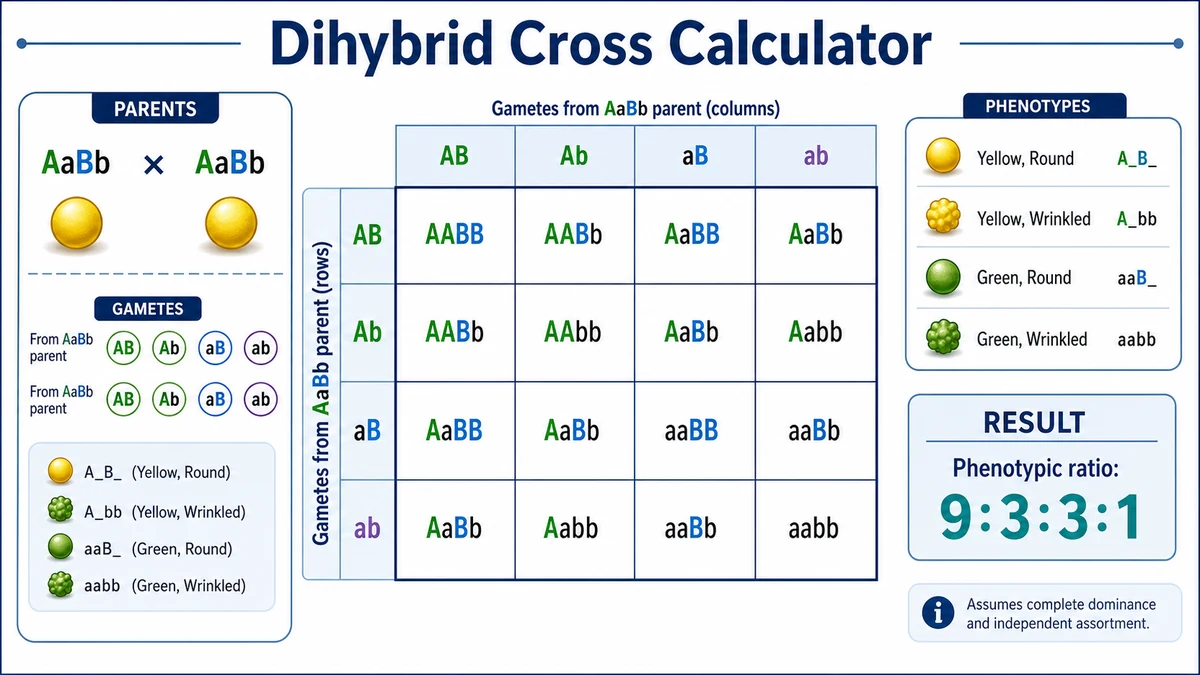
Select each parent’s genotype at the A/a and B/b loci to calculate the theoretical outcomes. The tool is useful for biology homework, genetics practice, classroom demonstrations, and checking the classic 9:3:3:1 ratio.
Important: This calculator models standard Mendelian inheritance. It assumes independent assortment, complete dominance, and equal gamete probability. Real inheritance may follow a different pattern.
What the Dihybrid Cross Calculator Shows
The calculator produces:
- Possible gametes from each parent
- A complete 4×4 Punnett square
- Exact offspring genotype probabilities
- Grouped phenotype probabilities
- Percentages for A_B_, A_bb, aaB_, and aabb
The letters A/a represent alleles at the first locus, while B/b represent alleles at the second locus. Uppercase letters are treated as dominant and lowercase letters as recessive.
How to Use the Dihybrid Cross Calculator
- Select Parent 1’s genotype at the A-locus: AA, Aa, or aa.
- Select Parent 1’s genotype at the B-locus: BB, Bb, or bb.
- Select Parent 2’s genotype at the A-locus.
- Select Parent 2’s genotype at the B-locus.
- Review the possible gametes generated for each parent.
- Examine the completed 4×4 Punnett square.
- Check the genotype and phenotype percentages.
- Use Reload to clear the cross and start again.
Before solving a homework problem, confirm whether the answer requires genotypes, phenotypes, fractions, percentages, ratios, or a completed Punnett square.
How a Dihybrid Punnett Square Works
A dihybrid cross follows two genes or loci simultaneously. Every gamete receives one allele from the A/a locus and one allele from the B/b locus.
A parent with the genotype AaBb can produce four gamete types under independent assortment:
- AB
- Ab
- aB
- ab
The number of distinct gametes produced by a parent can be calculated as:
Number of gamete types = 2n
Here, n is the number of heterozygous loci. For AaBb, both loci are heterozygous, so:
22 = 4 possible gamete types
Parents With Homozygous Loci
Not every parent produces four distinct gametes:
- AABB produces AB only.
- AABb produces AB and Ab.
- AaBB produces AB and aB.
- Aabb produces Ab and ab.
- aaBb produces aB and ab.
- aabb produces ab only.
The calculator may repeat gamete headers when a parent is homozygous at one or both loci. These repeated slots represent repeated probability paths and should still be counted.
Dihybrid Cross Probability Formula
A standard 4×4 Punnett square contains 16 cells:
4 parent gamete slots × 4 parent gamete slots = 16 cells
When the cells are equally likely, each represents:
1 ÷ 16 × 100 = 6.25%
Genotype and phenotype probabilities are calculated by counting matching cells:
Probability = matching cells ÷ 16 × 100
For example, if four cells contain AaBb:
4 ÷ 16 × 100 = 25% AaBb
Classic AaBb × AaBb Example
The best-known dihybrid cross occurs when both parents are heterozygous at both loci:
AaBb × AaBb
Each parent produces AB, Ab, aB, and ab. Combining these gametes produces 16 equally likely cells and four phenotype categories:
- A_B_: 9/16, or 56.25%
- A_bb: 3/16, or 18.75%
- aaB_: 3/16, or 18.75%
- aabb: 1/16, or 6.25%
The resulting phenotype ratio is:
9:3:3:1
This ratio applies only when both parents are AaBb, the loci assort independently, and each trait follows complete dominance.
Dihybrid Test Cross Example
A common test cross combines a parent that is heterozygous at both loci with a double-recessive parent:
AaBb × aabb
The AaBb parent produces AB, Ab, aB, and ab, while the aabb parent produces only ab. The possible offspring are:
- AaBb
- Aabb
- aaBb
- aabb
Under independent assortment, each outcome has a theoretical probability of 25%, producing a 1:1:1:1 phenotype ratio.
Genotype Versus Phenotype
Genotype is the exact allele combination inherited by an offspring. Examples include AABB, AaBb, Aabb, and aabb.
Phenotype is the expressed trait category predicted from that genotype under the selected inheritance model.
The calculator uses these phenotype patterns:
- A_B_: Dominant phenotype for both traits
- A_bb: Dominant first trait and recessive second trait
- aaB_: Recessive first trait and dominant second trait
- aabb: Recessive phenotype for both traits
The underscore means the second allele at that locus can be either uppercase or lowercase without changing the phenotype under complete dominance.
When the 9:3:3:1 Ratio Does Not Apply
Many real traits do not follow the calculator’s simplified Mendelian model. Different results may occur with:
- Linked genes and recombination
- Incomplete dominance
- Codominance
- Epistasis or gene interaction
- Sex-linked inheritance
- Lethal allele combinations
- Polygenic traits
- Reduced penetrance or variable expression
- Environmental effects on phenotype
Linked genes may be inherited together more frequently than predicted by independent assortment. Incomplete dominance and codominance also require phenotype categories that treat heterozygotes differently.
Probability Is Not a Guaranteed Outcome
A Punnett square describes expected probability, not the guaranteed composition of a small family, litter, clutch, or group of plants.
For example, a theoretical probability of 25% does not guarantee that exactly one of four offspring will have that outcome. Random fertilization can produce different results in a small sample.
Observed ratios generally become more informative with larger samples. Use the Chi-Square Calculator when comparing observed counts with an expected genetic ratio.
Assumptions and Limitations
- The calculator handles two genetic loci.
- Both loci are assumed to assort independently.
- Complete dominance is assumed at both loci.
- Each valid gamete is assumed to have the expected Mendelian probability.
- A/a and B/b are generic allele labels.
- The tool does not calculate linkage or recombination frequency.
- It does not model incomplete dominance, codominance, epistasis, or polygenic inheritance.
- Predicted ratios may not match small observed samples.
- The calculator does not analyse DNA or determine medical genetic risk.
Do not use this educational calculator alone for genetic counselling, medical diagnosis, professional breeding, conservation decisions, or commercial agricultural planning.
Dihybrid Cross Calculator FAQs
What is a dihybrid cross?
A dihybrid cross follows two traits or genetic loci simultaneously. It is commonly represented with a 4×4 Punnett square.
What does AaBb mean?
AaBb means the organism is heterozygous at both loci. It carries one dominant and one recessive allele for each gene.
What gametes can AaBb produce?
Under independent assortment, AaBb can produce AB, Ab, aB, and ab.
Why does a dihybrid Punnett square have 16 cells?
Each AaBb parent produces four gamete types. Four maternal possibilities multiplied by four paternal possibilities creates 16 cells.
Does every dihybrid cross produce 9:3:3:1?
No. This ratio applies specifically to AaBb × AaBb under independent assortment and complete dominance.
Can the calculator handle linked genes?
No. Linked genes require recombination-frequency or linkage-map calculations.
Can this calculator be used for human genetic risk?
No. It is an educational Mendelian genetics tool and cannot analyse DNA, family history, penetrance, complex inheritance, or medical risk.
Related Genetics and Probability Calculators
Sources
Independent Assortment Is an Assumption
A classic dihybrid 9:3:3:1 ratio assumes complete dominance, independent assortment, and the relevant heterozygous parental cross. Linked genes, epistasis, incomplete dominance, sex linkage, and viability differences can produce other patterns. Use the calculator to organize gametes and predicted genotypes, then state the inheritance model rather than presenting the ratio as universally expected.