
Tank Volume Calculator
Simple tank calculator for total volume and optional filled volume.
A tank can look half full without actually holding half its capacity, especially when a cylinder lies on its side. The Tank Volume Calculator converts internal dimensions into total capacity, filled volume, and fill percentage for vertical cylindrical, horizontal cylindrical, and rectangular tanks.
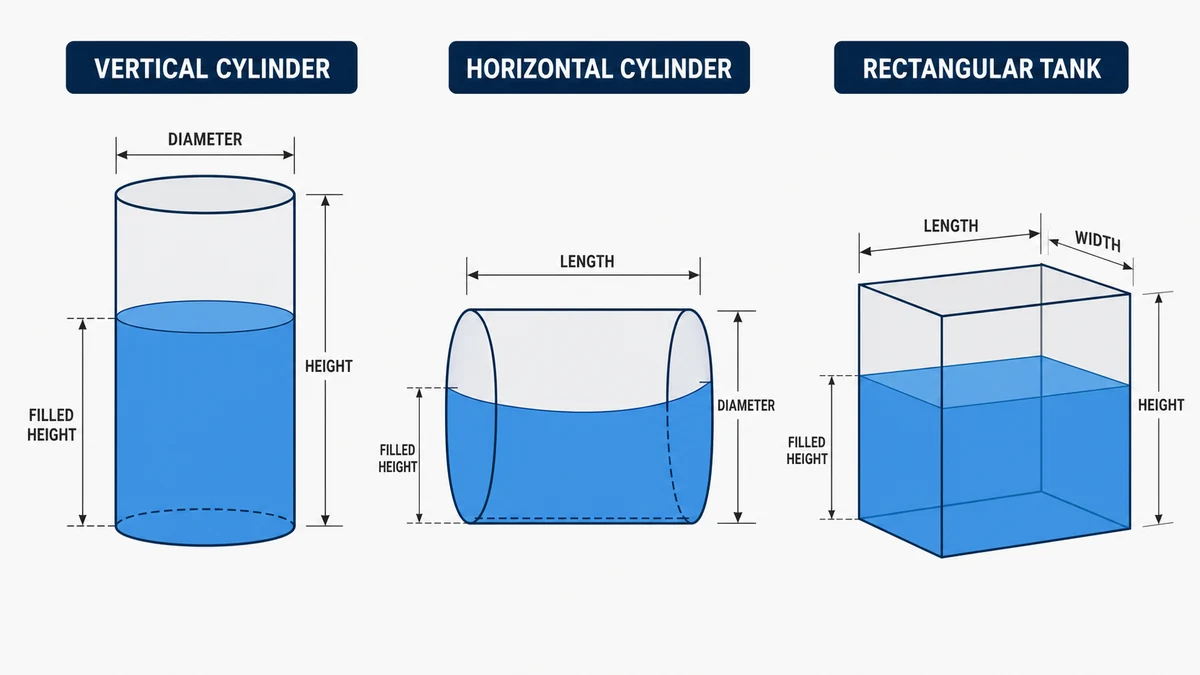
Select the matching tank shape, enter measurements in centimeters, meters, inches, or feet, and choose liters, cubic meters, US gallons, or cubic feet for the result. An optional filled-height measurement estimates how much liquid is currently inside the tank.
What the Tank Volume Calculator Calculates
The calculator reports three connected results:
- Total volume: The estimated internal capacity when the tank is completely full
- Filled volume: The estimated amount currently inside based on the entered liquid depth
- Fill level: Filled volume divided by total volume, expressed as a percentage
The available shapes are an upright circular cylinder, a circular cylinder resting horizontally, and a rectangular box-shaped tank. Each calculation assumes a regular tank with flat ends or sides. Domed ends, conical bottoms, rounded corners, baffles, and other features are not included.
How to Calculate Tank Capacity
- Select vertical cylinder, horizontal cylinder, or rectangular tank.
- Choose the unit used for every entered dimension.
- Select the preferred result unit.
- Enter the required internal diameter, length, width, or height.
- Enter filled height only when you need the current liquid volume.
- Calculate and review total volume, filled volume, and fill percentage.
- Reset the fields before measuring a different tank.
Measure filled height vertically from the lowest inside point of the tank to the liquid surface. For a horizontal cylinder, the filled height cannot exceed the internal diameter. For vertical and rectangular tanks, it cannot exceed the full internal height.
Tank Volume Formulas
All measurements must represent compatible units before the volume formula is applied. The calculator standardizes the selected dimension unit internally and converts the calculated cubic volume into the requested result unit.
Vertical Cylinder Formula
For an upright circular tank, radius is half the internal diameter:
r = diameter ÷ 2
Total volume = π × r2 × H
Filled volume = π × r2 × h
Here, H is the tank’s full internal height and h is the liquid height. Because the cross-sectional area remains constant, a vertical cylinder filled to 40% of its height contains approximately 40% of its ideal geometric capacity.
Rectangular Tank Formula
A rectangular tank uses internal length, width, and height:
Total volume = L × W × H
Filled volume = L × W × h
This linear relationship applies to box-shaped aquariums, open containers, and rectangular reservoirs with uniform vertical sides. Substrate, decorations, filters, rounded corners, and freeboard reduce the usable liquid volume.
Horizontal Cylinder Formula
The total capacity of a flat-ended horizontal cylinder is:
Total volume = π × r2 × L
Orientation does not change a cylinder’s total volume. It does change the relationship between liquid depth and filled volume. The filled cross-section is a circular segment rather than a smaller rectangle or cylinder.
Segment area = r2 × cos-1((r – h) ÷ r) – (r – h) × √(2rh – h2)
Filled volume = segment area × L
Why Horizontal Tank Fill Is Nonlinear
Near the bottom of a horizontal cylindrical tank, a small increase in depth covers a narrow curved section. Near the middle, the same increase covers a much wider section. The relationship reverses near the top. A quarter of the diameter therefore represents less than a quarter of the volume, while half the diameter represents exactly half the ideal capacity.
This is why multiplying total capacity by the percentage of measured depth gives an incorrect answer for most partially filled horizontal tanks. Circular-segment geometry is needed unless the tank is empty, half full, or completely full.
Tank Volume Calculation Examples
Suppose a vertical cylindrical water tank has a 2-meter internal diameter and a 3-meter internal height. Its radius is 1 meter:
π × 12 × 3 = 9.425 m3
Because one cubic meter equals 1,000 liters, the ideal full capacity is approximately 9,425 liters.
For a rectangular tank measuring 2 meters long, 1 meter wide, and 1.5 meters high:
2 × 1 × 1.5 = 3 m3
If the liquid depth is 1 meter, the filled volume is 2 cubic meters, or 2,000 liters. The tank is approximately 66.67% full.
A horizontal cylinder with a 2-meter diameter and 4-meter length has a full capacity of approximately 12.566 cubic meters. At a filled height of exactly 1 meter, the liquid reaches the centerline, so the filled volume is half the total, or approximately 6.283 cubic meters.
Use Internal Tank Dimensions
Capacity is determined by the usable space inside the tank. Outside dimensions include wall thickness and can overstate the available volume. Measure the internal diameter and internal length for cylindrical tanks, or internal length, width, and height for rectangular tanks.
When internal measurements are unavailable, subtract known wall thickness from both sides of each outside dimension. This remains an estimate because liners, coatings, ribs, supports, and fittings may occupy additional space. Manufacturer-rated capacity is the better source when it is available.
Understanding Volume Units
- 1 cubic meter = 1,000 liters
- 1 cubic foot = 28.316846592 liters
- 1 US gallon = 3.785411784 liters
- 1 liter = 0.001 cubic meter
The calculator reports US liquid gallons, not UK imperial gallons. A US gallon and an imperial gallon are different quantities, so confirm the required standard before comparing the result with a tank label, drawing, or supplier specification.
Accuracy and Practical Limitations
The result is an ideal geometric estimate. Actual working capacity can differ because of wall thickness, rounded or domed ends, sloped or conical bottoms, internal fittings, baffles, sediment, tank tilt, dents, thermal expansion, overflow clearance, and manufacturer tolerances.
A single depth measurement also assumes the tank is level and the liquid surface is horizontal. Use calibrated tank charts, approved gauges, engineering drawings, or manufacturer data for commercial inventory, regulated fuel or chemical storage, pressure vessels, structural loading, and other safety-critical decisions.
Frequently Asked Questions
How do I calculate how many gallons a tank holds?
Calculate the internal cubic volume using the formula for the tank shape, then convert the result to US gallons. The calculator performs both steps automatically when US gallons are selected.
Should I enter internal or external tank dimensions?
Enter internal dimensions whenever possible. External measurements include the tank walls and may overestimate the space available for liquid.
Is a horizontal cylindrical tank half full at half its diameter?
Yes. When liquid reaches the cylinder’s centerline, the ideal flat-ended tank contains half its total volume. Other depth percentages are generally not equal to volume percentages.
Does the calculation include rounded or domed tank ends?
No. The cylindrical calculations assume flat ends. Use manufacturer data or a shape-specific method for hemispherical, elliptical, domed, or conical sections.
Can I estimate water, fuel, or aquarium volume?
The result can provide a planning estimate for regularly shaped tanks. Account for unusable space and follow official requirements for fuel, chemicals, regulated storage, or structural support.
Why does my calculated capacity differ from the tank label?
The label may state nominal, safe working, or manufacturer-rated capacity rather than ideal geometric volume. Wall thickness, rounded ends, fittings, freeboard, and measurement tolerances can also create differences.
Related Volume Calculators
Sources
- National Bureau of Standards – Gallonage Tables for Horizontal Cylindrical Tanks With Flat Ends
- NIST Guide to the SI – Volume Conversion Factors
- OpenStax Contemporary Mathematics – Measuring Volume
Usable Capacity Is Often Less Than Geometric Volume
Tank dimensions produce a geometric capacity, but real usable volume may be reduced by wall thickness, rounded corners, internal fittings, freeboard, sediment, or an outlet positioned above the bottom. Identify whether dimensions are internal or external and whether a horizontal cylinder is partially filled. For chemical or structural applications, verify results against manufacturer documentation and safety requirements.