Face Shape Calculator
Measurements
Action
Results
Forehead, cheekbone, jawline, and face-length proportions can provide useful clues about your overall facial profile. The Face Shape Calculator compares these measurements with your chin appearance to identify the closest common face-shape category and explain which features influenced the result.
What Does the Face Shape Calculator Measure?
The Face Shape Calculator looks at the relationship between the widest parts of your face rather than judging one measurement alone. It checks whether your face is noticeably longer than it is wide, which area is widest, how closely the forehead and jaw widths match, and whether the chin looks rounded, moderate, or pointed.
These characteristics are compared with common styling categories such as oval, round, square, heart, diamond, and longer face profiles. They are descriptive categories used for general styling guidance, not medical or anatomical classifications.
How to Measure Your Face Shape
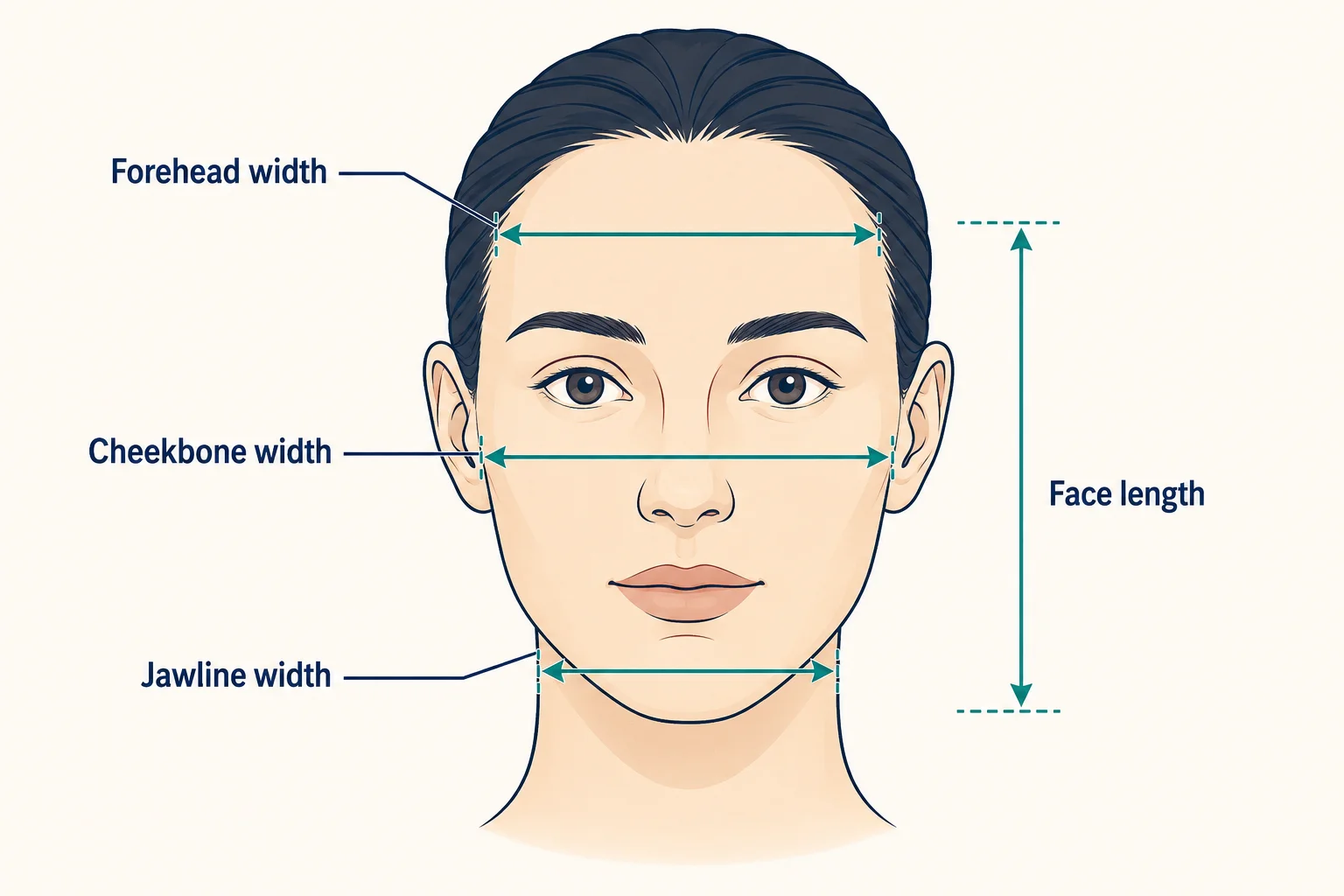
For a more consistent result, pull your hair away from your face, look straight ahead, and use a flexible measuring tape. Keep the tape straight and avoid following the curves of your skin. You may use inches or centimeters, but every measurement must use the same unit.
- Forehead width: Measure horizontally across the widest part of your forehead, usually between the eyebrows and hairline.
- Cheekbone width: Measure straight across the most prominent points of your upper cheeks.
- Jawline width: Measure across the widest points of your lower jaw rather than along the jaw’s curved edge.
- Face length: Measure from the centre of your hairline down to the lowest point of your chin.
- Chin appearance: Select the option that most closely describes whether your chin looks rounded, moderate, or pointed.
Take each measurement twice if possible. Small changes in tape position can affect the category returned by the Face Shape Calculator.
How to Use the Face Shape Calculator
- Measure your forehead, cheekbones, jawline, and face length.
- Enter all four values using the same unit.
- Select the closest description of your chin.
- Click Calculate to view the likely face shape and proportion details.
- Read the “Why this result” explanation instead of relying only on the category name.
If two measurements are extremely close, repeat them and compare the new result. This helps reduce changes caused by measurement position.
How the Face Shape Calculator Works
There is no single universal formula that determines every face shape. The calculator therefore uses a combination of ratios and feature comparisons. One important calculation is:
Length-to-width ratio = face length ÷ cheekbone width
The calculator also identifies the widest entered feature and compares the forehead with the jawline. In general:
- Oval patterns tend to be longer than wide, with relatively balanced widths and a softer taper toward the chin.
- Round patterns generally have closer length and width proportions with a softer jaw and chin.
- Square patterns often show a prominent jaw, relatively balanced forehead and jaw widths, and more angular features.
- Heart patterns commonly have a wider forehead and a narrower jaw that tapers toward the chin.
- Diamond patterns usually have prominent cheekbones with a narrower forehead and jawline.
- Longer profiles have a face length that is clearly greater than the main width measurement.
These patterns overlap, so the Face Shape Calculator returns the closest overall match rather than claiming an exact anatomical type.
Face Shape Calculation Example
Suppose you enter the following measurements:
- Forehead width: 14.5 cm
- Cheekbone width: 15.2 cm
- Jawline width: 13.2 cm
- Face length: 19 cm
- Chin appearance: rounded
Length-to-width ratio = 19 ÷ 15.2 = 1.25
In this example, the face is longer than it is wide, the cheekbones are the widest feature, and the jaw is narrower. The Face Shape Calculator combines these observations with the selected chin appearance to find the closest category.
Understanding Mixed Face-Shape Results
Many people do not fit one category perfectly. You might have the proportions of an oval face with a more angular jaw, or a heart-like forehead with diamond-like cheekbones. A result near the boundary between categories should be interpreted as a general profile rather than a strict label.
Hairline shape, facial soft tissue, age, facial expression, camera angle, and measurement technique can also influence the result. If your proportions are close, use the calculator’s detailed feature explanation to understand the result.
Important Limitations
- The result is an approximate styling classification.
- It is not a medical, biometric, forensic, or identity assessment.
- The calculator does not evaluate facial symmetry or attractiveness.
- Small measurement differences can produce a different category.
- Hairstyle, glasses, makeup, facial hair, and personal preference may matter more than a category when choosing a style.
For other proportion-based tools, try the Body Shape Calculator or the Bikini Calculator. You can also use the Hair Growth Calculator when planning a longer-term hairstyle change.
Frequently Asked Questions
What is my face shape?
Measure your forehead, cheekbones, jawline, and face length, then compare their proportions. The Face Shape Calculator performs these comparisons and returns the closest common category.
Should I use inches or centimeters?
Either unit works because the tool compares proportions. Use the same unit for all four measurements and do not mix inches with centimeters.
Why did I get a different result after measuring again?
Small changes in the position or angle of the measuring tape can alter close proportions. Measure twice while looking straight ahead and use the more consistent values.
Can someone have more than one face shape?
Yes. Face-shape categories overlap, and many people have characteristics associated with two or more shapes. Treat the result as the closest match, not an absolute classification.
Is the Face Shape Calculator medically accurate?
No. It is designed for general styling and educational guidance. It does not provide a clinical assessment, facial identification, or biometric analysis.