Mortgage Interest Calculator

See interest cost over time, first-payment interest, and interest savings with extra payments.

Loan inputs
Results
Interest breakdown + savings preview.
Monthly payment (P&I)
Interest in first payment
Interest paid in first 12 months
Total interest (no extra)
Total interest (with extra)
Interest saved (extra vs none)
Payoff date (no extra)
Payoff date (with extra)
Interest preview (first 12 payments)
# Date Payment Principal Interest Balance
Run a calculation to see the schedule.
Note: Table shows P&I only (interest/principal). Extra payments increase principal paid.

Important Note : The calculator estimates principal-and-interest mortgage interest only. CFPB explains that mortgage payments are split between principal and interest, and early in the mortgage term more of the payment usually goes toward interest because the loan balance is still high.

Use this Mortgage Interest Calculator to estimate how much interest you may pay on a mortgage over time. Enter the loan amount, annual interest rate, loan term, start date, optional extra monthly payment, and interest period to calculate monthly principal and interest, first-payment interest, total interest, interest savings, and payoff dates.

This calculator is useful when you want to understand how mortgage interest works, estimate the long-term cost of a home loan, or see how extra monthly payments may reduce total interest and shorten the payoff timeline.

Reviewed by: Ajax Calculator Team

Last updated: April 30, 2026

Method source: Standard fixed-rate mortgage amortization formulas using loan amount, monthly interest rate, loan term, scheduled principal-and-interest payment, optional extra principal payment, and month-by-month interest calculations.

Editorial standards: See our Editorial Policy for how we review and update calculator content.

What This Mortgage Interest Calculator Does

This calculator estimates mortgage interest using a fixed-rate amortization model. It can calculate:

  • Monthly principal and interest payment
  • Interest charged in the first mortgage payment
  • Interest paid during the first selected number of months
  • Total interest without extra payments
  • Total interest with extra monthly payments
  • Estimated interest saved from extra payments
  • Payoff date with and without extra payments
  • First-12-payments interest and principal preview

The calculator focuses on principal and interest only. It does not estimate property taxes, homeowners insurance, PMI, HOA dues, escrow changes, or other housing costs.

Mortgage Interest Formula

For a fixed-rate mortgage, the monthly principal and interest payment is calculated using the standard amortization formula:

M = P × [r(1 + r)n] ÷ [(1 + r)n − 1]

Where:

  • M = monthly principal and interest payment
  • P = loan amount or principal borrowed
  • r = monthly interest rate, calculated as annual interest rate ÷ 12
  • n = total number of monthly payments

The interest for each month is calculated as:

Monthly interest = current loan balance × monthly interest rate

The principal paid in each month is:

Principal paid = monthly payment − monthly interest

If you enter an extra monthly payment, the calculator applies that extra amount toward principal after the regular scheduled payment.

Worked Example

Suppose you have a $280,000 mortgage with a 6.5% annual interest rate and a 30-year term.

Input Example Value
Loan amount $280,000
Annual interest rate 6.5%
Loan term 30 years
Extra monthly payment $200
Interest period 12 months

The estimated monthly principal and interest payment is about:

$1,769.79

The monthly interest rate is:

6.5% ÷ 12 = 0.5417% per month

The first month’s interest is approximately:

$280,000 × 0.0054167 = $1,516.67

That means the first scheduled payment is split approximately like this:

  • Interest: $1,516.67
  • Principal: $253.12
  • Total P&I payment: $1,769.79

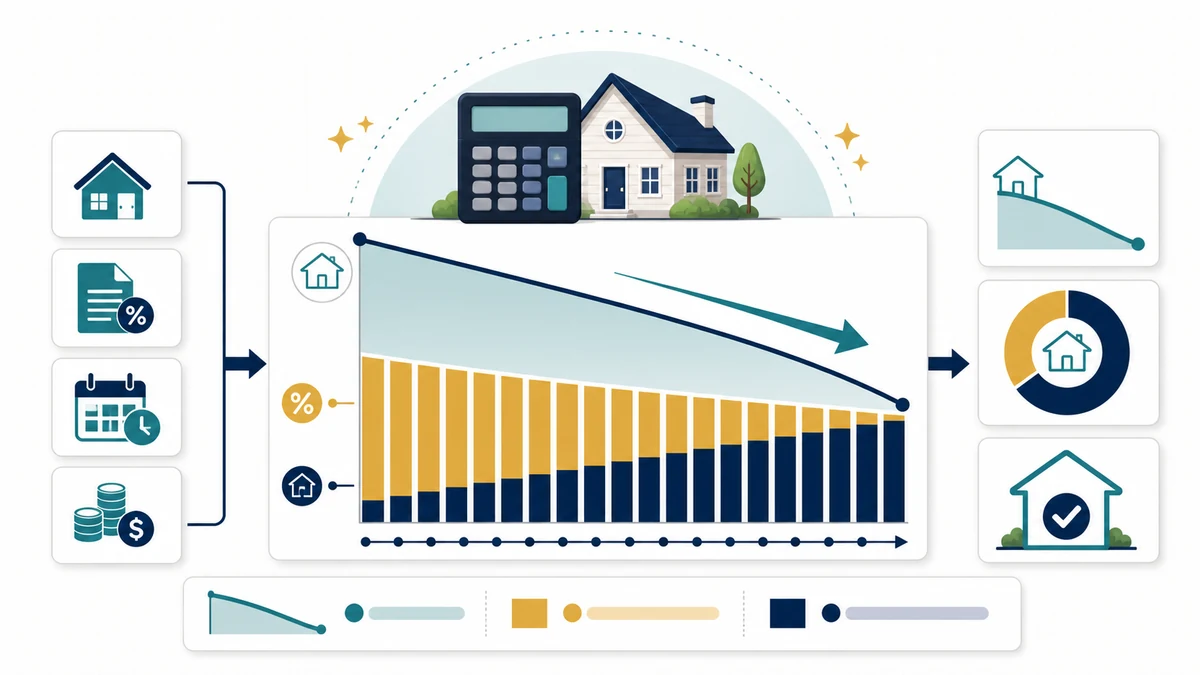
This shows why mortgage interest is highest near the beginning of the loan. Early payments are calculated on a larger remaining balance, so a bigger share of each payment goes toward interest.

Example Interest Savings With Extra Payments

Using the same $280,000 loan at 6.5% for 30 years, the estimated total interest without extra payments is about:

$357,124.57

If you add an extra $200 per month toward principal, the estimated total interest may drop to about:

$255,841.38

Estimated interest saved:

$357,124.57 − $255,841.38 = $101,283.19

In this example, the extra monthly payment reduces the balance faster, which lowers future interest and shortens the payoff timeline.

How to Use the Mortgage Interest Calculator

  1. Enter the loan amount. This is the mortgage principal borrowed.
  2. Enter the annual interest rate. Use the mortgage note rate or interest rate for basic amortization estimates.
  3. Enter the loan term in years, such as 15, 20, or 30 years.
  4. Select a start date if you want the payoff dates and schedule labels to match a timeline.
  5. Optionally enter an extra monthly payment if you plan to pay additional principal each month.
  6. Enter the interest period in months if you want to see interest paid during a specific early period, such as the first 12 months.
  7. Click Calculate to see the interest breakdown, savings estimate, payoff dates, and payment preview.

How to Interpret the Results

Monthly payment (P&I) shows the estimated monthly principal and interest payment for the mortgage loan.

Interest in first payment shows how much of the first monthly payment goes to interest.

Interest paid in first 12 months or the selected interest period shows the total interest paid during the early part of the loan.

Total interest without extra payments estimates the interest cost if you make only the scheduled monthly payment.

Total interest with extra payments estimates the interest cost if the extra monthly payment is applied to principal every month.

Interest saved compares the no-extra-payment scenario with the extra-payment scenario.

Payoff date estimates when the mortgage may be paid off under each scenario.

Interest preview shows the early amortization schedule, including payment, principal, interest, and remaining balance.

Why Mortgage Interest Is Higher at the Beginning

Mortgage interest is calculated on the remaining loan balance. At the beginning of a mortgage, the balance is still high, so the monthly interest charge is also high. As the balance gradually falls, less interest is charged each month and more of each payment goes toward principal.

This is why the first mortgage payment may mostly go toward interest, while later payments pay down more principal. The monthly payment may stay the same on a fixed-rate mortgage, but the principal and interest split changes over time.

Interest Rate vs APR

A mortgage interest rate is the rate used to calculate interest on the loan balance. APR, or annual percentage rate, can include the interest rate plus certain fees, points, and loan costs.

For this calculator, use the mortgage interest rate if you want a basic principal-and-interest amortization estimate. If a lender quotes both an interest rate and APR, the interest rate is usually the direct input for monthly P&I payment calculations, while APR is useful for broader loan-cost comparison.

How Extra Mortgage Payments Save Interest

Extra payments can reduce mortgage interest when they are applied to principal. Paying extra principal lowers the remaining balance faster. Since future interest is calculated on the remaining balance, a lower balance means less interest over time.

For best results, confirm with your lender or servicer that extra payments are applied to principal and not held as a future scheduled payment. Also check whether your loan has any prepayment penalty.

First Payment Interest Example

Loan Amount Interest Rate Monthly Interest Rate First Month Interest
$200,000 6.5% 0.5417% $1,083.33
$280,000 6.5% 0.5417% $1,516.67
$350,000 6.5% 0.5417% $1,895.83

This table shows why larger loan balances create higher first-payment interest when the interest rate is the same.

15-Year vs 30-Year Mortgage Interest

The loan term has a major effect on total interest. A shorter term usually has a higher monthly payment but lower total interest. A longer term usually has a lower monthly payment but higher total interest over the life of the loan.

Loan Term Monthly Payment Effect Total Interest Effect
15-year mortgage Higher monthly P&I payment Usually much lower total interest
30-year mortgage Lower monthly P&I payment Usually much higher total interest

A 30-year mortgage may be easier to fit into a monthly budget, but a 15-year mortgage can reduce total interest substantially if the higher payment is affordable.

Mortgage Interest Example Table

Loan Amount Rate Term Estimated Monthly P&I Estimated Total Interest
$250,000 6.5% 30 years $1,580.17 $318,861.57
$280,000 6.5% 30 years $1,769.79 $357,124.57
$300,000 6.5% 30 years $1,896.20 $382,633.89
$300,000 6.5% 15 years $2,613.32 $170,397.67

These examples are principal and interest only. Taxes, homeowners insurance, PMI, HOA dues, and closing costs are not included.

Mortgage Interest vs Total Monthly Payment

This calculator focuses on mortgage interest and principal-and-interest amortization. A full monthly housing payment may include more than P&I, such as:

  • Property taxes
  • Homeowners insurance
  • Private mortgage insurance
  • HOA or condo fees
  • Flood insurance
  • Escrow adjustments

If you need a fuller monthly housing payment estimate, use a mortgage calculator that includes taxes, insurance, PMI, and other housing costs.

Common Uses for a Mortgage Interest Calculator

This calculator can help you:

  • Estimate total mortgage interest over the loan term
  • See how much interest is paid in the first payment
  • Estimate interest paid in the first year
  • Compare 15-year and 30-year mortgage interest costs
  • Test how extra monthly payments affect total interest
  • Estimate how much sooner a mortgage may be paid off
  • Understand the principal and interest split in early payments

What This Calculator Does Not Include

This calculator does not include every mortgage or homeownership cost. It does not calculate:

  • Property taxes
  • Homeowners insurance
  • Private mortgage insurance
  • HOA dues
  • Closing costs
  • Discount points
  • Origination fees
  • Escrow changes
  • Adjustable-rate mortgage changes
  • Late fees or prepayment penalties

For a complete borrowing decision, review your lender’s loan estimate, closing disclosure, and mortgage documents.

Assumptions and Limitations

  • The calculator assumes a fixed interest rate.
  • It assumes regular monthly payments.
  • It uses a standard amortization formula for principal and interest.
  • It assumes extra monthly payments are applied to principal.
  • It does not include taxes, insurance, PMI, HOA dues, or escrow changes.
  • It does not model adjustable-rate mortgages.
  • It does not include lender fees, discount points, closing costs, or APR-related charges.
  • It provides an estimate and may not match your lender’s exact amortization schedule.

Tips for Reducing Mortgage Interest

  • Make extra principal payments when your budget allows.
  • Choose a shorter loan term if the higher monthly payment is affordable.
  • Compare interest rates from multiple lenders before closing.
  • Ask whether discount points make sense for your expected time in the home.
  • Refinance only if the long-term savings are greater than the costs.
  • Confirm that extra payments are applied directly to principal.
  • Check your loan terms for any prepayment penalty.

Related Calculators

References

Frequently Asked Questions

What does a mortgage interest calculator do?

A mortgage interest calculator estimates how much interest you may pay on a mortgage. It can show first-payment interest, total interest, payoff date, and interest savings from extra payments.

How is mortgage interest calculated?

Mortgage interest is usually calculated on the remaining loan balance. For a monthly fixed-rate mortgage, the monthly interest equals the current balance multiplied by the monthly interest rate.

Why is the first mortgage payment mostly interest?

The first payment is calculated on the full starting loan balance. Because the balance is highest at the beginning, the interest portion is also highest near the start of the loan.

What is monthly P&I?

Monthly P&I means principal and interest. Principal reduces the loan balance, while interest is the cost of borrowing money.

Does this calculator include taxes and insurance?

No. This calculator focuses on principal and interest. It does not include property taxes, homeowners insurance, PMI, HOA dues, or escrow changes.

Can extra monthly payments reduce mortgage interest?

Yes. Extra payments can reduce mortgage interest if they are applied to principal. A lower principal balance means future interest is calculated on a smaller amount.

What is the difference between mortgage interest rate and APR?

The mortgage interest rate is used to calculate interest on the loan balance. APR is broader and may include certain fees, points, and other loan costs.

Does this calculator work for adjustable-rate mortgages?

This calculator is mainly designed for fixed-rate mortgage estimates. Adjustable-rate mortgages can change over time, so future interest and payments may differ.

Why is my lender’s interest total different from this estimate?

Your lender’s figures may differ because of exact payment dates, rounding, fees, escrow rules, APR disclosures, adjustable rates, prepayment rules, or loan-specific terms.

Should I always make extra mortgage payments?

Extra payments can save interest, but they may not be the best choice for everyone. Consider your emergency savings, other debts, investment goals, tax situation, and whether your loan has a prepayment penalty.

Disclaimer

This calculator is for educational and planning purposes only. It estimates mortgage principal-and-interest costs using standard fixed-rate amortization math. It does not provide financial, mortgage, legal, tax, or lending advice. Actual mortgage interest, APR, payments, payoff dates, fees, escrow amounts, taxes, insurance, PMI, and loan terms may vary by lender, borrower profile, location, loan program, and market conditions. Always review official loan estimates, closing disclosures, and lender documents before making a mortgage decision.

More of our calculators...

Mortgage Calculator with Taxes and Insurance

Estimate monthly mortgage payment with principal, interest, taxes, insurance, HOA, PMI, closing costs, loan amount, and amortization preview.

Amortization Calculator

Generate a loan amortization schedule with monthly payment, principal, interest, balance, payoff date, total interest, and optional extra payments.

Refinance Calculator

Compare your current mortgage with our Refinance calculator. Estimate new payment, monthly savings, closing costs, break-even time, interest, and payoff dates.

Credit Card Interest Calculator

Estimate credit card interest from APR, billing-cycle days, and average daily balance. Project monthly interest, payments, purchases, and ending balance.

Balance Transfer Calculator

Compare keeping your current credit card balance vs transferring it to a promo APR card. Estimate interest, transfer fees, savings, and payoff time.

Interest Rate Calculator

Calculate the interest rate needed to grow a present value into a future value. Supports annual, monthly, daily, and continuous compounding.

Inflation Calculator

Calculate how inflation changes money value over time. Estimate future value, today’s purchasing power, cumulative inflation, and monthly inflation schedule.

Salary calculator

Convert hourly, weekly, biweekly, semi-monthly, monthly, and annual pay. Estimate gross salary from hours per week and paid weeks per year.

PayPal Fee Calculator

Calculate PayPal fees, net received amount, and required gross payment. Enter percentage and fixed fees to estimate seller transaction costs.